Easy to serve, difficult to please

This week I learned that a former department head at a college where I’ve taught adjunct classes off and on for a decade had died.

I first worked for her the semester my eldest was born. A colleague facing some unexpected surgery offered me a Western Civ II course at this other school and put me in touch with the department head there. She gave me the course on the spot, with just a few weeks to go before the spring semester. I had a hard time keeping up—I began that spring with five adjunct classes at two colleges, an ESL tutoring job for a German elementary student at Sarah’s school, and part-time work at a sporting goods store—but I was most grateful because we needed the money and the work was good. As so often, it was exactly what we needed when we needed it.

My department head didn’t have another class for me after that spring but said she would be in touch as the need arose. Lo and behold, as Sarah and I expected our second child two years later, she reached out with another spring class. I gratefully accepted. Again—just enough, when needed.

That summer I found out about a full-time position at Piedmont Tech and that’s where I’ve been ever since. When I let my department head at this other school know, she thanked me and wished me luck, and said to let her know if I ever needed anything. A generous offer, and she meant it. Over the next few years she’d check in regularly on LinkedIn—yes, LinkedIn can actually be helpful!—always encouraging me and letting me know that if I needed work all I had to do was ask.

I asked when Sarah and I found out we were expecting twins, children four and five. And my department head happily set me up with an online class, semester after semester until her retirement.

She will be missed. She not only played a willing role in God’s providential care for our family—something, as a fellow believer, she would have happily acknowledged—but was simply a good boss.

I’m old enough now to have lost several former bosses: my first boss, a family friend who managed the seafood restaurant where I kept the buffet line supplied with clean plates in middle school, and then her husband, an auctioneer and antiques appraiser who employed me for the year between college and grad school and where I learned a lot about old stuff—as well as how to properly load a moving truck. My department head joins them.

As I’ve reflected on this over the last couple days, their authority reminded me of Confucius’s concept of the junzi, the “superior” or “noble man,” a subject I once taught in an adjunct World History course for this department head: the superior man is “easy to serve but difficult to please.” A rare combination. They were gentle but demanding, graciously insisting on high standards of work, encouraging me to live up to my potential. It was never difficult to work for any of them but I always knew I could do better, and improved as I worked for them. I’m glad to say these are not the only such bosses I’ve had.

The internet is full of vindictive, cynical, hostile takes on the relationship between employer and employee, and it’s not hard to understand why so many people assume it must be adversarial. But I’ve been blessed to see a number of genuinely good bosses, including my current and former deans and department heads at my full-time work, and to cherish the memories of these who have passed away. Precisely by being a good boss they proved to be more. RIP.

Upcoming event: Greenville Local Author Expo

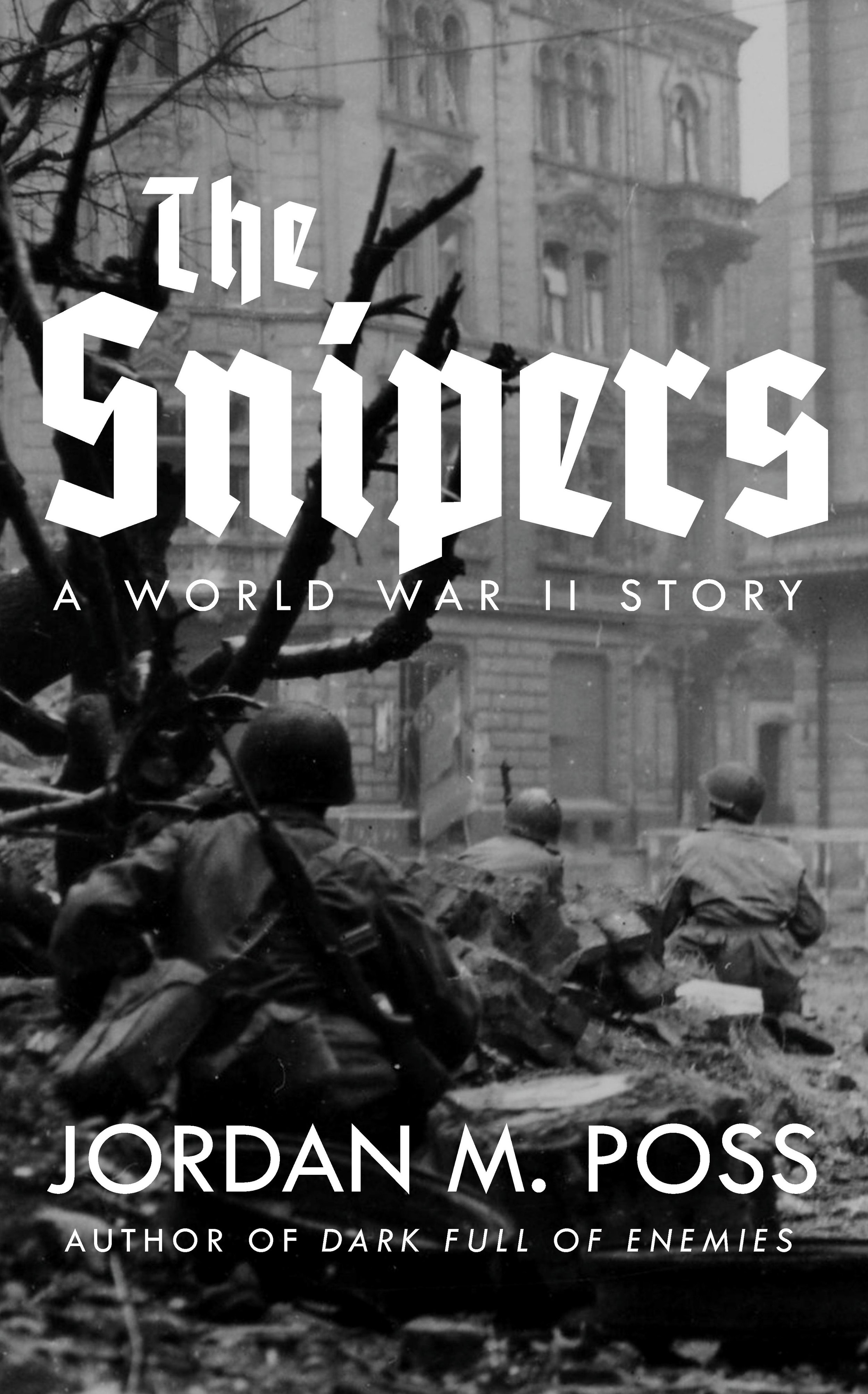
I was honored to participate in the first few Local Author Expos hosted by the Greenville Library, including a virtual expo hosted on Zoom during the COVID epidemic. I missed a few years and told myself I’d apply again when I had a new book out—then I published The Snipers and forgot. Might have had something to do with newborn twins.

Well, I’m pleased to say I’ll be back at the expo this year. I’ll have all my books on display and for sale and will be happy and talk and sign copies.

The event will take place Saturday, March 14th at the Hughes Main Library branch in downtown Greenville and lasts from 10:00 AM to 1:00 PM. The library hasn’t announced its featured speakers or panelists yet but year by year they’ve had some good ones. (I regretted missing last year, when David Joy, a North Carolina novelist whose books I’ve read, was a guest.) You can find a full list of participants and look for event updates here.

I’m grateful to be able to participate again and am looking forward to it. If you live in the upstate area it’s convenient to you, I hope to see y’all there.

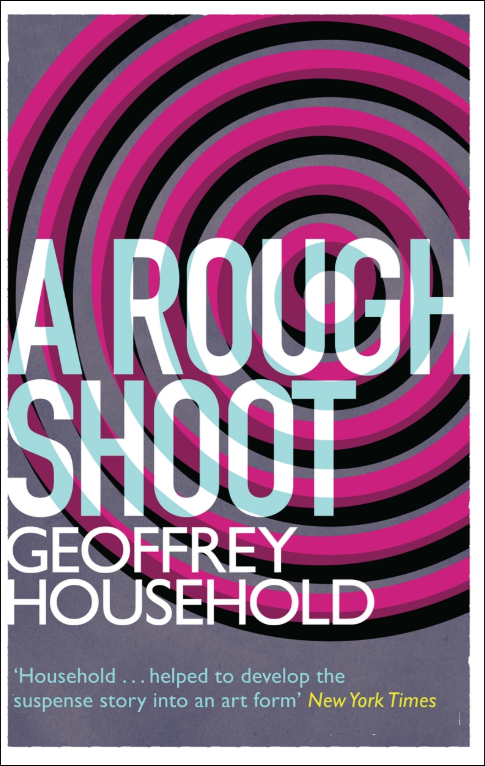
A Rough Shoot

Geoffrey Household knew how to open a thriller. His most famous book, Rogue Male, published in 1939 and which I read just over three years ago, begins with its unnamed protagonist in the hands of an unnamed central European dictatorship’s unnamed secret police, who have tortured him nearly to death and are about to dispose of him using a convenient cliff. Believe it or not, the situation escalates from there.

A Rough Shoot, published in 1951, continues this tradition. Roger Taine, a former British Army infantry colonel and now a salesman and family man, is walking the patch of Dorset farmland to which he’s purchased the hunting rights when he spots two men in the bushes. The sun is going down and he can’t see clearly what they’re doing, but they seem to be rigging up traps and he assumes them to be poachers. When one of them, backing through the hedge on hands and knees, presents his backside as a target, Taine decides to give the poachers a painful scare. He levels his shotgun and gives the man a load of birdshot.

The man collapses and his companion flees. Taine realizes that something has gone wrong. He approaches the man he shot where he lies unmoving on the ground and rolls him over. The men had been putting down big triangular stakes for some kind of device and, when Taine shot him, the man had fallen chest-first onto one of them.

None of this is a spoiler—it all happens in the first three pages. The rest of the novel is Taine’s attempt to deal with the consequences and discover who the two men were and what they were doing.

A Rough Shoot, like Rogue Male, has the Buchanesque qualities of vividly realized landscapes and the continuous chase. Taine’s predicament evolves as newer and greater dangers present themselves, keeping the ongoing action fresh and exciting. From Taine’s attempt to conceal the body and his realization that more and more suspicious men are poking around his shoot, asking questions of the tenant farmer and landowner and wanting to find out more about him, to his meeting with an former Polish commando whose story of exile, unofficial espionage, and a rising neo-fascism coordinating itself across Western Europe, A Rough Shoot escalates continuously in tension and stakes. What begins as a personal crisis for Taine—he is guilty, by his estimation, of manslaughter at least—turns into a tiny local battle in the ruins and upset of the postwar.

I can’t say much more without revealing too many specifics, but Taine’s business, wife, and children are inevitably drawn into a plot begun by Taine’s one impetuous, high-spirited act, and the first half’s smothering tension of concealment, silence, and stalking—the suspense of hunting—gives way in the final third to the chase: the prey flushed, the hunters pursuing.

I reflected a couple years ago on what it must have been like, in the 1940s and 50s, to visit the bookstalls and see a steady stream of novels like this—unpretentious gems of pure craft and enjoyment—flowing from publishers. Reading A Rough Shoot, a slender novel with no chapter divisions, just steadily building story, I could imagine myself traveling by train and needing a good page turner. A Rough Shoot would have fit the bill back then and, thanks to the strength of its simple but tense and Household’s exquisite craft, it still does. It’s inventive and exhilarating and was one of the joys of our recent time snowed in. This is only the second Household thriller I’ve read, but there will be more.

Worn slap out

One of my favorite moments of serendipity when learning German in college was when our teacher introduced us to the word schlapp. This was a synonym, he said, for müde, “tired,” and unless I’m misremembering he pantomimed dangling limply like a puppet. Ich bin schlapp.

I say this was serendipitous because a common expression where I grew up is “worn slap out.” I have no idea if there’s any actual relation between the words, but the cognate, false or not, leapt out at me. The slap is an intensifying particle—I’m not just worn out, I’m worn slap out. I can take no more wear.

Well, I’m worn slap out.

I and the whole family had the flu over Christmas and, with the new semester, I’ve had a lot of residual exhaustion compounded by insomnia. As a result I’ve missed the last two weeks here, the longest I’ve gone without writing anything on the blog since 2020 or before. I’ve begun a few posts but haven’t gotten anywhere on them. I’m hoping to fix that in the coming weeks.

I saw my doctor earlier this week and I think I’m on track to manage and reverse the tiredness. A lot of it is simply the results of the good things going on in life right now—plenty of work, the kids God has blessed us with. But the flu and the two weekends of bad winter weather have built up a deficit I’m maybe just a bit too old to bounce back from like before.

So I’m still here, but may not achieve my former pace of blogging for a while. I appreciate those of y’all who I know check in regularly. Your readership means a lot.

I doublechecked schlapp this morning, by the way, as it’s been nigh on twenty years since that German class and I wondered if I could be misremembering. It is used as slang for tired but properly means “limp,” “flabby,” or even “nerveless.” All accurate, too. But hopefully not for long.

Elegy for the mass market paperback

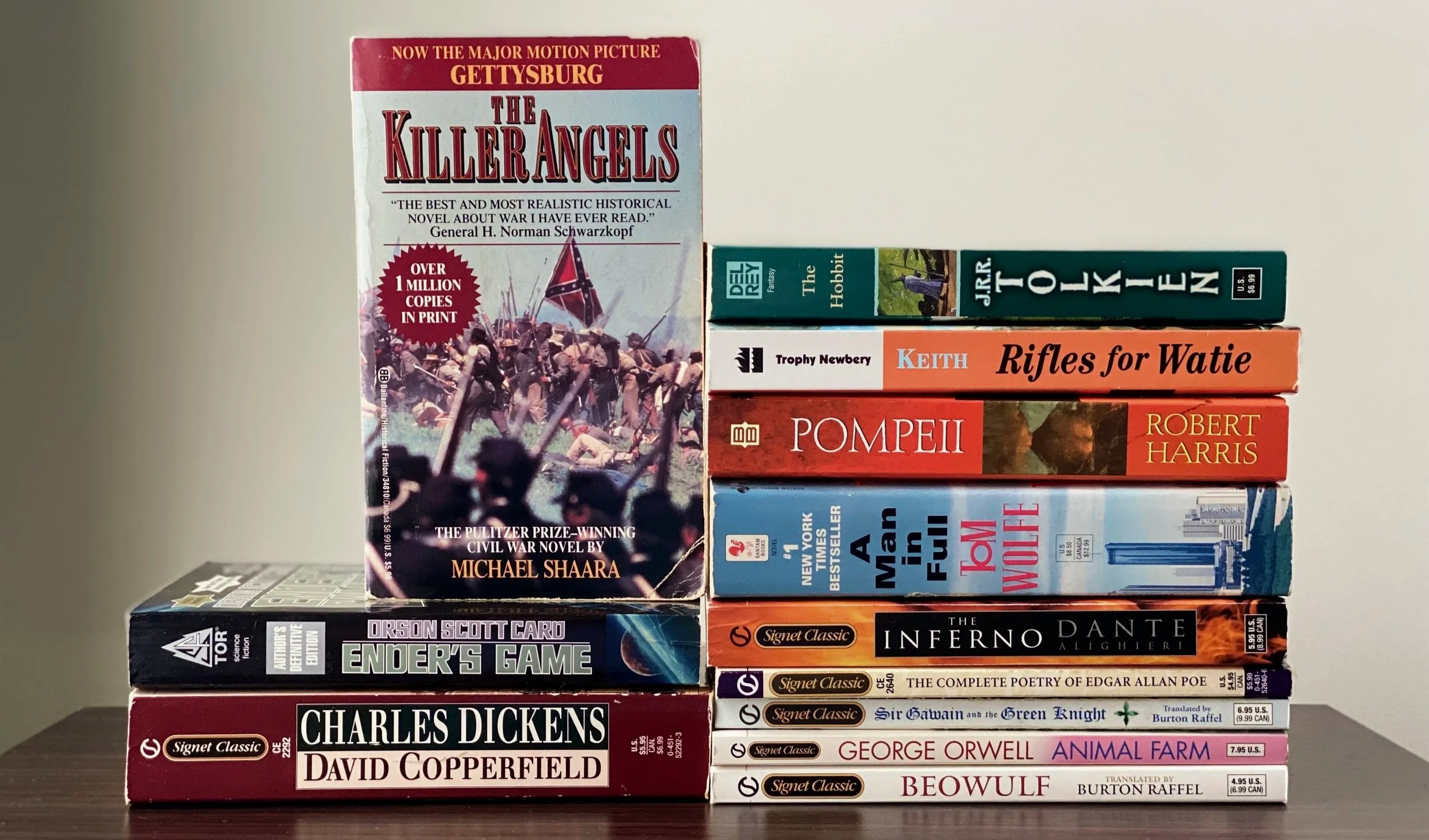
Some of my oldest and most cherished mass market paperbacks

It’s been a busy week both recovering from last weekend’s ice-storm and two lost days of school and preparing for this weekend’s snow, but not so busy that I didn’t catch a tempest in the Substack teapot: the apparent extinction of the mass market paperback.

In actual fact, Publisher’s Weekly reported last month that the country’s largest book distributor had decided not to bother shipping mass market paperbacks anymore, citing a steep decline in sales over the last few decades and profit margins that were already thin. This will naturally have an effect on how many of them are available and where, but the news was being misunderstood on Substack as either 1) mass market paperbacks will no longer be produced by publishers at all or, more egregiously, 2) paperbacks in general are being discontinued.

In the middle of his hubbub a not insignificant number of voices were raised crying “Good riddance!” Mass market paperbacks, they said, are cheap, badly designed, have small print and margins so narrow your thumbs cover the words, and their spines fall apart almost immediately. A lot of the same people paired their condemnation of the mass market paperback with praise for the hardback.

The mass market paperback may not, in fact, be extinct quite yet, but I can’t tolerate hatred for it.

Let me start with the crassly material. Cheapness is a feature, not a bug. The hardback aficionados seem to forget the kids who want to read but can’t stomach getting only one book for $30 they worked hard for or saved until the day they could visit a good bookstore. The money is just a facilitator, not the point; How much reading will my $20 get me? is the question I asked over and over as a teenager. I still do paperback math in my head—for most modern hardbacks I could have gotten at least six mass market paperbacks back in the day.

As for flimsiness, that’s just the nature of paper and glue. Even the $20—and more and more often $22 or $25—trade paperbacks dominating bookstores today will eventually fall apart from rough use or shoddy binding. Even hardbacks are not bound like they used to be. In my experience, if one takes even a little care of one’s books—not getting them wet, not just throwing them around, not intentionally breaking the spine like a barbarian—they’ll last a long time, and a mass market paperback from a decent publisher will likely be as sturdy as any other size.

And regarding design, a small book will necessarily have smaller print. Adapt. And just how big are your thumbs?

So much for that. Why do I feel so strongly about this?

My affection for the mass market paperback runs deep. I was a country boy without a lot of spare cash for books, so from quite early on, when I got a book, I got a mass market paperback. Many of the books my parents ordered for me at a discount from the God’s World Book Club in elementary school—Rifles for Watie and Across Five Aprils come to mind, as well as things like World’s Strangest Baseball Stories—were mass market paperbacks. I still have many of these.

The Hallmark store on St Simons Island where my mom shopped for gifts and ornaments every summer had an entire wall of these books. It was here that I first found a copy of The Killer Angels, which I knew as the source of Gettysburg, my favorite movie. My parents bought it for me and I just about wore it out reading it in the condo, by the pool, even at supper while a Japanese hibachi chef lit onion volcanoes on fire. Look at the photo at the top of this post—that’s the same copy. Cheap, yes—$5.99 is printed on the spine—but still serviceable.

When I started reading seriously in high school, the mass market paperback made entire literatures available to me for five or six dollars apiece. Signet Classics, which was repackaging their line in nicely designed matte-finish covers as I finished high school and started college, became my go-to. I’d pick up as many as I could with my birthday money during summer trips to St Simons—by this time blessed with a Books-a-Million, which always had a huge inventory of them—or at the Greenville Barnes & Noble when I didn’t have to be in class and had a little money. Burton Raffel’s Beowulf and Sir Gawain, Ovid, Virgil, Boccaccio, Euripides, Malory, Shakespeare, O Henry, David Copperfield, The Song of Roland—just this partial list is an introduction to a whole civilization for about $50.

The most important of all of these was a Signet Classics mass market paperback of Inferno, translated by John Ciardi, which I got sometime in 2001, a quarter century ago. And I can precisely date another important mass market paperback acquisition thanks to Amazon, where my very first order was a copy of All Quiet on the Western Front—in a metallic bronze cover I can still picture—on February 8, 2000.

Again, these are two books that transformed my life and I got both for about $10. (Amazon records the price of my copy of All Quiet as $4.79.) But much more important than the cost effectiveness is what I got out of these books, and the memories I have of them.

I’ve already mentioned a few of these. I also remember reading Inferno on the bus as a high school junior, canto by canto and reading every one of Ciardi’s notes both to uncover more of this amazing book and to block out the chaos around me. I first read Sir Gawain in a single Sunday afternoon as a college freshman, and plowed through The Bonfire of the Vanities over several weeks of lunch in the campus snack shop the same year. I carried my copy of Raffel’s Beowulf in my jacket pocket as I graduated from Clemson sixteen years ago. It was August and it got sweaty but it’s still here on my shelf. And of course there’s the drive to Atlanta in 2000 that I’ve mentioned before, when I read a chapter called “Riddles in the Dark” and realized I loved The Hobbit (purchased at Walmart) and would forever.

The mass market paperback met an important need for me at a specific time. Maturing as a reader, wanting to read a lot, but not having much money or space, and being limited to what was widely available in big bookstores, mass market paperbacks were an intermediate step between the $1 and $2 books in the Dover Thrift catalog I pored over in high school and the Penguin Classics I began collecting in college. Good books, readily available, in workmanlike binding, inexpensive—anything more strikes me as luxury.

I don’t begrudge anyone their hardback library—far from it—but I hate to see the mass market paperback impugned. It’s done humble and honorable service making entertainment and learning available to millions. I’m one of them.

I hope the mass market paperback’s death has been greatly exaggerated and that it will have many years left. But even if not, I’m grateful, and I’ll still enjoy mine.

Kubrick, conspiracism, and what happens when we assume

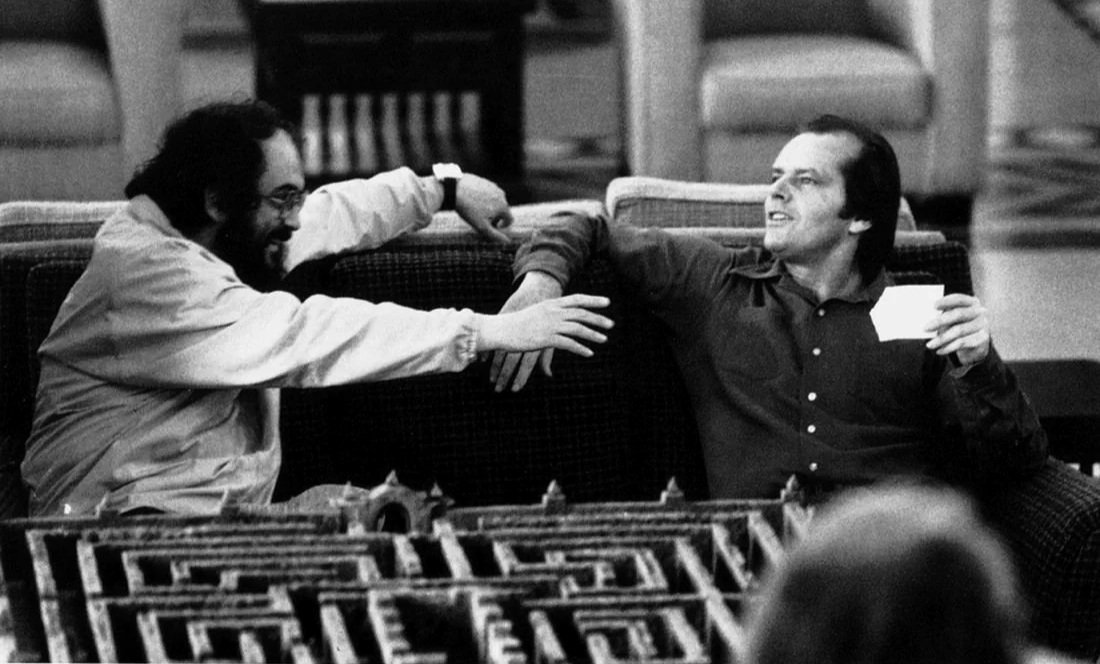
Stanley Kubrick and Jack Nicholson on set. The miniature hedgemaze in the foreground is an accidental metaphor for the subject of this post.

YouTuber Man Carrying Thing posted a funny and thought-provoking video yesterday concerning a strange emergent pop culture conspiracy theory. Apparently some disappointed fans of “Stranger Things” decided that secret new episodes are on their way, a fact signaled through elaborate visual codes in the final season. (I have no dog in this fight. I saw the first season when it first appeared and have not bothered with any of it since.) These fans have compiled huge numbers of minor details as “evidence” but the date of the supposed release of these surprise episodes has already come and gone. Undeterred, they continue with the predictions.

Jake (Man Carrying Thing) has some thoughtful things to say about this weird story, the most important of which, I think, is the role of bad storytelling in creating false assumptions and the way those assumptions fuel the mad conclusions these fans have come to. In the process he makes a brief comparison to Stanley Kubrick and The Shining, which is what I really want to write about here.

The Shining is the subject of several bizarre but elaborately worked out theories, the two most prominent of which are that the film functions as a hidden-in-plain-sight confession by Kubrick that he faked the moon landings for NASA and that the film has something to say about the fate of American Indians.

The latter is more easily disposed with along the lines Jake uses for some of the “evidence” of the “Stranger Things” theory. Why does the Overlook Hotel have so many Native American decorations? Because that’s what a Western hotel in that era would decorate with. Next question.

The NASA stuff goes deeper, though, and this is where Jake’s comments on the assumptions behind such theories are pertinent. The conspiracy theory interpretations of The Shining lean heavily on several assumptions, the most important of which is that Stanley Kubrick meticulously planned everything about his films down to the last item in every frame. Every detail, the argument goes, is intentional and meaningful, and so the film can and has, as Jake notes, been analyzed frame by frame for “evidence” of these theories. But is this assumption correct?

No. Kubrick was meticulous, yes, but not that meticulous. Or not that kind of meticulous. He was, in fact, too good an artist for that.

I encourage everyone to watch “The Making of The Shining,” a documentary shot by Kubrick’s 17-year old daughter Vivian and included as a special feature on the DVD and Blu-ray. (You can also watch it online here.) While the myth of Kubrick is of the chilly visionary with a perfect movie in his head that he brutally forces into reality, Vivian Kubrick captures her father changing and adapting on the fly, picking the ballroom music at the last minute, discussing the different versions—plural—of the script, and even coming up with the iconic floor-level angle of Jack Nicholson in the storage locker as they’re shooting the scene. She presents us the collaborative mess of filmmaking.

Kubrick knew what he wanted, but he had to work his way there, improvising and improving. This both rubbishes the conspiracist assumption about Kubrick, that The Shining presents some utterly controlled pre-planned message, and also functions as broadly applicable insight into creative work and human nature.

Any good artist in whatever medium will have a clear goal and an idea of how to accomplish it but will also adapt as they go, even the meticulous ones. That’s because every plan is subject to the combined friction of creative work and reality, which test the artist. The later illusion of coherence and completeness is part of the art. A great artist like Kubrick can disguise it well, because thanks to his gifts the final product is better than what he set out to make. But the Duffer brothers? Jake—and audience reaction to the conclusion of “Stranger Things”—suggests otherwise.

As for human nature, conspiracy theories, whose protagonists are often hypercompetent if not omnipotent, fail to take account of the messy, improvisatory quality of reality, especially when they presume to encompass a larger slice of it than that available on a film set. They are, as German scholar Michael Butter puts it in The Nature of Conspiracy Theories, “based on the assumption that human beings can direct the course of history according to their own intentions . . . that history is plannable.” Or in Jake’s words, “So many conspiracy theories would lose their convincing quality if those who believed them acknowledged human fallibility.”

Recognizing this can make us less susceptible to falsehood—because we all know what happens when we assume—and better creators. A strange but heartening intersection.

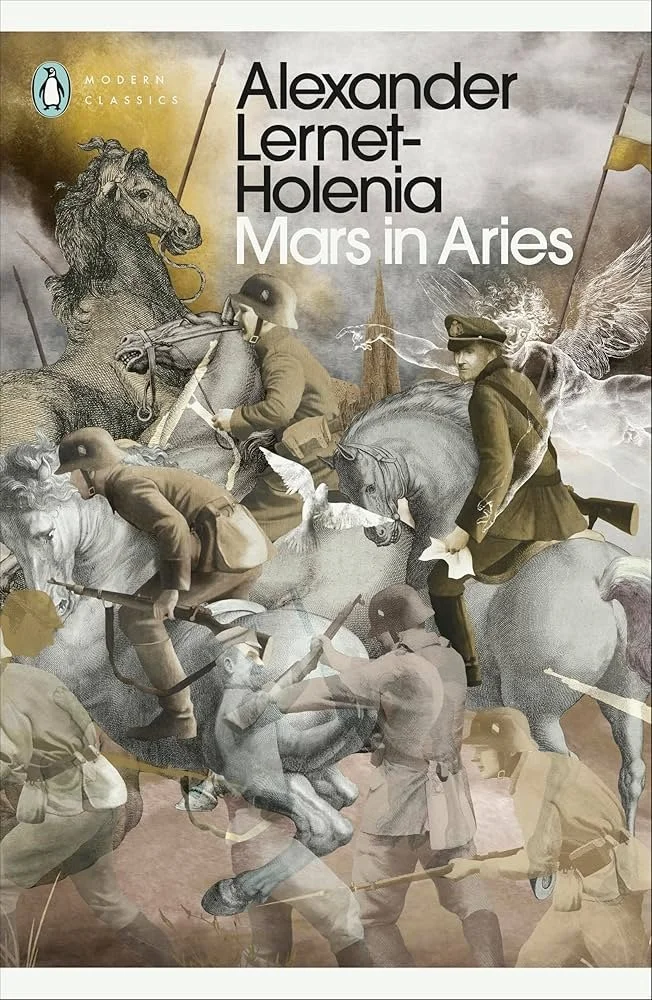
Mars in Aries

Last year I discovered the work of Alexander Lernet-Holenia, an Austrian novelist, playwright, screenwriter, and soldier. He served in the Austro-Hungarian Army during the First World War and as an Austrian reservist in the Wehrmacht, Austria having been consumed by the Third Reich in the Anschluß, in the Second. His work—at least what I’ve read so far, and I’m always looking for more—is atmospheric and uncanny, with his protagonists descending or arriving unexpectedly in worlds in which the invisible is made manifest and layered over the day-to-day.

Baron Bagge, the novella I reviewed for Miller’s Book Review last summer, does this with an Austrian cavalryman in the First World War. Count Luna, about an Austrian businessman convinced that a former rival who died in the concentration camps is haunting him, does this in the aftermath of the Second World War. Mars in Aries not only takes place during the Second World War, it was written and published—and banned—while it was yet ongoing.

Mars in Aries tells the story of Lieutenant Wallmoden who, we learn on the first page, is not the novel’s hero, simply its main character. The story takes place over a month or so in the late summer of 1939 as Wallmoden, an Austrian reservist, volunteers to join his unit rather than wait to be called up for mobilization by the Germans. He whiles away this peacetime service talking to his brother officers, conducting training exercises, and—occasionally—experiencing visions.

In an especially vivid one that occurs during training, Wallmoden is leading troops across a field near a village when he finds himself surrounded by ghosts. An army doctor assures him he is in good health, but it unsettles Wallmoden to have experienced this after conversations with another officer, a man of a mystical bent and with an interest in spiritualism, about whether or not one can tell if another person is an apparition.

Being of a well-off background and an officer, Wallmoden also makes social calls. It is during one of these that he meets Baroness Pistohlkors. She claims to have been born in the United States and briefly married there before being dumped—all the result of a misunderstanding—and remarrying a consumptive nobleman who moved her back to Europe and promptly died. Still young and breathtakingly beautiful, she is a titled and wealthy widow. An old man who is, strangely, often in her company, insinuates to Wallmoden that despite the two marriages the Baroness is still a virgin.

Wallmoden finds the old man offputting, the Baroness’s foreign friends strange, and her behavior stranger still—why, for instance, does she sometimes speak to only one other person at parties? or disappear before the parties end? and why do the handful of people who know her warn him of her bad reputation?—but he is smitten.

In just a few weeks, heedless of whatever she has earned a reputation for, he develops a passion for her, but the Baroness plays hard to get. Only after Wallmoden’s dogged pursuit does she, one day, agree to meet him for a tryst. They set a date and time for their rendezvous and Wallmoden returns to his camp.

That night the army deploys.

Wallmoden’s unit drives from Vienna to the Slovakian border with Poland preparatory to the German invasion. Wallmoden is unaware of the geopolitical maneuvers by the higher powers, never named, who control world politics, and is preoccupied with letting Baroness Pistohlkors know why he missed their meeting and with scheduling a belated one. He also continues to have visions or waking dreams, like a crawfish migration across the road leading over the Polish border or a ghostly encounter with two bathing girls from some past time, an encounter invisible to everyone else and that leaves no sign behind except a pair of wet footprints.

I don’t want to reveal anything further. I’ve already worked to conceal a lot about the plot. Wallmoden eagerly awaits word from the Baroness, the invasion comes and his unit strikes into Poland, he gets some surprising bad news, and has a yet more surprising encounter after being wounded. The story ends with a stunning reversal, with Wallmoden content but—both literally and metaphorically—nowhere near where he wanted to be.

Mars in Aries may well be my favorite of Lernet-Holenia’s books so far. It has the atmosphere of Baron Bagge and the absorbing ambiguity of Count Luna, as well as a satisfying streak of mystery. It works as both a romance and a war novel. The first half, in which we follow Wallmoden on his desperate bid for Baroness Pistohlkors’s heart, should prove especially poignant to anyone who ever felt unrequited love, and the second half, covering the invasion of Poland, utterly swamps the first. Lernet-Holenia, basing the book on his own experiences in the Wehrmacht, makes the invasion viscerally real—hot, dusty, exhausting, a parade of destruction and casual violence. The harsh reality of these scenes—to which I’ll return momentarily—make the reversal at the end that much more surprising.

The title, an astrological sign, does not reflect any actual celestial alignments during the invasion but apparently does suggest passion and aggressive desire. This is thematically appropriate, but the novel’s original title, The Blue Hour (Die blaue Stunde), a slang term used within the story for brief romantic trysts, works well on several levels, too.

As an additional layer of interest, Mars in Aries was published in 1941 and immediately banned by the Nazis. Actually banned, as in: sale was legally prohibited and the print run put in storage and destroyed. Reading it now, its apparent inoffensiveness—a love story with some mystical elements—may obscure what the Propaganda Ministry objected to. While the novel portrays German victory in Poland, it shows soldiering as unromantic, unheroic, and laborious; some of Wallmoden’s fellow officers openly talk about annihilating civilian settlements; the Poles, though rarely seen by Wallmoden, accordingly have an tone of underdog heroism; and some of the strange social gatherings in the first half of the novel suggest criminal activity—as a few other characters point out to Wallmoden—including Resistance work.

Fortunately, Lernet-Holenia had kept his publisher’s proofs and used them to republish the book after the war. I’m glad he did, and that the combined might of real censorship and Allied bombing couldn’t erase Mars in Aries.

This is an unusual novel, with a unique combination of romance, the uncanny or even gothic, and realistic warfare, and its climax is a suspenseful and moving surprise. Mars in Aries is beautifully written, exceptionally well-crafted, and, at about 200 pages, compact and powerful. I look forward to rereading it soon.

In Dilbert memoriam

A childhood favorite. some of my interests have never changed.

I’m late to the game in memorializing Scott Adams, who died a week ago today, and can offer only a personal appreciation. I hadn’t kept up with him consistently for about twenty years and heard of him just often enough to be amused at what he was getting up to. When I heard of his terminal illness last year and his plans to seek assisted suicide, I was grieved.

But to begin in the proper place. I was a comics-loving kid and while I was aware of Dilbert, which came packaged with all my favorites in my grandparents’ Atlanta Journal-Constitution and Anderson Independent, I don’t know how often I actually read it. My fundamental sense of what comic strips were came from Peanuts, Calvin and Hobbes, and—for one-panel high strangeness—The Far Side. These are still the three highest peaks in my estimation of the form. Dilbert was of a different world and valence than these, and its subjects and artwork probably didn’t immediately appeal.

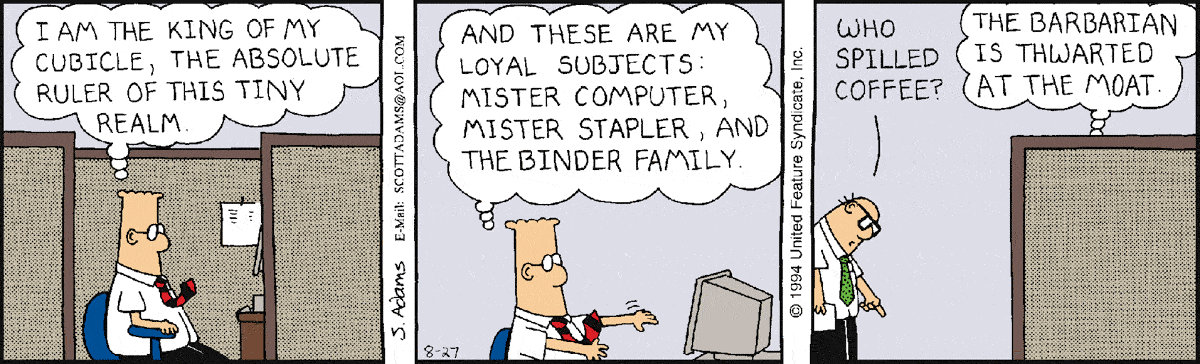
But sometime in the mid-90s I got a new classmate at my small Christian school. I already owe one lifelong debt to Clint because he told me about this short story he had read at his previous school, “The Tell-Tale Heart,” and accidentally introduced me to Poe, but he was also a huge fan of Dilbert. I remember him bringing a copy of Fugitive from the Cubicle Police—the politically correct title for what in the strip itself is referred to as the Cubicle Gestapo—to read between classes. His enthusiasm and the specific strips he shared with me from this book led me to look closer at Dilbert. It was soon a favorite.

It’s a testament to Adams’s genius that a couple of twelve-year olds could have found Dilbert’s workplace humor so funny. For us Dilbert was essentially fantasy literature, full of strange races and the vocabulary of forbidden tongues. I had no idea what HR was (those were the days) or what a consultant or software engineer did or what any of the office-specific jargon and tech lingo of the mid-90s actually meant, but we floated along on the vibes and characterization, inferring the meaning and import of jokes. Adams was very good at this. His skill with story, characterization, and the crucial timing of written humor meant our lack of experience of this world posed no obstacle to understanding—and laughing. We got the point even when we didn’t get the reference.

The chapter on office pranks was not especially helpful job preparation for a middle-schooler

Soon I had a respectable stack of Dilbert books, including one that worked as a key to Dilbert’s world and appealed to my Aristotelian love of taxonomy: Seven Years of Highly Defective People, a best-of sorted by character with notes by Adams in the margins. These were informative and funny and his personality came through clearly.

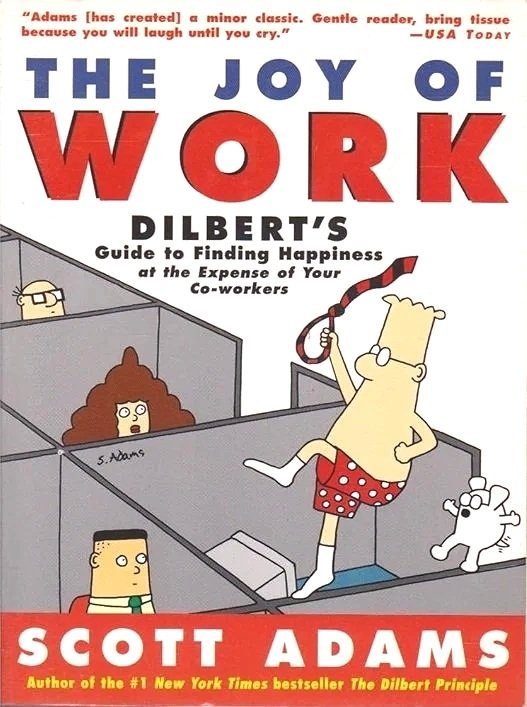
I got to know that better by signing up—again, this is still the mid or late 90s—for his e-mail newsletter, which automatically made me part of the DNRC: Dogbert’s New Ruling Class, the intellectual elite of his forthcoming new world order. Here Adams offered updates and commentary and responded to reader e-mails with a brimful serving of his wry snark. It was here, I think, or perhaps in The Joy of Work, one of his non-cartoon books on business culture, that I learned the word cynical.

I was in middle school by then (I remember reading The Dilbert Future on my first trip to Europe in 1998, not quite fourteen) and that’s a heady moment to be introduced to cynicism. Not that it wouldn’t naturally have occurred about that time, but I’m not sure learning that one could adopt a self-aware, sardonic, Olympian aloofness about one’s environment was helpful to me. I’m already bent, in Malacandran terms, in these directions anyway, and Dilbert encouraged me to adopt a more self-conscious and ironic posture strictly because it was funny. This cynicism was, ironically, quite naive.

Perhaps this would have been fine in a Sisyphean office environment, but at fourteen my environments were family, church, and school, fields where earnestness is actually warranted—most of the time. Because I learned cynicism as a way of humor about the same time I learned that, as a true believer, I would often be let down, I learned to use wry humor as a shield. I don’t think Dilbert did me any long-term damage but I’ve had to mature past these attitudes and habits.

Back to Adams himself and the DNRC. The Dilbert newsletter was probably my first experience of a writer opening up his mind to his readers. In addition to cartooning, the business world, and the vast intellectual superiority of his subscribers, Adams unironically flogged his vegetarian taco brand and his thought experiments—another phrase I learned from him. He shared a lot of the ideas he’d eventually package as God’s Debris. I may have been naive but I wasn’t suggestible and wouldn’t follow the funny man into woo-woo agnosticism. I had accidentally learned how to observe proper boundaries with people I liked but couldn’t agree with on the important stuff, a lesson I can take no credit for. It also won’t be the last appearance of grace in this story.

I kept up with Dilbert online through college—it was one of several strips I checked daily—but Adams himself, whom I admired as the off-kilter mind behind the cartoon, fell out of my awareness and I was content simply to read the strip. Somewhere between my undergrad and grad school years I lost the habit even of this, so it was a shock to run across it occasionally and see updates. Dilbert in polo and lanyard? That would have been unthinkable in 1998. (But guess what I wear to work every day.)

I have no opinion on Adams and politics. When he popped up on my radar over the last ten years saying contrarian things to the great consternation of a lot of people, I was unsurprised. Hadn’t y’all met him? He was a contrarian. If he hadn’t been, Dilbert would never have had the edge and absurdity that made it great. It would have been Cathy in a software company.

But to return to where I started, when Adams announced his imminent death from pancreatic cancer and his plans to end his own life, I was grieved. I remembered my mixed feelings about his dorm room-style philosophizing, his know-it-all pandeism, his air of superiority—in a word, his arrogance, a trait that attracts middle schoolers like a whirlpool attracts flotsam—and worried that his gifts would end in a final act of nihilism as dark as anything in Catbert’s HR department. What I did not do was hope or pray for him.

I am in no position to weigh the merit of Adams’s announcement of his conversion to Christianity just before he died last week. The various algorithms have tried to feed me a lot of videos—all with thumbnails of frantic, outraged people mugging in front of microphones—arguing yea or nay on his reasons. What I do know is that Adams was facing death, the ultimate argument-ender, and these podcasters are not, and that God is not willing that any should perish. In a history replete with sinners converting in the most miserable of conditions, how is God diminished by saving one more? What I felt when I learned of his decision, a Pascal’s Wager deathbed conversion, was relief and gratitude.

Again, these are my observations as an old fan who, after childhood, held Adams at arm’s length but always appreciated him. Dilbert’s peculiar sense of humor is a key middle-layer of the development of my own sensibilities, and Adams’s genius was the same as that that made Peanuts, Calvin and Hobbes, and The Far Side great—the ability to heighten the ordinary while keeping it familiar, to people his imaginary landscape with characters we recognize as our friends, family, coworkers, and ourselves, to make this hilarious, and to do it seemingly effortlessly. Also like Schulz, Watterson, and Larson, he was, for better or worse, uncompromising. That his complicated story and difficult personality ended with not just a turn toward grace but a casting of himself on God makes it all the more poignant.

Adams’s story seems to me one of eucatastrophe, of grace snatching victory from the jaws of defeat. It is not a story Adams would have written. Is there any better end for the cynic than redemption?

Weimar notes

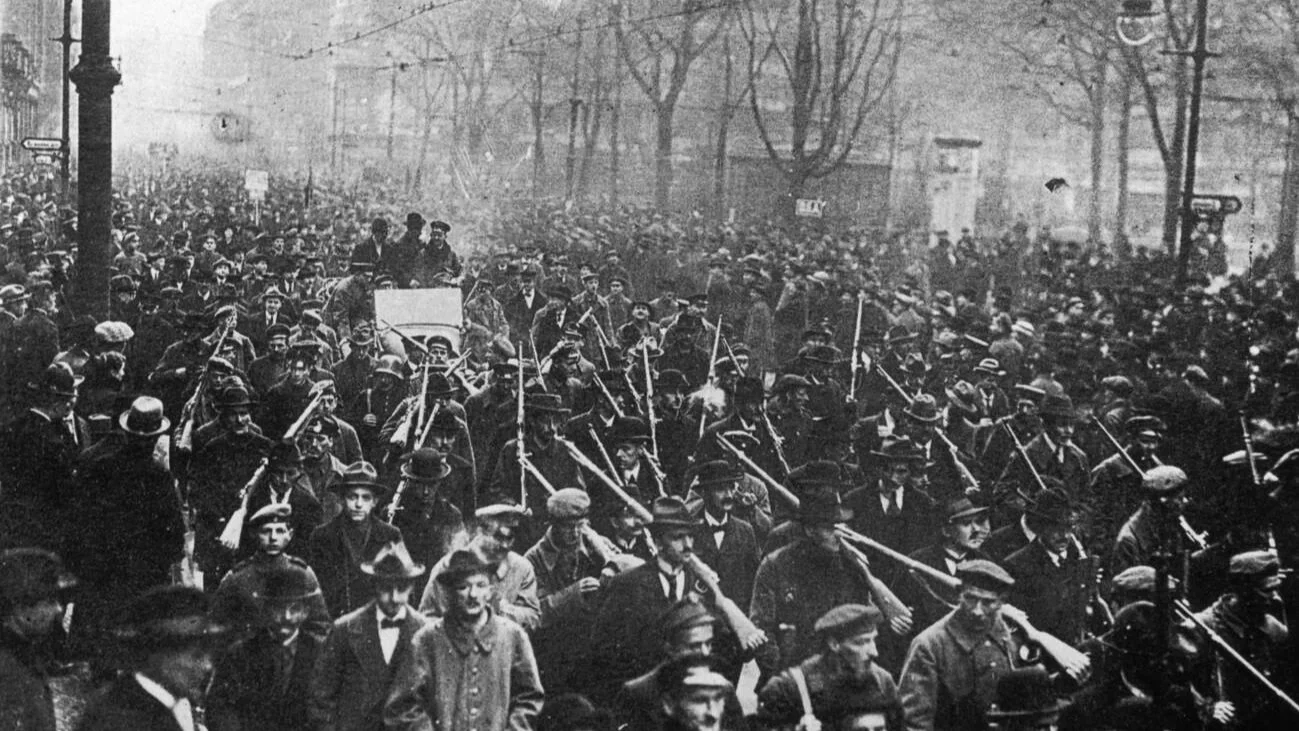
Militants of the Communist Spartacist Uprising in Berlin, January 1919

When I finished Frank McDonough’s book The Weimar Years last month I had hoped to write a full review, but time, sickness, and a host of other complications meant I had to be content with a long paragraph in my non-fiction reading year-in-review. Unfortunately, the single-paragraph summation I hold myself to for those posts meant I could only raise a few issues that I had a lot of thoughts about, gesture toward them, and move on.

Here are two—both more or less about terminology or rhetoric—that I’ve been mulling anew under the influence of McDonough’s book and a few unrelated factors.

Right and left

After finishing The Weimar Years and celebrating Christmas, I caught up on some club episode of The Rest is History. The one I was most excited for was a live show Holland and Sandbrook presented at Royal Albert Hall last spring. The subject: Wagner.

Holland and Sandbrook begin their discussion by asking the audience to reconsider what they think they know about Wagner—a smart move. But this problem of terminology popped up immediately. You have heard it said, they essentially say, that Wagner is a right-wing figure, but I say unto you… he’s more of a left-winger. In their actual words, “a hippie.” But Wagner had “some right-wing opinions,” namely anti-Semitism. So: a leftie who is right-wing à la carte?

There’s an argument to be made for Wagner’s place on the left, given his role in the 1848 revolutions and his support for the overthrow of the Saxon monarchy as well as his generally bohemian lifestyle. But what precisely makes his anti-Semitism right-wing? And, from a certain kind of chest-thumping American view, supporting the overthrow of monarchies and seeking to create an all-encompassing national artform out of national myth could be spun as right-wing.

This was a great episode—and I especially appreciated Holland’s argument that Wagner’s music is not in itself anti-Semitic—but that left-right business neatly encapsulated much of my problem with this political frame.

Back to McDonough’s book. McDonough uses the language of left and right throughout but also, importantly, makes it clear what each of the dozen or so major German political parties of the 1920s wanted and stood for. Focusing on 1) goals, 2) methods, and 3) how these changed depending on circumstances explains much more, especially when it comes to the elephant in the room: the National Socialists—and yes, the Socialist part absolutely matters—who were themselves starkly divided along several political axes throughout the Weimar period. This is also considerably more helpful than a simple left-right spectrum when one reads of instances in which supposed opposites like the Nazis and the German Communist Party collaborated against the national government.

The terminology of right and left is rooted in a specific historical moment and the specific problems parties in that place and time argued and fought over. Unmoored from those specifics, I find it unserious. It’s a time-honored way to argue about vibes. I avoid it as much as possible when I teach modern history, invoking it only to give the point of view of people within the narrative I’m telling but not as neutral description.

“Democracy” vs this democracy

I didn’t get into the left-right thing in my paragraph on The Weimar Years but I did raise this question. Here’s what I wrote there:

But the epilogue, in which McDonough specifically blames Paul von Hindenburg for the death of “Weimar democracy,” is a bit of a fumble, as it is abundantly clear from McDonough’s own narrative—and even the earlier parts of the epilogue—that the Weimar Constitution had built-in weaknesses that were bound to weaken and undermine it. McDonough essentially faults Hindenburg for not believing in democracy hard enough. But if “democracy” in the abstract gave Germany this democracy in concrete, stubborn reality, it deserved to go.

Since finishing McDonough’s book I’ve browsed two new histories of Weimar from German historians: Vertigo: The Rise and Fall of Weimar Germany, by Harald Jähner and Fateful Hours: The Collapse of the Weimar Republic, by Volker Ullrich. (In the course of writing this I’ve also learned of a history of Weimar by Katja Hoyer, due out this summer.)

All of these (minus Hoyer’s book, for obvious reasons) do a bit of two-step around the concept of democracy: when the authors write about “democracy,” they sometimes mean the specific constitutional arrangements of the Weimar Republic—who voted, how, under what circumstances, how the Reichstag was constituted, who became chancellor and what authority they had, etc—and sometimes the concept of Democracy, in the abstract. The defeat and destruction of Weimar democracy is a tragedy for them because it means a defeat of Democracy.

But to paraphrase Burke, abstract democracy is not to be found; it inheres in sensible objects. It is useless to talk about Democracy without talking about the specifics of a given democracy, and a given democracy is only as valuable as its institutions and—one ought to add—the people who are using it. And as I wrote above, Weimar democracy was flawed from its inception because of the specifics of how it was designed and functioned and what options it made possible. Unstable, ineffective, hamstrung both by the outcome of a war it wasn’t responsible for and diplomatic agreements to which it consented, and—in the hands of feckless and corrupt politicians of all parties including the supposedly egalitarian socialists—unable to represent the people, it was a failure as a democracy long before Hitler seized power.

As I finished reading McDonough’s account and looked through those two other books—one more obviously leftist-oriented but both moaning and lamenting for Democracy throughout—I had a strange realization. The effect of switching from the collapse of actual Weimar democracy to a lament or apologia for Democracy in the abstract is suspiciously similar to “Real socialism has never been tried.” Democracy attracts the same mulish defensiveness as socialism. Both are the object of unwarranted faith. Neither can be blamed when they fail.

A confession

I started The Weimar Years shortly after the Charlie Kirk murder. Political violence openly celebrated by one side of the culture seemed like a good reason to familiarize myself with the broader narrative of Weimar.

That was a mistake, as looking for a useable, “relevant” past almost always is. Unfortunately historians of Weimar are just as prone to it. In both Jähner’s and Ullrich’s books I did a quick search for “Trump, Donald” in the index and guess what I found? Dumb parallels to the present, mentions of a specific political bugbear that will date their books as badly as a book I have on Mussolini that keeps bringing up George W Bush.

But McDonough doesn’t make this mistake, which is one of the great values of The Weimar Years. Throughout he emphasizes contingency and particularity: that things could have turned out other than how they did, something he makes clear through his detailed political narrative, and that Weimar Germany was a unique time and place offering no easy comparisons to our own. Pretending that Weimar tells us something or gives us insight into our enemies because there was political violence and politicians said mean things about their opponents is glib and misleading—for both the past and the present. The specifics matter.

So I confess to beginning McDonough’s book for the wrong reasons, but am glad I read it and for the sensibility of his approach, which brought me back to my senses. The closer I looked at Weimar, the less I saw of us, now. Which is as it should be. Not that we can’t learn anything from it, but we won’t until we understand it on its own terms.

More to come

I’m still trying to strengthen my grasp of Weimar. Of the two other books I’ve looked at, I may read Ullrich’s on the basis of his two-volume Hitler biography. He intones the ritual laments for Democracy in the portions I’ve read but his treatment of some of the specific topics and people I looked up struck me as more balanced than Jähner’s, which celebrates the hedonism and decay of the time. I may end up holding out for Hoyer this summer, as her book on the German Empire, Blood and Iron, was exceptionally good.


1970s comment sections

See what this passage from Dave Barry’s recent memoir Class Clown in which he recounts his experiences working at a local daily newspaper as a young reporter in the early 1970s reminds you of:

 
I also learned a lot about what readers of a local newspaper are, and are not, interested in. You could make a major mistake in a story about a meeting of a zoning board and never hear a peep from the readers about it. But if you, in writing a photo caption, misidentified a goose as a duck (I did this), you would hear about it from literally dozens of readers, some of them quite irate. And if the newspaper should ever—God forbid—leave out the daily horoscope, the phones would not stop ringing.
 

I’ve given it away in the title of this post, of course, but this reminds me of nothing so much as trying to communicate on the internet. Majoring on the minors, mindlessly angry criticism, even astrology—there is nothing new under the sun. And there’s that famous bit of internet advice that, if in need of information, you shouldn’t directly ask for it, but instead make an incorrect assertion on the topic and watch the corrections pour in from the Actually guys.

Just in case we forget that technology seldom introduces entirely new bad behavior, it just amplifies it. And Barry has tons and tons of these stories.

Class Clown is a great read, by the way—funny throughout, often moving, it offers both a fun capsule overview of Barry’s life and about fifty years of journalism and culture.