Easy to serve, difficult to please

This week I learned that a former department head at a college where I’ve taught adjunct classes off and on for a decade had died.

I first worked for her the semester my eldest was born. A colleague facing some unexpected surgery offered me a Western Civ II course at this other school and put me in touch with the department head there. She gave me the course on the spot, with just a few weeks to go before the spring semester. I had a hard time keeping up—I began that spring with five adjunct classes at two colleges, an ESL tutoring job for a German elementary student at Sarah’s school, and part-time work at a sporting goods store—but I was most grateful because we needed the money and the work was good. As so often, it was exactly what we needed when we needed it.

My department head didn’t have another class for me after that spring but said she would be in touch as the need arose. Lo and behold, as Sarah and I expected our second child two years later, she reached out with another spring class. I gratefully accepted. Again—just enough, when needed.

That summer I found out about a full-time position at Piedmont Tech and that’s where I’ve been ever since. When I let my department head at this other school know, she thanked me and wished me luck, and said to let her know if I ever needed anything. A generous offer, and she meant it. Over the next few years she’d check in regularly on LinkedIn—yes, LinkedIn can actually be helpful!—always encouraging me and letting me know that if I needed work all I had to do was ask.

I asked when Sarah and I found out we were expecting twins, children four and five. And my department head happily set me up with an online class, semester after semester until her retirement.

She will be missed. She not only played a willing role in God’s providential care for our family—something, as a fellow believer, she would have happily acknowledged—but was simply a good boss.

I’m old enough now to have lost several former bosses: my first boss, a family friend who managed the seafood restaurant where I kept the buffet line supplied with clean plates in middle school, and then her husband, an auctioneer and antiques appraiser who employed me for the year between college and grad school and where I learned a lot about old stuff—as well as how to properly load a moving truck. My department head joins them.

As I’ve reflected on this over the last couple days, their authority reminded me of Confucius’s concept of the junzi, the “superior” or “noble man,” a subject I once taught in an adjunct World History course for this department head: the superior man is “easy to serve but difficult to please.” A rare combination. They were gentle but demanding, graciously insisting on high standards of work, encouraging me to live up to my potential. It was never difficult to work for any of them but I always knew I could do better, and improved as I worked for them. I’m glad to say these are not the only such bosses I’ve had.

The internet is full of vindictive, cynical, hostile takes on the relationship between employer and employee, and it’s not hard to understand why so many people assume it must be adversarial. But I’ve been blessed to see a number of genuinely good bosses, including my current and former deans and department heads at my full-time work, and to cherish the memories of these who have passed away. Precisely by being a good boss they proved to be more. RIP.

Elegy for the mass market paperback

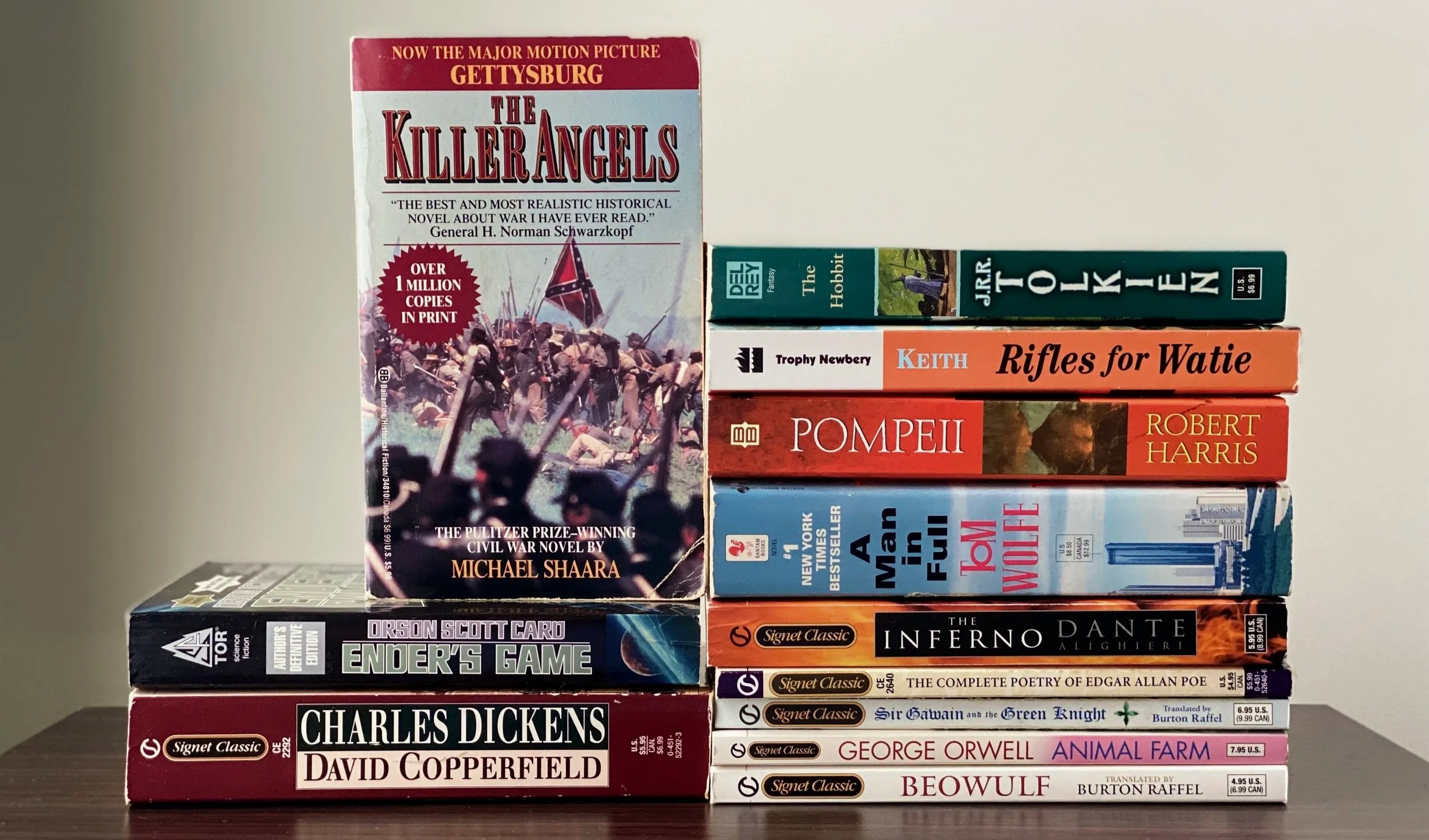
Some of my oldest and most cherished mass market paperbacks

It’s been a busy week both recovering from last weekend’s ice-storm and two lost days of school and preparing for this weekend’s snow, but not so busy that I didn’t catch a tempest in the Substack teapot: the apparent extinction of the mass market paperback.

In actual fact, Publisher’s Weekly reported last month that the country’s largest book distributor had decided not to bother shipping mass market paperbacks anymore, citing a steep decline in sales over the last few decades and profit margins that were already thin. This will naturally have an effect on how many of them are available and where, but the news was being misunderstood on Substack as either 1) mass market paperbacks will no longer be produced by publishers at all or, more egregiously, 2) paperbacks in general are being discontinued.

In the middle of his hubbub a not insignificant number of voices were raised crying “Good riddance!” Mass market paperbacks, they said, are cheap, badly designed, have small print and margins so narrow your thumbs cover the words, and their spines fall apart almost immediately. A lot of the same people paired their condemnation of the mass market paperback with praise for the hardback.

The mass market paperback may not, in fact, be extinct quite yet, but I can’t tolerate hatred for it.

Let me start with the crassly material. Cheapness is a feature, not a bug. The hardback aficionados seem to forget the kids who want to read but can’t stomach getting only one book for $30 they worked hard for or saved until the day they could visit a good bookstore. The money is just a facilitator, not the point; How much reading will my $20 get me? is the question I asked over and over as a teenager. I still do paperback math in my head—for most modern hardbacks I could have gotten at least six mass market paperbacks back in the day.

As for flimsiness, that’s just the nature of paper and glue. Even the $20—and more and more often $22 or $25—trade paperbacks dominating bookstores today will eventually fall apart from rough use or shoddy binding. Even hardbacks are not bound like they used to be. In my experience, if one takes even a little care of one’s books—not getting them wet, not just throwing them around, not intentionally breaking the spine like a barbarian—they’ll last a long time, and a mass market paperback from a decent publisher will likely be as sturdy as any other size.

And regarding design, a small book will necessarily have smaller print. Adapt. And just how big are your thumbs?

So much for that. Why do I feel so strongly about this?

My affection for the mass market paperback runs deep. I was a country boy without a lot of spare cash for books, so from quite early on, when I got a book, I got a mass market paperback. Many of the books my parents ordered for me at a discount from the God’s World Book Club in elementary school—Rifles for Watie and Across Five Aprils come to mind, as well as things like World’s Strangest Baseball Stories—were mass market paperbacks. I still have many of these.

The Hallmark store on St Simons Island where my mom shopped for gifts and ornaments every summer had an entire wall of these books. It was here that I first found a copy of The Killer Angels, which I knew as the source of Gettysburg, my favorite movie. My parents bought it for me and I just about wore it out reading it in the condo, by the pool, even at supper while a Japanese hibachi chef lit onion volcanoes on fire. Look at the photo at the top of this post—that’s the same copy. Cheap, yes—$5.99 is printed on the spine—but still serviceable.

When I started reading seriously in high school, the mass market paperback made entire literatures available to me for five or six dollars apiece. Signet Classics, which was repackaging their line in nicely designed matte-finish covers as I finished high school and started college, became my go-to. I’d pick up as many as I could with my birthday money during summer trips to St Simons—by this time blessed with a Books-a-Million, which always had a huge inventory of them—or at the Greenville Barnes & Noble when I didn’t have to be in class and had a little money. Burton Raffel’s Beowulf and Sir Gawain, Ovid, Virgil, Boccaccio, Euripides, Malory, Shakespeare, O Henry, David Copperfield, The Song of Roland—just this partial list is an introduction to a whole civilization for about $50.

The most important of all of these was a Signet Classics mass market paperback of Inferno, translated by John Ciardi, which I got sometime in 2001, a quarter century ago. And I can precisely date another important mass market paperback acquisition thanks to Amazon, where my very first order was a copy of All Quiet on the Western Front—in a metallic bronze cover I can still picture—on February 8, 2000.

Again, these are two books that transformed my life and I got both for about $10. (Amazon records the price of my copy of All Quiet as $4.79.) But much more important than the cost effectiveness is what I got out of these books, and the memories I have of them.

I’ve already mentioned a few of these. I also remember reading Inferno on the bus as a high school junior, canto by canto and reading every one of Ciardi’s notes both to uncover more of this amazing book and to block out the chaos around me. I first read Sir Gawain in a single Sunday afternoon as a college freshman, and plowed through The Bonfire of the Vanities over several weeks of lunch in the campus snack shop the same year. I carried my copy of Raffel’s Beowulf in my jacket pocket as I graduated from Clemson sixteen years ago. It was August and it got sweaty but it’s still here on my shelf. And of course there’s the drive to Atlanta in 2000 that I’ve mentioned before, when I read a chapter called “Riddles in the Dark” and realized I loved The Hobbit (purchased at Walmart) and would forever.

The mass market paperback met an important need for me at a specific time. Maturing as a reader, wanting to read a lot, but not having much money or space, and being limited to what was widely available in big bookstores, mass market paperbacks were an intermediate step between the $1 and $2 books in the Dover Thrift catalog I pored over in high school and the Penguin Classics I began collecting in college. Good books, readily available, in workmanlike binding, inexpensive—anything more strikes me as luxury.

I don’t begrudge anyone their hardback library—far from it—but I hate to see the mass market paperback impugned. It’s done humble and honorable service making entertainment and learning available to millions. I’m one of them.

I hope the mass market paperback’s death has been greatly exaggerated and that it will have many years left. But even if not, I’m grateful, and I’ll still enjoy mine.

In Dilbert memoriam

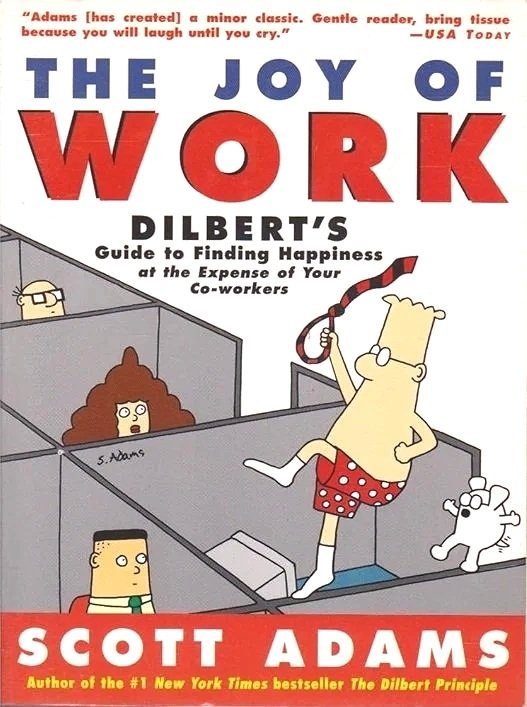
A childhood favorite. some of my interests have never changed.

I’m late to the game in memorializing Scott Adams, who died a week ago today, and can offer only a personal appreciation. I hadn’t kept up with him consistently for about twenty years and heard of him just often enough to be amused at what he was getting up to. When I heard of his terminal illness last year and his plans to seek assisted suicide, I was grieved.

But to begin in the proper place. I was a comics-loving kid and while I was aware of Dilbert, which came packaged with all my favorites in my grandparents’ Atlanta Journal-Constitution and Anderson Independent, I don’t know how often I actually read it. My fundamental sense of what comic strips were came from Peanuts, Calvin and Hobbes, and—for one-panel high strangeness—The Far Side. These are still the three highest peaks in my estimation of the form. Dilbert was of a different world and valence than these, and its subjects and artwork probably didn’t immediately appeal.

But sometime in the mid-90s I got a new classmate at my small Christian school. I already owe one lifelong debt to Clint because he told me about this short story he had read at his previous school, “The Tell-Tale Heart,” and accidentally introduced me to Poe, but he was also a huge fan of Dilbert. I remember him bringing a copy of Fugitive from the Cubicle Police—the politically correct title for what in the strip itself is referred to as the Cubicle Gestapo—to read between classes. His enthusiasm and the specific strips he shared with me from this book led me to look closer at Dilbert. It was soon a favorite.

It’s a testament to Adams’s genius that a couple of twelve-year olds could have found Dilbert’s workplace humor so funny. For us Dilbert was essentially fantasy literature, full of strange races and the vocabulary of forbidden tongues. I had no idea what HR was (those were the days) or what a consultant or software engineer did or what any of the office-specific jargon and tech lingo of the mid-90s actually meant, but we floated along on the vibes and characterization, inferring the meaning and import of jokes. Adams was very good at this. His skill with story, characterization, and the crucial timing of written humor meant our lack of experience of this world posed no obstacle to understanding—and laughing. We got the point even when we didn’t get the reference.

The chapter on office pranks was not especially helpful job preparation for a middle-schooler

Soon I had a respectable stack of Dilbert books, including one that worked as a key to Dilbert’s world and appealed to my Aristotelian love of taxonomy: Seven Years of Highly Defective People, a best-of sorted by character with notes by Adams in the margins. These were informative and funny and his personality came through clearly.

I got to know that better by signing up—again, this is still the mid or late 90s—for his e-mail newsletter, which automatically made me part of the DNRC: Dogbert’s New Ruling Class, the intellectual elite of his forthcoming new world order. Here Adams offered updates and commentary and responded to reader e-mails with a brimful serving of his wry snark. It was here, I think, or perhaps in The Joy of Work, one of his non-cartoon books on business culture, that I learned the word cynical.

I was in middle school by then (I remember reading The Dilbert Future on my first trip to Europe in 1998, not quite fourteen) and that’s a heady moment to be introduced to cynicism. Not that it wouldn’t naturally have occurred about that time, but I’m not sure learning that one could adopt a self-aware, sardonic, Olympian aloofness about one’s environment was helpful to me. I’m already bent, in Malacandran terms, in these directions anyway, and Dilbert encouraged me to adopt a more self-conscious and ironic posture strictly because it was funny. This cynicism was, ironically, quite naive.

Perhaps this would have been fine in a Sisyphean office environment, but at fourteen my environments were family, church, and school, fields where earnestness is actually warranted—most of the time. Because I learned cynicism as a way of humor about the same time I learned that, as a true believer, I would often be let down, I learned to use wry humor as a shield. I don’t think Dilbert did me any long-term damage but I’ve had to mature past these attitudes and habits.

Back to Adams himself and the DNRC. The Dilbert newsletter was probably my first experience of a writer opening up his mind to his readers. In addition to cartooning, the business world, and the vast intellectual superiority of his subscribers, Adams unironically flogged his vegetarian taco brand and his thought experiments—another phrase I learned from him. He shared a lot of the ideas he’d eventually package as God’s Debris. I may have been naive but I wasn’t suggestible and wouldn’t follow the funny man into woo-woo agnosticism. I had accidentally learned how to observe proper boundaries with people I liked but couldn’t agree with on the important stuff, a lesson I can take no credit for. It also won’t be the last appearance of grace in this story.

I kept up with Dilbert online through college—it was one of several strips I checked daily—but Adams himself, whom I admired as the off-kilter mind behind the cartoon, fell out of my awareness and I was content simply to read the strip. Somewhere between my undergrad and grad school years I lost the habit even of this, so it was a shock to run across it occasionally and see updates. Dilbert in polo and lanyard? That would have been unthinkable in 1998. (But guess what I wear to work every day.)

I have no opinion on Adams and politics. When he popped up on my radar over the last ten years saying contrarian things to the great consternation of a lot of people, I was unsurprised. Hadn’t y’all met him? He was a contrarian. If he hadn’t been, Dilbert would never have had the edge and absurdity that made it great. It would have been Cathy in a software company.

But to return to where I started, when Adams announced his imminent death from pancreatic cancer and his plans to end his own life, I was grieved. I remembered my mixed feelings about his dorm room-style philosophizing, his know-it-all pandeism, his air of superiority—in a word, his arrogance, a trait that attracts middle schoolers like a whirlpool attracts flotsam—and worried that his gifts would end in a final act of nihilism as dark as anything in Catbert’s HR department. What I did not do was hope or pray for him.

I am in no position to weigh the merit of Adams’s announcement of his conversion to Christianity just before he died last week. The various algorithms have tried to feed me a lot of videos—all with thumbnails of frantic, outraged people mugging in front of microphones—arguing yea or nay on his reasons. What I do know is that Adams was facing death, the ultimate argument-ender, and these podcasters are not, and that God is not willing that any should perish. In a history replete with sinners converting in the most miserable of conditions, how is God diminished by saving one more? What I felt when I learned of his decision, a Pascal’s Wager deathbed conversion, was relief and gratitude.

Again, these are my observations as an old fan who, after childhood, held Adams at arm’s length but always appreciated him. Dilbert’s peculiar sense of humor is a key middle-layer of the development of my own sensibilities, and Adams’s genius was the same as that that made Peanuts, Calvin and Hobbes, and The Far Side great—the ability to heighten the ordinary while keeping it familiar, to people his imaginary landscape with characters we recognize as our friends, family, coworkers, and ourselves, to make this hilarious, and to do it seemingly effortlessly. Also like Schulz, Watterson, and Larson, he was, for better or worse, uncompromising. That his complicated story and difficult personality ended with not just a turn toward grace but a casting of himself on God makes it all the more poignant.

Adams’s story seems to me one of eucatastrophe, of grace snatching victory from the jaws of defeat. It is not a story Adams would have written. Is there any better end for the cynic than redemption?

Wiley Junction

Near the house where I grew up stood a long, low, thin strip of stores we collectively called “Wiley Junction.” This included a Gulf station—later BP—the old one-room Wiley Post Office, and one shop where you could buy NASCAR trading cards, rent a movie, or lie in a tanning bed. But the store attached to the gas station was always Wiley Junction’s main draw.

The “junction” proper was the awkward joining of Old Highway 441, a two-lane road built to parallel the long-defunct Tallulah Falls Railroad, and New 441, a two-lane highway built in the 1970s with a more aggressive approach to the terrain—cutting through hills and banks and leveling off hollows to drive straighter through our county. In Wiley (unincorporated) Old and New 441 curved toward each other, like dancers bumping rears, and offered a natural location for a connector road. We drove through Wiley Junction literally every day. And most days we stopped at Wiley Junction—the store.

The Wiley Junction store was typical of the now-endangered local country stores throughout the South. Long and narrow, one entered through a glass door in the middle with the cash register at your right elbow, visible through the bunker-like gap between the lottery ticket stands on the counter and the overhanging racks of cigarettes. There was no bulletproof glass but there was a “need a penny, take one” dish. I wondered why I couldn’t take one every time—an informal education in courtesy.

To the left were three narrow aisles of goods: Slim Jims, pork rinds, chocolate bars, Big League Chew, and Lance crackers foremost, with bait, tackle, Styrofoam coolers, and basic hardware necessities hooked to a pegboard wall in back. The aisles led to the coolers, which had a smaller selection than today’s mega gas station chains but were always amply stocked. I bought many, many Cokes and Mello Yellos there, especially during those mid-90s summers when you could win prizes directly from the bottlecap. I never got that Coca-Cola Mustang but it was a great day when I won a second, free 20 oz bottle.

That was one half of Wiley Junction. Turning from the coolers and walking back to the register, you entered a bottleneck between the checkout counter and the short-order kitchen—which is the part of Wiley Junction I miss most.

You can identify this kind of country store not just by its thin, low-slung appearance, but by the smell. Wiley Junction had that smell. Clean, but not sterile. Lived-in. A faint hint of the concrete floor under the brown tile. A suggestion, somehow apparent to your nose, that the place was built by hand. But the kitchen added to that scent and elevated it. Wiley Junction smelled always, richly and warmly, of its signature offering: biscuits.

Even a short trip into the store to pick up one item left you smelling like biscuits the rest of the day. That happened to my sister one morning when she went into the store for perhaps two minutes, and I tormented her for years by calling her “Biscuit.” The thing is, the smell was wonderful. It was a greasy smell, sure, but with a sharp sweetness to it that I struggle to describe. The smell had texture—smooth and floury and warm.

Wiley Junction’s breakfast kept the place hopping in the mornings. Local tradesmen, construction workers, highway crews, state troopers with the odd local businessman thrown in during the week; local families, fishermen, hunters, and vacationers who had gotten wise to a good thing on the weekends. Sometimes it was hard to find parking.

From the narrow space between the kitchen and the cash register one could pass into an open dining area that somehow felt larger than the rest of that skinny building. There were particle board booths with one-piece benches contoured to the country rump and a bay window opening toward New 441. It was good to eat there. You would almost certainly see someone you knew. Often, for me, that was my granddad.

I’ve written about him a lot here. He was a plumber-electrician and frequently picked up biscuits at Wiley Junction on his way to construction sites all over Rabun County. On special occasions, when we had a church car wash or when the whole extended family was setting forth on a fishing trip to Tugalo, he’d pick up a big white sack of biscuits for everyone. But on weekdays, running into him during the few minutes when he’d be sitting in one those booths, eating his biscuit, was a treat—no matter that we saw him almost every day anyway. Something about Wiley Junction and the biscuits made it special.

Yesterday was the 27th anniversary of his death, aged just 65, in 1998. A few years later the Georgia DOT bought up Wiley Junction and bulldozed it to widen the New Highway. It’s a four-lane now with a grass median and is safer for the traffic it has to handle between Atlanta and Western North Carolina, little of which stops in Wiley any more. But when I visit home I can’t pass that weedy, angular patch of land without thinking about what was lost.

My granddad has now enjoyed just over a quarter century of the life everlasting, and so I can hope to see him again. Wiley Junction, a happy blip in a fallen world, is not coming back in any form. But if seeing my granddad again proves to be anything like it was to see him in real life, that first moment of recognition and reunion will bear with it, before it fades away forever in light of unimaginably better things, the lingering scent of breakfast in a country store.

How fragility honors the dead

I’m currently reading and almost finished with Ron Rash’s latest novel, The Caretaker. One of the main characters, Blackburn Gant, is a disfigured polio survivor and the titular caretaker of a church graveyard in Blowing Rock, North Carolina. Blackburn, owing to his occupation, his outsider status in the town, and the events of the novel, has a mind consumed with death, regret, and his quiet duty to render proper respect to the dead in his little patch of ground.

Late in the novel, as the plot builds toward a climactic confrontation, Blackburn walks into town and has this small moment:

 
As he neared Middlefork, Blackburn saw to the left where, among broken slabs of stone, small blue flowers bloomed. If you came upon periwinkle in woods or a meadow, Wilkie said a graveyard likely had been there. It had always struck Blackburn how something fragile as a flower could honor the dead longer than stone. Longer than memory too, a lot longer.
 

A beautiful and evocative passage. Sarah has told me that daffodils, which might surprise you in scattered clusters or even great bright patches in the middle of the woods as you drive through the rural South, often mark the sites of old homeplaces. Ever since she pointed that out I’ve noticed them everywhere, vanished homesteads, without even the usual stone marker of a lonely chimney, and I’ve often felt something of what Blackburn feels here.

At least in the South, businesses that cut tombstones describe themselves as selling monuments. One wonders just how much of our purposeful effort to remember or be remembered—no matter how monumental—will survive while the small, accidental, fragile things with which we’ve marked a loss or even just the passing of time will outlast both them and us.

Great-Uncle Harry

The church at Linton, where Harry Palin’s father served as vicar; ANZAC Cove at Gallipoli; soldiers going over the top at the Somme

This week was another week spent sick, with a sick wife and two sick kids, which was a challenge but also meant a bit more time to read than has been the case lately. Among the most pleasurable books I finished—one of the most enjoyable and moving reads in quite a while—was Great-Uncle Harry, a recently published biography by Monty Python’s Michael Palin.

The Harry of the title is Harry Palin, whom Michael Palin never knew as anything more than a younger son of the family who was lost in the First World War, decades before he was born. An older aunt gave Palin papers and memorabilia many years ago, but it wasn’t until touring the Somme battlefields and noting Harry’s name on a memorial wall that he felt the need to learn more about Harry. This book, after years of travel, consulting the archives of English public schools, tea importers, colonial newspapers, and the British army as well as Harry’s own war diaries, is the remarkable result.

Harry was the youngest child of a bookish English country vicar and his Irish-American wife, and Michael is able, through his thorough exploration of the existing records, to piece together a picture of an amiable but directionless young man. Harry quit school and worked two abortive jobs on tea plantations in India before decamping for New Zealand, where he was working as a farmhand when war broke out in 1914. He joined up in a New Zealand unit and deployed to Egypt before fighting in the sweltering, claustrophobic campaign at Gallipoli and, finally, fatally, at the Somme in France. There he fell in September 1916, the last man killed in a small attack on a crossroads. The location of his death is quiet ploughland today. He has no grave.

That Michael Palin was able to construct even this thorough a picture of an ordinary, undistinguished, and relatively unsuccessful young man more than a century after his death is surprising. Palin draws not only on the archival records I mentioned above—including lackluster performance reviews from the tea planters he worked for—but on broader research into Harry’s context, including the memoirs, both published unpublished, of other men in Harry’s unit, like the experienced sergeant who saw and reported him killed. He was even able to track down descendants of the girl to whom Harry proposed, unsuccessfully, before his final deployment to France.

Even more strikingly, Palin consulted with Peter Jackson, whose documentary They Shall Not Grow Old is one of the finest tributes to the men of this generation. Jackson consulted his extensive and well-catalogued collection of New Zealand First World War photos to find several from Gallipoli that very likely show Harry in action. These appear in the book’s photo inserts, remarkable candids of the young man described, often at the great distance imposed by the kind of records available to Palin, in the book itself.

This level of care and research marks Great-Uncle Harry as a labor of love, and the sense of duty Palin owes to Harry is evident throughout. So too is Palin’s charity and generosity to Harry’s generation, one easily and frequently scoffed at and more and more often impugned, but presented here on its own terms and with great understanding. This is a work not only of recovered memory but of profound pietas.

But Great-Uncle Harry is not only one man’s story. Palin also provides a portrait of Harry’s entire family, paying special attention to Harry’s parents and their unusual love story, as well as Harry’s older and seemingly more respectable siblings, as well as his nieces and nephews—including Michael’s father. If there is any flaw in this well-researched, briskly and engagingly written book, it is that Harry’s parents take up too great a proportion of the story in a book about Harry. But this is a minor criticism, and by the time Harry arrives as one last, late child of this most Victorian couple, one has a clear, strong feeling for his family and the world they live in. And, as we already know Harry’s fate, a note of poignancy enters with him.

That note runs through the remainder of Palin’s book, deepening with each chapter. The result is a uniquely intimate and moving look at a man whose memory time and fate and the sheer numbers slaughtered in the war should have annihilated, but which has been rescued by a generation he never lived to know. “Harry and I,” Palin reflects in his conclusion, “are not so far apart.”

CS Lewis, 60 and 125 years later

Last week I was too busy critiquing Napoleon to note the 60th anniversary of the death of CS Lewis here—one more thing to hold against Napoleon—though I did manage to slip through an Instagram memorial. Fortunately, today is Lewis’s 125th birthday, so in the spirit of commemoration and appreciation here are a few good things I read from others to mark sixty years since his passing.

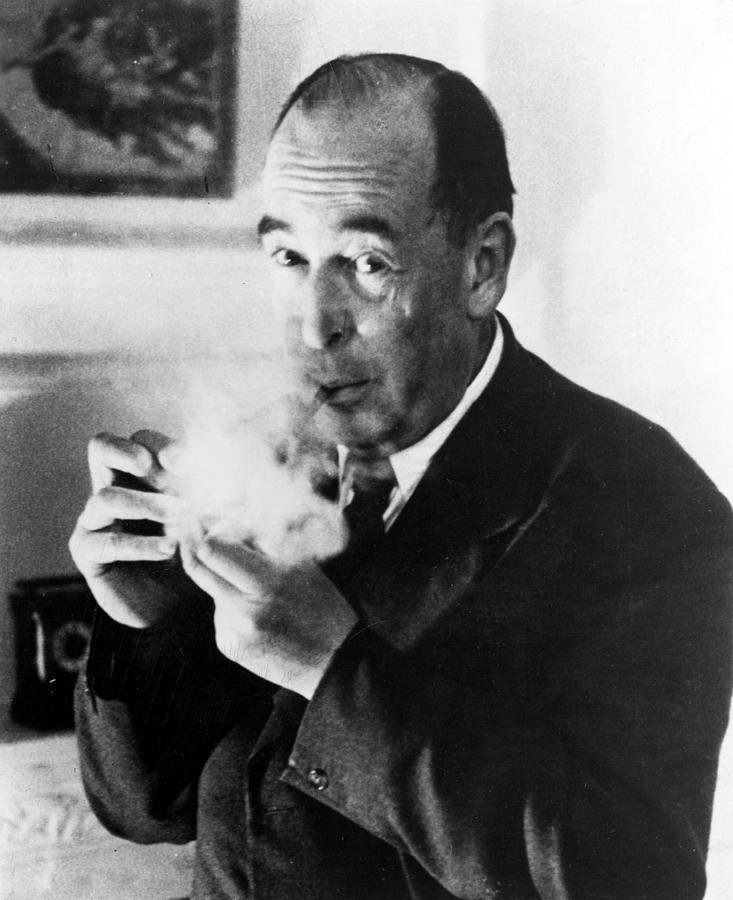
CS Lewis (1898-1963)

At her Substack Further Up, Bethel McGrew has an excellent reflection on her own lifelong connection to Lewis and the way the endless quoting of his work risks simplifying him into a generator of therapeutic fortune cookie messages:

Lewis is much-quoted, for good reason: He is prolifically quotable. (There are also a few famously misattributed quotes, like “You are a soul, you have a body,” which no doubt would have annoyed him greatly.) And yet, there’s a paradoxical sense in which his quotability almost risks watering down his true value as a thinker. There’s a temptation to see Lewis as a one-stop “Christian answer man,” the super-Christian who always had the perfect eloquent solution to every Christian’s hard problems. To be sure, he came closer than most Christian writers to providing a sense-making framework for hard problems. But even he wouldn’t claim to have “solved” them. Indeed, his very strength as a writer was that his work swung free of top-down systematic theologies which claim to provide comprehensively satisfying theological answers.

She continues with a particularly poignant example from A Grief Observed. I recommend the whole post.

At Miller’s Book Review, another outstanding Substack, Joel Miller considers Lewis’s humor in the years just before his death, when failing health should have robbed him of his joy:

Sayer says that Lewis “never lost his sense of humor.” Indeed, he was famously good natured, even amid dire circumstances. On July 15, 1963, he suffered a heart attack and slipped into a coma. Friends feared the worst; some came and prayed; a priest gave the sacrament of extreme unction. Amazingly, an hour after the sacrament, Lewis awoke, revived, and asked for a cup of tea.

True to form, he found a joke in it. “I was unexpectedly revived from a long coma,” he wrote Sister Penelope, an Anglican nun with whom he frequently corresponded. “Ought one honor Lazarus rather than Stephen as the protomartyr? To be brought back and have all one’s dying to do again was rather hard.”

Miller also reflects on his own experience of reading and rereading Lewis. Like Miller, I came to Narnia late, well after many of Lewis’s other books, and I have also read and reread Lewis’s work many times. As Miller notes, though Lewis did not expect his work to be remembered, it’s a safe bet that readers like him and myself will continue to find and appreciate Lewis’s work.

At World magazine, Samuel D James has a good short essay on Lewis as a prophet:

Precisely because Lewis knew that the claims of Christianity were all-encompassing, he recognized that no civilization that abandoned it could function. This was not because Lewis desired some kind of baptized Anglo-Saxon ethnonationalist state (born in Belfast, Lewis never forgot the high cost of religious intolerance), but because modern man’s alternatives were quite literally inhumane. Lewis saw from afar, with striking prescience, that humans had no choice but to retreat from personhood if they wanted to escape the implications of Christian revelation.

At The Critic, Rhys Laverty elaborates more deeply on the same theme:

At the close of the Second World War, Lewis was one of a number of Christian intellectuals (alongside Jacques Maritain, Simone Weil, W.H. Auden, and T.S. Eliot) who had begun to consider what world the Allied powers would now make for themselves. Lewis saw a future in which the rejection of transcendent values would allow a technologised elite to re-make nature as they saw fit, ultimately overthrowing human nature itself — a process made possible through the ideological capture of education.

Laverty invokes not only The Abolition of Man, as James does, but Lewis’s dramatization of those ideas in the final novel of The Space Trilogy, That Hideous Strength, in which the elite of the National Institute of Coordinated Experiments (NICE) pursue genuinely diabolical technological progress and control:

With N.I.C.E, Lewis anticipated our contemporary technocracy. “Progress” is our unquestionable sacred cow, and its faithful handmaiden is technology. Whether we are tearing up areas of ancient natural beauty in order to build infrastructure supposedly intended to help protect the environment, prescribing new cross-sex hormones and surgery to enable greater self-realisation, or developing artificial wombs which we unconvincingly insist will only ever be used for the care of premature infants, there is now no technological innovation that we will deny ourselves today if it supposedly contributes to the nebulous “future good of humanity”.

It is only Green Book education which makes N.I.C.E possible. If truth, goodness, beauty, and so on are merely relative then there is nothing to rein in man’s “conquest of nature”. His scruples are mere hang-ups to be educated out. He will be driven by pure reason or pure appetite, with no sentiment to regulate their respective metrics of efficiency or pleasure. 

I commend all four of these essays to y’all. They’re good celebrations of a worthy life and a worthy mind, and have gotten me wanting to reread pretty much all of my Lewis shelf. Which might take a while.

Let me conclude with a brief personal reflection of my own. Growing up in the environment I did, I don’t remember ever not knowing about Lewis. He was a byword for intelligent Christian thought, something that stood out to me among the generally anti-intellectual atmosphere of fundamentalism. My earliest accidental exposure was probably the BBC Narnia films. I recall catching a long stretch of The Silver Chair on PBS at my grandparents’ house one morning. As dated as those adaptations are now, it scared me. But it also riveted me, and stayed with me. Indeed, The Silver Chair may still be my favorite of the Narnia books.

But it was a long time before I actually read anything by CS Lewis. My parents got me a set of his non-fiction books at our church bookstore when I was in high school. I started The Great Divorce one night and something about the Grey Town and the bus ride into the unknown disturbed me so much that I put it away. That nightmare quality again. But when I tried the book one sleepy Sunday afternoon in college—my way prepared by Dante, whom I discovered my senior year of high school—I read the entire thing in one sitting. It’s still among my favorite Lewis books.

From there it was on to The Screwtape Letters and Mere Christianity and The Four Loves. I read The Lion, the Witch, and the Wardrobe and liked it but returned to the non-fiction, devouring Lewis’s essays on any topic. After college I read The Space Trilogy—all three in one week, if I remember correctly—and delved into his scholarly work: An Experiment in Criticism and, crucially, The Discarded Image. I also read as much about Lewis as I read by him, and dug into the works that Lewis loved only to discover new loves of my own, most notably GK Chesterton.

Only with the birth of my children did I seriously return to Narnia, and now I genuinely love them. My kids do, too. They’ll be yet another generation entertained and blessed by Lewis’s work.

He is one of the few authors who has grown with me for so long—guiding me, enlightening me, introducing me to great literature, telling me entertaining and meaningful stories of his own, and deepening both my understanding and my faith. Where the fictional Lewis of The Great Divorce meets George MacDonald as his heavenly guide, the Virgil to his Dante, Lewis could well play that role for me.

On this, his 125th birthday, just over a week from the 60th anniversary of his death, I am more grateful than ever for CS Lewis. RIP.

JRR Tolkien, 50 years later

Yesterday was the 50th anniversary of the death of JRR Tolkien, an occasion for reflection and appreciation. A few impromptu thoughts on Tolkien’s work and what it—and Tolkien himself—have meant to me over the years:

Part of Tolkien’s legacy for me is purely philosophical. Writing at The Critic yesterday, Sebastian Milbank considers the unlikely success of Tolkien’s storytelling in a literary environment under the Sauron-like dominion of irony, cynicism, amorality, and the tortured solipsism of post-Freudian psychology. Milbank:

More than anything else Lord of the Rings communicates a sensibility utterly at odds with the spirit of the age in which it was written. It is one of profound, tragic loss, of the vulnerability of irretrievable, ancient beauty, that must desperately be conserved and defended. It is of the inherent heroism of standing against destructive change, of hope beyond all reason, amidst the logic of history, which Tolkien named “the long defeat”.

Further, there is no “authorial wink,” no signaling or messaging for fellow bien pensants of the kind typical of elitist, politically motivated modernist art. In its morality (not moralism), earnestness, and total commitment to the act of storytelling and the sub-creation of imaginary worlds, Tolkien’s legendarium has become perhaps the anti-modernist myth par excellence, and not by taking any conscious stance but simply by being utterly and sincerely itself.

And yet this philosophical and religious understanding of the drama of Tolkien’s stories came to me later, after long thought and even longer thoughtless basking in his world and words. And I do mean words quite literally.

During college I moved from The Hobbit and The Lord of the Rings to some of Tolkien’s essays. This proved a fortuitous time to do so. I read “Beowulf: The Monsters and the Critics” at about the same time I was taking British History I and British Literature I, a one-two punch of subjects that have become lifelong passions. Reading and rereading Beowulf, and learning about the Anglo-Saxons, and rereading The Lord of the Rings, and then giving intense nuts-and-bolts attention to language, style, tone, and technique in my Creative Writing minor classes, aided by the insights and example of John Gardner, revealed much that was at work beneath the surface of Tolkien’s stories. For the first time I perceived the purposeful deliberation behind his choice of words and the structure of his sentences and poems, and the careful use of allusion to expand the world in which a small story takes place.

This was heady stuff and, emboldened with the enthusiasm of discovery and youthful experiment, I plunged into my Novel Writing class in my final semester of college armed with new and exciting tools. The eventual result was No Snakes in Iceland. It may be that I belong to that class of “mediocre imitators,” as Milbank calls them in his piece, but my first published novel would not have come to be without Tolkien’s example.

And Tolkien’s example extends beyond the literary. Milbank does not delve far into Tolkien the man in his essay, but Tolkien’s actual life story stands as just as strong a rebuke to modernism as his novels. A child of hardship, orphaned at an early age, raised in a teeming industrial city, a soldier in some of the worst combat in history, here is a man who lived through all the blights that should have embittered and driven him to misery and indulgence nevertheless living quietly and faithfully with his wife and children and working just as happily in his professional field as on his private hobbies. He is not the tortured, arrogant literary scribbler of modern myth and his protagonists are neither whiners nor degenerates. Geniuses don’t have to be jerks. A man of faith, duty, family, close friendship, rigorous and honest scholarship, and devotion to the small and parochial and workaday, Tolkien was in every way a candidate for a saintly “hidden life.” And yet everyone knows who he was.

This is perhaps the starkest irony of Tolkien’s life: that a man so contented with his lot and so unambitious (in the way of the worlds of commerce, politics, or celebrity) should become the author of the twentieth century. The more I have studied his life the more I admire him and wish for the grace to emulate him.

All of these things matter to me—the philosophy, the aesthetic, the man himself—but at the root of Tolkien’s meaning for me lie the stories. As it should be.

I can actually date my love for Tolkien. I read The Hobbit in high school at a friend’s urgent insistence (thanks, Josh!) and—again, fortuitously—my county’s brand-new Walmart had the book in stock. On July 10, 2000, I was reading it while my family sat in Atlanta traffic on our way to Turner Field for the home run derby. I had reached a chapter called “Riddles in the Dark.” We drove through a tunnel, one of those places where the interstate runs under a major street like Jimmy Carter Boulevard, and I was hooked. I had enjoyed The Hobbit up to this point but now I loved it, and knew I would read the rest and move straight on to The Lord of the Rings as soon as I could. I’ve never looked back and that love and excitement has never flagged or diminished.

That’s the power of a good story told by a great artist. In Chesterton’s words, Tolkien became for me the “center” of a “flaming imagination.” That imagination has remained aflame for twenty-three years because Tolkien not only told a good story, which plenty of people can do, but because his work is rich and deep and loving and, most of all, true enough to return to again and again for more. No burglar can diminish this hoard by even a cup.

I’ve used the word “fortuitous” twice in this reflection despite knowing that Tolkien would not himself think of it that way. Rightly so. Tolkien believed in Providence and it is largely through his example that I can grasp and trust in that idea. So when I do think of those coincidences, the circumstances and strong confluences and old friendships that kindled and kept my love for Tolkien burning, I hear Gandalf’s closing admonition to Bilbo: “You don’t really suppose, do you, that all your adventures and escapes were managed by mere luck, just for your sole benefit?”

No, I don’t. Thank goodness.

JRR Tolkien, artist, scholar, elf-friend, and faithful servant of God, from whom all creativity descends, RIP.

More if you’re interested

Milbank’s essay at The Critic is excellent—one of the best recent pieces on Tolkien that I’ve read. Check out the whole thing here. For more on the religious and philosophical underpinnings of Tolkien’s world, all worked out organically through his storytelling rather than imposed as a moral, read Peter Kreeft’s The Philosophy of Tolkien. I’ve written about Tolkien here many times before—just click the Tolkien tag below for more—but in the early days of this blog I reviewed a delightful and beautifully illustrated children’s book called John Ronald’s Dragons that I want to recommend here again.

Cormac McCarthy, RIP

Tommy Lee Jones as Sheriff Bell in No Country for Old Men. No one else has captured McCarthy’s blend of the old and modern like the Coen brothers.

I was genuinely grieved to learn of the death of Cormac McCarthy yesterday afternoon. No other writer has accomplished something quite like his body of work, and no other writer’s work has meant quite what his has meant to me.

I discovered him in the summer between my last two years of college. I have a standing rule that I will check out any unfamiliar book or author I hear about more than twice within a certain short amount of time. With McCarthy, I ran across references to his novel Blood Meridian in three places within the same week. I picked it up at the Barnes & Noble in town and that was that.

Blood Meridian is McCarthy’s magnum opus. It is also the worst place to start with his work. It is rich, dense, sprawling, arcane, operatic, a deliberate fusion of old fashioned curlicued prose and modern muscularity and bluntness. The chapters have strange headings summarizing the content and McCarthy does not use quotation marks. And of course there is the much-remarked upon brutality. But because of the allusions that had convinced me to pick Blood Meridian up, that was the one thing I was prepared for. 

I was flummoxed. I knew something great was going on but I struggled to wrap my mind around it. I thought the lack of quotation marks was a risible affectation. And I only barely followed the story. I think I gave it three stars on Amazon.

But it stayed with me. I kept thinking about it. And I bought more of McCarthy’s novels. 

I read through everything except Suttree by the time I graduated, and I reread several of them over the coming years. At last, I reread Blood Meridian last year, and while I want to say that I found it a completely different book, it was I who had changed. Age and maturity and years and years of reading McCarthy and reflecting back on Blood Meridian through his other work and—to throw it into relief—the work of less skilled imitators had prepared me for the novel. I had grown into it. It amazed me all over again.

Blood Meridian was the beginning of a long challenge to my way of writing. It was a bold early demonstration to me of the power of the precisely-chosen verb, of how to use a wide-ranging but carefully controlled vocabulary to create texture (or music, if you prefer), of the necessity of deep research presented as an organic part of the story, seamlessly and without ostentation. 

And the lack of quotation marks that annoyed me so much at first caused me to reconsider even more. McCarthy, I realized, had set himself an artistic limitation by refusing punctuation conveniences. He did not use quotation marks—or semicolons or, unless absolutely necessary, commas—the same way a sonnet writer does not use a fifteenth line. It was a self-imposed boundary that strengthened and liberated his style. It meant, as McCarthy has said himself, that there was less to get in the way. It allows the language to tell the story. Pure words.

From this I learned to avoid leaning on typography to communicate meaning. And so while I have not gone nearly as far as McCarthy in this regard, in my fiction I don't italicize words for emphasis or to establish the rhythm of a person's speech or use elaborate punctuation or typesetting. In a scenario like that of his penultimate novel, The Road—which as a student of the early medieval period I don’t have a hard time imagining—how much of your typographical shenanigans will survive transmission? McCarthy wrote to last. I hope to, too.

So much for style. What Blood Meridian and McCarthy’s work also taught me was to confront the harshness and evil of reality head on. Because of the violence and darkness of his work—most especially Blood Meridian, with its scalphunters and Comanches and hangings and the inscrutable, unstoppable Satanic figure of the Judge—people call him a nihilist. He wasn’t. What McCarthy had was a deeply moral sense of the utter fallenness of the world and an unwillingness to look away.

There is a time and place for the opposite approach, but we need our McCarthys, too, in all their bleakness. Witness this passage from a 1992 interview that I’ve seen circulating since yesterday:

There’s no such thing as life without bloodshed. I think the notion that the species can be improved in some way, that everyone could live in harmony, is a really dangerous idea. Those who are afflicted with this notion are the first ones to give up their souls, their freedom. Your desire that it be that way will enslave you and make your life vacuous.

Uplifting? No. But it’s true. All the charge of nihilism means is “McCarthy did not reassure me.” Good. Those “afflicted with this notion,” which is most of us nowadays, need to be unsettled. McCarthy, a master of this kind of prophetic unsettling, showed us how.

Cormac McCarthy, novelist, prophet, and personal hero, RIP.

Tell them...

I think about mortality a lot—possibly too much. This is the elegiac streak that has caused everything from the Iliad and Beowulf to True Grit and The Inheritors to resonate so strongly with me. And one particular aspect of death that I often reflect on is last words, whether famous or not.

Wikipedia has a marvelous collection of last words—hundreds and hundreds of examples. As with all things Wikipedia, especially bulk lists of information, you should certainly check the source of each quotation before you plow ahead with it, but simply reading through them one after another is a powerful opportunity for reflection.

Death catches people at unpredictable times, and a person’s last words have a way of freezing each speaker’s final moment in all its particularity and, often, peculiarity. Tellingly, Wikipedia’s list includes a subheading for “Ironic last words” like the example par excellence of General John Sedgwick. Warned of Confederate sharpshooters during the fighting at Spotsylvania Courthouse, he said, “They couldn’t hit an elephant at this distance.” He was shot in the head moments later.

But I’m particularly interested in the last words of people who knew what was coming, that their time was short. What is that like? I often wonder. The knowledge of their approaching death seems to have sharpened their speech. It is poignant in an almost literal sense. These words fall into several varieties.

A certain kind of poncey literary type seems to go out with a sniffy quip. Thus Lytton Strachey, author of the dishonest and low-minded Eminent Victorians: “If this is dying, I don’t think much of it.” Or, in perhaps the most famous example, the last words of Oscar Wilde. Others offer proto-Oprah pablum, as in the case of William James: “These then are my last words to you. Be not afraid of life. Believe that life is worth living and your belief will help create the fact.”

Pure treacle. There are others who greet death with defiance, especially among those who were executed, like Breaker Morant (“Shoot straight, you bastards. Don’t make a mess of it.”), or who plead for mercy, or who scorn their killers.

But two other kinds of last words strike me especially deeply. The first are those who, in their final moments, were more concerned for others than themselves. Among these are New Zealand mountaineer Rob Hall, on the phone with his pregnant wife as he froze to death on Mount Everest: “I love you. Sleep well my sweetheart. Please don’t worry too much.” Or Abigail Adams, to her distraught husband: “Do not grieve, my friend, my dearest friend. I am ready to go. And John, it will not be long.” There are many more examples among soldiers killed in battle like Marine Captain Lloyd Williams, who is most famous for coining the phrase “Retreat, hell!” but, upon being gassed at Belleau Wood, told a corpsman, “Don’t bother with me. Take care of my good men.”

These lay dying and tried to tell those around them it would be all right or to look after someone else. I can only pray to have the courage and clarity and simple goodness to emulate them when my time comes.

The other kind, which often overlaps with the above, are those who use their final moments to send messages—asking someone to tell others something for them. I started paying close attention to this when I noticed a lot of such last words among men killed in the Civil War.

Some of these can seem petty, or at least spiteful. When Union officer George Dashell Bayard succumbed to a mortal wound from a ricocheting cannonball at Fredericksburg in December 1862, he took his final moments to say this: “Tell McClellan that my last regret as a military man is that I did not die serving under him.” That’s General George McClellan, former commander of the Army of the Potomac, whom Lincoln had replaced with General Ambrose Burnside a few months prior. Bayard’s last words were a dig at Burnside. You did this to me. I don’t know what to make of that.

Confederates seem especially concerned with sending a final message. At Gettysburg, Mississippian General William Barksdale was severely wounded leading in an attack on the second day. I’ve seen a few slightly different versions of his final words, but here they are as reported in Allen Guelzo’s Gettysburg: The Last Invasion: “Tell my wife I fought like a man and will die like one.”

Even John Wilkes Booth, a noncombatant, felt something of the same instinct. While his two final words, “Useless, useless,” spoken as he stared at his paralyzed hands, are well-remembered, just before this he told a nearby soldier, “Tell Mother I died for my country.” What might have been moving in a uniformed man on the battlefield feels laughably self-serving in this context—the classic egotism of the assassin. Maybe that’s why the clearer, sharper final words are more famous. They’re more honest.

Perhaps the two most famous Confederate generals, both in delirium on their deathbeds in 1863 and 1870, asked others to tell someone something. Stonewall Jackson, dying of pneumonia, was issuing orders. Just before saying his famous last words, he trailed off with, “Order AP Hill to prepare for action! Pass the infantry to the front rapidly. Tell Major Hawks…” And General Lee, seven years later, half a decade after the war, also had AP Hill on his mind just before his most famous final words: “Tell Hill he must come up!”

Colonel Isaac Avery’s dying note

But the two that really get me are lesser-known, ordinary men—a junior officer and a common soldier. Another fatality at Gettysburg, Colonel Isaac Avery of North Carolina, was struck in the neck on July 3 and apparently bled to death. Before he died, he scribbled the following note lefthanded: “Major, Tell my father I died with my face to the enemy.” The note is in the North Carolina state archives.

And then there’s Richard Rowland Kirkland of South Carolina, still remembered as “the Angel of Marye’s Heights.” At Fredericksburg, Sergeant Rowland had voluntarily gathered canteens and taken them over the wall into no-man’s-land to give water to the wounded and dying Yankees scattered all over the open fields below the heights. Less than a year later, at Chickamauga in north Georgia, the situation was reversed, and the recently promoted Lieutenant Rowland was shot leading an attack uphill against dug-in Union infantry. Before he died, he told his men to save themselves and concluded with one request: “Tell my father I died right.”

You feel the weight and meaning of these words instinctively, on the gut level, and yet it is hard to articulate what makes them so powerful.

There are the factors one can describe sociologically—honor, courage, chivalrous masculinity, and all the other things modern scholars write so scornfully about but that meant so much to that generation. There are also what we rather weakly call “human factors”: Thinking of family in one’s final moments, the parallel concern to give them some consolation that their death was a good death, that their memory—all that will be left of them—can be cherished unsullied.

But I think the crucial factor is distance. These men realize they are dying and think of family, and I imagine they have never felt farther away. It’s the particularity of their deaths—the when and where—frozen in their words. Tell them… may be the most terrible and beautiful and revealing phrase in the war.