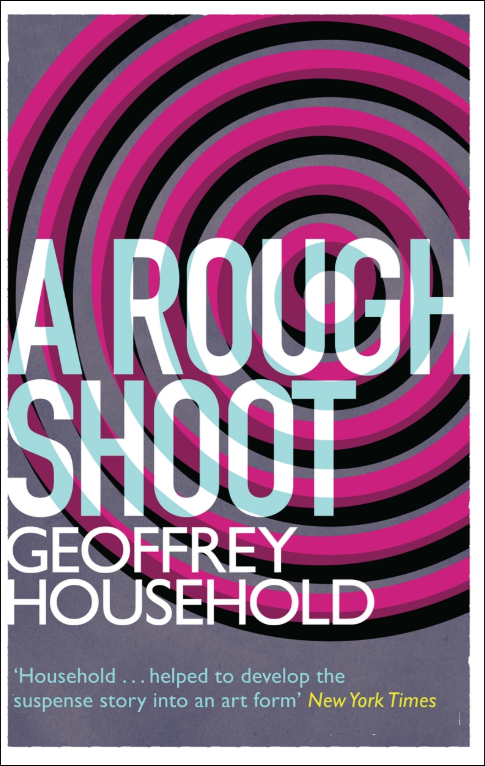
A Rough Shoot
/Geoffrey Household knew how to open a thriller. His most famous book, Rogue Male, published in 1939 and which I read just over three years ago, begins with its unnamed protagonist in the hands of an unnamed central European dictatorship’s unnamed secret police, who have tortured him nearly to death and are about to dispose of him using a convenient cliff. Believe it or not, the situation escalates from there.
A Rough Shoot, published in 1951, continues this tradition. Roger Taine, a former British Army infantry colonel and now a salesman and family man, is walking the patch of Dorset farmland to which he’s purchased the hunting rights when he spots two men in the bushes. The sun is going down and he can’t see clearly what they’re doing, but they seem to be rigging up traps and he assumes them to be poachers. When one of them, backing through the hedge on hands and knees, presents his backside as a target, Taine decides to give the poachers a painful scare. He levels his shotgun and gives the man a load of birdshot.
The man collapses and his companion flees. Taine realizes that something has gone wrong. He approaches the man he shot where he lies unmoving on the ground and rolls him over. The men had been putting down big triangular stakes for some kind of device and, when Taine shot him, the man had fallen chest-first onto one of them.
None of this is a spoiler—it all happens in the first three pages. The rest of the novel is Taine’s attempt to deal with the consequences and discover who the two men were and what they were doing.
A Rough Shoot, like Rogue Male, has the Buchanesque qualities of vividly realized landscapes and the continuous chase. Taine’s predicament evolves as newer and greater dangers present themselves, keeping the ongoing action fresh and exciting. From Taine’s attempt to conceal the body and his realization that more and more suspicious men are poking around his shoot, asking questions of the tenant farmer and landowner and wanting to find out more about him, to his meeting with an former Polish commando whose story of exile, unofficial espionage, and a rising neo-fascism coordinating itself across Western Europe, A Rough Shoot escalates continuously in tension and stakes. What begins as a personal crisis for Taine—he is guilty, by his estimation, of manslaughter at least—turns into a tiny local battle in the ruins and upset of the postwar.
I can’t say much more without revealing too many specifics, but Taine’s business, wife, and children are inevitably drawn into a plot begun by Taine’s one impetuous, high-spirited act, and the first half’s smothering tension of concealment, silence, and stalking—the suspense of hunting—gives way in the final third to the chase: the prey flushed, the hunters pursuing.
I reflected a couple years ago on what it must have been like, in the 1940s and 50s, to visit the bookstalls and see a steady stream of novels like this—unpretentious gems of pure craft and enjoyment—flowing from publishers. Reading A Rough Shoot, a slender novel with no chapter divisions, just steadily building story, I could imagine myself traveling by train and needing a good page turner. A Rough Shoot would have fit the bill back then and, thanks to the strength of its simple but tense and Household’s exquisite craft, it still does. It’s inventive and exhilarating and was one of the joys of our recent time snowed in. This is only the second Household thriller I’ve read, but there will be more.