Weimar notes
/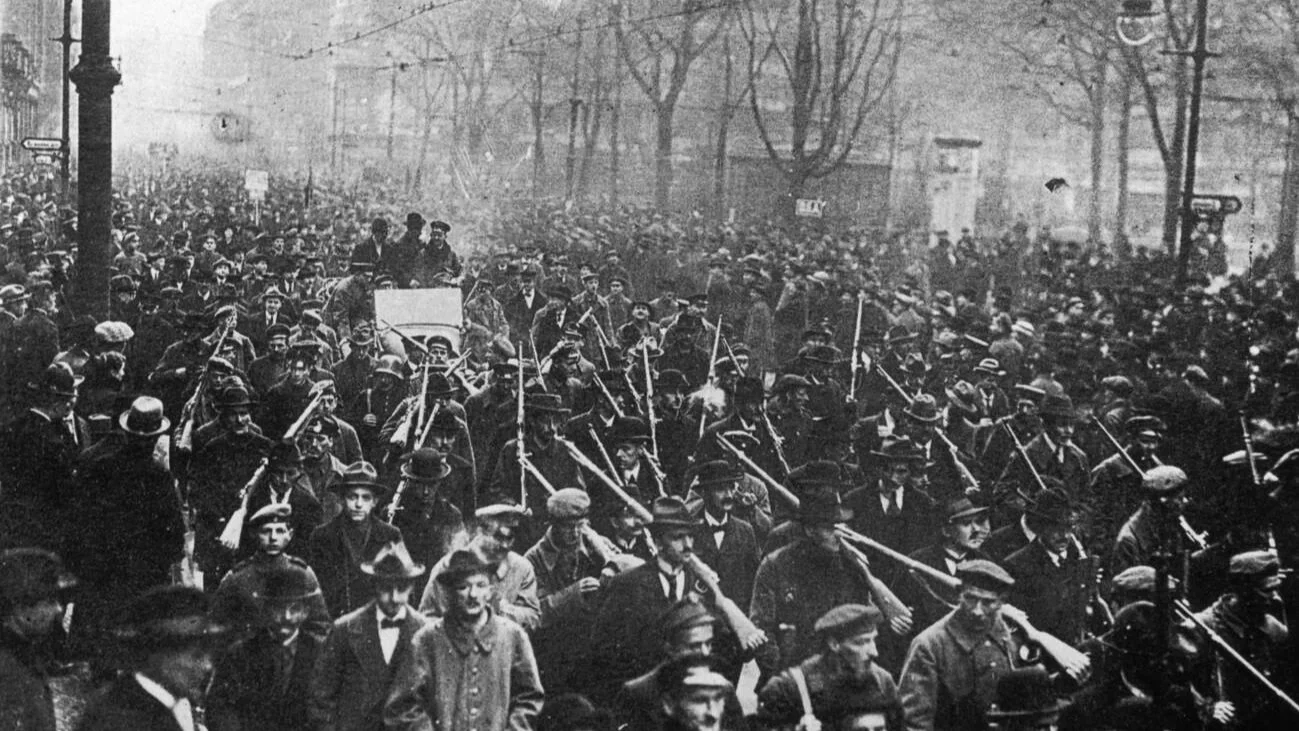
Militants of the Communist Spartacist Uprising in Berlin, January 1919
When I finished Frank McDonough’s book The Weimar Years last month I had hoped to write a full review, but time, sickness, and a host of other complications meant I had to be content with a long paragraph in my non-fiction reading year-in-review. Unfortunately, the single-paragraph summation I hold myself to for those posts meant I could only raise a few issues that I had a lot of thoughts about, gesture toward them, and move on.
Here are two—both more or less about terminology or rhetoric—that I’ve been mulling anew under the influence of McDonough’s book and a few unrelated factors.
Right and left
After finishing The Weimar Years and celebrating Christmas, I caught up on some club episode of The Rest is History. The one I was most excited for was a live show Holland and Sandbrook presented at Royal Albert Hall last spring. The subject: Wagner.
Holland and Sandbrook begin their discussion by asking the audience to reconsider what they think they know about Wagner—a smart move. But this problem of terminology popped up immediately. You have heard it said, they essentially say, that Wagner is a right-wing figure, but I say unto you… he’s more of a left-winger. In their actual words, “a hippie.” But Wagner had “some right-wing opinions,” namely anti-Semitism. So: a leftie who is right-wing à la carte?
There’s an argument to be made for Wagner’s place on the left, given his role in the 1848 revolutions and his support for the overthrow of the Saxon monarchy as well as his generally bohemian lifestyle. But what precisely makes his anti-Semitism right-wing? And, from a certain kind of chest-thumping American view, supporting the overthrow of monarchies and seeking to create an all-encompassing national artform out of national myth could be spun as right-wing.
This was a great episode—and I especially appreciated Holland’s argument that Wagner’s music is not in itself anti-Semitic—but that left-right business neatly encapsulated much of my problem with this political frame.
Back to McDonough’s book. McDonough uses the language of left and right throughout but also, importantly, makes it clear what each of the dozen or so major German political parties of the 1920s wanted and stood for. Focusing on 1) goals, 2) methods, and 3) how these changed depending on circumstances explains much more, especially when it comes to the elephant in the room: the National Socialists—and yes, the Socialist part absolutely matters—who were themselves starkly divided along several political axes throughout the Weimar period. This is also considerably more helpful than a simple left-right spectrum when one reads of instances in which supposed opposites like the Nazis and the German Communist Party collaborated against the national government.
The terminology of right and left is rooted in a specific historical moment and the specific problems parties in that place and time argued and fought over. Unmoored from those specifics, I find it unserious. It’s a time-honored way to argue about vibes. I avoid it as much as possible when I teach modern history, invoking it only to give the point of view of people within the narrative I’m telling but not as neutral description.
“Democracy” vs this democracy
I didn’t get into the left-right thing in my paragraph on The Weimar Years but I did raise this question. Here’s what I wrote there:
But the epilogue, in which McDonough specifically blames Paul von Hindenburg for the death of “Weimar democracy,” is a bit of a fumble, as it is abundantly clear from McDonough’s own narrative—and even the earlier parts of the epilogue—that the Weimar Constitution had built-in weaknesses that were bound to weaken and undermine it. McDonough essentially faults Hindenburg for not believing in democracy hard enough. But if “democracy” in the abstract gave Germany this democracy in concrete, stubborn reality, it deserved to go.
Since finishing McDonough’s book I’ve browsed two new histories of Weimar from German historians: Vertigo: The Rise and Fall of Weimar Germany, by Harald Jähner and Fateful Hours: The Collapse of the Weimar Republic, by Volker Ullrich. (In the course of writing this I’ve also learned of a history of Weimar by Katja Hoyer, due out this summer.)
All of these (minus Hoyer’s book, for obvious reasons) do a bit of two-step around the concept of democracy: when the authors write about “democracy,” they sometimes mean the specific constitutional arrangements of the Weimar Republic—who voted, how, under what circumstances, how the Reichstag was constituted, who became chancellor and what authority they had, etc—and sometimes the concept of Democracy, in the abstract. The defeat and destruction of Weimar democracy is a tragedy for them because it means a defeat of Democracy.
But to paraphrase Burke, abstract democracy is not to be found; it inheres in sensible objects. It is useless to talk about Democracy without talking about the specifics of a given democracy, and a given democracy is only as valuable as its institutions and—one ought to add—the people who are using it. And as I wrote above, Weimar democracy was flawed from its inception because of the specifics of how it was designed and functioned and what options it made possible. Unstable, ineffective, hamstrung both by the outcome of a war it wasn’t responsible for and diplomatic agreements to which it consented, and—in the hands of feckless and corrupt politicians of all parties including the supposedly egalitarian socialists—unable to represent the people, it was a failure as a democracy long before Hitler seized power.
As I finished reading McDonough’s account and looked through those two other books—one more obviously leftist-oriented but both moaning and lamenting for Democracy throughout—I had a strange realization. The effect of switching from the collapse of actual Weimar democracy to a lament or apologia for Democracy in the abstract is suspiciously similar to “Real socialism has never been tried.” Democracy attracts the same mulish defensiveness as socialism. Both are the object of unwarranted faith. Neither can be blamed when they fail.
A confession
I started The Weimar Years shortly after the Charlie Kirk murder. Political violence openly celebrated by one side of the culture seemed like a good reason to familiarize myself with the broader narrative of Weimar.
That was a mistake, as looking for a useable, “relevant” past almost always is. Unfortunately historians of Weimar are just as prone to it. In both Jähner’s and Ullrich’s books I did a quick search for “Trump, Donald” in the index and guess what I found? Dumb parallels to the present, mentions of a specific political bugbear that will date their books as badly as a book I have on Mussolini that keeps bringing up George W Bush.
But McDonough doesn’t make this mistake, which is one of the great values of The Weimar Years. Throughout he emphasizes contingency and particularity: that things could have turned out other than how they did, something he makes clear through his detailed political narrative, and that Weimar Germany was a unique time and place offering no easy comparisons to our own. Pretending that Weimar tells us something or gives us insight into our enemies because there was political violence and politicians said mean things about their opponents is glib and misleading—for both the past and the present. The specifics matter.
So I confess to beginning McDonough’s book for the wrong reasons, but am glad I read it and for the sensibility of his approach, which brought me back to my senses. The closer I looked at Weimar, the less I saw of us, now. Which is as it should be. Not that we can’t learn anything from it, but we won’t until we understand it on its own terms.
More to come
I’m still trying to strengthen my grasp of Weimar. Of the two other books I’ve looked at, I may read Ullrich’s on the basis of his two-volume Hitler biography. He intones the ritual laments for Democracy in the portions I’ve read but his treatment of some of the specific topics and people I looked up struck me as more balanced than Jähner’s, which celebrates the hedonism and decay of the time. I may end up holding out for Hoyer this summer, as her book on the German Empire, Blood and Iron, was exceptionally good.