The Odyssey trailer reaction

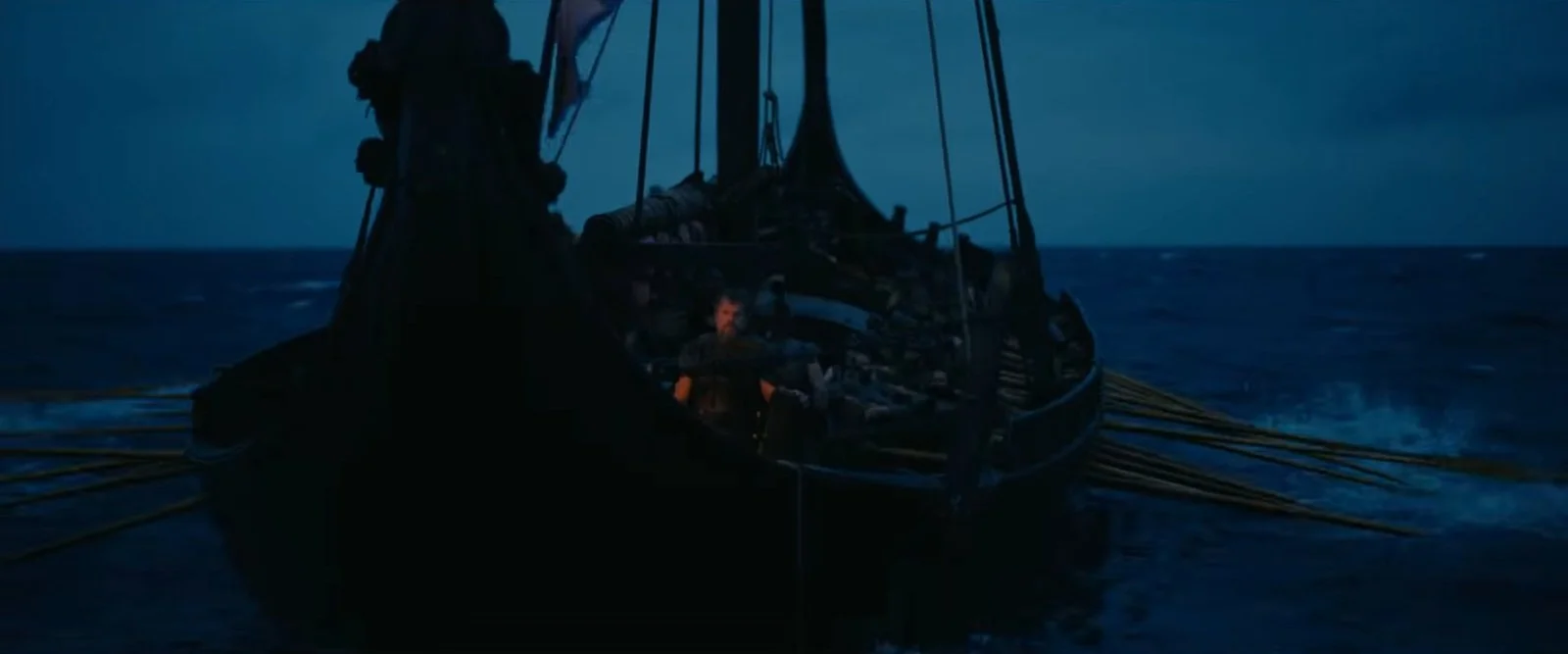
Matt Damon as Odysseus in the teaser trailer for The Odyssey (2026)

To say that Christopher Nolan’s treatment of Homer is highly anticipated would be an understatement. By the time I discovered the first teaser for The Odyssey this evening while doing some last-minute Christmas shopping for my kids, the official trailer on the Universal YouTube channel had been up twelve hours and already had 9.8 million views. (Addendum: In the time it’s taken me to dash off these thoughts and observations, the trailer has cleared ten million views.)

So, in a very real sense, what I think doesn’t matter. Here are my thoughts anyway.

I’ve mentioned recently that, while I like Nolan generally and love a couple of his movies, I think his success and the leeway studios have given him since he wrapped up his Batman trilogy have led him further and further into self-indulgence. This peaked with Tenet, which was entertaining because Nolan is a spectacular showman and completely incomprehensible because, with its involuted story, he leaned hard into all of his own worst instincts. Part of what kept it from being a pure disaster was that its slick near-future world was fitting for his style: Inception and Interstellar both fit the bill, as does the futuristic Wayne Enterprises tech of his Batman movies, especially The Dark Knight Rises.

But imagine that recognizable Nolan aesthetic—matte black tactical gear, brushed steel and brutalist concrete, affectless acting, and obsessive rejection of linear time—transferred to… the Bronze Age.

I follow a number of gifted historical and archaeological artists on social media and the scuttlebutt is that Nolan’s crew reached out to some experts in Mycenaean material culture and then ghosted them. It shows. Homer’s world was a world of elaborate courtesy and protocol, gold, jewels, and precious metals, and suits of burnished bronze armor that thundered when their warriors leapt from their chariots to do battle. Matt Damon’s crew from Ithaca look like someone asked an LLM to blend 1950s sword-and-sandal Romans with a SWAT team.

That’s harsh, I guess. I’m not particularly hopeful. As much as I like Nolan, he has to be one of the filmmakers least suited to this kind of story. (Let me second what some of those historical artists have wished for: a Homer adaptation from Robert Eggers.) If I hope anything, I hope I’m wrong.

With (most of) the negativity out of the way, here are a few things that impressed me in this teaser:

  • The IMAX cinematography looks atmospheric as Hades, so to speak. Hoyte van Hoytema is working with Nolan again and a number of the brief glimpses we get of major episodes from the Odyssey look good in strict filmmaking terms.

  • Anne Hathaway as Penelope looks pretty woebegone in her brief appearance. I like Hathaway but wonder if she has the requisite cunning for the woman who was so perfectly matched to Odysseus. (My ideal casting: Rebecca Ferguson, who combines regal beauty with obvious, potentially terrifying intelligence.)

  • I like the shots in Polyphemus’s cave, but am puzzled that we actually get a brief glimpse of a giant, shadowy form entering behind Odysseus’s men. Word was that Nolan’s Odyssey would be demythologized to some degree. Perhaps not? Or will the adventure scenes be Odysseus’s exaggerated retelling? If Nolan indulges in his nonlinear storytelling it will surely be when Odysseus is rescued and hosted by the Phaiakians and tells them his story—a portion of the poem that, to be fair, lends itself to Nolan’s thing.

  • We get a glimpse of Benny Safdie as Agamemnon near the beginning. Ridiculous Greek fantasy armor. Perhaps an artifact of Odysseus telling an embellished version of his story?

  • We don’t see him in the trailer, but Jon Bernthal is listed as playing Menelaus. I’d like to have seen him—or someone like him—in the lead. Bernthal looks tough and has unbelievable charisma. Somehow he keeps getting slotted into second-fiddle roles behind flat, awkward leads (e.g. “The Pacific,” in which he by all rights should have played John Basilone, and “The Walking Dead”). Robert Pattinson is also slated to play Antinous, one of Penelope’s suitors, which should give him plenty of opportunities to steal the scene.

  • Back to the trailer. We get brief glimpses of the Trojan Horse. No idea what the Achaians are doing hoisting it out of the sea, but the shots of the warriors crammed inside look great.

  • Near the end we get some eerie shots of what appear to be Odysseus’s journey to the underworld. Not at all what I imagine when reading the story, but exceptionally atmospheric and spooky. Rightly so. Curious to know if we’ll see a bored, disillusioned Achilles.

  • Devotees of ancient Greek shipbuilding are upset about behind-the-scenes images of the ships here. I know just enough to identify them as clinker-built, which is right for the Anglo-Saxons and Vikings but obviously wrong for Mycenaean Greece. That may or may not bother you.

  • We end with an Odysseus and Penelope before the war, who seem much weepier and worrisome than the figures from Homer. Homer’s Odysseus cries, to be sure, but only after twenty years of bloodshed and captivity. Maybe it’s just that I have a hard time taking Matt Damon seriously when he channels high emotion. (His outburst as General Groves in Oppenheimer came across to me as impotent rather than righteous rage.)

So—we’ll see. This is a teaser trailer with perhaps a minute of footage, after all, and much of the film’s staggeringly large cast doesn’t appear at all. (Keeping Zendaya—as Athena!?—offscreen might have been a smart move.) It will certainly trade in spectacle, and maybe that will be enough. I’ve loved plenty of other atrocious historical films on that level (Exhibit A, Exhibit B), but something else those movies had going for them was strong performances and surehanded storytelling. Again—we’ll see.

I’m with those who were hoping for something a bit more meticulous in its reconstruction of Homer’s world, something we still haven’t really seen onscreen before. But that, for better or worse, is not Nolan’s forte. Even from this teaser it’s clear that he’s put his unmistakable stamp on the story. My hope is that, even without material fidelity to the original’s world, Homer himself will once again prove so strong that his power will shine through despite the filmmakers.
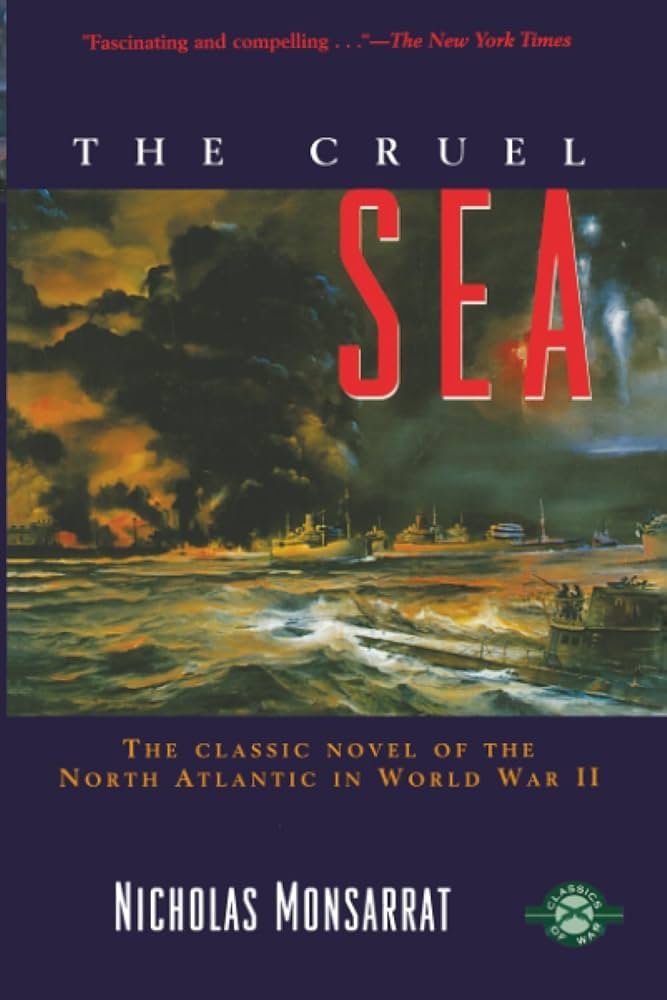
The Cruel Sea

Several years ago I read CS Forester’s 1955 World War II novel The Good Shepherd, a short, intense story about an American destroyer captain as he attempts to protect a convoy through the worst of the U-boats’ hunting grounds in the North Atlantic. Though told in the third person, it is intensely, claustrophobically internal, bringing the reader into intimate contact with both the calculating mind and physical punishment of its protagonist over the worst 72 hours of his career. It’s excellent, one of my favorite reads that year. The Cruel Sea, published in 1951 by Royal Navy veteran Nicholas Monsarrat, is even better.

Beginning in a Scottish shipyard in the fall of 1939, The Cruel Sea introduces the captain, Commander George Ericson, a dedicated but undistinguished officer who already has a long career behind him, as he takes command of a newly constructed corvette, the HMS Compass Rose. He also meets his three junior officers—the untried Lockhart and Ferraby, a journalist and bank clerk fresh out of officer training, and the experienced but boorish Australian Bennet.

As the Compass Rose is fitted for anti-submarine duty in the North Atlantic, the reader gets to know the ship, its crew, and these central characters. Ericson is well-trained, disciplined, and eager. Lockhart, an unattached former freelancer, begins the war single and with few connections to make him fearful of combat; he’s cool and a quick learner. Ferraby, only twenty, utterly inexperienced and with a new wife at home, is uncertain and often unmanned by his lack of skill. Bennet, cowardly and lazy, pounces on that. Testing the new ship and undertaking its first missions into the warzone strains and exposes weak points in Compass Rose’s leadership. New officers and crew, like the posh, university-educated Morell, who has a flighty actress wife back home in London, and Baker, a young man obsessed with women despite his lack of experience with them, further complicate matters.

I don’t want to give much away about the plot. The Cruel Sea is not plot-driven. Having established its characters and their task—a task they’ll labor at almost without pause for six years—the story hums along on two brilliantly combined storytelling elements.

The first is the day-to-day reality of convoy duty and actual combat, both of which Monsarrat describes unromantically and with startling clarity. The drudgery and physical misery come through palpably, as do the horrors Compass Rose’s crew confront on nearly every mission. Sailors incinerated by the burning oil leaking from a torpedoed tanker, survivors discovered floating in their lifejackets weeks too late, a man dying of third-degree burns as a hapless officer rubs ointment on his exposed muscles, men wounded, drowned, frozen, blown to pieces—Monsarrat never embellishes or wallows in his descriptions, and the simplicity and directness of his narration makes it all the more disturbing and moving.

The second key element is the character of the men themselves, especially leaders. War, The Cruel Sea impresses upon us firmly, depends as much on relationships and leadership as it does on technology. This is a character study spread across six years of danger, combat, and death, and the smooth functioning of superiors and subordinates, their mutual trust, and the judgements each is empowered to make are as crucial as sonar, signal lamps, or depth charges.

Personal character matters. More than one man is wrecked by a bad relationship with a woman. The book’s title emphasizes the cruelty of the sea, but the torture some characters are put through by unfaithful wives rivals the sea for unfeeling destructiveness. Other men lead dissipated lives ashore or lives otherwise marked by moral weakness. Compass Rose’s greatest trial—again, I don’t want to spoil any specific incidents—painfully exposes the strong and the bad.

One incident I will describe, one of the most famous in the book and one included in the trailer for the 1953 film adaptation, combines the stress and danger and technical demands of combat with the problem of personal character and responsibility. In Compass Rose’s worst mission, a convoy to Gibraltar that is almost annihilated by U-boats, Ericson steers the corvette toward a group of men who survived the sinking of their ship and are struggling in the water. As he approaches he learns that Compass Rose has picked up a strong sonar signal directly underneath the survivors. It is almost certainly a U-boat. Ericson must decide in an instant: pick up the survivors and let the U-boat get away—and possibly even torpedo Compass Rose—or drop depth charges into the middle of the struggling men. He orders the depth charges launched. He lives with the consequences for the rest of the book.

The novel’s six-year span, with characters coming and going and the scene occasionally shifting to the homefront, to the Arctic convoy route to Murmansk, or even to Brooklyn, gives the reader a sharp sense of the experience of the war, especially its long years of struggle before success and the escalation of the violence. The first two-thirds are a bleak grind. The harshness of the work, the unrelenting danger, and the horrors and personal stresses the characters are subjected to hardens or dulls them by turns. They feel they have not only been caught in a machine, but worry about becoming machinelike themselves. Ericson struggles with memories of a softer, more flexible earlier stage of the war; a young sailor who went AWOL to check on his wife might have been let off with a warning in 1939, though by 1944 the same man committing the same offense would be sent to prison, and Ericson feels he must shut down even good-natured joking among his offers in order to maintain discipline. Lockhart, self-protective, closes himself off to all but his captain, but finds himself falling in love with a beautiful Wren and must decide whether to commit with the war unfinished.

Only late in the book do the characters realize that there is an end in sight, a sense that brings its own anxieties with it. By the time two of the central surviving characters stand together on the bridge of a different ship, different men from those they began the novel as six years before, we feel their gratitude that the war is over but understand why it is a muted, subdued gratitude—exhaustion, and much more besides.

I don’t want to give the impression that The Cruel Sea is especially dour. It has frequent moments of wit and levity of the best British kind—wry, understated, often dark—and its characters are a pleasure to spend time with. But precisely because Monsarrat has peopled his novel with such lifelike, sympathetic characters, when they suffer and die it is as powerful and agonizing as their good times were enjoyable. By the end the story has reminded us, in case we forgot, that every life has shares of joy and loss. Monsarrat makes us feel both.

Despite overlap in subject matter, the comparison I began with is not entirely fair. Both are excellent novels. But where The Good Shepherd concerns one man, a captain, over three days, The Cruel Sea follows multiple members of a ship’s crew across the entire duration of the war. The Good Shepherd is a minutely focused portrait of a leader in his most acutely stressful moment. The Cruel Sea, on the other hand, vast, changeable, dangerous, and beautiful like the sea itself, is an epic.

On smallpox blankets

A slight ding on Philip Jenkins’s History of the United States, which I’m still reading and still enjoying. In a chapter on the Indian prehistory of North America, Jenkins points out the role of virgin soil epidemics in massive demographic change across the continent, well beyond any areas of initial European settlement (thanks to networks of preexisting trade routes and exacerbated by endemic inter-Indian warfare) and far before any “deliberate policy of Indian Removal” by any modern European-descended state.

All well and good—I’m often at pains in class to point out these early disasters, occurring in an age before germ theory, were accidental. But that paragraph ends with this passage:

Sometimes destruction by biological means was deliberate: in the 1760s, the British ransacked smallpox hospitals for contaminated bedding to offer as gifts to the Ottawa people.

On a strict technical level, most of that sentence is true—although the word ransacked is a bit much, as we’ll see. The problem is that Jenkins accidentally implies a widespread policy (“the British ransacked . . . hospitals”) over a long period (“the 1760s”) when this occurred exactly one time in one specific place.

The root of the smallpox blankets legend is the 1763 siege of Fort Pitt (formerly Fort Duquesne, later Pittsburgh) during Pontiac’s War, one of the aftershocks of the French and Indian War. Well-coordinated attacks on overextended British outposts in the far-flung new reaches of the Empire overwhelmed or came close to overwhelming several forts. Fort Pitt held out, but the siege conditions and overcrowding led to an outbreak of smallpox.

The precise details are unclear (here’s a good longer explanation) but in a letter to British Commander-in-Chief Jeffrey Amherst, the commander of Fort Pitt’s garrison mooted the idea of giving contaminated blankets from smallpox patients in the fort (n.b: from the fort hospital, not hospitals plural) to a diplomatic party as part of the customary exchange of gifts during negotiations. Amherst apparently approved on the basis that the situation at the fort was desperate. Based on fort records, it appears two blankets and a handkerchief were used (by someone, possibly a trader on his own initiative rather than the fort’s commander) and their previous owners reimbursed.

But here’s the most important part of the incident: it didn’t work.

Smallpox, per the CDC, can theoretically spread through bedding contaminated with pus and bodily fluids but is unlikely to, especially if the fluids dry and age. It is much more often transmitted “by direct and fairly prolonged face-to-face contact between people.” Beyond the mechanics of how smallpox spreads most effectively, other contextual factors further complicate the story. Here’s Fred Anderson in The War that Made America, which I recently recommended:

There is no evidence that Amherst’s genocidal intentions and [Fort Pitt commander] Ecuyer’s abominable act actually succeeded in spreading smallpox among the Shawnees and Delawares who besieged Fort Pitt, for smallpox was already endemic in both groups at the time.

Another historian has pointed out that the smallpox outbreak at Fort Pitt arrived with the Indians in the first place.

Again, we are dealing with a single failed attempt at biological warfare in a desperate situation. So while that sentence in Jenkins’s book—a sort of tossed-off aside—is in some sense correct, it falls apart at the detail level.

The bigger problem is precisely that tossed-off quality and the impression it creates. The smallpox blankets are legendary—mythic. Even students who don’t know much about the colonial era or the complex history of European and Indian relations usually recognize this story. That’s because it has escaped its original context and all its bothersome details and, having thus escaped, the attempt to spread smallpox is assumed to have been successful.

So it’s become a story too good to check and, as proof of white perfidy, can be transplanted to the European villain of choice. I’ve seen Cortes and the Pilgrims accused of it, or “Europeans” generally, as if it happened many times.

This is an unfortunate single sentence in a book that is otherwise excellent so far, but the mere fact of its appearing in a good book by a careful historian points toward its prominence as easy shorthand for the evils of European and Indian interaction. But that very ease should raise our suspicions, especially since the story is so often used as a one-size-fits-all cudgel. Any story that handy for the purpose needs to be checked.

Jenkins on regionalism and contingency

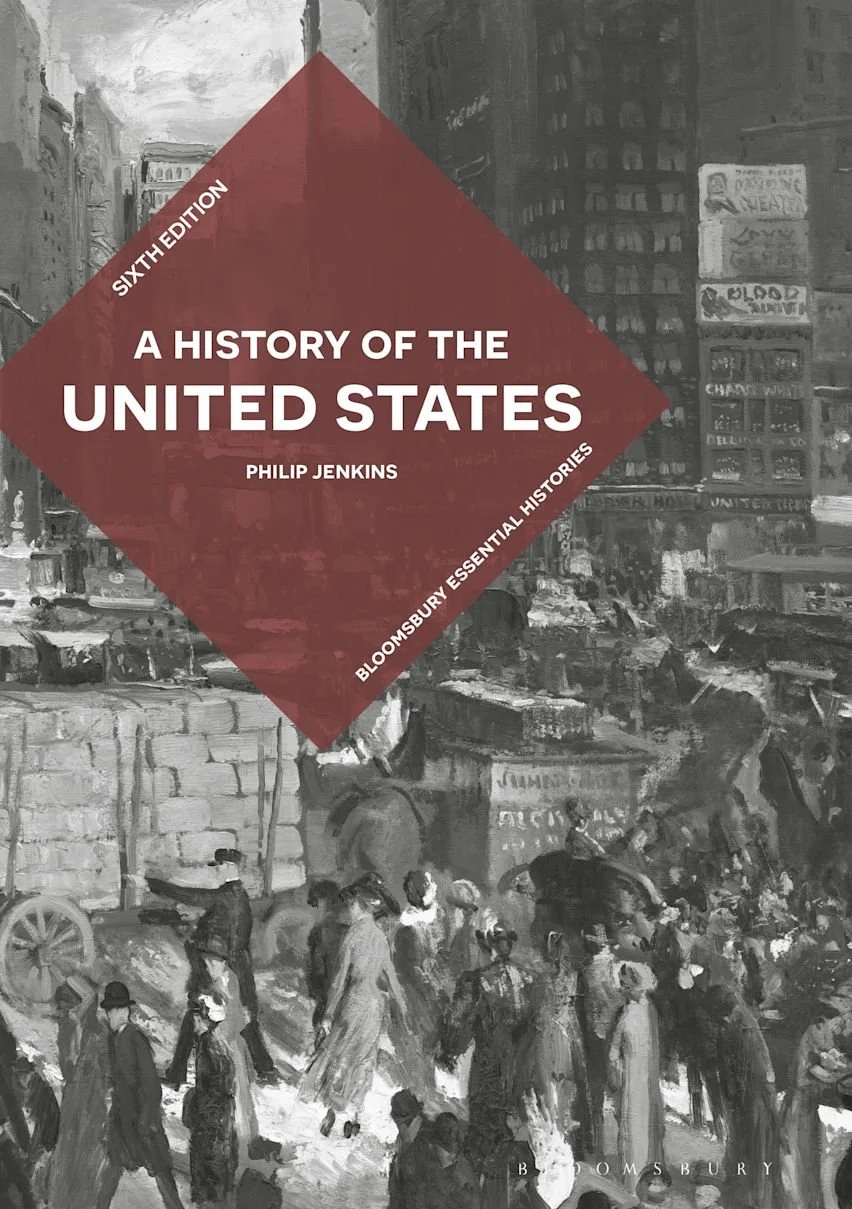
One of the best perks of teaching is the opportunity to review examination copies of textbooks. This morning I received a copy of the new sixth edition of A History of the United States, by Philip Jenkins, part of Bloomsbury’s Essential Histories series. Jenkins is a historian of religion whose work I’ve greatly appreciated over the years, and I was excited to discover that he’s also written a short, one-volume American history text. I’m reading it with a view to replacing the late Robert Remini’s Short History of the United States in one of my online adjunct courses.

So far it’s off to a good start. One of the challenges of teaching history is trying to draw attention to recurrent patterns or themes. The standard multi-author committee-produced textbook—what you think of when you hear the word—usually does this clumsily, if at all. A single-author text that pays a bit more attention to literary qualities, like Remini’s Short History or Wilfred McClay’s Land of Hope, can develop these themes and throughlines narratively as it goes—which is also, not coincidentally, how I teach the subject.

Jenkins begins by explicitly laying out the themes he wants the reader to notice in a dedicated introductory chapter. Ordinarily this wouldn’t be my favorite approach, but it allows Jenkins to describe some of the peculiar parameters of American history very specifically, priming the reader to detect them. I especially liked what he had to say about two in particular:

First, having established “the tyranny of distance” as one of the key factors in the story, he points toward the differing trajectories and cultures of the US’s many regions, the two earliest and most important of which are the north and the South:

Different regions produced their own distinct cultures, the exact nature of which has given rise to much debate. The question of “Southern-ness” has been a popular topic for such works, though the very term betrays the prejudice that it is the south that is untypical from an American or even world norm. In terms of its history of slavery and racial hierarchy, the American South closely resembles the worlds of the Caribbean and of much of Central or South America. We could equally well argue that it was rather the north of the early nineteenth century that produced a set of cultural and intellectual assumptions that were bizarre by the standards of the contemporary Western world, while the aristocratic, rural, and deferential south was a much more “normal” entity than its egalitarian, urban, and evangelical neighbors. For anyone acquainted with the astonishing social turbulence of the Northern cities before the Civil War, it is startling to hear claims that it was the south that had a peculiar tendency to violence.

This is not just about geography but about culture and historiography. For a long time, the extent to which New Englanders have portrayed their story as normative, as the story of the US to which recalcitrants and rebels have to be brought into conformity, has been invisible. (Why, for example, did the entire country just celebrate a holiday inspired by the Pilgrims?) This can lead to especially warped interpretations since, as Jenkins points out, the culture that arose in the northeastern US is such a weird historical outlier. Restoring a broader perspective creates a better understanding not only of north and South, but of the whole.

Even more crucially, Jenkins pushes back against whiggishness, the assumption that history moves determinedly along toward a particular endpoint, both of the present and the past:

Yet when we tell the story of US expansion, it is tempting to describe a natural and even inevitable process, by which the Lower Forty-Eight acquires its predestined dimensions and natural borders. That was certainly how Americans thought, and how they recorded events, and we still use the phrase that was commonly cited to describe this process. . . . 

The speed and seemingly irresistible weight of American expansion make such a narrative of Manifest Destiny tempting. US histories can look like a map on a television documentary, with an illuminated core region along the East Coast, which spreads swiftly and inevitably over those hitherto dark regions, which in turn become lit up as they achieve their authentic destiny of being included in that United States. It is hard not to write the story backward, as if the ending was always predetermined. The problems with such an account are many[.]

Among these problems is the implied sense of inevitability Jenkins mentions, a sense rooted in the most subtle and insidious bias of historical study, historian’s fallacy, which erases the fog in which historical figures operated. Jenkins emphasizes contingency and the fact that historical actors didn’t know the end of the story. Here’s an example I mentioned, with reference to this piece by Jeremy Black, in my Substack digest over the weekend:

For much of American history, many Americans were convinced that the lands that became Canada would inevitably fall into the possession of the United States. That was a real prospect during the War of 1812, and frequent later tensions between the United States and Great Britain made it highly likely that Canada would someday be a theater for American conquest and annexation.

There’s what word inevitably again. (A helpful rule: when trying to understand a past culture, look at what the movers and shakers thought was inevitable at the time.) Jenkins expands on the problems of assuming inevitable outcomes, of “arcs” “bending” toward particular results:

Quite apart from any cultural or racial biases, the whole idea of “inevitability” is shaky. The emergence of the continental United States with its boundaries, that Lower Forty-Eight, was contingent, dependent on the outcome of political struggles and social movements. It is easy to imagine scenarios when the United States would have acquired a very different shape, and this is no mere issue of speculative alternative history. We are dealing with what well-informed people believed or hoped in those earlier eras. Most basically, it was far from obvious to contemporary observers that the United States would have resisted multiple serious efforts at secession or partition, which reached their peak during the 1860s. In retrospect, we know that the nascent Confederate States of America created in 1860 would not endure as a major New World power, or that the remnant United States of America would not be confined to the north-east and Midwest; but Abraham Lincoln could not take that fact for granted.

What happened was not inevitable, things could have turned out differently, and uncertainty is an important part of every historical story. Conveying these facts is an important part of my approach to teaching, and I’m hopeful that the rest of Jenkins’s book will underscore these themes.

For what it’s worth, I’d still recommend Remini’s book, but Remini’s narrative is a little too complacently satisfied with the postwar liberal consensus—the idea of America as an idea, gradually developing its doctrines to ever fuller and broader degrees—which is itself a kind of whiggishness. And when initially selecting a text for this course I considered McClay’s book, but its otherwise excellent narrative has a few too many major omissions (the Plains Indians Wars)—yet another historiographical and teaching problem.

Five basic typesetting fixes for self-publishing

I’m currently reading The Cruel Sea, a 1951 novel about the Battle of the Atlantic by Nicholas Monsarrat. A few days ago on Substack I shared a few pictures of the interior of the book, simply but beautifully designed and set in Janson, a readable typeface still in wide use today.

In my note I called this kind of mid-century design “typographical comfort food.” A number of people agreed, noting the “visual delight” of the look of the page and that good typesetting makes it feel “like I can breathe through my eyes” reading it. Another, very much to the point, described the reassurance that comes with good type design: “You know you’re in good hands.”

This last comment is particularly important because at least two others remarked on self-published books in this context. One, an author of sci-fi, said he took this aspect of books for granted until he started publishing his own work, at which point he realized “it really does make a difference!” Another, slightly more dourly, wrote of the need to undo the damage done by desktop publishing.

I don’t know so much about widespread damage, but self-published books very often look bad at the page level. I’ve certainly put books back on the shelf after looking at an unreadable interior. But I’ve been doing desktop publishing of one kind or another as an amateur for thirty years, and—through a lot of trial and error and, crucially, just looking at a lot of books—have learned a lot about what makes the interior of a book look like a book. I’m no expert, but what I hope to offer here are a handful of specific things people designing their own books can do to make sure readers focus on the writing and not on shoddy typography.

Paragraph spacing

A lot of the problems I see with self-published books come from designing the interior of the book in a program like Word. This by itself is not a problem—I’ve laid out all of my books in Word. The problem is leaving Word’s often moronic default settings in place.

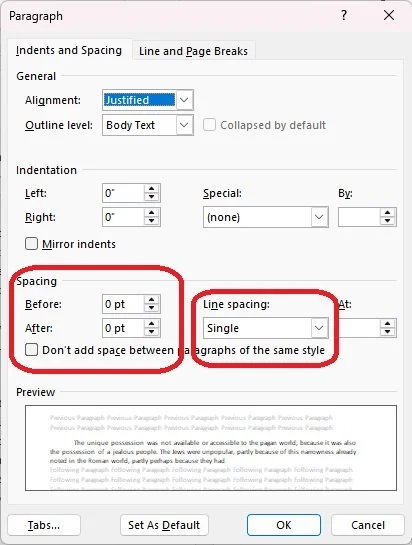
Among the worst of these is Word’s automatic insertion of a space between paragraphs. No professionally published book does this, and to a potential reader, even one who doesn’t know much about design or publishing, it won’t look right. Something will feel off.

This setting can be corrected in the paragraph formatting menu. Under the “Spacing” section, you’ll want to make sure that both “spacing before” and “spacing after” are set to zero.

Level up: Word’s default indentation is set to half an inch (.5”). Finished books don’t indent paragraphs this much. Reset it to .2” or .25”.

Line spacing

Manuscripts may be double-spaced, but a finished book should be single-spaced. You may occasionally see a professionally published book fiddle with the line spacing a bit—1.1 or 1.2 between lines, for instance—but the lines will always be closer to single-spaced than otherwise and precisely how this looks on the page will depend somewhat on the typeface or font (about which more below). Again, too much space between the lines won’t look right.

Like paragraph spacing, this is adjustable in the paragraph formatting menu.

Faith through justification

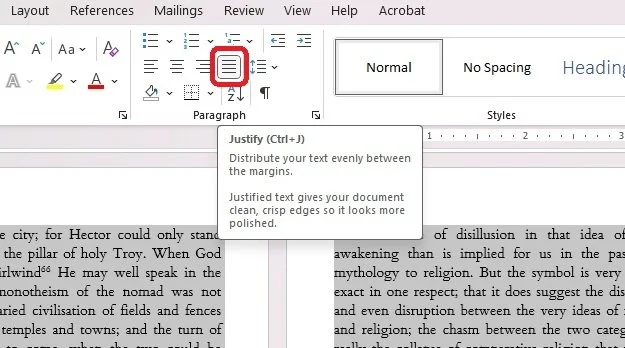
“Alignment” is how the text in a manuscript lines up with the margins. Word’s default is the entirely sensible “left aligned,” meaning the text will be flush with the left margin but not the right. Professionally published books are “justified,” meaning the text reaches all the way to the right margin on every line (except for the last sentence of a paragraph). This used to be a painstaking task for old-fashioned printers, who had a variety of ways to scootch and squish the text to fit the length of a line, but computers adjust the text to fit the margins automatically. Simply highlight the text and, out of the four alignment buttons, click “justify.”

Caveat: publishers do occasionally get artsy and toy with unjustified text with “ragged” edged paragraphs (my CSB Reader’s Bible has unjustified text), but I’ve never met anyone who actually likes this when they see it. Err on the side of traditional standards.

Level up: Be aware that, once you’ve justified the text of your manuscript, you’ll probably want to go through it looking for places where justification has opened huge gaps between the words on a line. You can manually control hyphenation or letter spacing to fine-tune this.

Stay out of the gutter

Even competently designed self-published books sometimes misstep when it comes to setting up the margins of the page. This is not typically a make-or-break aspect of page design but can be off-putting to readers.

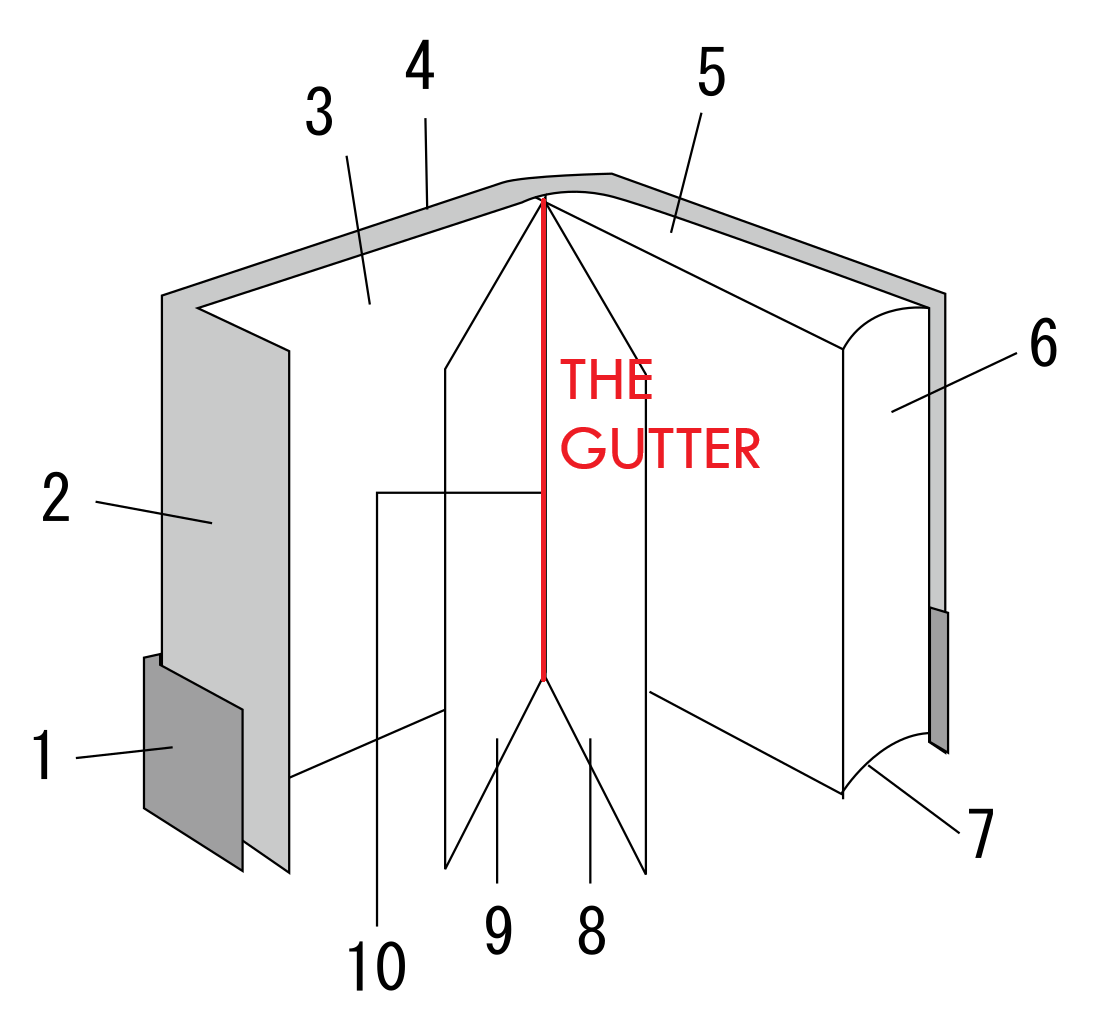
Pick up a dozen or so books at random and flip through, looking at the margins, and you’ll see a wide variety of designs and widths. What you won’t see, however, are margins so narrow that they allow the text to stretch all the way across the page, or margins that allow the text dip into the gutter, the middle of the book where the pages join. If the line is too long, it can tiring to the eye and difficult to see into the gutter, and you want your book design to eliminate as many physical obstacles to the act of reading as possible.

This is slightly more relative than some of the other tips I’m giving here, but in a normally sized paperback book (say 5x8”) the outer margin should be about half an inch. This can be the narrowest margin. The top of the page should be a bit wider, the bottom wider still (to accommodate a page number in the footer, for instance), but the inner margin by the gutter should be around half again as wide as the outer.

I’m still unsatisfied with the margins I laid out in my first published novel. My most recent book and the one I’m most pleased with in regard to margins, has an outer and bottom margins of .7”, a top margin of .6”, and an inner “gutter” margin of .9”. When setting this up in the margins menu in Word, be sure to select “mirror margins” to get the facing-page format of a published book.

Appropriate typefaces

Word’s default typeface or “font” all the way through my school and college years was 12-point Times New Roman (single-spaced, I’ll add). At some point when I was in graduate school someone somewhere at Microsoft decided to goof all of this up. They added that automatic line after a paragraph and reset the default font to 11-point Calibri.

The other defaults in this post are mostly basic manuscript format things you’ll need to adjust to make your book look like a book, but these default font settings are mindbogglingly stupid.

The best size for your text is going to depend on a few factors like the length of the book and how that affects the cost of manufacture. Like margins, what looks best is going to be partly a matter of judgment.

What is and is not an appropriate typeface for the text of a book is not. The problem with Word’s Calibri is that it’s sans-serif. (Here’s a quick primer on serifs.) Professionally published books may use a sans-serif typeface for chapter headings or other design elements, but the actual text itself should always be in a serif font for readability.

Fortunately, there are many, many of these available. A few of my personal favorites, what I like about them, and where you might sample them:

  • Bembo—a classic old-style typeface with a slightly old-fashioned look and elegant italics. You may see it in older Penguin Classics, religious books from Ignatius Press, or many John Grisham paperbacks.

  • Sabon—a modern typeface with well-balanced letters; it is also highly readable at all sizes, even down to footnote sizes like 6 points. Very widely used both for fiction and non-fiction now.

  • Dante—nicely balances old-style design with readability. You may see it in the Walt Longmire mysteries, Penguin Modern Classics fiction, or a variety of non-fiction books.

  • Minion—a relatively recent but widely used font that is highly readable but, in my opinion, a little bland. Frequently used for non-fiction but you will sometimes see it used for novels—like the Tor Essentials reprint of The Prestige that I read this fall.

  • Caslon—a nicely weighted typeface with elegant italics that suggests the old-fashioned printing press (it is often used for books on the American Revolution, and there are some varieties that look artificially weathered, like 300-year old pamphlets).

  • Baskerville—another classic, widely used by university presses and fiction publishers a few decades ago. Like Bembo and Caslon, it has as suggestion of class and history about it. You can see it in Susanna Clarke’s Jonathan Strange & Mr Norrell.

There are plenty of other good typefaces commonly used for professional typesetting, but any one of these will look better than Calibri, Times New Roman, or whatever Word’s default is tomorrow. If these don’t come pre-packaged with your edition of Word, they’re available online in either licensed or free generic versions.

Avoid:

  • Sans-serif fonts

  • Typewriter fonts like Courier

  • Slab-serif fonts, thick, heavy typefaces that are better used for titles or headings than the main body of text

  • Fonts designed to look like calligraphy or other handwriting

  • Whimsical fonts, of which there are many available

If what you’re after is professionalism and readability, you should pick something unobtrusive and clear.

Level up: With those strictures in mind, experiment with typefaces a bit. A choice of font doesn’t have to be strictly functional, it can suggest tone, add texture, or, like Caslon for those American Revolution books, suggest a time and place.

Conclusion

One of the challenges—or, if you enjoy this stuff like I do, one of the fun things—about self-publishing is that there are always things to fine-tune and improve. Again, the above is a list of basics that, even if they won’t give your self-published book perfect interior and type design, they’ll at least eliminate some of the most obvious mistakes or problems. As that one Substack commenter put it, you want potential readers to feel that they’re “in goods hands” just by looking inside. I hope y’all find it helpful.

On proportionality bias

This week The Rest is History dropped an excellent five-part series on Jack the Ripper. I managed to listen to all of it in two days. I strongly recommend it if you have any interest in that case, Victorian England, or the history of crime investigation, but also because Tom Holland and Dominic Sandbrook several times mention—albeit not by name—a useful concept for thinking about how we look for causes in past events: proportionality bias.

I’ve written about this briefly before, in a review of Rob Brotherton’s Suspicious Minds, on the cognitive aspects of conspiracism. Briefly, proportionality bias is our built-in tendency, when trying to explain something important, to look for something equally important as the cause. A cause that is, subjectively, incommensurate with the results is unsatisfying and tempts us toward identifying something else—usually something we are already suspicious of. Again, this is a built-in tendency, not a pathology, but while proportionality bias may be a helpful heuristic on the personal level, it does not scale to world events.

The go-to example is the JFK assassination. Many still can’t accept that the president of one of the most powerful states in history—a man involved in international intrigues at the highest levels including espionage, covert assassination programs, proxy wars, and near nuclear war—was killed by an unsympathetic loser who happened to have temporary work in a building his limousine happened to drive past. It happens to be true but is narratively unsatisfying. The conclusion that it must have been something or someone else comes first, and not necessarily consciously; arguments against Oswald are only meant to confirm it.

Something similar has been happening among certain types with regard to Charlie Kirk. It can’t have been a terminally online loser who killed him out of some half-formed, privately nursed political grievance; it must have been (insert fantasy villain of your choice, though one, the subject of a million crank fixations, keeps coming up).

In the case of Jack the Ripper, this is how we get theories of vast royal machinations or secret Masonic rituals—or some combination of the two—as the force behind the Whitechapel murders. That it was likely a still-unidentified local pervert who was skilled with a knife would, to many, prove disappointing. The imagination would prefer a dark cabal of willing actors, or at least a colorful weirdo, to the anonymous forces of poverty, deviance, and insanity.

Again, Holland and Sandbrook do a good job explaining this, even tying it back to their JFK series. The one point I would add to the above is the role that subjectivity of proportionality bias.

When I reviewed Brotherton’s book, I mentioned the assassinations of JFK and Archduke Franz Ferdinand in June 1914. The former is still the subject of fevered speculation and conspiracy theory; the latter, though part of a flourishing conspiratorial worldview in the 1920s, not so much. Why? Because JFK’s murder still feels important to people in way Franz Ferdinand’s, having become something we learn about in middle school rather than discuss casually, does not.

By the same token, Jack the Ripper is important—to us, for reasons Holland and Sandbrook explain well. In the same way that protesters will show up to vandalize the statues of high-profile targets like Robert E Lee or Christopher Columbus but not for Magellan or Raphael Semmes, or that ancient aliens enthusiasts will fixate on famous landmarks like the Pyramids but not much more complicated ancient construction projects like Roman aqueducts, preexisting cultural cachet matters perhaps more than the arguments themselves. This should, by itself, raise our suspicions.

Spurious, horrible, the worst kind

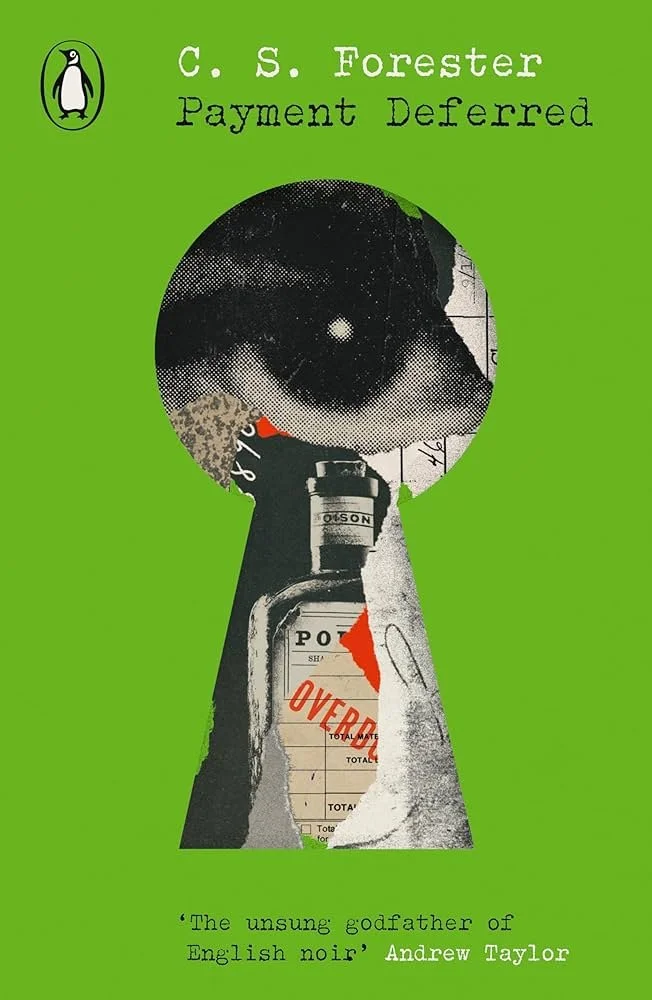
Earlier today I started reading Payment Deferred, a 1926 crime novel from the early career of CS Forester of Horatio Hornblower fame. A curious passage of description from the first chapter, when a long-lost relative arrives at an uncle’s London home and looks around:

For a moment the conversation flagged, and the boy, still a little shy, had leisure to look about him. These were the only relatives he had on earth, and he would like to make the most of them, although, he confessed to himself, he was not greatly attracted at first sight. The room was frankly hideous. The flowered wallpaper was covered with photographs and with the worst kind of engravings. The spurious marble mantelpiece was littered with horrible vases. Of the two armchairs one was covered with plush, the other with a chintz that blended unhappily with the wallpaper. The other chairs were plain bentwood ones. On a table in the window were dusty aspidistras in vast green china pots. In the armchair opposite him sat his uncle, in a shabby blue suit flagrantly spotted here and there. He was a small man, with sparse reddish hair and a bristling moustache of the same colour.

It continues from there at some length, but two things struck me about this passage:

The first is just how vague it is. The room is “hideous.” In what way? When Forester elaborates, we learn that the decor includes “the worst kind of engravings” and “horrible vases” set on a “spurious” mantel. The latter I take to mean that the marble is fake, but why are the vases “horrible”? Are they cheap? Broken? Out of fashion? Badly made? And just what are “the worst kind of engravings?” The 1920s equivalent of Thomas Kinkade? Cuttings from Victorian newspapers? Bookplates from Fanny Hill?

Forester clearly wants to impart the nephew’s impression of cheap, run-down living, but we get a better sense of his emotional response to the room than of what it actually looks like. Hideous, horrible, the worst kind—these could mean almost anything.

And yet—the second thing that struck me—it works. This should be bad writing, but isn’t. I think this is down to two things:

First, the description strengthens as the paragraph goes on, and it does so by becoming more particular and concrete. Compare the “horrible vases” with the “plain bentwood” chairs, the “dusty aspidistras in vast green china pots,” and the uncle himself. Shabbiness, inelegance, and neglect create a powerful but subtle sense not only of the place but the character of the people who live there. This is much better.

Second, even in the vague early parts of the description the verbs are strong. In fact, I think they do most of the work in the first several sentences, which is asking a lot of the repeatedly used to be, which I’ve written about before. But even in passive voice, “was covered with” and especially “was littered with” convey strong visual information of clutter, disorganization, and, again, neglect and further cues about the uncle and his family.

Every writer has his strengths and weaknesses. I’ve read only one other Forester novel, the excellent The Good Shepherd. This was published almost thirty years after Payment Deferred, but the two books share a strong interiority, not so much bringing us into as forcing us, claustrophobically, into the minds of the characters from page one. I remember no defects whatsoever in The Good Shepherd, so my suspicion is that passages like the above are the mark of his early career. He was only 27 when Payment Deferred was published, and it would be another eleven years before the first Hornblower book appeared.

At any rate, I’m already enjoying it, and seeing evidence of future greatness in early imperfection is always instructive.

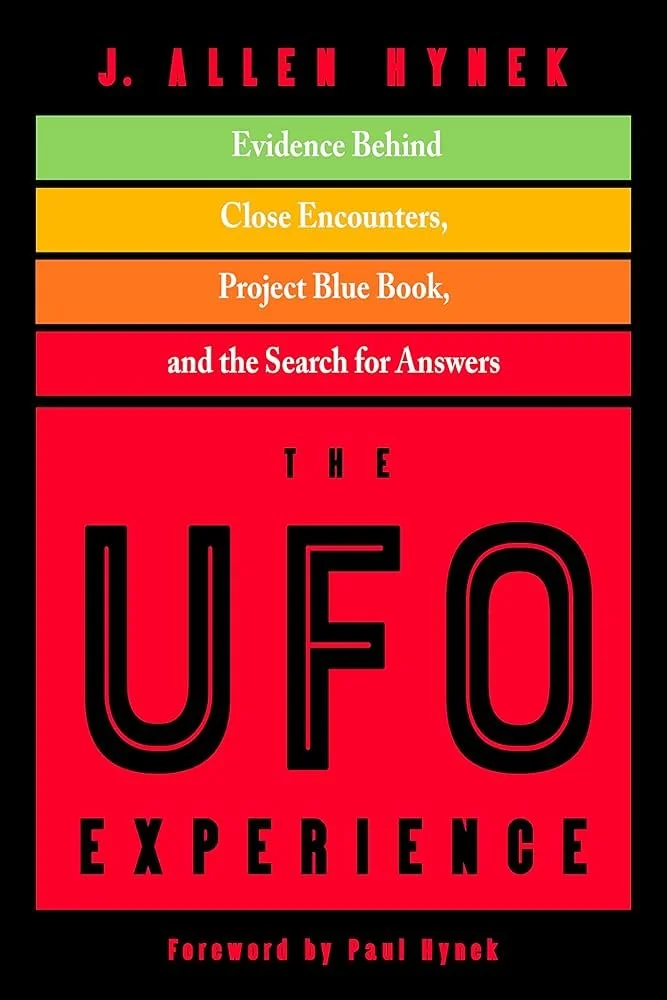
The UFO Experience

In the late 1940s, the US Air Force approached Professor J Allen Hynek with a request for his services as a consultant. The original wave of flying saucer sightings was at its height, and the Air Force, in its defense role, was investigating this strange new phenomenon. How many reports of strange flying objects were simply misidentifications of planets and stars? They hoped Hynek, a respected astronomer, could help rule such cases out.

Over twenty years and three Air Force projects later, flying saucer flaps had evolved into UFO mania, the reports had evolved from sightings to encounters to abductions, and Hynek had been there for all of it. The Air Force, however, having determined early on that, whatever UFOs really were, they weren’t Russian and apparently weren’t a threat, had lost interest. But public fascination with UFOs, thousands of sightings and rumored sightings, and the multiple competing mythologies growing up around the phenomenon only intensified. Due to Hynek’s high public profile thanks to the Air Force (he is the man who gave us “swamp gas” as a feature of UFO investigation), the curious often asked Hynek to recommend “a good book” on UFOs. The UFO Experience, published in 1972, was Hynek’s attempt to provide it.

This is an interesting book for two major reasons. The first is Hynek’s perspective, which is genuinely openminded and scientific. Hynek approached the problem of UFOs as a field researcher, requiring solid, extensive data and basing interpretations on the data rather than forcing data into preconceived explanations. This would prove one of his ultimate frustrations with the Air Force, a topic we’ll come back to.

But data by itself isn’t of much use—it must be organized before it can be interpreted. And so approximately the first half of The UFO Experience is a taxonomy of UFO sightings with ample reference to cases Hynek (mostly) personally investigated. This is certainly the most famous part of the book. Even if you haven’t heard of Hynek, you’ve almost certainly heard the phrase “close encounter.”

Hynek’s taxonomy falls into two major categories with three subcategories apiece. The first are mere sightings: of nighttime lights; of “daylight discs,” the iconic 1950s flying saucer; and strange objects picked up on radar, possibly offering a hard empirical record of something seen by human witnesses. The second category, the close encounters, sightings of UFOs within 500 feet, a distance theoretically precluding misidentification of stars or aircraft, are of the first kind (sighting of an object in the air), the second kind (sighting of an object on the ground or otherwise physically affecting the environment), and the third kind (sighting of an object with the additional presence of some kind of living occupant).

Not only is this the most famous part of the book, it also has the best stories—the Levelland, Texas UFOs, the Lonnie Zamora sighting, and more. It also illustrates the other crucial scientific aspect of Hynek’s approach, which is his rigorously applied standards of evidence.

Hynek excluded from his study single-witness reports as too easily faked (or at least impossible to corroborate) as well as the testimonials of “contactee” types, flying saucer cultists who claimed to receive regular visits from extraterrestrials who offered touchy-feely advice on disarmament, among other things. In addition to prioritizing up-close sightings with multiple witnesses—preferably independent witnesses of good character or reputation—he factored in the subjective strangeness of reported sightings, an often overlooked data point. Contactee stories, with their feelgood peace-and-love vibes, were too obviously wishful thinking; more compelling were stories of inexplicable close encounters by honest people in professions requiring steadiness and sobriety—cops, doctors, farmers, engineers, military and commercial pilots, radar technicians, air traffic controllers. That many witnesses had been previously uninterested in UFOs was another important factor.

And Hynek, interestingly, found a lot of these, enough to convince him that, having eliminated out huge numbers of hoaxes and misidentifications, something strange was still going on. But understanding or explaining it would require a systematic approach through observation and testing and conclusions that did not exceed the possibilities suggested by the evidence. Hynek is, for example, notably skeptical of the Betty and Barney Hill abduction story, repeating but by no means endorsing their “recovered memories” of boarding the UFOs and enduring medical exams, and never endorses the extraterrestrial hypothesis.

Hynek’s primary concern is always to discover what we can say, scientifically and certainly, about what people have seen, and no more. But this careful, judicious approach was not apparently to the taste of the military, the public, or fellow scientists. He would be repeatedly disappointed.

That leads into the second half of the book, in which Hynek reflects on his twenty years doing the Air Force’s shoe leather work and examines some of the ways UFO investigations had gone wrong. I picked up The UFO Experience specifically to read about Hynek’s methodology, standards of evidence, and taxonomy—with all the good stories, being a non-believing, mostly aesthetic appreciator of the UFO phenomenon—but was surprised to find this half as interesting as the first. That’s because Hynek, though a thoughtful, judicious man, had scores to settle.

The first and most extensive is with the US Air Force. UFO lore of the Roswell coverup and Men in Black ilk posits Project Blue Book and its agents as omnipresent suppressors of information. Nothing could be further from the truth. Hynek criticizes Projects Sign, Grudge, and Blue Book as underfunded, understaffed, and headed by junior officers more keen to get promoted out of the position than to gather and assess evidence. Apathy was the rule, information-gathering was slapdash at best, and conclusions, in those instances when they were actually provided, were flippant and unconvincing. This only worsened once the projects had fulfilled their original purpose of determining whether the Russians were behind the UFOs.

Hynek also had harsh words for the scientific establishment, which refused to question its own paradigms in light of new evidence—the opposite of true science—and resorted to ridicule, blackballing, and naked appeals to its own authority to answer criticism and shut down public questions. They were also too eager to lump the curious in with the kooks. Hynek, in a prescient passage, predicts that these attitudes and browbeating the public with what one might now call, say, “settled science” will undermine science itself.

Hynek ends the book with a call for genuine curiosity, a willingness to investigate and incorporate knew knowledge, and a continued commitment to scientific rigor. I suspect he’d be still be disappointed.

This brings me to the second major reason I found The UFO Experience interesting, the purely historical—its place in the history of this phenomenon. Hynek wrote and published his “good book” on UFOs after they had become a secure feature of the American imagination but before some of the aspects we most commonly associate with it today had become mainstream. Abduction stories like the Hills’ were a relatively recent addition to the legendarium. The Pascagoula incident the year after Hynek published this book, the Travis Walton story two years after that, and Whitley Strieber’s Communion in the mid 80s—which also popularized the almond-eyed greys so often read back into the previous history—made abduction the central pillar of UFO myth and inextricably associated them with aliens.

Hynek also published The UFO Experience just four years after Chariots of the Gods, the original “ancient astronauts” book. Hynek, for whom many of the close encounters of the third kind he relates are, by his own standards, suspiciously “woo-woo,” makes absolutely no mention of this variety of UFO enthusiasm, which was genuinely fringe. It would require decades to grow and metastasize. But alongside the Roswell incident, which was resurrected and backfilled with UFO lore after Hynek’s time, ancient astronauts theories seemingly provide historical validation beyond the sudden appearance of flying saucers in 1947 and are responsible for much popular enthusiasm for UFOs now, from the History Channel (so-called) to Joe Rogan.

This book, then, arrived at a historical sweet spot, a moment of huge potential poised between how the original UFO legend began, how Hynek, newly free of the burden of government apathy, hoped it could develop, and what it would actually become. And that was certainly not more scientific.

The UFO Experience is a fascinating attempt by a principled, hard-working, thoughtful man to wrest some degree of scientific sense out of a phenomenon already buried under speculation, lunacy, and mockery. His standards of evidence and organized, taxonomical mind make for a fascinating presentation of the subject, and the cases he recaps and examines prove all the more compelling as a result. Not only has Hynek’s example shown me, personally, a way out of pure contempt for the believers, it’s a reminder of how rigorous, systematic thought and high standards could still salvage something useful out of a field that has only grown more bizarre since Hynek first applied his mind to understanding it.

Betraying that they’ve never had a friend

Everyone once in a while the benighted YouTube algorithm serves up a winner. Here’s an excellent short video essay that was recommended to me this afternoon. I watched it based on the thumbnail alone. The subject: the deep friendships of great literary characters being interpreted as sexual relationships, a terminal cultural cancer that never fails to annoy me.

The host, of the channel Geeky Stoics, a channel I’ve never previously come across, invokes several examples of this internet-fueled trend* but mostly focuses on two: Frog and Toad,** heroes of Arnold Lobel’s warm, gentle, very funny children’s stories, and Frodo Baggins and Sam Gamgee of Lord of the Rings. These are apposite choices, since both are great favorites in the Poss household and both have been subjected to this perverted eisegesis for some time now.

From there he advances to latter-day male loneliness and the generally sorry state of friendship in the modern West, topics I care deeply about and that he treats with extraordinary concision and care. It’s a solidly presented, thought-provoking little video, and I strongly recommend it.

But what made this video especially good was the use of CS Lewis’s book The Four Loves to frame the discussion. Just last week on Substack I made the case for The Four Loves as an underrated Lewis book, a late work brimming with his mature thought on the different aspects of love—its forms, objects, and enactments as affection, friendship, eros, and the theological virtue of charity. The video essay begins with a line from the chapter on friendship that I’ve thought about many, many, many times, especially when some smug terminally online type starts not so much insinuating as narrating the imaginary deviance of characters like Frodo and Sam:

 
Those who cannot conceive Friendship as a substantive love but only as a disguise or elaboration of Eros betray the fact that they have never had a Friend.
— CS Lewis
 

As I said, I have plenty of occasions to remember this line, but never as a gotcha—what it reveals is too sad for that.

The one point where I think the video misses a potentially fruitful nuance relates to class: while Frog and Toad are quite obviously peers, similarly situated in life, Frodo and Sam are a master and servant—Tolkien explicitly compared them to a British officer of the First World War and his batman. This does not preclude deep genuine friendship, something moderns struggle to understand and that the Peter Jackson movies mostly obscure. Just as we moderns have lost much with our condemnation of exclusivity or discrimination in relationships, so our suspicion of rank, hierarchy, or any other form of “inequality” has closed off whole dimensions of human experience to us.

But that’s a relatively minor point. There’s much more to the video, including more of Lewis’s discussion of the distinctions between friendship—a side-by-sideness oriented toward a common interest or mission—and other forms of love. Check out both Geeky Stoics’ video and The Four Loves, which is even available in a shorter, earlier version narrated by Lewis himself.

* Related: See this recent long video by Hilary Layne on the widespread deleterious effects of fanfic, not the least of which is the “shipping” of often inappropriate combinations of characters. Layne has a companion piece on Substack here.

** Often described by people on social media with the strangely specific phrase “canonically gay.” There is no mention of Frog and Toad being anything other than friends in the stories, the first collection of which is called Frog and Toad are Friends, making me wonder what these illiterates think the adverb canonically means.

Two dangers of colloquialism

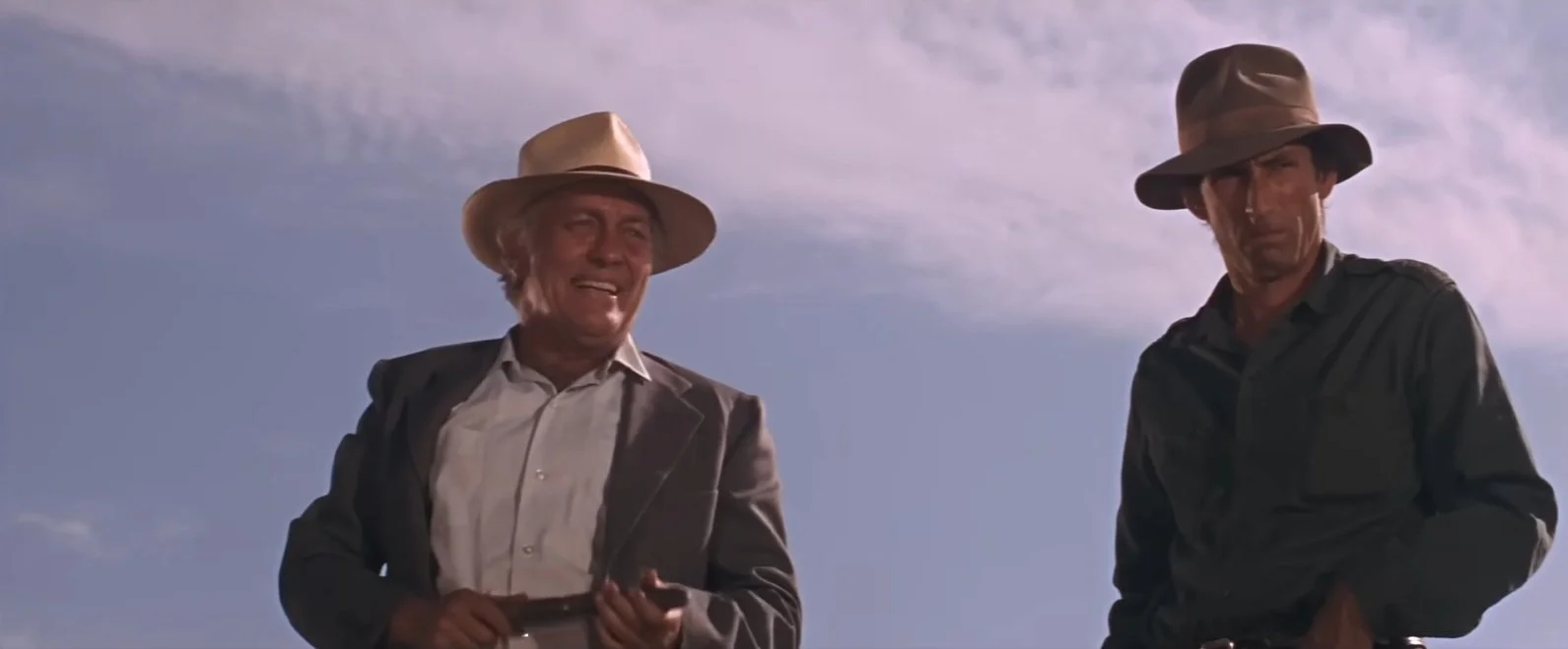
Failure to communicate. Strother Martin in Cool Hand Luke.

This has been a mad month, and on top of everything else keeping me busy I injured my right hand last week, so all the book reviews and other writing I had hoped to do over Thanksgiving Break came to nothing. For now. I’m glad to say I can type again, at least.

But if I had some enforced inactivity on the writing front over Thanksgiving, that at least gave me time to think. One topic I returned to several times was the danger of idiom, colloquialism, or unpredictable connotation in language. Two incidents—one-sided conversations overheard, really—separated by several years awakened me to two related aspects of the danger and drove home the need for clear and unmistakable meaning to me.

The more recent of the two came from a YouTube true crime channel that provides commentary on recorded police interviews. In one featured interview with a murder suspect, two detectives, a man and a woman, take turns applying pressure. It’s not exactly the good cop/bad cop routine, but the female cannily uses persuasion and emotional leverage while the male presses aggressively and confrontationally. Several times he uses the expression “come to Jesus” in the colloquial sense of a reckoning coming due, i.e. “It’s time to fess up.”

The YouTube narrator, apparently unaware of this common and (to me) obvious idiom, pauses to express outrage that the male detective is introducing religion to his interrogation and suggests his obsession with Jesus is undermining the female detective’s technique. Commenters also showed their ignorance—and, this being the internet, their violent irreligion—in predictable terms. Only one that I saw after scrolling through hundreds pointed out the narrator’s basic misunderstanding.

That’s one danger—in using an idiom or colloquialism, your meaning may be utterly lost, especially to observers or third parties. Take the image at the top of this post, for example. Some of y’all will be able to hear this image in your head. Some will have no idea what it means. It would be a mistake, then, to tie the meaning of this post to repeating a phrase like “Failure to communicate.”

The second, which I witnessed long ago on Facebook, is related but not identical. During an unexpected snowstorm back home in Georgia, a storm that occurred during a school day and threatened to trap students at school, Governor Nathan Deal took to social media to reassure the public that their kids would be taken care during the emergency, that Georgia public school teachers “are adequate to handle this situation.”*

Georgia’s state of preparedness for winter weather became a hot political topic for a few minutes afterward, but that’s not what greatly exercised an old acquaintance on Facebook. No, a guy I went to school with—after the manner of “guys I went to school with” the world over—posted a tantrum about Deal’s description of public school teachers as “adequate.” The problem? The word adequate itself, which this guy took as a negative of the “meets expectations” variety, anything not exceptional being perceived as bad. “We are more than just adequate!” etc etc.

The second, related danger—despite using precise, accurate language (Georgia’s teachers did, in fact, prove adequate to take care of students during the emergency), your audience may supply their own meaning based on purely informal connotation, what a word or expression means to them.

The problem in both cases is informality, a “you know what I mean” attitude toward language. In the first, informal expression from the communicator leads to misunderstanding on the part of a receiver ignorant of that informal expression. In the second, a precise, neutral message from the communicator leads to misunderstanding on the part of a mind that understands the words but, accustomed to informal use of a perfectly acceptable word, imputes false meaning to them.**

Speak colloquially and be misunderstood, or speak precisely and be misunderstood. This is just the nature of communication in a limited, fallen world, I suppose, but it’s frustrating, especially in the second case. You can’t, after all, predict every way your meaning can be misconstrued by someone.

The only solutions to this kind of misunderstanding that I can conceive of are erring on the side of precision (and you can be precise even when using idioms and dialect, sometimes even more precise than standard English allows); a commitment by everyone to learn more about English expression and even words and not jump to conclusions (easily the most optimistic idea I’ve ever floated on this blog); and—whether failing or in addition to those two—good faith and charity.

* I’ve tried and failed to find the exact wording of both Governor Deal’s message and the Facebook status referenced here, but the one word that matters most I remember clearly.

** It’s telling that both responded with outrage and an apparent unwillingness to discern whether they had misunderstood, but that’s a topic for another time.