Jenkins on regionalism and contingency
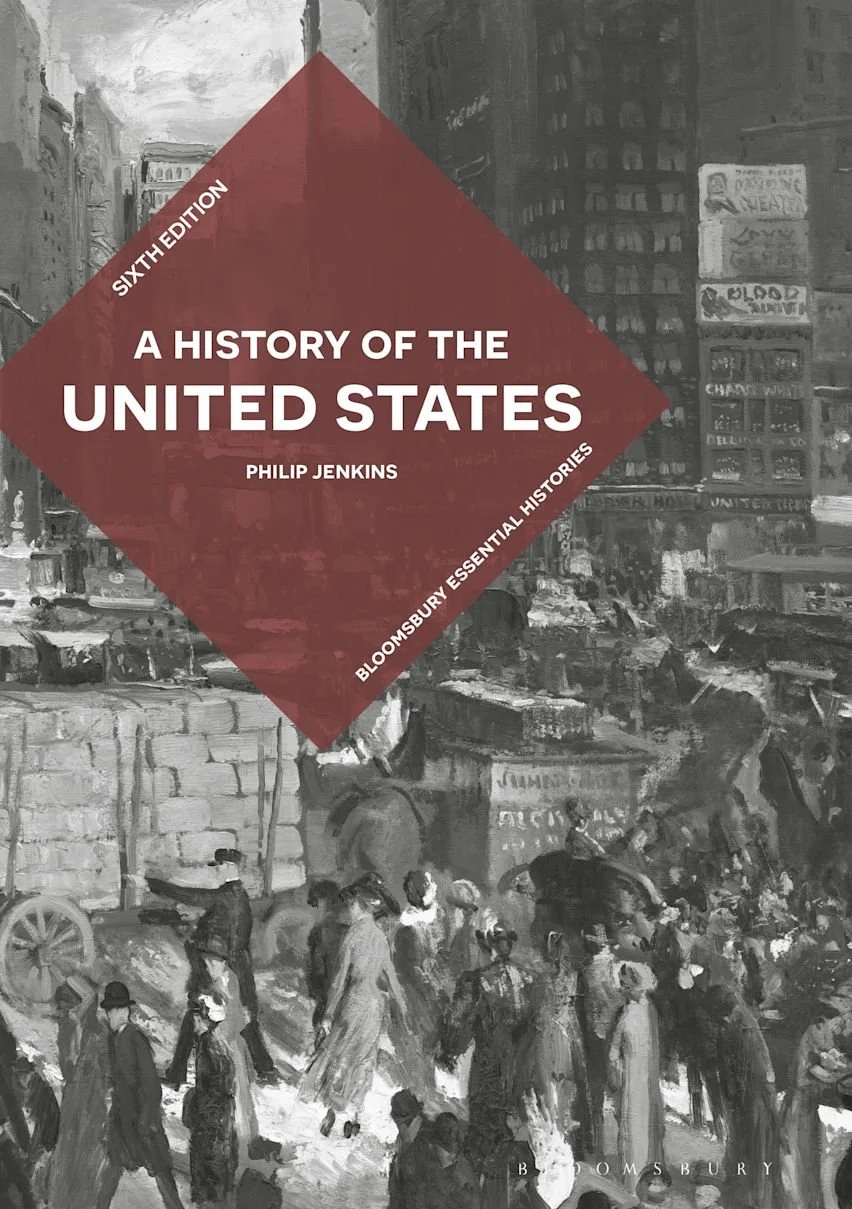
/One of the best perks of teaching is the opportunity to review examination copies of textbooks. This morning I received a copy of the new sixth edition of A History of the United States, by Philip Jenkins, part of Bloomsbury’s Essential Histories series. Jenkins is a historian of religion whose work I’ve greatly appreciated over the years, and I was excited to discover that he’s also written a short, one-volume American history text. I’m reading it with a view to replacing the late Robert Remini’s Short History of the United States in one of my online adjunct courses.
So far it’s off to a good start. One of the challenges of teaching history is trying to draw attention to recurrent patterns or themes. The standard multi-author committee-produced textbook—what you think of when you hear the word—usually does this clumsily, if at all. A single-author text that pays a bit more attention to literary qualities, like Remini’s Short History or Wilfred McClay’s Land of Hope, can develop these themes and throughlines narratively as it goes—which is also, not coincidentally, how I teach the subject.
Jenkins begins by explicitly laying out the themes he wants the reader to notice in a dedicated introductory chapter. Ordinarily this wouldn’t be my favorite approach, but it allows Jenkins to describe some of the peculiar parameters of American history very specifically, priming the reader to detect them. I especially liked what he had to say about two in particular:
First, having established “the tyranny of distance” as one of the key factors in the story, he points toward the differing trajectories and cultures of the US’s many regions, the two earliest and most important of which are the north and the South:
Different regions produced their own distinct cultures, the exact nature of which has given rise to much debate. The question of “Southern-ness” has been a popular topic for such works, though the very term betrays the prejudice that it is the south that is untypical from an American or even world norm. In terms of its history of slavery and racial hierarchy, the American South closely resembles the worlds of the Caribbean and of much of Central or South America. We could equally well argue that it was rather the north of the early nineteenth century that produced a set of cultural and intellectual assumptions that were bizarre by the standards of the contemporary Western world, while the aristocratic, rural, and deferential south was a much more “normal” entity than its egalitarian, urban, and evangelical neighbors. For anyone acquainted with the astonishing social turbulence of the Northern cities before the Civil War, it is startling to hear claims that it was the south that had a peculiar tendency to violence.
This is not just about geography but about culture and historiography. For a long time, the extent to which New Englanders have portrayed their story as normative, as the story of the US to which recalcitrants and rebels have to be brought into conformity, has been invisible. (Why, for example, did the entire country just celebrate a holiday inspired by the Pilgrims?) This can lead to especially warped interpretations since, as Jenkins points out, the culture that arose in the northeastern US is such a weird historical outlier. Restoring a broader perspective creates a better understanding not only of north and South, but of the whole.
Even more crucially, Jenkins pushes back against whiggishness, the assumption that history moves determinedly along toward a particular endpoint, both of the present and the past:
Yet when we tell the story of US expansion, it is tempting to describe a natural and even inevitable process, by which the Lower Forty-Eight acquires its predestined dimensions and natural borders. That was certainly how Americans thought, and how they recorded events, and we still use the phrase that was commonly cited to describe this process. . . .
The speed and seemingly irresistible weight of American expansion make such a narrative of Manifest Destiny tempting. US histories can look like a map on a television documentary, with an illuminated core region along the East Coast, which spreads swiftly and inevitably over those hitherto dark regions, which in turn become lit up as they achieve their authentic destiny of being included in that United States. It is hard not to write the story backward, as if the ending was always predetermined. The problems with such an account are many[.]
Among these problems is the implied sense of inevitability Jenkins mentions, a sense rooted in the most subtle and insidious bias of historical study, historian’s fallacy, which erases the fog in which historical figures operated. Jenkins emphasizes contingency and the fact that historical actors didn’t know the end of the story. Here’s an example I mentioned, with reference to this piece by Jeremy Black, in my Substack digest over the weekend:
For much of American history, many Americans were convinced that the lands that became Canada would inevitably fall into the possession of the United States. That was a real prospect during the War of 1812, and frequent later tensions between the United States and Great Britain made it highly likely that Canada would someday be a theater for American conquest and annexation.
There’s what word inevitably again. (A helpful rule: when trying to understand a past culture, look at what the movers and shakers thought was inevitable at the time.) Jenkins expands on the problems of assuming inevitable outcomes, of “arcs” “bending” toward particular results:
Quite apart from any cultural or racial biases, the whole idea of “inevitability” is shaky. The emergence of the continental United States with its boundaries, that Lower Forty-Eight, was contingent, dependent on the outcome of political struggles and social movements. It is easy to imagine scenarios when the United States would have acquired a very different shape, and this is no mere issue of speculative alternative history. We are dealing with what well-informed people believed or hoped in those earlier eras. Most basically, it was far from obvious to contemporary observers that the United States would have resisted multiple serious efforts at secession or partition, which reached their peak during the 1860s. In retrospect, we know that the nascent Confederate States of America created in 1860 would not endure as a major New World power, or that the remnant United States of America would not be confined to the north-east and Midwest; but Abraham Lincoln could not take that fact for granted.
What happened was not inevitable, things could have turned out differently, and uncertainty is an important part of every historical story. Conveying these facts is an important part of my approach to teaching, and I’m hopeful that the rest of Jenkins’s book will underscore these themes.
For what it’s worth, I’d still recommend Remini’s book, but Remini’s narrative is a little too complacently satisfied with the postwar liberal consensus—the idea of America as an idea, gradually developing its doctrines to ever fuller and broader degrees—which is itself a kind of whiggishness. And when initially selecting a text for this course I considered McClay’s book, but its otherwise excellent narrative has a few too many major omissions (the Plains Indians Wars)—yet another historiographical and teaching problem.