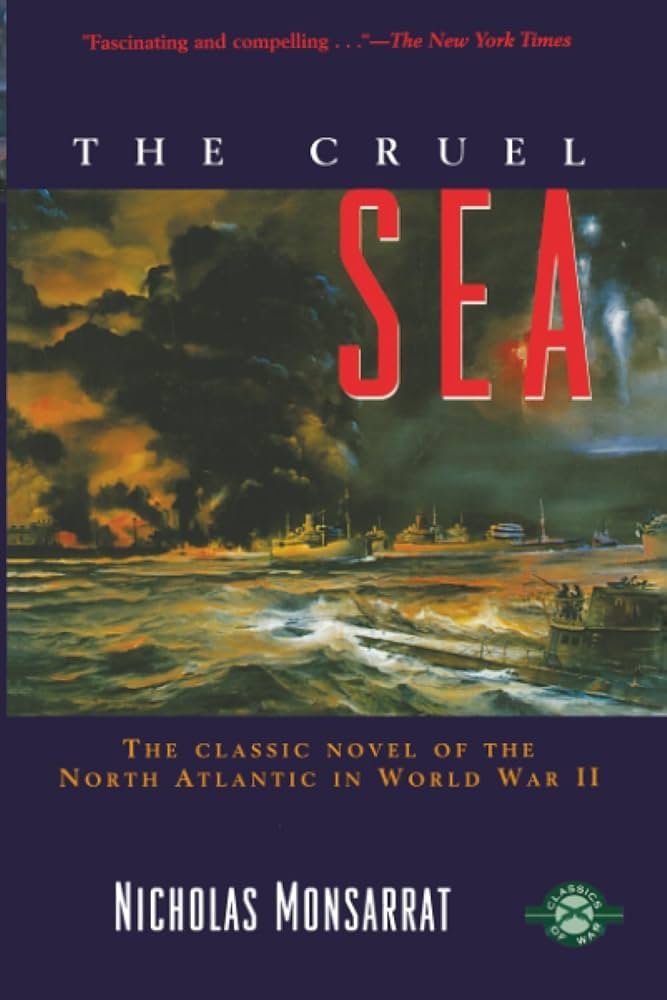
The Cruel Sea
/Several years ago I read CS Forester’s 1955 World War II novel The Good Shepherd, a short, intense story about an American destroyer captain as he attempts to protect a convoy through the worst of the U-boats’ hunting grounds in the North Atlantic. Though told in the third person, it is intensely, claustrophobically internal, bringing the reader into intimate contact with both the calculating mind and physical punishment of its protagonist over the worst 72 hours of his career. It’s excellent, one of my favorite reads that year. The Cruel Sea, published in 1951 by Royal Navy veteran Nicholas Monsarrat, is even better.
Beginning in a Scottish shipyard in the fall of 1939, The Cruel Sea introduces the captain, Commander George Ericson, a dedicated but undistinguished officer who already has a long career behind him, as he takes command of a newly constructed corvette, the HMS Compass Rose. He also meets his three junior officers—the untried Lockhart and Ferraby, a journalist and bank clerk fresh out of officer training, and the experienced but boorish Australian Bennet.
As the Compass Rose is fitted for anti-submarine duty in the North Atlantic, the reader gets to know the ship, its crew, and these central characters. Ericson is well-trained, disciplined, and eager. Lockhart, an unattached former freelancer, begins the war single and with few connections to make him fearful of combat; he’s cool and a quick learner. Ferraby, only twenty, utterly inexperienced and with a new wife at home, is uncertain and often unmanned by his lack of skill. Bennet, cowardly and lazy, pounces on that. Testing the new ship and undertaking its first missions into the warzone strains and exposes weak points in Compass Rose’s leadership. New officers and crew, like the posh, university-educated Morell, who has a flighty actress wife back home in London, and Baker, a young man obsessed with women despite his lack of experience with them, further complicate matters.
I don’t want to give much away about the plot. The Cruel Sea is not plot-driven. Having established its characters and their task—a task they’ll labor at almost without pause for six years—the story hums along on two brilliantly combined storytelling elements.
The first is the day-to-day reality of convoy duty and actual combat, both of which Monsarrat describes unromantically and with startling clarity. The drudgery and physical misery come through palpably, as do the horrors Compass Rose’s crew confront on nearly every mission. Sailors incinerated by the burning oil leaking from a torpedoed tanker, survivors discovered floating in their lifejackets weeks too late, a man dying of third-degree burns as a hapless officer rubs ointment on his exposed muscles, men wounded, drowned, frozen, blown to pieces—Monsarrat never embellishes or wallows in his descriptions, and the simplicity and directness of his narration makes it all the more disturbing and moving.
The second key element is the character of the men themselves, especially leaders. War, The Cruel Sea impresses upon us firmly, depends as much on relationships and leadership as it does on technology. This is a character study spread across six years of danger, combat, and death, and the smooth functioning of superiors and subordinates, their mutual trust, and the judgements each is empowered to make are as crucial as sonar, signal lamps, or depth charges.
Personal character matters. More than one man is wrecked by a bad relationship with a woman. The book’s title emphasizes the cruelty of the sea, but the torture some characters are put through by unfaithful wives rivals the sea for unfeeling destructiveness. Other men lead dissipated lives ashore or lives otherwise marked by moral weakness. Compass Rose’s greatest trial—again, I don’t want to spoil any specific incidents—painfully exposes the strong and the bad.
One incident I will describe, one of the most famous in the book and one included in the trailer for the 1953 film adaptation, combines the stress and danger and technical demands of combat with the problem of personal character and responsibility. In Compass Rose’s worst mission, a convoy to Gibraltar that is almost annihilated by U-boats, Ericson steers the corvette toward a group of men who survived the sinking of their ship and are struggling in the water. As he approaches he learns that Compass Rose has picked up a strong sonar signal directly underneath the survivors. It is almost certainly a U-boat. Ericson must decide in an instant: pick up the survivors and let the U-boat get away—and possibly even torpedo Compass Rose—or drop depth charges into the middle of the struggling men. He orders the depth charges launched. He lives with the consequences for the rest of the book.
The novel’s six-year span, with characters coming and going and the scene occasionally shifting to the homefront, to the Arctic convoy route to Murmansk, or even to Brooklyn, gives the reader a sharp sense of the experience of the war, especially its long years of struggle before success and the escalation of the violence. The first two-thirds are a bleak grind. The harshness of the work, the unrelenting danger, and the horrors and personal stresses the characters are subjected to hardens or dulls them by turns. They feel they have not only been caught in a machine, but worry about becoming machinelike themselves. Ericson struggles with memories of a softer, more flexible earlier stage of the war; a young sailor who went AWOL to check on his wife might have been let off with a warning in 1939, though by 1944 the same man committing the same offense would be sent to prison, and Ericson feels he must shut down even good-natured joking among his offers in order to maintain discipline. Lockhart, self-protective, closes himself off to all but his captain, but finds himself falling in love with a beautiful Wren and must decide whether to commit with the war unfinished.
Only late in the book do the characters realize that there is an end in sight, a sense that brings its own anxieties with it. By the time two of the central surviving characters stand together on the bridge of a different ship, different men from those they began the novel as six years before, we feel their gratitude that the war is over but understand why it is a muted, subdued gratitude—exhaustion, and much more besides.
I don’t want to give the impression that The Cruel Sea is especially dour. It has frequent moments of wit and levity of the best British kind—wry, understated, often dark—and its characters are a pleasure to spend time with. But precisely because Monsarrat has peopled his novel with such lifelike, sympathetic characters, when they suffer and die it is as powerful and agonizing as their good times were enjoyable. By the end the story has reminded us, in case we forgot, that every life has shares of joy and loss. Monsarrat makes us feel both.
Despite overlap in subject matter, the comparison I began with is not entirely fair. Both are excellent novels. But where The Good Shepherd concerns one man, a captain, over three days, The Cruel Sea follows multiple members of a ship’s crew across the entire duration of the war. The Good Shepherd is a minutely focused portrait of a leader in his most acutely stressful moment. The Cruel Sea, on the other hand, vast, changeable, dangerous, and beautiful like the sea itself, is an epic.