The Raven: The Classic Poem

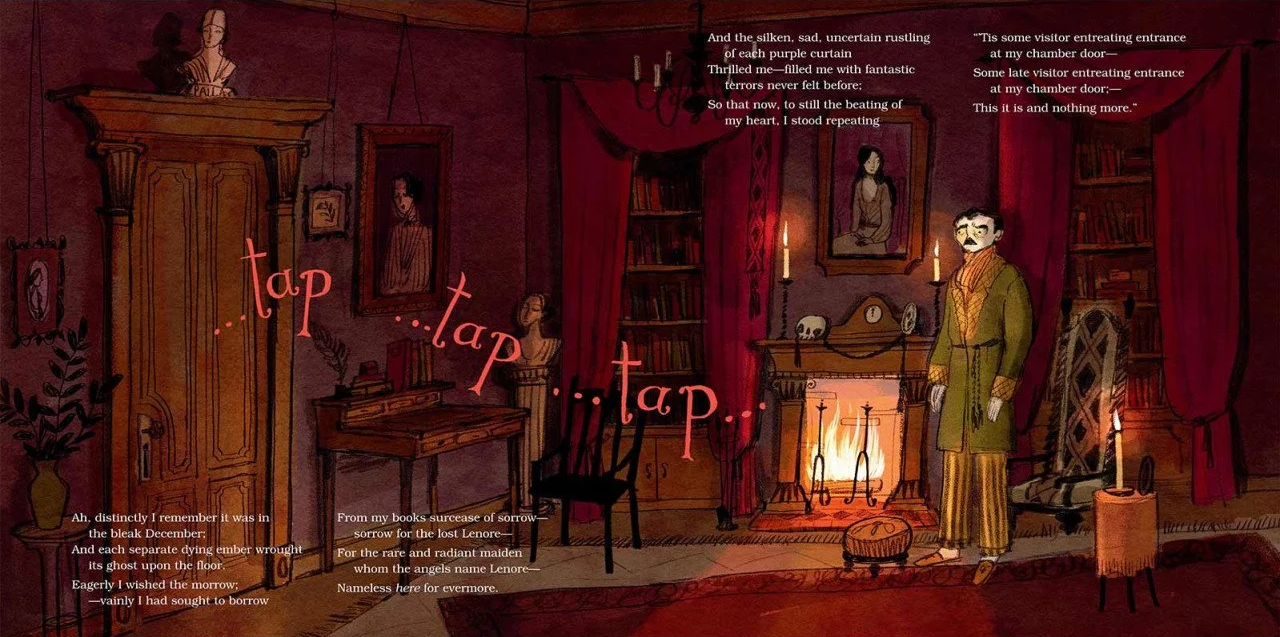
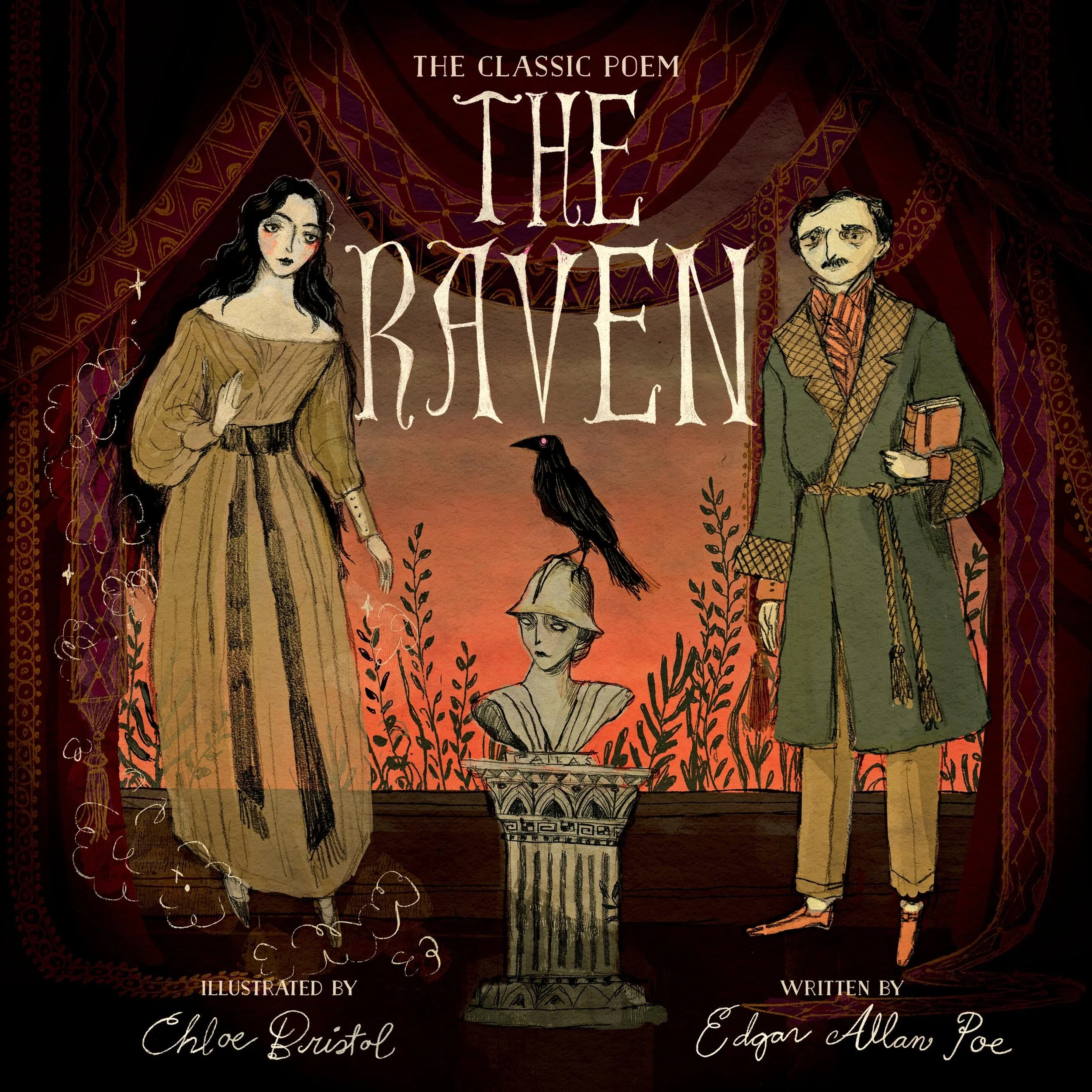
A representative two-page spread from The Raven as illustrated by Chloe bristol

Opportunities to share Edgar Allan Poe, one of my favorite authors, with my kids are vanishingly rare. Even good modern works meant to make his stories accessible to new readers, like graphic novelist Gareth Hinds’s excellent collection of Poe stories and poems, skew creepier and darker than necessary. As a result, I’ve told my kids a lot about Poe, summarized some of his best stories for them, and we’ve listened to audio performances of some of his work, but I haven’t found much visual media that can introduce Poe’s work to them without inducing nightmares.

I was excited, then, to discover this hardback picture book of “The Raven” at our used book store over the weekend. The Raven: The Classic Poem is a single Poe work given a thorough artistic treatment. Beginning with the poem’s speaker—depicted as Poe himself—drowsing in his armchair, the pictures follow the events stanza by stanza as he first wakes to a tapping, investigates its possible source, and finally admits the raven, which flits across the study to perch on the bust of Pallas. First the name “Lenore,” her shadow, and finally her ghostly form emerge with the narrator’s ruminations, and the pictures leave the narrator at the center of a giant, abstracted black shadow with one burning red eye.

This sounds simple and straightforward, but illustrator Chloe Bristol’s pictures imbue the familiar refrains of the poem with great weight and establish a wonderfully spooky and mournful mood. I can’t stress enough the perfect balance she strikes: atmospheric without being scary, gothic without veering into self-parody, faithful to the words of the poem while still being inventive and surprising.

I found Bristol’s artwork so good and such a support to Poe’s own words that I bought a copy on impulse. I read it aloud to my three oldest that night, and they were suitably engrossed in the pictures and chilled by the poem without finding it disturbing. I enjoyed reading it—and appreciating, for the first time in a good while, what a good poem “The Raven” is for performance—and together we enjoyed talking about it. Bristol notes on her website that the project’s stated aim was to make the poem “digestible” for younger audiences. She did exactly that.

The book ends with a one-paragraph biographical sketch of Poe that emphasizes the role of “The Raven” in his late-career fame. This is the one place I wish the book included more detail, but that’s a niggle. There’s a note explaining or clarifying some of what’s going on in the poem that should be helpful for parents, educators, or precocious kids picking up the book. It also includes some insight into Bristol’s approach to the illustrations, some of which are based on the rooms at Edgar Allan Poe National Historic Site in Philadelphia, one of the handful of surviving Poe houses.

But the main draw is Poe’s poem, which Bristol’s pictures beautifully showcase. Whether you love Poe and want to introduce him to your kids with an appropriate amount of spookiness or you simply enjoy good poetry and good picture books, The Raven: The Classic Poem is ideal for both purposes and well worth seeking out. I’m certainly glad I stumbled across it.

Richard Cory and ambiguity

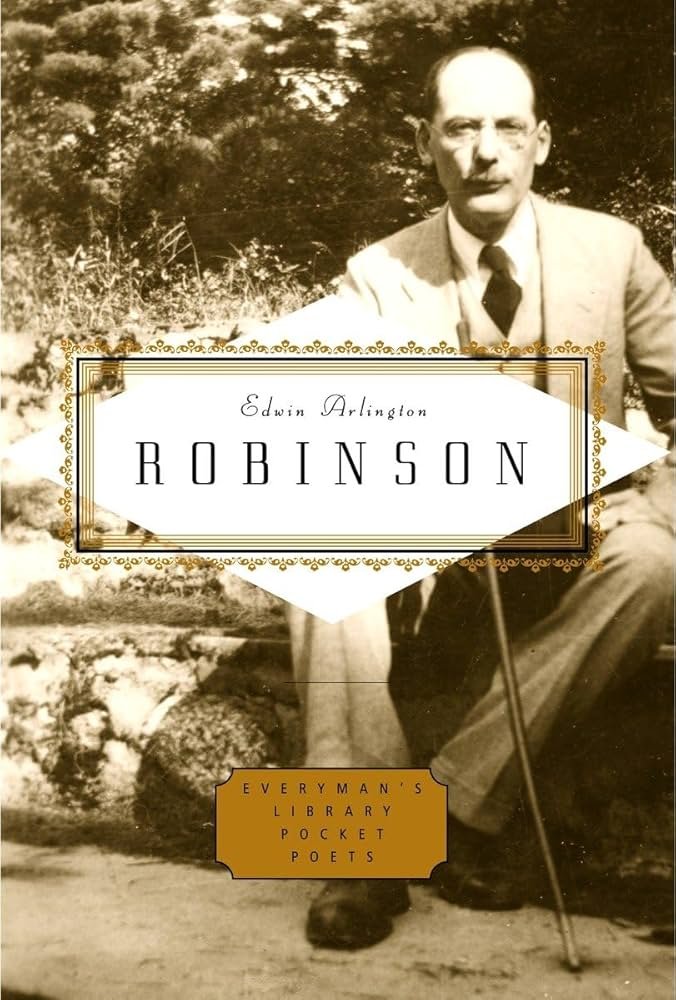
One of my favorite poets is Edwin Arlington Robinson. Though both popular and respected in his day, winning the Pulitzer for poetry three times, he seems largely forgotten now. I suspect this is largely a matter of timing: he mastered traditional form and meter, especially the sonnet and villanelle, just as Pound and Eliot and company were coming along to blow it all up.

Robinson’s skill also makes his tightly constructed verse seem effortless, even conversational. It’s clear and understandable—something else the modern poetry establishment, which came more and more to resemble a clique or cult, won’t abide—and mines powerful emotions from everyday scenes and images. Perhaps his best-known poems in this regard are a series of character sketches describing people from a fictitious New England village: “Reuben Bright,” “Aaron Stark,” “Luke Havergal,” “Cliff Klingenhagen,” and my personal favorite—read it and you’ll get why—“Miniver Cheevy.”

Another favorite, and one of Robinson’s most memorable, challenging, and dark, is “Richard Cory.” Take a minute and read it—I’m going to spoil it.

In sixteen lines, Robinson introduces us to a handsome, elegant, popular, courteous, and, yes, wealthy local gentleman, a man with everything going for him. Envy is perhaps too strong a word for the community’s attitude—Richard Cory is too well respected, if not beloved, to warrant envy—but the anonymous speaker of the poem makes it clear that Richard Cory lives in a world everyone else only aspires to. And then Richard Cory kills himself.

I still feel the shock of the final line all the years later, and the bitter irony with which it reframes the entire preceding poem. There is some ambiguity there—was Richard Cory discontent? ungrateful? depressed?—but the import is fairly clear: money can’t buy happiness, and you never know what troubles afflict someone of seemingly greater privilege than you.

The Simon and Garfunkel version, released on Sounds of Silence in 1966, traffics in a different kind of ambiguity. It’s less than three minutes long—listen to it here.

Paul Simon, in adapting Robinson’s poem, makes some noteworthy thematic changes. Where Robinson began with the impression Richard Cory gave his neighbors on the street and mentions his wealth last, Simon leads off with his wealth and even explains where it came from—an inheritance from his banker father, though we’re told later he owns a factory—highlighting the extent of his property and influence. “He had everything a man could want,” in this version, “Power, grace, and style,” which is the reverse of the human view Robinson gives us. (Simon also updates the outward signs of Richard Cory’s wealth for the swingin’ sixties with “the orgies on his yacht.”)

But the biggest change is the inclusion of a chorus, in which the anonymous speaker of Robinson’s poem, one of Richard Cory’s neighbors, comments on his own situation:

But I, I work in his factory
and I curse the life I’m living
and I curse my poverty
and I wish that I could be (3x)
Richard Cory.

The chorus comes around three times and, on its final repetition, which comes immediately after the announcement of Richard Cory’s suicide, it takes on a powerful irony. Much the way Richard Cory’s fate in the last line of Robinson’s original changes the feeling and meaning of the rest of the poem, in Simon’s lyric version it changes the tone and meaning of the chorus.

This is where the ambiguity arises. Just what kind of envy—certainly the appropriate word here—is the speaker revealing?

If Simon has directly addressed his adaptation anywhere, I haven’t seen it. But an interpretation I’ve run across again and again online takes the final repetition of the chorus to be an admission by the speaker that he wants, like Richard Cory, to kill himself. (This is the interpretation presented in the Wikipedia summary, which cites no sources.)

I don’t think this is correct. For one, it makes the speaker far too individual, where in both Robinson and the rest of Simon’s version the “we” and the “I” stand in for the whole community. It’s also nihilistic in a way I don’t feel jibes with the rest of the song or Simon’s general oeuvre. But, most importantly, I think it has a simpler, more straightforward meaning related to that of the original poem: people don’t learn. The desire for wealth and material comfort lead us to overlook, ignore, or wish away the problems that come with them. We all know money doesn’t buy happiness—it’s a cliche for a reason—but who actually lives as if they know that? Literature and mythology, not to mention real life, are full of people who choose wealth and success knowing it will destroy them.

The yearning-for-suicide reading, which is rooted in an apparent ambiguity, bothers me. I think it’s a misreading of the song, yes, but I also think ambiguity, which can be a valuable tool in the hands of a purposeful artist, is overvalued today. The ambiguous ending is a mainstay of twee arthouse cinema. But ambiguity ceases to be cute when applied to suicide.

While feeling down and exhausted over the last month I’ve been doing a slow reread of Chesterton’s Orthodoxy. Chesterton’s light and frothy reputation is belied by his serious treatment of a subject like suicide. Here he is in Chapter V, “The Flag of the World,” writing forcefully about the deadly sin at the heart of it:

Not only is suicide a sin, it is the sin. It is the ultimate and absolute evil, the refusal to take an interest in existence; the refusal to take the oath of loyalty to life. The man who kills a man, kills a man. The man who kills himself, kills all men; as far as he is concerned he wipes out the world. His act is worse (symbolically considered) than any rape or dynamite outrage. For it destroys all buildings: it insults all women. . . . [H]e is a mere destroyer; spiritually, he destroys the universe.

The power of Robinson’s poem and Simon’s song derives from the assumed heinousness of Richard Cory’s act. That’s why it’s shocking in both. His wealth, personal elegance, and position in life only make it ironic, not less terrible. If Richard Cory’s suicide is just one more option, one a person with far more reasons to be bitter might justifiably desire to take, the entire story loses its meaning and weight.

Maybe that’s what Simon intended. I don’t know—but it would ruin the song. As good a song as it is, Robinson’s poem, in its structure and its properly used ambiguity, is better, and better for us.

The Odyssey trailer reaction

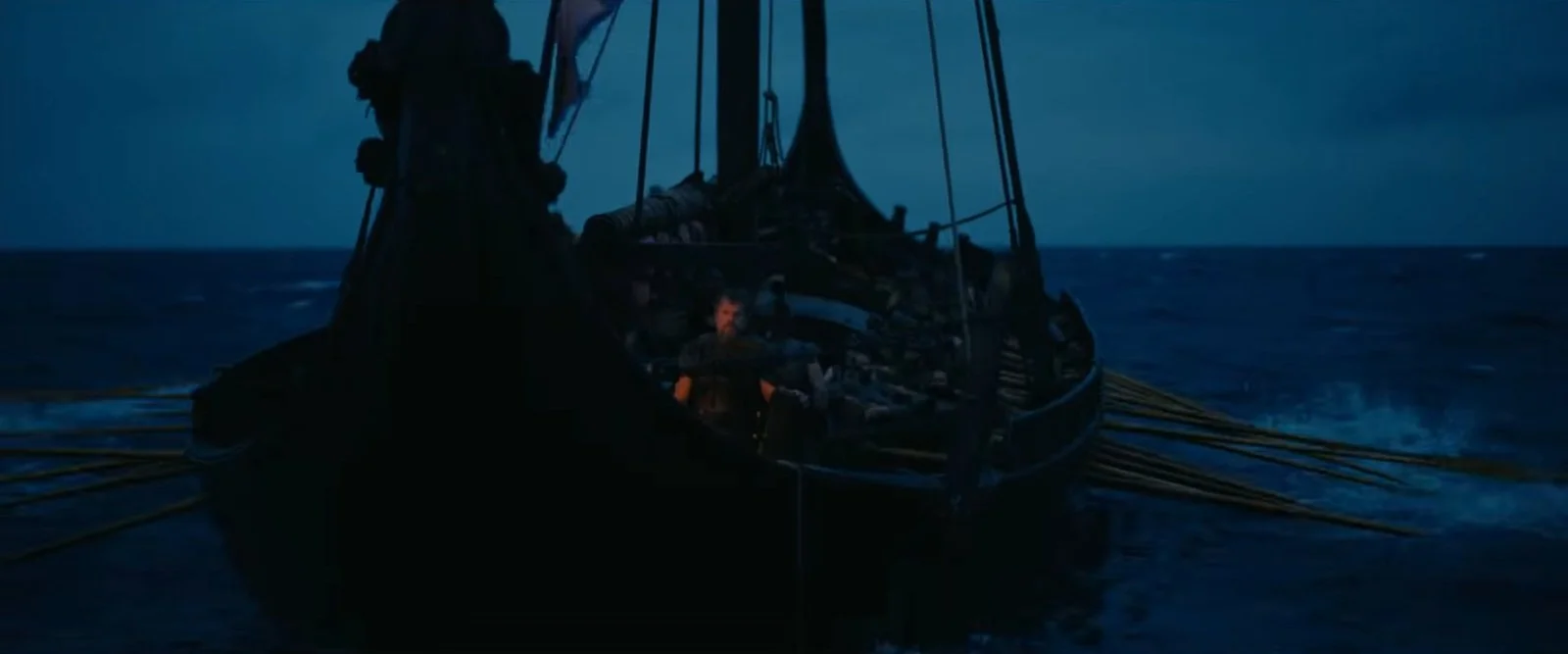
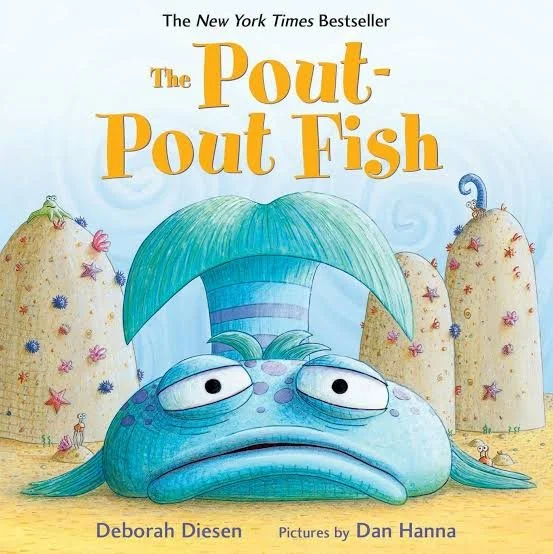
Matt Damon as Odysseus in the teaser trailer for The Odyssey (2026)

To say that Christopher Nolan’s treatment of Homer is highly anticipated would be an understatement. By the time I discovered the first teaser for The Odyssey this evening while doing some last-minute Christmas shopping for my kids, the official trailer on the Universal YouTube channel had been up twelve hours and already had 9.8 million views. (Addendum: In the time it’s taken me to dash off these thoughts and observations, the trailer has cleared ten million views.)

So, in a very real sense, what I think doesn’t matter. Here are my thoughts anyway.

I’ve mentioned recently that, while I like Nolan generally and love a couple of his movies, I think his success and the leeway studios have given him since he wrapped up his Batman trilogy have led him further and further into self-indulgence. This peaked with Tenet, which was entertaining because Nolan is a spectacular showman and completely incomprehensible because, with its involuted story, he leaned hard into all of his own worst instincts. Part of what kept it from being a pure disaster was that its slick near-future world was fitting for his style: Inception and Interstellar both fit the bill, as does the futuristic Wayne Enterprises tech of his Batman movies, especially The Dark Knight Rises.

But imagine that recognizable Nolan aesthetic—matte black tactical gear, brushed steel and brutalist concrete, affectless acting, and obsessive rejection of linear time—transferred to… the Bronze Age.

I follow a number of gifted historical and archaeological artists on social media and the scuttlebutt is that Nolan’s crew reached out to some experts in Mycenaean material culture and then ghosted them. It shows. Homer’s world was a world of elaborate courtesy and protocol, gold, jewels, and precious metals, and suits of burnished bronze armor that thundered when their warriors leapt from their chariots to do battle. Matt Damon’s crew from Ithaca look like someone asked an LLM to blend 1950s sword-and-sandal Romans with a SWAT team.

That’s harsh, I guess. I’m not particularly hopeful. As much as I like Nolan, he has to be one of the filmmakers least suited to this kind of story. (Let me second what some of those historical artists have wished for: a Homer adaptation from Robert Eggers.) If I hope anything, I hope I’m wrong.

With (most of) the negativity out of the way, here are a few things that impressed me in this teaser:

  • The IMAX cinematography looks atmospheric as Hades, so to speak. Hoyte van Hoytema is working with Nolan again and a number of the brief glimpses we get of major episodes from the Odyssey look good in strict filmmaking terms.

  • Anne Hathaway as Penelope looks pretty woebegone in her brief appearance. I like Hathaway but wonder if she has the requisite cunning for the woman who was so perfectly matched to Odysseus. (My ideal casting: Rebecca Ferguson, who combines regal beauty with obvious, potentially terrifying intelligence.)

  • I like the shots in Polyphemus’s cave, but am puzzled that we actually get a brief glimpse of a giant, shadowy form entering behind Odysseus’s men. Word was that Nolan’s Odyssey would be demythologized to some degree. Perhaps not? Or will the adventure scenes be Odysseus’s exaggerated retelling? If Nolan indulges in his nonlinear storytelling it will surely be when Odysseus is rescued and hosted by the Phaiakians and tells them his story—a portion of the poem that, to be fair, lends itself to Nolan’s thing.

  • We get a glimpse of Benny Safdie as Agamemnon near the beginning. Ridiculous Greek fantasy armor. Perhaps an artifact of Odysseus telling an embellished version of his story?

  • We don’t see him in the trailer, but Jon Bernthal is listed as playing Menelaus. I’d like to have seen him—or someone like him—in the lead. Bernthal looks tough and has unbelievable charisma. Somehow he keeps getting slotted into second-fiddle roles behind flat, awkward leads (e.g. “The Pacific,” in which he by all rights should have played John Basilone, and “The Walking Dead”). Robert Pattinson is also slated to play Antinous, one of Penelope’s suitors, which should give him plenty of opportunities to steal the scene.

  • Back to the trailer. We get brief glimpses of the Trojan Horse. No idea what the Achaians are doing hoisting it out of the sea, but the shots of the warriors crammed inside look great.

  • Near the end we get some eerie shots of what appear to be Odysseus’s journey to the underworld. Not at all what I imagine when reading the story, but exceptionally atmospheric and spooky. Rightly so. Curious to know if we’ll see a bored, disillusioned Achilles.

  • Devotees of ancient Greek shipbuilding are upset about behind-the-scenes images of the ships here. I know just enough to identify them as clinker-built, which is right for the Anglo-Saxons and Vikings but obviously wrong for Mycenaean Greece. That may or may not bother you.

  • We end with an Odysseus and Penelope before the war, who seem much weepier and worrisome than the figures from Homer. Homer’s Odysseus cries, to be sure, but only after twenty years of bloodshed and captivity. Maybe it’s just that I have a hard time taking Matt Damon seriously when he channels high emotion. (His outburst as General Groves in Oppenheimer came across to me as impotent rather than righteous rage.)

So—we’ll see. This is a teaser trailer with perhaps a minute of footage, after all, and much of the film’s staggeringly large cast doesn’t appear at all. (Keeping Zendaya—as Athena!?—offscreen might have been a smart move.) It will certainly trade in spectacle, and maybe that will be enough. I’ve loved plenty of other atrocious historical films on that level (Exhibit A, Exhibit B), but something else those movies had going for them was strong performances and surehanded storytelling. Again—we’ll see.

I’m with those who were hoping for something a bit more meticulous in its reconstruction of Homer’s world, something we still haven’t really seen onscreen before. But that, for better or worse, is not Nolan’s forte. Even from this teaser it’s clear that he’s put his unmistakable stamp on the story. My hope is that, even without material fidelity to the original’s world, Homer himself will once again prove so strong that his power will shine through despite the filmmakers.

Great literature is popular literature

…but not necessarily vice versa.

Two items that got my attention this week and continue some literary themes I’ve thought a lot about over the years (eg here, here, and especially here):

First, a writer at Front Porch Republic bookends his review of Alan Jacobs’s new book Paradise Lost: A Biography with an interesting story. Here’s the beginning of the review:

As I drove into a hotel parking garage one afternoon, I mentioned to the attendant that I had come for a conference on John Milton. “Milton?” he replied. “Wasn’t he the one who had Satan say it’s better to reign in Hell than serve in Heaven?” Yes, I said, that’s the guy!

and the conclusion:

Jacobs ends the book by asking whether Paradise Lost has any future outside of academic scholarship. He suggests that yes, it might. . . . After all, if a parking garage attendant in an American city still knows who Milton is, there is hope that Paradise Lost will continue to find admiring readers in the twenty-first century.

Second, a friend on Instagram sent me this reel of an Italian butcher reciting part of Inferno in his shop. As I noted on Instagram, hearing a native recite Dante really brings out the rhythm of Dante’s verse and especially the rhyme of terza rima in a way I seldom get picking through a bilingual edition. But what I most appreciated was his exuberant enthusiasm for Dante and the way he brought that into his shop. Here’s a man who has passages of the Comedy memorized and can recite them at length for their own sake, not because he’s a tweedy professorial type or so that he can dissect and deconstruct them.

This brought to mind a story about Dante himself related by 14th-century Florentine writer Franco Sacchetti. One day Dante overheard a blacksmith singing some of Dante’s poetry but garbling the words, “clipping here and adding there,” which “seemed to Dante to be doing him a very great injury.” Dante entered the smith’s shop and started hurling his tools into the street. When the smith protested, they had this exchange:

“What the devil are you doing? Are ye mad?”

Dante asked him: “What art thou doing?”

“I am doing my own business,” answered the smith; “and ye are spoiling my tools, throwing them into the street.”

Said Dante: “If thou desirest that I should not spoil thy things, do not thou spoil mine.”

“Thou art singing out of my book,” Dante explains later, “and art not singing it as I wrote it; I have no other trade but this, and thou art spoiling it for me.” Again—a writer’s words matter.

But that’s not my point here. What struck me in both stories were the humble—a butcher, a parking lot attendant—knowing their epic poetry (albeit imperfectly in the case of the smith, but who wouldn’t prefer a world in which you could walk downtown and hear tradesmen and shopkeepers talking about great literature, even if they make mistakes quoting it?). And they didn’t just know this poetry—it mattered to them. In case we needed any further proof, great literature really is for everyone and always has been.

By the way, the butcher is eighth-generation butcher Dario Cecchini. Here’s his shop and one of his restaurants, which specializes in fantastic-looking steaks. If and when I ever visit Florence again, this is on my to-do list. And he’s reciting lines from the beginning of Canto V of Inferno.

Artistic appreciation comes first

I was revisiting Chesterton’s Everlasting Man over the weekend and was struck by this passage in the opening paragraph of Chapter V, “Man and Mythologies”:

It seems strangely forgotten nowadays that a myth is a work of imagination and therefore a work of art. It needs a poet to make it. It needs a poet to criticize it. There are more poets than non-poets in the world, as is proved by the popular origin of such legends. But for some reason I have never heard explained, it is only the minority of unpoetical people who are allowed to write critical studies of these popular poems. We do not submit a sonnet to a mathematician or a song to a calculating boy; but we do indulge the equally fantastic idea that folk-lore can be treated as a science. Unless these things are appreciated artistically they are not appreciated at all.

That last line is gold.

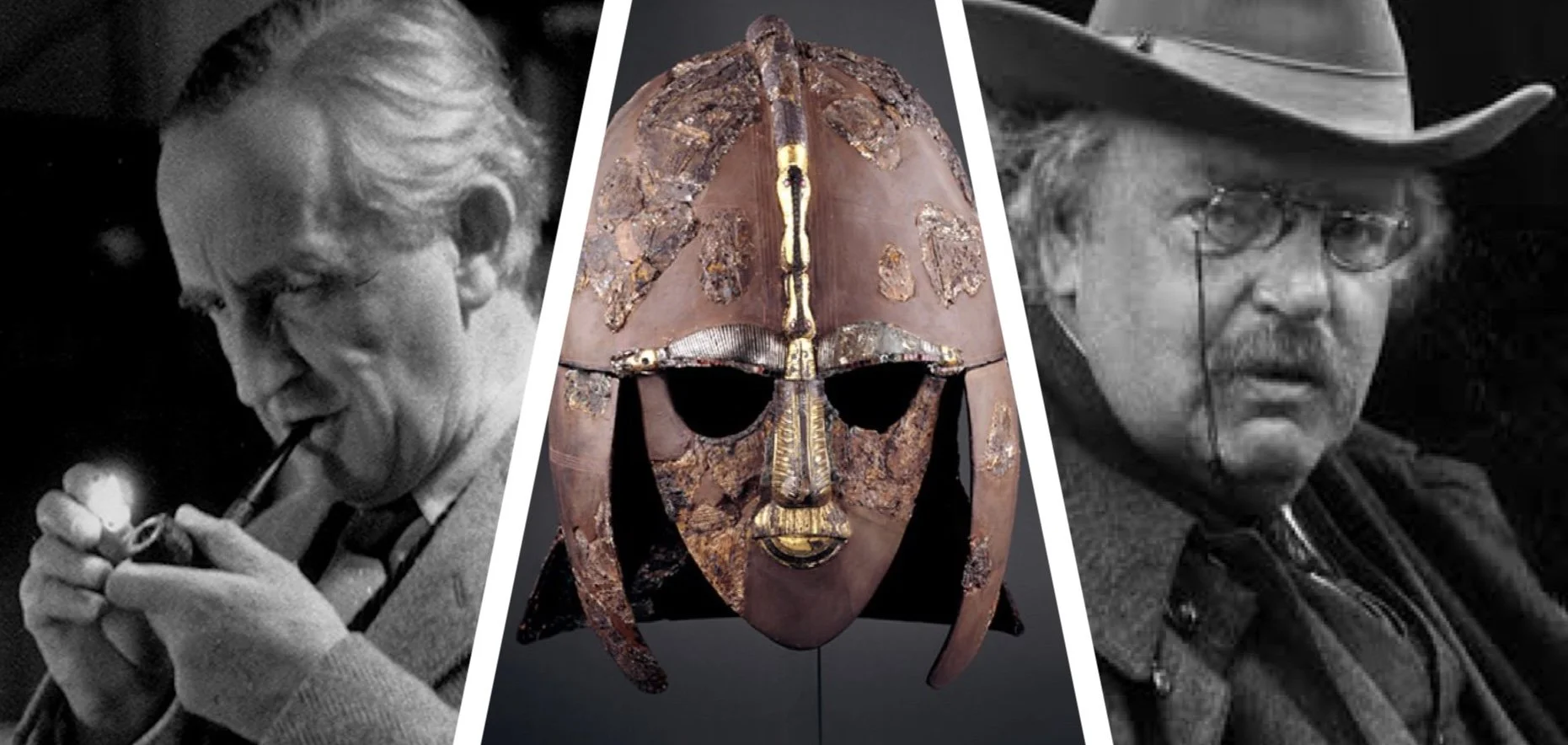
What I found striking was that Chesterton is essentially making the same point about understanding and interpreting mythology in general that Tolkien was in his lecture “Beowulf: The Monsters and the Crtiics.”

Unless these things are appreciated artistically they are not appreciated at all.
— GK Chesterton

Early on Tolkien asks “why should we approach this, or indeed any other poem, mainly as an historical document?” And after summarizing the many prevailing angles of scholarship—and sometimes mere prejudice—from which Victorian and early 20th century scholars dismissed Beowulf as worthy of study, he argues: “[I]t is plainly only in consideration of Beowulf as a poem, with an inherent poetic significance, that any view of conviction can be reached or steadily held.”

And he makes his point about the misunderstood—or simply missed—artistic purpose of the poet in a famous allegory:

A man inherited a field in which was an accumulation of old stone, part of an older hall. Of the old stone some had already been used in building the house in which he actually lived, not far from the old house of his fathers. Of the rest he took some and built a tower. But his friends coming perceived at once (without troubling to climb the steps) that these stones had formerly belonged to a more ancient building. So they pushed the tower over, with no little labour, in order to look for hidden carvings and inscriptions, or to discover whence the man’s distant forefathers had obtained their building material. Some suspecting a deposit of coal under the soil began to dig for it, and forgot even the stones. They all said: ‘This tower is most interesting.’ But they also said (after pushing it over): ‘What a muddle it is in!’ And even the man’s own descendants, who might have been expected to consider what he had been about, were heard to murmur: ‘He is such an odd fellow! Imagine his using these old stones just to build a nonsensical tower! Why did not he restore the old house? He had no sense of proportion.’ But from the top of that tower the man had been able to look out upon the sea.

This is not to deny the value of doing the historical, cultural, and linguistic spadework to gain better understanding of mythology and its place in a given culture. That would be an overcorrection, as Tom Shippey has argued, in Beowulf and the North Before the Vikings, that Tolkien’s lecture unintentionally swung the pendulum too far away from studying Beowulf for its history, so that Beowulf and Hrothgar are assumed to have the historicity of Leda and the swan.

These things require balance, but the artistic and imaginative—what Chesterton elsewhere in the same book called “the inside of history”—must come before historical parsing and sociological datamining. Once the artistic purpose is understood, what the myth-makers were hoping to see or show us from the top of their construction, the rest will fall more clearly into place.

Palma’s Divine Comedy

Considering how much space his work takes up in my mind, I don’t write about Dante often enough here. Some books you read so early, and at such a formative time, that they become part of the foundation of one’s taste, worldview, and imagination, informing everything without always being seen. The Divine Comedy is one of those for me, and I want to make a rare comment about it here, specifically in praise of the recent English translation by Michael Palma.

One of the commonplaces of writing about Dante in English is the difficulty—in English—of terza rima, the rhyme scheme Dante created for the Comedy. This is a “threefold rhyme” of aba-bcb-cdc-ded-efe etc, with each tercet linking ahead and behind. It’s elegant, beautiful when done well, and theologically significant. (Dante’s three-part epic ends with a vision of the Trinity, after all.) All well and good, but it’s also a bear to work with. As many, many translators have noted, the lack of inflected endings on English words severely limits possible rhymes in comparison with a Romance language like Italian.

What’s an English translator to do, then? The solutions depend greatly on a given translator’s priorities, which usually boil down to choices between the following:

  • Accuracy of wording or sense

  • Accuracy of tone

  • Accuracy of form, including rhyme

Wording, of course, is the most flexible of the three. Dante wrote in medieval Italian. The particulars of how one renders that in English is going to depend greatly on the latter two priorities. Most translators go for tone, capturing Dante’s force and directness while using an unmetered or loosely metered line and little or no rhyme. The most literal translations—Hollander and Singleton, for example—do this successfully. Dante comes through even if a notable aspect of the form doesn’t.

But there are rare translators who do chase the white whale of rhyme. The most successful have typically done so only when natural-sounding rhymes present themselves, like Anthony Esolen, long my favorite for reading, or by limiting or altering the rhyme scheme in some way, like John Ciardi, who rhymes the first and last lines of each tercet and doesn’t worry about the rest. Both suggest what Dante sounded like without straining.

Much more rare is the translator who tries to do the entire Comedy in Dante’s rhyme. Dorothy Sayers is the most famous example. While her notes are rightly praised and valued, her translation, in retaining terza rima, lengthens the poetic line to accommodate involuted English constructions, the contorted grammar of which is larded with archaisms. One feels at all times the effort she is putting into achieving end-rhyme. While she manages to keep the rhyme, she loses Dante’s concision, energy, and wording. I’ve never found that a worthwhile sacrifice.

I mention all these technical considerations and poetic hazards to highlight Palma’s achievement in his Divine Comedy. He has successfully translated the Comedy in terza rima from start to finish—one hundred cantos!—without strain or contortion, without reaching for rhymes, and while accurately capturing both Dante’s wording and his forcefulness, directness, and every subtle emotional register. Words, tone, and form all align effortlessly. I didn’t think it was possible.

The greatest pleasure of this reading of the Comedy, which I undertook at leisure over the last five weeks, was to glance up from the page and realize I’d been reading English terza rima without even noticing. Palma has made this great work, which I’ve read umpteen times over the quarter century since I discovered it in high school, fresh and powerful again. Dante’s final vision in Paradiso XXXIII, which I read this afternoon while giving an exam, was vivid to me in a way it has never been before.

Given recent receptiveness to formalism in translation—such as Emily Wilson’s blank verse Iliad and Odyssey—I hope Palma’s Comedy will find enthusiastic widespread appreciation. It will certainly take its place on my Dante shelf alongside Esolen, Musa, and Ciardi as one of my favorites. If you’re looking for a good opportunity to reread Dante or to read the Comedy for the first time, I heartily recommend it.

The damned and the blessed

Dante’s Comedy has three parts, but people commonly read only Inferno. I can somewhat understand why—Inferno is dramatic, fast-paced, and gossipy, with passages of seemingly straightforward horror. I think modern readers can also mistake Dante’s meditation on sin for salacious wallowing. But even if they read it in good faith, those who read only Inferno shortchange themselves.

I had already read the Comedy several times by the time I took Classical and Medieval Lit as an elective in college. (The chance to read my favorite book for credit was one reason I took it.) I’ve always been interested in structure as a part of storytelling, but it was in this class that my professor first drew my attention specifically to Dante’s use of parallelism across the three parts of the Comedy.

Case in point: I’ve been reading Michael Palma’s new complete translation of the Comedy and began Purgatorio last night. In canto II, Dante kneels to wash the smut of hell from his face—a requirement before he can enter Purgatory—and encounters a shipload of saved souls arriving to begin their purgation. They’re singing Psalm 114 as a hymn of deliverance and, before Dante can speak, greet him:

. . . with every face
turned toward us, the new people raised the cry:
“You there, do you know this mountain? If you do,
then show us the right road to climb it by.”

These souls are joyful and eager.

The contrast with the vestibule of hell, which parallels it in Inferno III, could not be more striking. There, instead of singing, there is pure, unrelenting, cacophonous noise. (“We will make the whole universe a noise in the end,” Lewis’s Screwtape asserts.) Instead of greeting Dante, the damned are too consumed with their tortures to do anything but flee the wasps that sting them. And where the souls arriving in Purgatory have a goal and direction, the damned run in circles—the central image of Inferno—forever.

The contrast extends through both books. In Purgatorio, souls repeatedly speak to Dante before they are spoken to. In canto IV, where I left off last night, the soul of Belacqua actually calls out to Dante and Virgil to get their attention; they wouldn’t have noticed him otherwise. The redeemed are as eager to share how God has saved them as they are to begin their sanctifying journey up the mountain. Here’s Manfred, a secular ruler who was excommunicated by multiple popes and only repented as he lay dying on the battlefield, in canto III:

After two mortal wounds had done for me,
weeping, I placed myself into the care
of Him who gives forgiveness willingly.
My sins were horrible beyond compare,
but the arms of Infinite Goodness open wide,
and all who return to It are gathered there.

The shades of the damned in Inferno, by contrast, are famously reluctant to give their names and are often identified by other souls out of pure spite. Grace gives direction and continues to unify and open, even after death; sin, aimless, turns in on itself and closes, especially after death.

Dante is one of the rare writers who can make goodness desirable, not least through contrast. After the thirty-odd cantos of ever deepening evil in Inferno, the opening of Purgatorio is the same splash of cool dew that cleanses Dante’s face. That tiny moment—a single tercet of dialogue—in which the new arrivals ask Dante where they must go to find the path upward filled me with an inexpressible yearning for grace.

Again, if you only read Inferno, you miss more than you might guess.

Intelligence in 1066

Harold Godwinson listens to a messenger in the Bayeux Tapestry

This morning on my commute I listened to the latest Rest is History Club bonus episodes. Among the questions Holland and Sandbrook fielded was one about the intelligence networks available during the Norman Conquest. Could William have known what Harold was doing before he sailed from Normandy?

Such questions are ultimately, per Holland, “unanswerable,” though it is not quite true that, as Sandbrook says, there is “no evidence.” The following passage from Wace’s Roman de Rou, which I cited and expanded upon in my master’s thesis, comes immediately to mind. From Glyn Burgess’s translation:

One of the knights in the area [of Pevensey] heard the noise and the shouting coming from the peasants and villeins, who saw the great fleet arrive. He was well aware that the Normans were coming with the intention of taking possession of the land. He took up position behind a mound so that no one could see him; he stood there watching how the great fleet arrived. He saw the archers emerging from the ships and afterwards the knights disembarking. He saw the carpenters, their axes, the large numbers of men, the knights, the building material thrown down from the ships, the construction and fortification of the castle and the ditch built all around it, the shields and the weapons brought forth. Everything he saw caused him great anguish. He girded on his sword and took his lance, saying he would go to King Harold and give him this news. Then he set out, sleeping late and rising early. He travelled extensively night and day in search of Harold, his lord, and found him beyond the Humber, where he had dined in a town. Harold was acting with great arrogance. He had been beyond the Humber and defeated his brother Tostig; things had gone very well for him. . . . Harold was returning joyfully and behaving with great arrogance, when a messenger gave him news of the sort which made him think differently. Suddenly the knight who had come from Hastings arrived.

‘The Normans have arrived’, he said, ‘and established themselves in Hastings. They intend to take the land from you, unless you can defend it. They have already built a castle with brattices and a ditch.’

Later, in a passage I’d forgotten about until rereading it this morning, Duke William benefits from similar intelligence:

In the land there was a baron, but I do not know his name, who had loved the duke greatly and become one of his close advisers; he would never have wanted things to go wrong for William, if he could manage it. He sent him word privately that he had come with insufficient forces; he had few men, he believed, to accomplish what he had undertaken. There were too many people in England and it was very difficult to conquer. In true faith he advised him, and in sincere love sent him word, that he should withdraw from the country and go back to his land before Harold arrived; he was afraid that things would go badly wrong for him.

Wace is a late, poetic source and is problematic for reasons both obvious (his portrait of Harold as a hubristic usurper) and subtle (using post-Conquest feudal terms like “baron” and “knight” and “villein” in an Anglo-Saxon context), but here he presents a plausible picture of what is now called HUMINT or human intelligence. It jibes with many, many other stories from the world before signals intelligence and aerial and satellite surveillance, a world of eyewitnesses desperately offering actionable information to their side’s leadership—something they can only do as quickly as the fastest horse can carry them—not to mention a world of rumor, uncertainty, and, in the case of the anonymous Anglo-Saxon lord who feeds information to William, secret betrayal.

Further, it jibes with the Bayeux Tapestry, which several times shows messengers bringing word to Harold, William, and others and the recipients listening intently, and other sources like the Anglo-Saxon Chronicle. When the Chronicle writes, over and over in every extant version, that Harold “was informed” or “came to know” of some new development, we should probably picture something like what Wace describes.

The evidence is extremely limited and raises as many questions as it answers, but it gives us enough for reasonable inferences. It also—and this is why I remembered the story so many years later—offers a rare glimpse of the men involved in these campaigns at the ground level. Who can read Wace’s account of that anonymous thegn, alerted by the people fleeing in terror and watching from behind a hill as the invasion proceeds unopposed, and not feel his “great anguish”?

You can read the whole passage of Wace in an older translation at Project Gutenberg here.

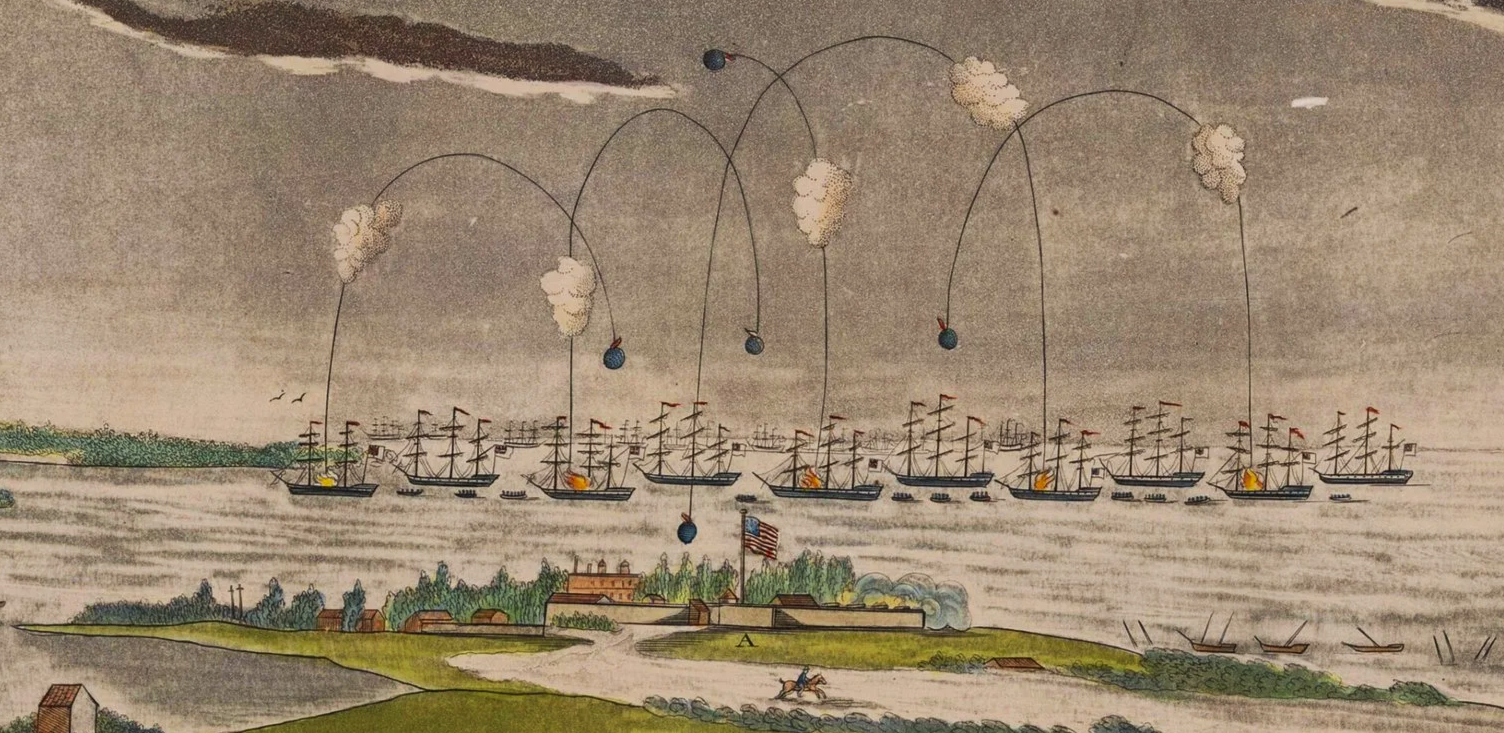
Butler, Palmerston, and the soldiering menace

Each week on Substack I publish a clerihew, my favorite form of light verse: a quatrain in AABB with intentionally awkward scansion and forced rhyme. The subject is always a person, whose name constitutes the first line. My clerihews usually concern historical figures. My subject last week was General Benjamin Butler.

The joke in the poem itself had to do with something tawdry that Butler, playing the part of the moneygrubbing Yankee to the hilt, supposedly did while dining at a wealthy lady’s home while in charge of the Union occupation of New Orleans. But in my brief historical note afterward I mentioned something for which he was infamous: General Order No. 28 of May 15, 1862, which reads:

As the officers and soldiers of the United States have been subject to repeated insults from the women (calling themselves ladies) of New Orleans in return for the most scrupulous non-interference and courtesy on our part, it is ordered that hereafter when any female shall by word, gesture, or movement insult or show contempt for any officer or soldier of the United States she shall be regarded and held liable to be treated as a woman of the town plying her avocation.

The women of occupied New Orleans had not welcomed the Union army or navy into the city and had shown repeated disrespect to them. One story has a lady emptying a chamber pot onto Admiral David Farragut. Cartoons depict them spitting at Union soldiers. One suspects simple snubs and insults were most widespread. But Butler could allow none of this to stand. In case it wasn’t clear, General Order No. 28 calls for any woman (he denies them the title “lady,” an obvious dig) disrespecting his troops to be considered and treated as a prostitute.

The reaction was predictable and swift. Here’s Confederate General PGT Beauregard, who issued a general order of his own in response, a straightforward appeal to gallantry and the protection of women’s honor:

Men of the South! shall our mothers, our wives, our daughters and our sisters, be thus outraged by the ruffianly* soldiers of the North, to whom is given the right to treat, at their pleasure, the ladies of the South as common harlots? Arouse friends, and drive back from our soil, those infamous invaders of our homes and disturbers of our family ties.

Political authorities weighed in as well. President Jefferson Davis condemned Butler. The Governor of Louisiana, Thomas Moore, published a longish open letter in which he echoed Beauregard, defended the women of New Orleans as reacting naturally to an invading foreign force, and, interestingly added force through historical argument:

The annals of warfare between civilized nations afford no similar instance of infamy to this order. It is thus proclaimed to the world that the exhibition of disgust or repulsiveness by the women of New Orleans to the hated invaders of their home and the slayers of their fathers, brothers, and husbands shall constitute a justification to a brutal soldiery for the indulgence of their lust. . . . History records instances of cities sacked and inhuman atrocities committed upon the women of a conquered town, but in no instance in modern times, at least without the brutal ravishers suffering condign punishment from the hands of their own commanders. It was reserved for a Federal general to invite his soldiers to the perpetration of outrages at the mention of which the blood recoils in horror.

Unable to penetrate deeper into Confederate territory or to break the spirit of civilian resistance, Moore suggests, Butler “sees the fruits of a victory he did not help to win eluding his grasp, and nothing left upon which to gloat his vengeance but unarmed men and helpless women.”

There’s a lot going on here, and more I could have quoted.

Over the years I’ve seen this incident downplayed as Confederate hysteria, with everything from “Lost Cause” mythology to “the patriarchy” playing a role. The short version: Southerners were ninnies upset about nothing, and anyway they deserved it. Sometimes the fact that Butler’s order did not result in a wave of rapes is adduced in support, but this is post facto justification. No one living through this could have known how it would turn out. The example of history gave them plenty to worry about.

And the historical dimension is what most piqued my interest. Reading up on Butler ahead of publishing that clerihew, I discovered in Library of America’s great four-volume set of primary source materials a British reaction to General Order No. 28. Here’s a note delivered by Lord Palmerston, then prime minister, to American ambassador Charles Adams (son of John Quincy, grandson of John) on June 11, 1862:

My dear sir,—I cannot refrain from taking the liberty of saying to you that it is difficult if not impossible to express adequately the disgust which must be excited in the mind of every honorable man by the general order of General Butler given in the inclosed extract from yesterday’s Times. Even when a town is taken by assault it is the practice of the Commander of the conquering army to protect to his utmost the inhabitants and especially the female part of them, and I will venture to say that no example can be found in the history of civilized nations till the publication of this order, of a general guilty in cold blood of so infamous an act as deliberately to hand over the female inhabitants of a conquered city to the unbridled licence of an unrestrained soldiery.

If the Federal Government chuses to be served by men capable of such revolting outrages, they must submit to abide by the deserved opinion which mankind will form of their conduct.

Adams asserted that he would not “recognize” Palmerston’s note—which was marked Confidential—“unless he was assured it was official.” Palmerston replied that it was, and publicly condemned Butler in a speech in the Commons. Adams, according to his secretary’s journal, “was much offended,” considering Palmerston’s note an “impudent” act of “insolence” and its arguments “sophistical.” Adams’s secretary, who viewed Adams as the winner of the tangle, thought Palmerston was projecting:

Knowing the brutality of his own officers and soldiers he readily imagined ours of the same stamp, and insolently presumed to lecture Mr. Adams on a thing which was not his business. His ill-manners were properly rebuked. American soldiers, he will find out, are not beasts, tho’ English soldiers are; and he will also learn that it is only a debased mind that would construe Gen’l Butler’s order as he has done.

If there is anything “sophistical” in this exchange, it is this. The explicit insult and implicit threat in General Order No. 28 were clear, hence the outrage. This is perhaps the first move in the long game of pooh-poohing the outrage at Butler.

At any rate, the women of New Orleans, Southerners generally, and foreign observers like Lord Palmerston knew what was up. So did Lincoln. Whether out of principle, canny strategic considerations, or for reasons of pure PR, Lincoln removed Butler from command in New Orleans in December 1862.

I was struck by the similarity of Palmerston’s appeal to that of Moore. Both correctly observe the dangers of a population of soldiers toward civilians in an occupied area. Both correctly observe that part of the long, slow evolution toward an ideal of “civilized” warfare involved the responsibility of leadership to protect civilians, even enemy civilians, and “even when a town is taken by assault,” which in the ancient world and much of the Middle Ages was understood to give the victor carte blanche to loot and rape.

Here’s something I’ve had to work hard to make my students understand given our “thank you for your service” culture of trust and admiration for soldiers: historically, soldiers were a menace. Even your own soldiers. (Perhaps especially your own soldiers, since if all was going well you would never see the enemy.) Discipline, martial law, flogging and the firing squad, and the inculcation of chivalrous ideals were partial solutions to the threat posed by large bodies of bored, strong, regularly paid young men to the civilian population, but only partial solutions. And these crumbled following the French Revolution which, as David Bell makes clear in The First Total War, rejected limited “civilized” warfare as an irrational fiction and embraced ruthless pragmatic brutality.

So, what to make of all this? Far from hysteria or Lost Cause mythologizing, the outrage was justifiable and the concern real. To pretend otherwise is partisanship.** Palmerston knew his history, and how thin and artificial the barrier between civilization and barbarism is. Adams imagined Union soldiers to have transcended history. One of these men is, at best, a deluded optimist.

A few years ago, quoting the Oxford History of Modern War, I wrote about the Civil War as a psychological conflict. Butler’s General Order No. 28 is a good example of what this looked like before the “frankly terrorist” campaigns of Sherman and others, campaigns that had more than a little of Jacobin total war in them. In addition to military victory, Butler needed to crush the enemy psychologically. Nothing short of abject subjugation would do, which is why Butler became a darling of the punitively-minded Radical Republicans. No “hearts and minds” here. In that way it’s of a piece with other nationalist wars.

* Appropriately, ruffian comes into English from Italian, in which it means “pimp.” Dante uses it in Inferno XVIII, the circle of panderers and seducers. Moore plays on the same theme when he writes that Butler can “add to infamy already well merited these crowning titles of a panderer to lust and a desecrator of virtue.”

** As a measure of the extent to which these events are still subject to purely partisan interpretation, why do we hear so much about the Southern desire to protect women being “misogyny” and “patriarchy,” but not Butler’s expressed intention to treat Southern women as prostitutes out of political spite?

Ties that could never be chosen

Yesterday Alan Jacobs shared a thought-provoking short post on “the redefinition of all legitimate relations as contractual ones and the consequent rejection of the validity of any connections that are not explicitly chosen,” a deep cultural shift that has made all of us more autonomous and less human. Jacobs mentions family ties specifically, which we all receive rather than select, and includes the following quotation from the late Sir Roger Scruton’s final book, a study of Wagner’s Parsifal:

Liberal individualism is an attractive philosophy, and has produced beautiful and influential theories of political legitimacy, including those of Locke, Harrison, Montesquieu, Rousseau and, in our time, John Rawls. But it does not describe real human beings. What matters to us, far more than our deals and bargains, are the ties that we never contracted, that we stumbled into through passion and temptation, as well as the ties that could never be chosen, like those that bind us to our parents, our country, and our religious and cultural inheritance. These ties put us, regardless of our aims and desires, in existential predicaments that we cannot always rectify.

As it happens, I’ve just finished reading a new edition of Waltharius, an early medieval Latin epic about Walter of Aquitaine. The poem is set in the mid-fifth century world of the Franks, Burgundians, Visigoths, and Huns. The action begins in the court of Attila somewhere in central Europe. There, we meet:

  • Walthari, heir to a Visigothic kingdom in the west

  • Hildigunda, daughter of the Burgundian king

  • Hagano, a Frankish nobleman

All three are hostages to Attila, collateral in a peace deal between Attila and their respective kingdoms. Further, Walthari and Hildigunda have been pledged to each other in marriage since childhood, and Walthari and Hagano, through the trials of combat in the ranks of Attila’s allied fighters, have become fast friends.

But then the peace treaty between Attila and the Franks ends and Hagano flees before he can be killed, and when Attila, as a reward for Walthari’s brave and loyal service (being a medieval hostage involved a lot more collaboration with one’s host than the word suggests now, and could be quite cushy), announces his plan to marry Walthari into his family and keep him on permanently, Walthari decides to flee, too, and to take Hildigunda with him. They love each other and don’t want their childhood betrothal undone.

One might expect a frantic pursuit across Europe but Walthari and Hildigunda’s flight goes smoothly until they reach Frankish territory. There, Gundahari attempts to stop them and confiscate not only Walthari’s horse and treasure but Hildigunda herself. He calls on Hagano’s aid, but Hagano refuses to fight his old friend until ten other men—including, crucially, some of his own kinsmen—have been killed. The climactic action is akin to that six-minute brawl in the alley in They Live, a brutal knock-down drag-out that ends with renewed friendship.

Much of the tension in Waltharius therefore comes from the attempts by the characters to honor unchosen obligations. Namely:

  • Walthari, Hildigunda, and Hagano’s hostage relationship with Attila, which was chosen for them by their families (and is threatened by events back home and Attila himself)

  • Walthari and Hildigunda’s betrothal, which was chosen for them by their parents (and is threatened first by Attila and then by Gundahari)

  • Walthari and Hagano’s friendship, which was chosen for them, in a sense, by Attila and their families (and is threatened by Gundahari)

  • Hagano and Gundahari’s lord-vassal relationship, which was chosen for them by Gundahari’s succession (and is threatened by Gundahari’s presumption and Walthari’s skill with a sword)

Per Scruton, these are conflicts that cannot easily be resolved, if at all, and medieval people were acutely aware of that. The conflict of obligations is hardly unique to Waltharius. Think of the Volsungsaga, in which Signy must not under any circumstances fail to avenge her father, but can only do so by killing her husband Siggeir, whom she must not under any circumstances fail to protect. No happy ending there.

In each case above, the characters must choose which obligation is prior, and honor that. One suspects that a modern person in similar circumstances would nope out of there, as the kids say. Medieval people had a word for that.

That “we cannot always rectify” such “predicaments” does not make them absurd, however. The unchosen is prior to and deeper than any transactional alternative that the world of what Jacobs calls “metaphysical capitalism” can offer. But one wonders, given the inescapable success of the commodifying, transactional vision of the world, whether a story like Waltharius is even intelligible to modern people.

All the more reason to read, study, and share it.

Take a minute to read all of Jacobs’s post, as well as the handful of earlier posts he links to at the top. The edition of Waltharius I read is an updated version of Brian Murdoch’s translation published by Uppsala Books. It’s a delight. Check it out here or at Uppsala’s website here.