The UFO Experience
/In the late 1940s, the US Air Force approached Professor J Allen Hynek with a request for his services as a consultant. The original wave of flying saucer sightings was at its height, and the Air Force, in its defense role, was investigating this strange new phenomenon. How many reports of strange flying objects were simply misidentifications of planets and stars? They hoped Hynek, a respected astronomer, could help rule such cases out.
Over twenty years and three Air Force projects later, flying saucer flaps had evolved into UFO mania, the reports had evolved from sightings to encounters to abductions, and Hynek had been there for all of it. The Air Force, however, having determined early on that, whatever UFOs really were, they weren’t Russian and apparently weren’t a threat, had lost interest. But public fascination with UFOs, thousands of sightings and rumored sightings, and the multiple competing mythologies growing up around the phenomenon only intensified. Due to Hynek’s high public profile thanks to the Air Force (he is the man who gave us “swamp gas” as a feature of UFO investigation), the curious often asked Hynek to recommend “a good book” on UFOs. The UFO Experience, published in 1972, was Hynek’s attempt to provide it.
This is an interesting book for two major reasons. The first is Hynek’s perspective, which is genuinely openminded and scientific. Hynek approached the problem of UFOs as a field researcher, requiring solid, extensive data and basing interpretations on the data rather than forcing data into preconceived explanations. This would prove one of his ultimate frustrations with the Air Force, a topic we’ll come back to.
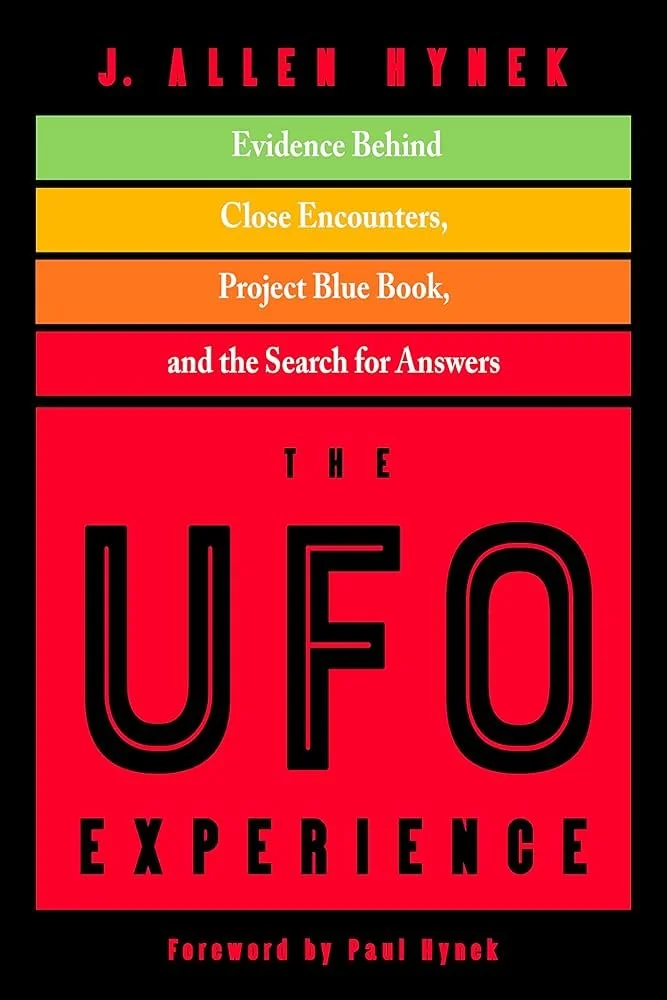
But data by itself isn’t of much use—it must be organized before it can be interpreted. And so approximately the first half of The UFO Experience is a taxonomy of UFO sightings with ample reference to cases Hynek (mostly) personally investigated. This is certainly the most famous part of the book. Even if you haven’t heard of Hynek, you’ve almost certainly heard the phrase “close encounter.”
Hynek’s taxonomy falls into two major categories with three subcategories apiece. The first are mere sightings: of nighttime lights; of “daylight discs,” the iconic 1950s flying saucer; and strange objects picked up on radar, possibly offering a hard empirical record of something seen by human witnesses. The second category, the close encounters, sightings of UFOs within 500 feet, a distance theoretically precluding misidentification of stars or aircraft, are of the first kind (sighting of an object in the air), the second kind (sighting of an object on the ground or otherwise physically affecting the environment), and the third kind (sighting of an object with the additional presence of some kind of living occupant).
Not only is this the most famous part of the book, it also has the best stories—the Levelland, Texas UFOs, the Lonnie Zamora sighting, and more. It also illustrates the other crucial scientific aspect of Hynek’s approach, which is his rigorously applied standards of evidence.
Hynek excluded from his study single-witness reports as too easily faked (or at least impossible to corroborate) as well as the testimonials of “contactee” types, flying saucer cultists who claimed to receive regular visits from extraterrestrials who offered touchy-feely advice on disarmament, among other things. In addition to prioritizing up-close sightings with multiple witnesses—preferably independent witnesses of good character or reputation—he factored in the subjective strangeness of reported sightings, an often overlooked data point. Contactee stories, with their feelgood peace-and-love vibes, were too obviously wishful thinking; more compelling were stories of inexplicable close encounters by honest people in professions requiring steadiness and sobriety—cops, doctors, farmers, engineers, military and commercial pilots, radar technicians, air traffic controllers. That many witnesses had been previously uninterested in UFOs was another important factor.
And Hynek, interestingly, found a lot of these, enough to convince him that, having eliminated out huge numbers of hoaxes and misidentifications, something strange was still going on. But understanding or explaining it would require a systematic approach through observation and testing and conclusions that did not exceed the possibilities suggested by the evidence. Hynek is, for example, notably skeptical of the Betty and Barney Hill abduction story, repeating but by no means endorsing their “recovered memories” of boarding the UFOs and enduring medical exams, and never endorses the extraterrestrial hypothesis.
Hynek’s primary concern is always to discover what we can say, scientifically and certainly, about what people have seen, and no more. But this careful, judicious approach was not apparently to the taste of the military, the public, or fellow scientists. He would be repeatedly disappointed.
That leads into the second half of the book, in which Hynek reflects on his twenty years doing the Air Force’s shoe leather work and examines some of the ways UFO investigations had gone wrong. I picked up The UFO Experience specifically to read about Hynek’s methodology, standards of evidence, and taxonomy—with all the good stories, being a non-believing, mostly aesthetic appreciator of the UFO phenomenon—but was surprised to find this half as interesting as the first. That’s because Hynek, though a thoughtful, judicious man, had scores to settle.
The first and most extensive is with the US Air Force. UFO lore of the Roswell coverup and Men in Black ilk posits Project Blue Book and its agents as omnipresent suppressors of information. Nothing could be further from the truth. Hynek criticizes Projects Sign, Grudge, and Blue Book as underfunded, understaffed, and headed by junior officers more keen to get promoted out of the position than to gather and assess evidence. Apathy was the rule, information-gathering was slapdash at best, and conclusions, in those instances when they were actually provided, were flippant and unconvincing. This only worsened once the projects had fulfilled their original purpose of determining whether the Russians were behind the UFOs.
Hynek also had harsh words for the scientific establishment, which refused to question its own paradigms in light of new evidence—the opposite of true science—and resorted to ridicule, blackballing, and naked appeals to its own authority to answer criticism and shut down public questions. They were also too eager to lump the curious in with the kooks. Hynek, in a prescient passage, predicts that these attitudes and browbeating the public with what one might now call, say, “settled science” will undermine science itself.
Hynek ends the book with a call for genuine curiosity, a willingness to investigate and incorporate knew knowledge, and a continued commitment to scientific rigor. I suspect he’d be still be disappointed.
This brings me to the second major reason I found The UFO Experience interesting, the purely historical—its place in the history of this phenomenon. Hynek wrote and published his “good book” on UFOs after they had become a secure feature of the American imagination but before some of the aspects we most commonly associate with it today had become mainstream. Abduction stories like the Hills’ were a relatively recent addition to the legendarium. The Pascagoula incident the year after Hynek published this book, the Travis Walton story two years after that, and Whitley Strieber’s Communion in the mid 80s—which also popularized the almond-eyed greys so often read back into the previous history—made abduction the central pillar of UFO myth and inextricably associated them with aliens.
Hynek also published The UFO Experience just four years after Chariots of the Gods, the original “ancient astronauts” book. Hynek, for whom many of the close encounters of the third kind he relates are, by his own standards, suspiciously “woo-woo,” makes absolutely no mention of this variety of UFO enthusiasm, which was genuinely fringe. It would require decades to grow and metastasize. But alongside the Roswell incident, which was resurrected and backfilled with UFO lore after Hynek’s time, ancient astronauts theories seemingly provide historical validation beyond the sudden appearance of flying saucers in 1947 and are responsible for much popular enthusiasm for UFOs now, from the History Channel (so-called) to Joe Rogan.
This book, then, arrived at a historical sweet spot, a moment of huge potential poised between how the original UFO legend began, how Hynek, newly free of the burden of government apathy, hoped it could develop, and what it would actually become. And that was certainly not more scientific.
The UFO Experience is a fascinating attempt by a principled, hard-working, thoughtful man to wrest some degree of scientific sense out of a phenomenon already buried under speculation, lunacy, and mockery. His standards of evidence and organized, taxonomical mind make for a fascinating presentation of the subject, and the cases he recaps and examines prove all the more compelling as a result. Not only has Hynek’s example shown me, personally, a way out of pure contempt for the believers, it’s a reminder of how rigorous, systematic thought and high standards could still salvage something useful out of a field that has only grown more bizarre since Hynek first applied his mind to understanding it.