Nolan’s Odyssey

I dashed off some initial thoughts on the first teaser trailer for Christopher Nolan’s adaptation of The Odyssey just before Christmas. I concluded with this: “Even from this teaser it’s clear that [Nolan has] put his unmistakable stamp on the story. My hope is that, even without material fidelity to the original’s world, Homer himself will once again prove so strong that his power will shine through despite the filmmakers.”

This is more or less exactly what I thought of the film, which I finally saw this Wednesday. Homer’s power and that “despite” both feature strongly in my opinion.

I won’t bother to summarize the story. Everyone knows a little bit of it and if you’re here, bothering to read this, you probably know it even better than most.

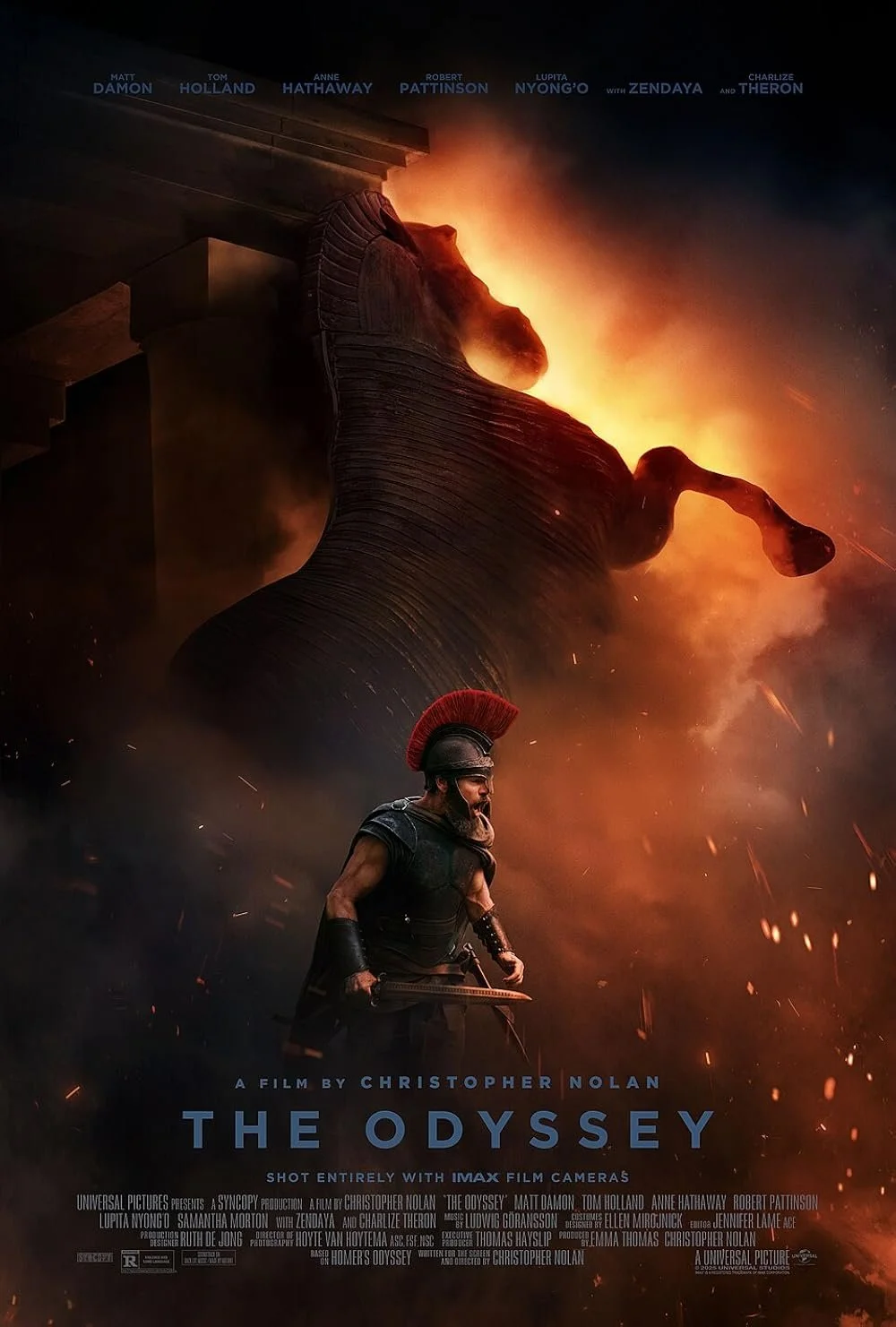
To begin with what I liked, The Odyssey is hugely entertaining. That’s the basic standard a good movie must meet, and as a movie The Odyssey is astonishing. (Its quality as an adaptation of a great work of literature is a separate question, which we’ll return to.) The film is technically accomplished, the IMAX cinematography and the staging of the many action scenes expertly done, and the special effects seamless. The vast, cast-of-thousands scale of sequences like the Fall of Troy is overwhelming in the best sense. And for all his practical effects street cred, Nolan wisely used CGI in a number of appropriate places, a lesson seemingly learned from the underwhelming attempt to mimic the atomic bomb with a practical gasoline explosion in Oppenheimer. And I’ll go ahead and say here that I think The Odyssey is a much better movie than that one.

The film’s pacing is strong but not flawless. I’ve heard a lot of people say the movie didn’t feel three hours long. That wasn’t my experience—it actually felt enormously long to me, but in a way that conveyed the scope of the story rather than simply being boring. The Odyssey’s strongest sections are, unsurprisingly, those depicting Odysseus’s wanderings. The cyclops scene is a small masterpiece, tense, terrifying, and suspenseful, and makes the familiar one-eyed giant strange and scary again. Likewise the passage between Scylla and Charybdis and, in an episode from the poem I always forget about, the monstrous Laestrygonians, depicted here as plate-armored giants who can turn the very trees against intruders. The most disturbing scene in the movie is certainly that involving Circe, whose transformation of Odysseus’s men using half-glimpsed body horror is both frightening and unspeakably gross.
My favorite sequences were certainly Odysseus’s encounter with the cyclops and his journey to Hades to speak to the shade of Tiresias. In mood, atmosphere, and technical execution they were flawless and totally absorbing. These sequences were also allowed to breathe, lingering and building tension in a way some others, though exciting, were not.

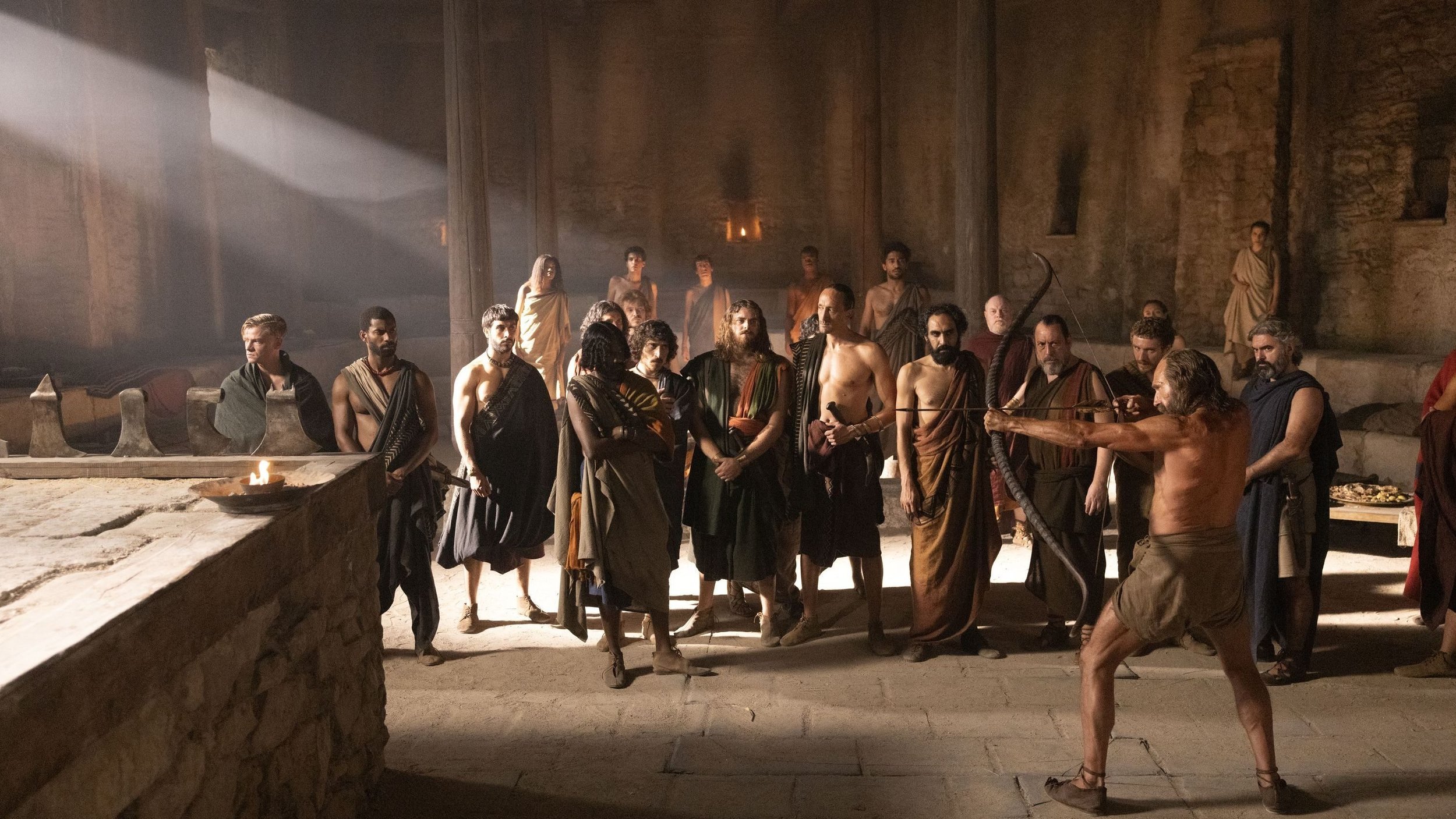
Another favorite, coming at the climax, is Odysseus’s slaughter of the suitors. Though not the film’s best action scene, it draws together many expertly prepared strands of the story—Odysseus’s bow, Antinous’s treachery, Telemachus’s arc toward manhood, and the utter loathsomeness of the suitors—in a satisfying explosion of violence. When Odysseus, having revealed himself to the crowd gathered in his palace by stringing his bow and shooting through the twelve axes, puts his next arrow into the throat of the first suitor to die, the audience at my showing clapped and cheered.

This climactic resolution is a good example of the dimension is which Nolan has most successfully adapted the Odyssey to the conventions of film—structure and resolution. The setups and payoffs necessary for a film to make sense and satisfy as a narrative are well done, likely his best work in this regard since The Prestige.

But easily the best aspect of Nolan’s Odyssey is just how much of the original is in here. It’s impressive for a movie that, though long, still comes in under three hours. While in most cases deviating from the plot of ancient literature in adaptation is accepted as necessary, Nolan hews very close, including things left out of other adaptations (the Laestrygonians, the sirens, Odysseus’s dog Argos) and leaving out little. Some of these omissions, like Nausicaa and the Phaiakians and the almost total absence of the gods, require reshuffling of other plot elements. We’ll return to this, but as an adaptation Nolan has chosen mostly wisely and with attention to narrative concision without sacrificing much.

As for The Odyssey’s flaws: with a couple exceptions I was unimpressed with the acting. Tom Holland had a welcome earnestness as Telemachus but felt stiff much of the time, and Zendaya performs Athena like a slightly less angry version of Chani in Dune, all frowns and glares. Matt Damon and Anne Hathaway were good in their roles as written by Nolan, but—again, a point we’ll return to—the cunning and wiliness of this eminently well-matched couple was missing. Damon’s Odysseus has blunt-force persistence but not much in the way of guile, and he lacks the glory-seeking and boastfulness that attract the destructive attention of Poseidon. Homer’s Odysseus had charisma. Damon’s is dogged, but one is not left wondering why his men would rebel against his authority.

The two exceptions—scene-stealers both—are John Leguizamo as Eumaeus and Robert Pattinson as the suitor Antinous. These two elevate the film, and Pattinson, who imbues Antinous with an awful oleaginous magnetism, is largely responsible for how satisfying Odysseus’s slaughter is.

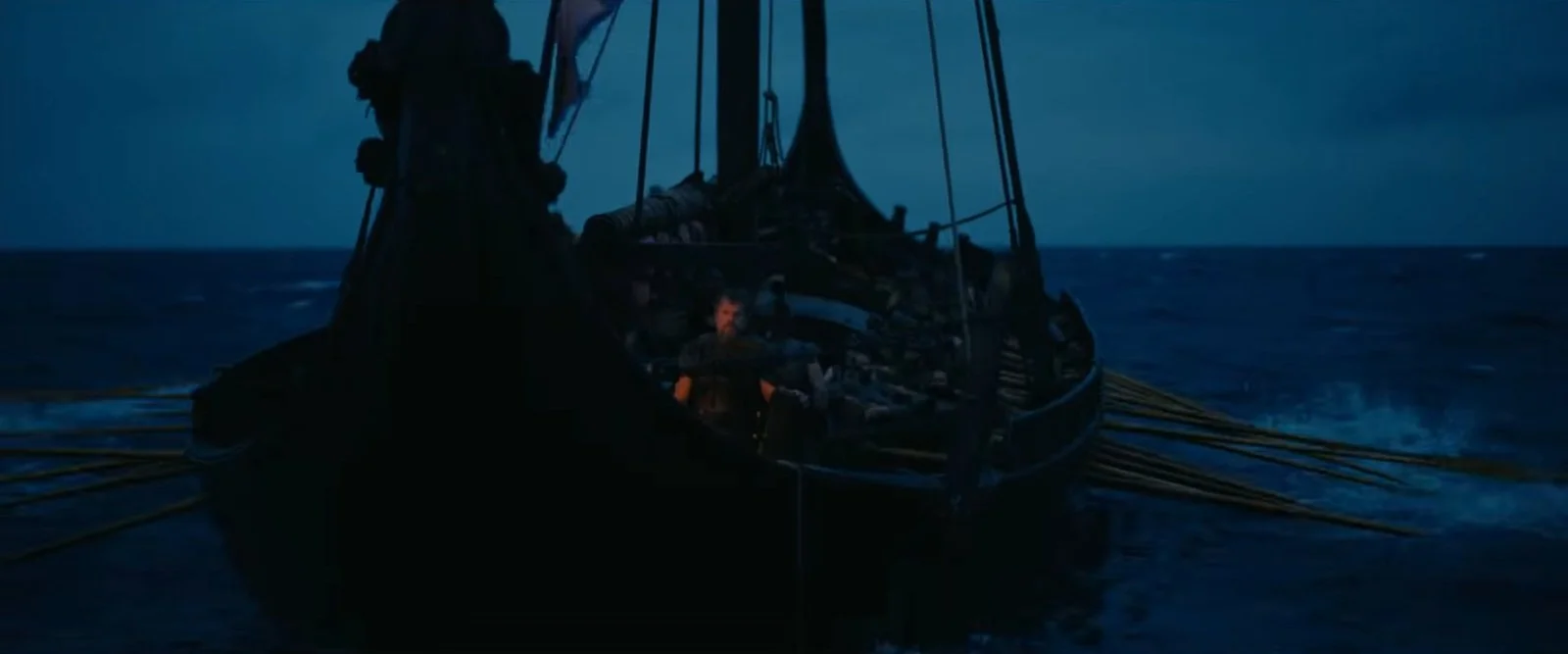
The material culture I was so uncertain about in my trailer reaction didn’t end up bothering me much. Yes, the armor is ridiculous fantasy Greek armor (that also doesn’t seem to stop or turn aside any weapons whatsoever), and yes, the ships are all wrong (they are literal Viking ships, the largest of which I got to look at in Mystic, Connecticut some years ago). The film’s approach to material culture is to shrug and say “whatever,” which makes it no different from any of the other Odyssey or Trojan War epics made since the silent era. I wish we had gotten a movie more firmly rooted in the Bronze Age of Odysseus, but we didn’t and that’s fine.

Which raises the dread spectre of the controversies surrounding Nolan’s Odyssey, including “historical accuracy.” It is not, as some internet types congratulate themselves for believing, ridiculous to want the film’s ships, sets, and costumes to reflect either the world of the Trojan War or the world Homer may have imagined in his own context. Just because Homer’s Odyssey is fiction—at least, that’s how we think of it—doesn’t mean its original context is valueless.

That’s not the path Nolan chose, unfortunately, but it is also true that the Nolanesque look he decided on isn’t inherently wrong, either. It’s worth judging on its own merits, and I think his brutalist matte black tactical imagination is somewhat self-limiting—a theme to which we’ll return. The look of The Odyssey is fine, but not a surprise. A surprise, whether rigorously historically sourced or even more archly fantastical, like 300, would have been nice.

However, Nolan himself undermines the argument that accuracy of whatever kind doesn’t matter by including numerous mentions of the Sea Peoples, mysterious raiders from the central and western Mediterranean who relentlessly attacked the east and brought on the Bronze Age Collapse. This is an unnecessary gesture toward real historical context that doesn’t mesh with the fantastical elements and doesn’t work historically—Homer’s characters wouldn’t have been aware of impending civilizational collapse and Homer himself didn’t include it because, though he lived in its long aftermath, he didn’t know about it. A strange choice but one clearly made for thematic reasons.

As for the casting controversies that generated a seriously annoying amount of internet bloviation: they proved a massive nothingburger. I’ll focus on Helen of Troy here. On one hand, as Homer translator Daniel Mendelsohn put it recently in a Rest is History Club episode, “it’s a little disingenuous to assume that Nolan wasn’t being consciously provocative in his choice” of Lupita Nyong’o as Helen. It’s not ridiculous—much less racist—to notice. On the other hand, Helen appears only briefly, and I didn’t find her presence jarring at all given what I’ve already said about the film’s historically unmoored approach. Something else bothered me much more.

The worst flaw of Nolan’s Odyssey reminded me of the recent adaptations The Green Knight and All Quiet on the Western Front. In both of those cases, I wrote much longer than normal reviews—as here—trying to strike a balance between appreciating the filmmaking and decrying the vandalism of the originals. The Odyssey is a much better movie than either of those and more faithfully presents the events and even the structure of the original, but it still fails to understand and present the original’s worldview.

In place of the deep concern with piety and hospitality in Homer’s poem, something almost every incident from the cyclops and Laestrygonians (uncivilized bad host, civilized bad hosts) to the Phaiakians (the ideal of civilized good hosts) illustrates, Nolan’s film foregrounds what he calls “Zeus’s law,” a watered down form of hospitality that amounts to the Golden Rule—almost directly quoted at one point—and a strange nonviolence. Despite what the suitors have spent years doing to Odysseus’s wife, son, servants, and palace, Odysseus for some reason can’t retaliate without going into exile. (Exiled by whom? I saw someone ask online. Is he not the king?) One of the few major departures from Homer is the film’s ending, in which Odysseus and Penelope, rather than restoring Ithaca through Athena’s help, leave, sailing west as in Dante and, later, Tennyson, but for twenty-first century reasons.

This strange, confused theme grows out of the film’s larger point about war and violence and the destruction of civilization. This is where the Sea Peoples come in—at the end, Penelope explicitly connects their threat with the Greek victory in the Trojan War. And for Odysseus himself, this is manifested in his guilt and trauma over the sack of Troy. Nolan’s Odyssey is about processing trauma and atoning for sin.

This leads to a running undercurrent of resentment. Antinous’s wickedness stems from his resentment of Odysseus and Telemachus much more than greed, Circe vents years, possibly centuries of resentment on Odysseus when thwarted, Sinon, in Hades, grouses at Odysseus for leaving him ignorant of his designs, and everyone resents Agamemnon. The biggest problem with Nyong’o’s Helen isn’t Nyong’o, it’s the seething resentment at being returned to Menelaus that Nolan has imparted to her.

This is not unique to this film, of course. I’m struck that in updating or making relevant an old story, the go-to modern method is to import and emphasis grudges and resentments. This reveals more about us than Homer, certainly.

Like Nolan’s matte black and concrete visual style, all of this is both ultramodern and—worse—uninteresting.

It’s strange, but The Odyssey makes the same mistake here as the The Return, which squandered a brilliant performance by Ralph Fiennes—whose Odysseus had obvious cunning—in simplifying and deconstructing the story. The Odyssey is a far better movie than The Return, but its psychologizing and therapeutic themes have the same flattening effect, a fact noted by no less a light than Emily Wilson, whose iambic pentameter translation I would not recommend but has been unfairly blamed for what a lot of online rage-baiters perceive as Nolan’s failings. Per Wilson: “The film presents an Odysseus who feels very bad about things that he’s done in war, and is struggling to process them in a very modern, psychiatrized way—and needs drugs to do so!” Fuss about helmets, ships, and casting all you like—this is the real, most serious departure from Homer.

Do we need another PTSD therapy fable? Is there not something in the alien world Homer’s imagination has kept alive for 2700 years that speaks to us without thinking we have to modernize it? Homer is brilliant on his own—dramatic, funny, terrifying, suspenseful, and moving by turns. It’s a fool’s errand to think one can improve him by making him relevant.

So this is not Homer’s Odyssey; it’s Nolan’s, for better and for worse. It’s riveting entertainment on a massive scale and worth seeing just for that. It also succeeds better than any other film version at covering most of the epic’s plot and events. But its worldview is not the original’s, and what it substitutes—or, rather, clumsily adds onto—is predictable and unsatisfying.

And yet, whatever misgivings one might have about Nolan’s imprint on the story, he was smart enough to get as much of Homer into the film as he could, and that’s the film’s saving grace. As I had hoped back in December, Homer’s power is much greater than any limitation or miscalculation on Nolan’s part, and so The Odyssey excites and moves precisely where it’s truest to the poet.
The Odyssey trailer reaction

Matt Damon as Odysseus in the teaser trailer for The Odyssey (2026)

To say that Christopher Nolan’s treatment of Homer is highly anticipated would be an understatement. By the time I discovered the first teaser for The Odyssey this evening while doing some last-minute Christmas shopping for my kids, the official trailer on the Universal YouTube channel had been up twelve hours and already had 9.8 million views. (Addendum: In the time it’s taken me to dash off these thoughts and observations, the trailer has cleared ten million views.)

So, in a very real sense, what I think doesn’t matter. Here are my thoughts anyway.

I’ve mentioned recently that, while I like Nolan generally and love a couple of his movies, I think his success and the leeway studios have given him since he wrapped up his Batman trilogy have led him further and further into self-indulgence. This peaked with Tenet, which was entertaining because Nolan is a spectacular showman and completely incomprehensible because, with its involuted story, he leaned hard into all of his own worst instincts. Part of what kept it from being a pure disaster was that its slick near-future world was fitting for his style: Inception and Interstellar both fit the bill, as does the futuristic Wayne Enterprises tech of his Batman movies, especially The Dark Knight Rises.

But imagine that recognizable Nolan aesthetic—matte black tactical gear, brushed steel and brutalist concrete, affectless acting, and obsessive rejection of linear time—transferred to… the Bronze Age.

I follow a number of gifted historical and archaeological artists on social media and the scuttlebutt is that Nolan’s crew reached out to some experts in Mycenaean material culture and then ghosted them. It shows. Homer’s world was a world of elaborate courtesy and protocol, gold, jewels, and precious metals, and suits of burnished bronze armor that thundered when their warriors leapt from their chariots to do battle. Matt Damon’s crew from Ithaca look like someone asked an LLM to blend 1950s sword-and-sandal Romans with a SWAT team.

That’s harsh, I guess. I’m not particularly hopeful. As much as I like Nolan, he has to be one of the filmmakers least suited to this kind of story. (Let me second what some of those historical artists have wished for: a Homer adaptation from Robert Eggers.) If I hope anything, I hope I’m wrong.

With (most of) the negativity out of the way, here are a few things that impressed me in this teaser:

  • The IMAX cinematography looks atmospheric as Hades, so to speak. Hoyte van Hoytema is working with Nolan again and a number of the brief glimpses we get of major episodes from the Odyssey look good in strict filmmaking terms.

  • Anne Hathaway as Penelope looks pretty woebegone in her brief appearance. I like Hathaway but wonder if she has the requisite cunning for the woman who was so perfectly matched to Odysseus. (My ideal casting: Rebecca Ferguson, who combines regal beauty with obvious, potentially terrifying intelligence.)

  • I like the shots in Polyphemus’s cave, but am puzzled that we actually get a brief glimpse of a giant, shadowy form entering behind Odysseus’s men. Word was that Nolan’s Odyssey would be demythologized to some degree. Perhaps not? Or will the adventure scenes be Odysseus’s exaggerated retelling? If Nolan indulges in his nonlinear storytelling it will surely be when Odysseus is rescued and hosted by the Phaiakians and tells them his story—a portion of the poem that, to be fair, lends itself to Nolan’s thing.

  • We get a glimpse of Benny Safdie as Agamemnon near the beginning. Ridiculous Greek fantasy armor. Perhaps an artifact of Odysseus telling an embellished version of his story?

  • We don’t see him in the trailer, but Jon Bernthal is listed as playing Menelaus. I’d like to have seen him—or someone like him—in the lead. Bernthal looks tough and has unbelievable charisma. Somehow he keeps getting slotted into second-fiddle roles behind flat, awkward leads (e.g. “The Pacific,” in which he by all rights should have played John Basilone, and “The Walking Dead”). Robert Pattinson is also slated to play Antinous, one of Penelope’s suitors, which should give him plenty of opportunities to steal the scene.

  • Back to the trailer. We get brief glimpses of the Trojan Horse. No idea what the Achaians are doing hoisting it out of the sea, but the shots of the warriors crammed inside look great.

  • Near the end we get some eerie shots of what appear to be Odysseus’s journey to the underworld. Not at all what I imagine when reading the story, but exceptionally atmospheric and spooky. Rightly so. Curious to know if we’ll see a bored, disillusioned Achilles.

  • Devotees of ancient Greek shipbuilding are upset about behind-the-scenes images of the ships here. I know just enough to identify them as clinker-built, which is right for the Anglo-Saxons and Vikings but obviously wrong for Mycenaean Greece. That may or may not bother you.

  • We end with an Odysseus and Penelope before the war, who seem much weepier and worrisome than the figures from Homer. Homer’s Odysseus cries, to be sure, but only after twenty years of bloodshed and captivity. Maybe it’s just that I have a hard time taking Matt Damon seriously when he channels high emotion. (His outburst as General Groves in Oppenheimer came across to me as impotent rather than righteous rage.)

So—we’ll see. This is a teaser trailer with perhaps a minute of footage, after all, and much of the film’s staggeringly large cast doesn’t appear at all. (Keeping Zendaya—as Athena!?—offscreen might have been a smart move.) It will certainly trade in spectacle, and maybe that will be enough. I’ve loved plenty of other atrocious historical films on that level (Exhibit A, Exhibit B), but something else those movies had going for them was strong performances and surehanded storytelling. Again—we’ll see.

I’m with those who were hoping for something a bit more meticulous in its reconstruction of Homer’s world, something we still haven’t really seen onscreen before. But that, for better or worse, is not Nolan’s forte. Even from this teaser it’s clear that he’s put his unmistakable stamp on the story. My hope is that, even without material fidelity to the original’s world, Homer himself will once again prove so strong that his power will shine through despite the filmmakers.

The Return

Ralph Fiennes strings Odysseus’s bow in The Return

Last night I finally had a chance to watch The Return, last year’s film adaptation of the climactic second half of the Odyssey. After anticipating it eagerly for some months, and more so as a steady drip of information about Christopher Nolan’s forthcoming Odyssey epic for IMAX has begun, I was underwhelmed.

First, the good. Ralph Fiennes is an excellent choice to play Odysseus and got into gnarly physical shape for the part. He looks every bit the weathered and toughened old warrior-king, and when he first opens his eyes on the beach at Ithaca they shine with sharply focused intelligence.

And, to be honest, that’s about it. There are a few nice touches I want to come back to, but the best I can say of The Return is that Fiennes performs excellently at the center of a movie that doesn’t measure up to what he’s doing.

I had two big problems with the film. The first is that, from production design and costuming to tone, the film is relentlessly dull and bleak. In the first two areas this bleakness betrays a depressing unoriginality and inauthenticity: inauthentic because this is not what Homer’s or Odysseus’s world looked like, unoriginal because The Return offers the same coarse, dingy, brown-on-brown vision of past peoples as primitives that was already old when Monty Python and the Holy Grail spoofed it.

The Return reminded me of Franco Zefirelli’s Hamlet in that it makes token nods toward a popular misconception of what a period is like—rough wool clothing in impractical designs, rickety dwellings made of sticks, cavernous stone palaces—while using flagrantly anachronistic elements—medieval castles in both cases—to create atmosphere. This could be forgiveable. Indeed, I love Zeferelli’s Hamlet. There will probably never be a movie that gives us a realistic look at the Bronze Age world Homer describes, but at least try to come up with something other than a stereotype.

The bleakness of the film’s tone is the bigger problem. Homer is serious when he needs to be, and presents the stakes—for Odysseus, for Penelope, for Telemachus, even for the suitors—seriously, but is never dour. The Return is simply dour. The film has no comic relief, no joy, no gratitude, no fond reminiscence or hope for the future. There is not even an Athena to pity or help or intercede for Odysseus. The Return is not just demythologized, it’s dehumanized.

This tonal problem is rooted in the film’s approach to the source material. The screenwriters have used the Odyssey to dramatize and explore modern pathologies. This is most evident in the case of Odysseus’s two most important allies upon his return, Eumaeus the swineherd and Telemachus, Odysseus’s son. In the film, both of them hate Odysseus for leaving for Troy and tell him so. They help him grudgingly. When he finally reveals himself and kills the suitors, Penelope reacts in horror and intervenes to spare Antinous, one of the ringleaders, whom Telemachus kills anyway. Penelope turns on them both, berating Odysseus for turning their hall into “a slaughterhouse” and leading Telemachus into a life of violence.

At this point, by replacing Homer’s characters with modern people, the story becomes absurd. What did you think was going to happen when Odysseus came back, lady? When Telemachus hesitated to give Odysseus his bow in the first place, why did you tell him to do so? Why did you bother to delay the suitors at all?

Then, in their long-anticipated reunion, Odysseus tells Penelope that he took so long to come home because he was ashamed of what he had become during the war. At this point all clicks into place: he’s been traumatized you see. Everyone in The Return is dealing with trauma. Trauma, trauma, trauma, just like a bunch of suburbanites moping their way through life. In place of Homer’s lost world of custom, loyalty, duty, ritual, and protocol, a world in which there is still room for love between father and son and tenderness between a well-matched husband and wife, The Return gives us angst and resentment.

It’s strange to me that the film finally squandered what goodwill I still had toward it during the climax, the well-staged slaying of the suitors. But I suppose it was there that the film shows its hand and I realized how far from Homer this story has wandered.

And yet a few glimpses of Homer shine through. When Odysseus poses as a beggar and is beaten and mistreated by the suitors, I felt an outrage true to the poem. When Eurycleia, Odysseus’s elderly nurse, recognizes him from a scar on his leg and is overpowered by excitement that he has returned, I felt that excitement, too. And, most poignantly of all, Odysseus’s encounter with his dying hunting dog Argos, abandoned outside the palace and the first creature on Ithaca to recognize his master, makes it into the movie. This simple, wordless scene moved me to tears.

If I’m being harsh it’s because I’m disappointed. I’m grateful to see an attempt to treat this story seriously, but grieved that the original wasn’t apparently good enough for the filmmakers. That the most emotionally powerful moments in the film were those lifted from the Odyssey with the least alteration or meddling makes The Return a useful warning against trying to improve on the classics.

I suspect it’s already too late for Nolan to learn the lesson. We’ll see next summer. In the meantime, I plan to reread Homer.

Homer and His Iliad at Miller's Book Review

I’m excited to say I have another guest post at Miller’s Book Review on Substack. Today I review classicist and historian Robin Lane Fox’s excellent recent book Homer and His Iliad, which I read this summer and briefly noted in my summer reading post here.

A short sample:

The poem’s style suggests that Homer was illiterate, master of a strictly oral tradition, but with important differences from the bodies of modern oral epic so often used to understand him. These epics from Albania, Finland, and the central Asian steppes are transmitted communally, mutate from telling to telling, and have a loose-limbed, gangling structure of “and then . . . and then,” stretching across their heroes’ entire lives.

The Iliad, on the other hand, is a tightly focused and artistically unified whole that minutely dramatizes one major incident over the course of a few weeks. Its characters, themes, and setting remain consistent throughout. Even minor details which Lane Fox calls “signposts”—a hero’s armor, horses taken as booty—are established early in the poem so that, when they reappear sometimes thousands of verses later, they do not seem a contrivance.

All of which indicate a single creative mind behind the work, a mind capacious enough to keep an entire war’s worth of characters and plot lines straight without reference to writing. If the style is indicative of oral poetry, the content—in its control, economy, and subtlety—suggests one poet.

Read the whole thing at Miller’s Book Review and be sure to subscribe for twice-weekly reviews and essays. I’m grateful to Joel for inviting me to contribute again.

Summer reading 2024

Though I’m thankful to say that, compared to where I was at the end of the spring, I’ve wrapped up the summer and begun the fall semester feeling refreshed and rejuvenated, my reading has still been unusually fiction-heavy. That’s not necessarily a bad thing—all work and no play, after all—but I do mean to restore some balance. I look forward to it.

“Summer,” for the purposes of this post, runs from approximately the first week or two of summer classes to today, Labor Day. Since there’s a lot more fiction and non-fiction this time around, I mean to lead off with the smattering of non-fiction reading that I enjoyed. And so, my favorites, presented as usual in no particular order:

Favorite non-fiction

While I only read a handful of non-fiction of any kind—history, biography, philosophy, theology, you name it—almost all of them proved worthwhile. They also make an unusually idiosyncratic list, even for me:

An Illustrated History of UFOs, by Adam Allsuch Boardman—A fun, wonderfully illustrated picture book about UFOs and all sorts of UFO-adjacent phenomena. Not deep by any means and only nominally skeptical, this book is surprisingly thorough, with infographic-style tables of dozens of different purported kinds of craft, aliens both cinematic and purportedly real, and brief accounts of some legendary incidents from Kenneth Arnold and the Roswell crash to Betty and Barney Hill’s abduction, Whitley Strieber’s interdimensional communion, and the USS Nimitz’s “flying Tic Tac.” If you grew up terrified to watch “Unsolved Mysteries” but also wouldn’t think of missing it, this should be a fun read. See here for a few sample illustrations.

Histories and Fallacies: Problems Faced in the Writing of History, by Carl Trueman—A concise, sensible, and welcoming guide to some of the pitfalls of historical research and writing. Trueman is especially good on the dangers of historical theories, which naturally incline the historian to distort his evidence the better to fit the theory. There are more thorough or exhaustive books on this topic but this is the one I’d first recommend to a beginning student of history. I mentioned it prominently in my essay on historiography at Miller’s Book Review back in July.

Three Philosophies of Life, by Peter Kreeft—A short, poetic meditation on three Old Testament wisdom books: Ecclesiastes and Job, two of my favorite books of the Bible, and Song of Songs, a book that has puzzled me for years. Kreeft presents them as clear-eyed dramatizations of three worldviews, the first two of which correctly observe that life is vain and full of suffering, with the last supplying the missing element that adds meaning to vanity and redemption to pain: God’s love. An insightful and encouraging short book.

Homer and His Iliad, by Robin Lane Fox—Who was Homer and what can we know about him? Was he even a real person? And what’s so great about his greatest poem? This is a wide-ranging, deeply researched, and well-timed expert examination of the Iliad and its author, thoroughly and convincingly argued. Perhaps the best thing I can say about Lane Fox’s book is that it made me fervently want to reread the Iliad. My favorite non-fiction read of the summer. Full-length review forthcoming.

Always Going On, by Tim Powers—A short autobiographical essay with personal stories, reminiscences of Philip K Dick, nuts and bolts writing advice, aesthetic observations, and philosophical meditations drawing from Chesterton and CS Lewis, among others. An inspiring short read.

The Decline of the Novel, by Joseph Bottum—An excellent set of literary essays on the history of the novel in the English-speaking world; case studies of Sir Walter Scott, Dickens, Thomas Mann (German outlier), and Tom Wolfe; and a closing meditation on popular genre fiction—all of which is only marginally affected by a compellingly argued but unconvincing thesis. I can’t emphasize enough how good those four case study chapters are, though, especially the one on Dickens. Full dual review alongside Joseph Epstein’s The Novel, Who Needs It? on the blog here.

Favorite fiction

Again, this was a fiction-heavy summer in an already fiction-heavy year, which was great for me while reading but should have made picking favorites from the long list of reads more difficult. Fortunately there were clear standouts, any of which I’d recommend:

On Stranger Tides, by Tim Powers—An uncommonly rich historical fantasy set in the early years of the 18th century in the Caribbean, where the unseen forces behind the new world are still strong enough to be felt and, with the right methods, used by new arrivals from Europe. Chief among these is Jack Chandagnac, a former traveling puppeteer who has learned that a dishonest uncle has cheated him and his late father of a Jamaican fortune. After a run-in with seemingly invincible pirates, Jack is inducted into their arcane world as “Jack Shandy” and slowly begins to master their arts—and not just knot-tying and seamanship. A beautiful young woman menaced by her own deranged father, a trip to Florida and the genuinely otherworldly Fountain of Youth, ships crewed by the undead, and Blackbeard himself further complicate the story. I thoroughly enjoyed On Stranger Tides and was recommending it before I was even finished. That I read it during a trip to St Augustine, where there are plenty of little mementos of Spanish exploration and piracy, only enriched my reading.

Journey Into Fear, by Eric Ambler—An unassuming commercial traveler boards a ship in Istanbul and finds himself the target of a German assassination plot. Who is trying to kill him, why, and will he be able to make it to port quickly enough to survive? As much as I loved The Mask of Dimitrios back in the spring, Journey into Fear is leaner, tighter, and more suspenseful. A wonderfully thrilling read.

The Kraken Wakes, by John Wyndham—Another brilliant classic by Wyndham, an alien invasion novel in which we never meet or communicate with the aliens and the human race always feels a step behind. Genuinely thrilling and frightening. Full review on the blog here.

Mexico Set, by Len Deighton—The second installment of Deighton’s Game, Set, Match trilogy after Berlin Game, this novel follows British agent Bernard Samson through an especially tricky mission to Mexico City and back as he tries to “enroll” a disgruntled KGB agent with ties to an important British defector. Along with some good globetrotting—including scenes in Mexico reminiscent of the world of Charles Portis’s Gringos—and a lot of tradecraft and intra-agency squabbling and backstabbing, I especially appreciated the more character-driven elements of this novel, which help make it not only a sequel but a fresh expansion of the story begun in Berlin Game. Looking forward to London Match, which I intend to get to before the end of the year.

LaBrava, by Elmore Leonard—A former Secret Service agent turned Miami photographer finds himself entangled in an elaborate blackmail scheme. The mark: a former Hollywood femme fatale, coincidentally his childhood favorite actress. The blackmailers: a Cuban exile, a Florida cracker the size of a linebacker, and an unknown puppet master. Complications: galore. Smoothly written and intricately plotted, with a vividly evoked big-city setting and some nice surprises in the second half of the book, this is almost the Platonic ideal of a Leonard crime novel, and I’d rank only Rum Punch and the incomparable Freaky Deaky above it.

Night at the Crossroads, by Georges Simenon, trans. Linda Coverdale—Two cars are stolen from French country houses at a lonely crossroads and are returned to the wrong garages. When found, one has a dead diamond smuggler behind the wheel. It’s up to an increasingly frustrated Inspector Maigret to sort through the lies and confusion and figure out what happened. An intricate short mystery that I don’t want to say much more about, as I hesitate to give anything at all away.

Epitaph for a Spy, by Eric Ambler—A stateless man spending some hard-earned cash at a Riviera hotel is, through a simple mix-up, arrested as a German spy. When the French police realize his predicament and his need to fast-track his appeal for citizenship, they decide to use him to flush out the real spy. Well-plotted, suspenseful, and surprising, with a great cast of characters. My favorite Ambler thriller so far this year. There’s also an excellent two-hour BBC radio play based on the book, which Sarah and I enjoyed on our drive back from St Augustine.

The Light of Day, by Eric Ambler—One more by Ambler, which I also enjoyed. Arthur Simpson, a half-English, half-Egyptian smalltime hood involved in everything from conducting tours without a license to smuggling pornography is forced to help a band of suspicious characters drive a car across the Turkish border. He’s caught—and forced to help Turkish military intelligence find out what the group is up to. Published later in Ambler’s long career, The Light of Day is somewhat edgier, but also funnier. It’s more of a romp than a heavy spy thriller, with wonderfully sly narration by Arthur himself. I greatly enjoyed it. Do yourself a favor, though, and read it without looking at any summaries, even the one on the back of the book. My Penguin Modern Classics paperback gave away a major plot revelation. I still enjoyed it, but have to wonder how much more I might have with that important surprise left concealed.

Runner up:

Swamp Story, by Dave Barry—A wacky crime novel involving brothers who own a worthless Everglades bait shop, potheads trying to make their break into the world of reality TV, a disgraced Miami Herald reporter turned birthday party entertainer, a crooked businessman, Russian mobsters, gold-hunting ex-cons, and a put-upon new mom who finds herself trying to survive all of them. Fun and diverting but not especially funny, which some of Barry’s other crime thrillers have managed to be despite going darker, I still enjoyed reading it.

John Buchan June

The third annual John Buchan June included five novels, a short literary biography of one of Buchan’s heroes, and Buchan’s posthumously published memoirs. Here’s a complete list with links to my reviews here on the blog:

Of this selection, my favorite was almost certainly The Free Fishers, a vividly imagined and perfectly paced historical adventure with a nicely drawn and surprising cast of characters. “Rollicking” is the word Ursula Buchan uses to describe it in her biography. An apt word for a wonderfully fun book. A runner up would be Salute to Adventurers, an earlier, Robert Louis Stevenson-style tale set in colonial Virginia.

Rereads

I revisited fewer old favorites this season than previously, but all of those that I did were good. As usual, audiobook “reads” are marked with an asterisk.

Conclusion

I’m looking forward to more good reading this fall, including working more heavy non-fiction back into my lineup as I settle into the semester. I’m also already enjoying a couple of classic rereads: Pride and Prejudice, which I’ve been reading out loud to my wife before bed since early June, and Shadi Bartsch’s new translation of the Aeneid. And, of course, there will be fiction, and plenty of it.

I hope my summer reading provides something good for y’all to read this fall. As always, thanks for reading!

Shame vs guilt in Homer

A helpful and important distinction in a chapter on glory and guilt in a “shame culture,” from Robin Lane Fox’s Homer and His Iliad:

Shame differs in two under-appreciated ways from guilt. It is not that guilt is a private, internal response, whereas shame always rests on the reactions of others: we can be privately ashamed of ourselves or secretly feel shame inside ourselves before an imagined onlooker. One cardinal difference is that we can be ashamed of something that is done or said by others to whom we relate, whereas we feel guilt only for what we ourselves have personally said or done. Teachers can be ashamed of what some of their pupils have done, but unless they instigated it, they do not feel guilt for it. Captains can be ashamed of some of their team members’ conduct, without feeling guilt, as they have not done it themselves. There is also a difference of scope and timing. We feel shame about something we might otherwise do and we are therefore inhibited from doing it. We feel guilt and have guilty thoughts only about something we have actually thought or done (or failed to do). The responses involve our sense of ourselves in different ways. When we feel guilt, we accept that we, our full selves, are fully responsible. We can feel shame, however, when we feel we have acted out of character, our true self, or fallen short of our best.

[W]e can be ashamed of something that is done or said by others to whom we relate, whereas we feel guilt only for what we ourselves have personally said or done.

As examples, Lane Fox brings forward Hector, who is ashamed of Paris and would be ashamed of himself if he hid safely inside Troy, Priam, who is ashamed of his surviving sons once Hector has been killed, and Achilles, who is ashamed of having let Patroclus die. None of these or any other character in the Iliad expresses what we would think of as guilt: “The Iliad has no word for it, but the absence may not be significant, because people can feel more than they express in words.”

Later in the chapter, Lane Fox answers this modern assumption by noting how, in contrast with some other historical aristocracies in which elites did not care what others thought of them, “Homer's heroes, by contrast, worry frequently what others may say of them, even people who are far inferior to themselves,” like Thersites. As if in answer to a modern assumption about the social aspect of shame, Lane Fox continues:

Are they, then, mere egoists? It is a mistake to regard shame as an egotistical or narcissistic response, as if all that matters in it is what others think of one. Shame is linked to the views of others, real or imagined, but it becomes an inhibition, ‘ashamed to’, or a reaction, ‘ashamed that’, only if these others’ views relate to actions and qualities which the person subject to shame values too.

Shame requires a set of shared virtues and the bonds of community. By contrast, virtually the only social dimension of shame that is recognized now is the act of “shaming”—as a verb—a person for something, which is automatically assumed to be wicked on the part of the shamer. (This, ironically, loads them with unforgivable guilt.) In a world with disintegrating community, the sense of shame imparted by the claims we make upon each other cannot be permitted. The assumption is that shame is a tool of malign control and we must be unbound, totally. And so the world demands shamelessness, with all that that entails.

Homer's imaginative sympathy

Earlier this week I ran across a book called The World of Herodotus at our local used book store. The author sold me on it instantly—Aubrey de Sélincourt, whom I know best as a translator of Livy and Herodotus for Penguin Classics in its early years. When I got home and was leafing through it, I happened across this passage, which expresses what is to me one of the strongest and characteristic features of Homer’s poetry:

[T]he burden of the poem is the universal tragedy of Man; none the less, the fact that one can ask it indicates another profound and beautiful trait in Homer—the breadth of his imaginative sympathy.
— Aubrey de Sélincourt

Is the Iliad the tragedy of Hector, who is killed, or of Achilles, who loses his friend—and is himself doomed, as we know, to early death? The question is idle, because the burden of the poem is the universal tragedy of Man; none the less, the fact that one can ask it indicates another profound and beautiful trait in Homer—the breadth of his imaginative sympathy. It is no part of Homer’s purpose to exalt the Greeks at the expense of the Trojans or the Trojans at the expense of the Greeks. He does not take sides. If Mycenae is ‘golden’, Troy is ‘holy’; if Achilles is ‘splendid as a god’, Hector is ‘glorious’, and Priam as well as Agamemnon is shepherd of his people. We are moved by the grief of Achilles when his friend is killed, but we are moved as deeply by the noble scene in which the King of Troy humbles himself to come to Achilles’ tent and beg for the body of his son. Greeks and Trojans—all are men, splendid in manhood, and the poet looks upon them with benign and indifferent love. They fight to the death, for it is the nature of men to do so—of men proud of their strength and skill, hungry for honour and fame, glorying in the sunlight and the world of sense, but doomed so soon to fall like the leaves of a tree and to go down into the eternal darkness. It is a view of life stripped of complexity, bare of speculation, unburdened by any mystery but the ultimate mysteries of beauty and of death.

I’ve taken pains to explain Homer’s fair and sympathetic presentation of both sides of the Trojan War—his concern being less with political rights and wrongs or regional loyalty and more with arete regardless of who demonstrates it—to my students for many years. This puts it beautifully.

I especially like how de Sélincourt talks of sympathy rather than its weakling modern cousin, empathy. Sympathy, which is not coincidentally a Greek word, is what Homer evokes so powerfully throughout, even—or perhaps especially—in those vignettes that introduce us to a character as he’s dying violently. Remember that, at root, sympathy means to feel with or even to suffer with, and who hasn’t finished the Iliad feeling as if he’s suffered alongside Hector, Achilles, and Priam?

I have to anticipate at least one modern rejoinder, though, provoked by de Sélincourt’s repeated use of the word men there. Wouldn’t a dead white man’s sympathies be narrow and bigoted? Aren’t the Iliad and the Odyssey just war stories for boys? Aren’t the main characters all afflicted with toxic masculinity? Certainly the readership for the present fad of feminist parallax fiction based on Greek myth would think so, to judge by the way they talk about these stories. To which I can only say that they haven’t read Homer very well, if at all, and that it’s not Homer whose “breadth of imaginative sympathy” is limited.

If Homer, in his world, could reach across boundaries and battle lines to feel and understand—and to make his audience feel and understand—I think he deserves as much or better from us.