Fahrenheit 451’s most accurate prediction

Having just read a book I hated in high school and found it, as an adult, a masterpiece, I decided to revisit a book I loved in high school but certainly haven’t read in more than twenty years: Fahrenheit 451. To be brief, it holds up.

Not to be brief, it is a commonplace of literary conversation to pit rival dystopias against each other. The two most frequent combatants are Orwell’s Nineteen Eighty-Four and Huxley’s Brave New World. Questions of literary quality aside, people debate which of the two better predicted the present. Leaving aside as well that “the present” is a moving target and neither author really intended to predict anything, Orwell is usually praised for imagining the modern surveillance state and its dog-eat-dog culture of denunciation and ideological purity and Huxley for his vision of a technocratic, efficiency-obsessed state that placates the masses with entertainment, psychoactive drugs, and hedonism and—in starkest contrast to Orwell—for depicting the oppression of his dystopia as self-imposed, even embraced.
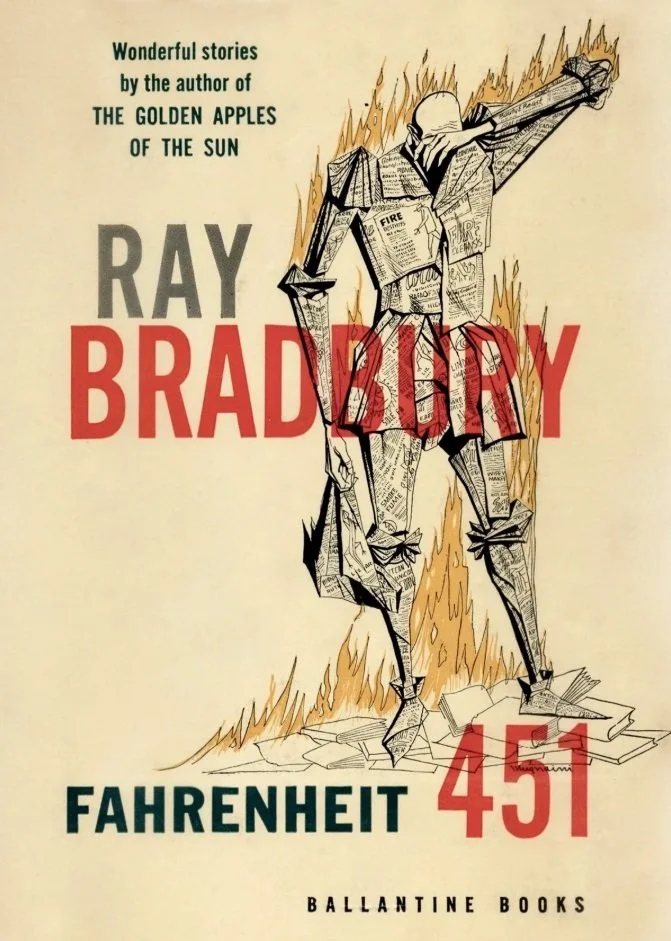
I happen to agree that Huxley’s insight into the willingness of the masses to be oppressed as long as they can enjoy themselves marks Brave New World as more likely than Nineteen Eighty-Four, if not a better novel. But I think even Huxley misses a piece of the dystopian picture that Bradbury nails in Fahrenheit 451.

First, note that Fahrenheit 451, per Bradbury himself, is “not about censorship” but “the moronic influence of popular culture through local TV news and the proliferation of giant screens.”

Bradbury’s book aligns with Orwell’s in the mobilization of the masses as part of a program of surveillance—the scene in which a news program orders everyone in a neighborhood to look outside at the same time in an attempt to catch Montag and the people robotically obey is chilling, one of the most memorable in the novel—and with Huxley’s in the self-imposed nature of that surveillance. Rather than monitor everyone, all the time, the unseen, unnamed authorities who dispatch the firemen rely on informers. Why would people go along with that, especially as enthusiastically as the informants in the novel do?

Because they don’t want to be bothered, upset, or offended. Bradbury makes this point several times. Literature goes away because it’s too challenging, people are too likely to read things that upset them, and when they drift instead to easy, bland, mass-produced visual entertainment the government doesn’t even have to ban books, the people simply stop reading them—all except a few weirdos whom it is easy to crush as dangers to placid minds of the compliant.

But the most accurate, realistic detail of the entire Fahrenheit 451 scenario is not the surveillance or the ease with which the public can be offended or even how easily they can be manipulated, but just how embarrassingly tawdry the people’s entertainment is. Huxley imagines a world in which people have given up freedom—even the freedom to make their own families—for drugs and orgies. Bradbury correctly intuits that people will sell their freedom much more cheaply. The people of Fahrenheit 451 want interactive daytime TV, nonstop music piped directly into their ears, constant affirmation, and the biggest, brightest, most immersive screens possible. Then they sit there, existing.

If you want an eerily accurate prediction from one of these books, the zoned-out, enervated, and completely empty minds of Mildred and her friends—who even, based on the question “Did you see that Clara Dove five-minute romance last night?” enjoy short-form video content!—should meet all requirements.

Montag’s wife Mildred is pathetic not because she is unfree and infuriating not because she rats Montag out, but because she has bargained away her soul for a mess of pottage. Less than that, actually—pottage would at least be nourishing.

Casting Chesterton

Last week on his microblog, Alan Jacobs shared the news that the BBC has ordered a new series called “The Detection Club.” Per the BBC’s press release, the show will follow Dorothy Sayers, Agatha Christie, and GK Chesterton as they team up to solve mysteries in 1930s London. The show is set to shoot next year.

Jacobs briefly considers the cast, which is as yet unknown. I have little or no opinion on who would make a good Sayers or Christie, but the idea of someone playing Chesterton in a drama immediately caught my interest. A few informal thoughts if I were the one casting Chesterton:

Prerequisites: Chesterton was unusually tall (6’4”), fat (fluctuating but often near 300 lbs), and had a mustache. These, plus a small pince-nez spectacles, a crumpled hat, and a cape and walking stick should factor into a bare-minimum visual impression. (Cf my old Churchill-in-a-box post.)

Chesterton late in life, c. 1931

Jacobs notes with regret that, with the death of Richard Griffiths a few years ago, “the ideal for GKC” is lost. I’m not sure I agree. My perception may be skewed by having only ever seen Griffiths as Uncle Vernon in Harry Potter, but though matching some of the superficial particulars for Chesterton—tall, fat, wild-haired, mustachioed—he had a sinister air that I’d find insurmountable. The attitude or air or even vibe of an actor playing a real person is as important as appearance, I think.

Someone adept at capturing a historical figure’s vibe without looking much like him is Timothy Spall. He came to mind on the strength of his performances as Churchill (in The King’s Speech) and David Irving (in Denial). It’s a commonplace to call a gifted character actor a chameleon, but Spall is the real deal. He’d have a lot to work against—he’s too short and, at least in the last few films I saw him in, too thin for Chesterton—but I think he could convey the strange combination of puckishness and intelligence that a Chesterton should have. He may also be too old but, if the series is set in the 1930s, that may be appropriate for the end of Chesterton’s life.

Similar: Eddie Marsan, another favorite of mine. Marsan is a smidge taller than Spall and looks a smidge more like the actual Chesterton. (He’s also a London native, like Chesterton.) That said, he tends to play either intense or petulant men, which wouldn’t work, as a Chesterton needs generosity of spirit and literally enormous bonhomie to be believable.

A somewhat obvious choice—who would probably resist the potential typecasting—is Mark Williams, who has played Father Brown since 2013. Williams is taller than either Spall or Marsan, heavyset (sometimes, anyway), and can do friendly absentmindedness better than just about anybody. Playing Chesterton would be a natural extension of his Father Brown, not least since he has always played Father Brown more like Chesterton than the Father Brown of the short stories, anyway.

An unusual possibility that occurred to me almost immediately: Nick Frost. Frost is about the same height as Spall but I wouldn’t have guessed it—he looks bigger onscreen. With a mustache and pince-nez I think he could very well look the part, and I think he’d sell Chesterton’s good humor.

A final serious suggestion: Mark Addy, who is tall, heavyset, looks more like Chesterton in the face, and can do both comedy and drama well. That said, he tends to be more restrained—or at least less manic—than some of these other options, though that might work well for an aging Chesterton.

All of this is predicated on the BBC treating the project seriously, of course. The presence of Christie as a character gives me pause, as I just recently noted the habitual malice toward her work among those adapting it for TV and film. Christie, Sayers, and Chesterton were all serious Christians and one hopes the show doesn’t avoid, downplay, or simply ignore that fact in favor of whatever the progressive posture du jour is when the series goes into production. The casting will show the BBC’s hand.

What I most hope they avoid is obvious Funny Fat Man stunt casting: James Corden or whoever. A fun mystery centered on affectionate, respectful portraits of three great writers sounds immensely appealing to me right now. One more farce sending up the dead and their vanished world does not.

Joel Coen on movies vs TV

In my 2022 movie year-in-review I mentioned my exhaustion with TV and my preference for movies. Joel Coen, from a 2020 podcast with longtime cinematographer Roger Deakins on why he and brother Ethan have stuck to movies and not ventured into TV, explains a little of what goes into my preference:

[L]ong-form was never something we could get our heads around. It’s a different paradigm. Not to be shitty about it, but you can look at stories that they have a beginning, middle, and end. But so much of television has a beginning, a middle, a middle, a middle, a middle, until the whole thing dies of exhaustion. It’s beaten to death and then you find a way of ending it.

We’ve all watched TV shows like this. Even some of our favorites fit the arc Coen describes here.

One of the reasons I hope movies and movie theatres survive is that the discipline of the form makes moviegoing better than binge-watching even a good TV show. The discipline of the filmmakers to turn out a compact, well-crafted, self-contained jewel—rather than giving themselves permission, as so many TV showrunners do, to sprawl all over the place—and the discipline of the audience starting a story and not being able to stop it, having to receive it continuously in the form intended by the filmmakers; these are virtues that dissipate in the size and potential aimlessness of a TV series.

There are exceptions, of course, but who has time to find them? And I’ll carve out space for mini-series, which demand some of the same beginning-middle-end discipline as a two-hour drama. Not for nothing is the five-episode Chernobyl and the six-episode The Night Manager the best TV I’ve seen in the last few years.

I’m currently listening to the full Deakins-Coen interview on my commute between campuses. I discovered it and the passage above thanks to this short post from World of Reel.