Rereading and maturity
/A few years ago an episode of the late lamented Great Books podcast on For Whom the Bell Tolls convinced me to give Ernest Hemingway another shot someday. Hemingway’s appearance as an important side character in Tim Powers’s latest, The Mills of the Gods, pushed me to start now.
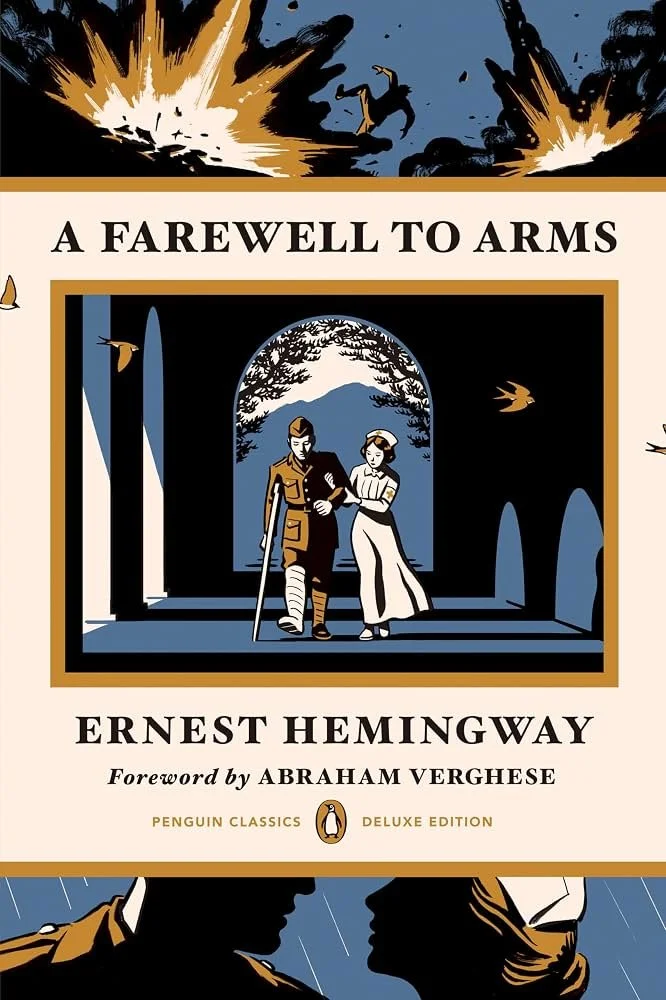
I spent years hating Hemingway, all because of A Farewell to Arms. I read it in high school at the age of sixteen or seventeen, probably because I had discovered All Quiet on the Western Front and wanted another hard-hitting novel about combat. A Farewell to Arms, with its ambulance driver narrator and minimal behind-the-lines action—during a retreat, no less—was not that book. I might have finished the book merely disappointed were it not for the romantic plot between protagonist Frederic Henry and nurse Catherine Barkley.
My seventeen-year old response to Hemingway’s novel was essentially: This idiot gets a woman pregnant, bails on the army, and expects us to feel sorry for him! Everything bad that happens to him is his fault!
The book miffed me so much that for the next twenty-five years the only other Hemingway I read was The Old Man and the Sea, which I liked. But I couldn’t help noticing that a lot of my own favorite writers loved Hemingway and often mentioned how much they had learned from reading and rereading his work. Elmore Leonard was the most important of these; I couldn’t shake off his opinion the way I did the literary critics and lit professors in their modish sinecures.
Now I’m rereading A Farewell to Arms. There are no words to describe how differently it affects me at forty-two.
I missed all the implicit, unstated details that make the story affecting. At seventeen I took Henry and Catherine to be immoral, simpliciter. Now I see that Henry, for all his experience and understanding of the war, is hopelessly naive. He doesn’t understand that his feelings for Catherine are pure childish infatuation. He begs her for sex and doesn’t realize she’s only caving to the continuous pressure he’s putting on her. He doesn’t see that she merely feels sorry for him. His neediness and even his contentment when things go his way are pathetic. Even after she has become pregnant and he feebly tries to plan for the future, she is standoffish and reserves part of herself from him. A telling moment about halfway through:
“Wine is a grand thing,” I said. “It makes you forget all the bad.”
“It’s lovely,” said Catherine. “But it’s given my father gout very badly.”
“Have you a father?”
“Yes,” said Catherine. “He has gout. You won’t ever have to meet him.”
Henry hasn’t even bothered to find out about Catherine’s family up to this point and he misses entirely the import of “You won’t ever have to meet him.” Catherine sees no future in this. Whether she has plans for later or simply feels trapped, she’s waiting him out.
Every other character sees these things but Henry. Most importantly, the novel does, too. A Farewell to Arms is narrated by an older Henry with a decade or more of perspective on these events. (Reading the baseball news in the hospital he notes for the reader of 1929: “Babe Ruth was a pitcher then playing for Boston.”) The novel’s profound pathos is rooted in irony. The reader, through the old Henry’s more mature narration, sees what Henry doesn’t: his situation, the problems he’s creating with Catherine, how she actually feels about him despite his fervent crush.
Henry is whining about problems he caused himself? That’s the point. Benefit of hindsight. He makes terrible choices, but unlike at seventeen, I sympathize, because I can recognize the foolishness that the young Henry can’t. Anyone who has ever remembered youthful sin and bad choices—especially in a doomed or one-sided relationship—has felt the same pang. A Farewell to Arms evokes it with agonizing truthfulness. This is what I was too immature to detect in high school.
A few years ago when I read The Great Gatsby for the first time I wondered why it was ever assigned to high schoolers. What could a fifteen- or sixteen-year old hope to get out of a book, as I put it later, “of hidden pasts, severed roots, lust, and mountains of regret,” that “depends for its resonance on similarly long, difficult experience”? They are likely not mature enough to get what Fitzgerald is doing. Worse, reading it for symbolism and technique when you’re not ready for the story will flatten and cheapen it if it doesn’t ruin it altogether.
A Farewell to Arms offers precisely that example in my own life. It makes much clearer to me now the role of maturity not only in understanding but in responding rightly to a great novel.
If I’m celebrating people publicly changing their minds this week, I’m glad to admit I was wrong about the novel and Hemingway. I regret that it took me so long to come back to A Farewell to Arms, but I’m glad that I’ve read it now in a time and place where I can get what Hemingway was doing. It’s subtle, understated, and that much more powerfully moving, and even though I know what tragedy is approaching Henry and Catherine, I can’t wait to finish it.