Fahrenheit 451’s most accurate prediction
/Having just read a book I hated in high school and found it, as an adult, a masterpiece, I decided to revisit a book I loved in high school but certainly haven’t read in more than twenty years: Fahrenheit 451. To be brief, it holds up.
Not to be brief, it is a commonplace of literary conversation to pit rival dystopias against each other. The two most frequent combatants are Orwell’s Nineteen Eighty-Four and Huxley’s Brave New World. Questions of literary quality aside, people debate which of the two better predicted the present. Leaving aside as well that “the present” is a moving target and neither author really intended to predict anything, Orwell is usually praised for imagining the modern surveillance state and its dog-eat-dog culture of denunciation and ideological purity and Huxley for his vision of a technocratic, efficiency-obsessed state that placates the masses with entertainment, psychoactive drugs, and hedonism and—in starkest contrast to Orwell—for depicting the oppression of his dystopia as self-imposed, even embraced.
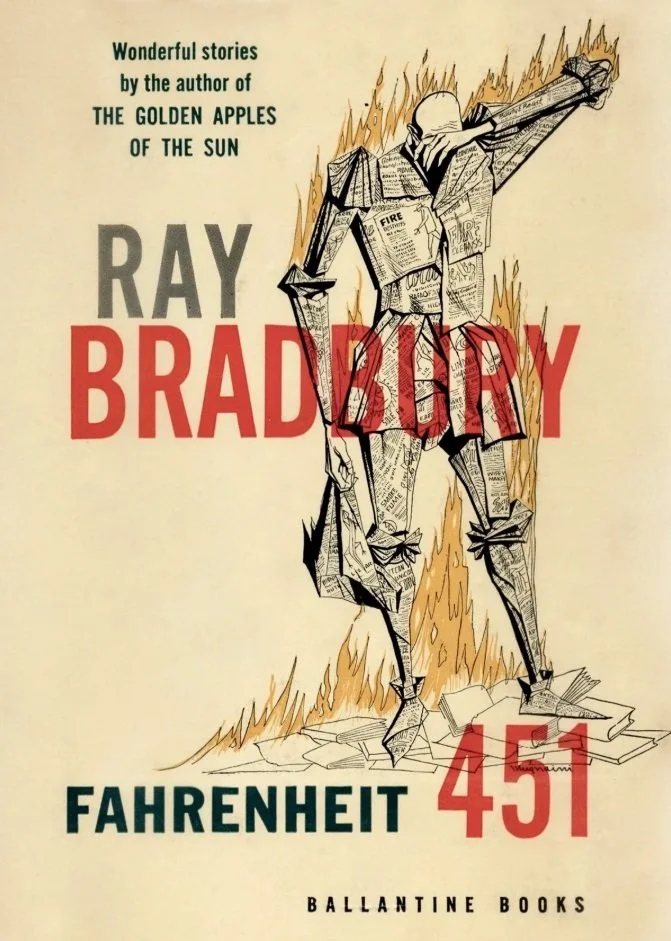
I happen to agree that Huxley’s insight into the willingness of the masses to be oppressed as long as they can enjoy themselves marks Brave New World as more likely than Nineteen Eighty-Four, if not a better novel. But I think even Huxley misses a piece of the dystopian picture that Bradbury nails in Fahrenheit 451.
First, note that Fahrenheit 451, per Bradbury himself, is “not about censorship” but “the moronic influence of popular culture through local TV news and the proliferation of giant screens.”
Bradbury’s book aligns with Orwell’s in the mobilization of the masses as part of a program of surveillance—the scene in which a news program orders everyone in a neighborhood to look outside at the same time in an attempt to catch Montag and the people robotically obey is chilling, one of the most memorable in the novel—and with Huxley’s in the self-imposed nature of that surveillance. Rather than monitor everyone, all the time, the unseen, unnamed authorities who dispatch the firemen rely on informers. Why would people go along with that, especially as enthusiastically as the informants in the novel do?
Because they don’t want to be bothered, upset, or offended. Bradbury makes this point several times. Literature goes away because it’s too challenging, people are too likely to read things that upset them, and when they drift instead to easy, bland, mass-produced visual entertainment the government doesn’t even have to ban books, the people simply stop reading them—all except a few weirdos whom it is easy to crush as dangers to placid minds of the compliant.
But the most accurate, realistic detail of the entire Fahrenheit 451 scenario is not the surveillance or the ease with which the public can be offended or even how easily they can be manipulated, but just how embarrassingly tawdry the people’s entertainment is. Huxley imagines a world in which people have given up freedom—even the freedom to make their own families—for drugs and orgies. Bradbury correctly intuits that people will sell their freedom much more cheaply. The people of Fahrenheit 451 want interactive daytime TV, nonstop music piped directly into their ears, constant affirmation, and the biggest, brightest, most immersive screens possible. Then they sit there, existing.
If you want an eerily accurate prediction from one of these books, the zoned-out, enervated, and completely empty minds of Mildred and her friends—who even, based on the question “Did you see that Clara Dove five-minute romance last night?” enjoy short-form video content!—should meet all requirements.
Montag’s wife Mildred is pathetic not because she is unfree and infuriating not because she rats Montag out, but because she has bargained away her soul for a mess of pottage. Less than that, actually—pottage would at least be nourishing.