Tom Wolfe on what novels do better than movies

Journalist and novElIst Tom Wolfe (1930-2018)

Journalist and novElIst Tom Wolfe (1930-2018)

A few weeks ago, while waiting on my ancient laptop to do something, I pulled down Tom Wolfe’s essay collection Hooking Up and read one of his most famous and controversial pieces, “My Three Stooges.” The essay is one part a defense of his technique, especially as used in his novel A Man in Full, and one part a strike back against a gang of literary establishment figures who had led the charge against the novel, Norman Mailer, John Updike, and John Irving. I’m not going to relitigate that controversy (you can watch Wolfe talk about the novel and the controversy here), and Wolfe himself uses the kerfuffle with his literary elite Larry, Curly, and Moe as a jumping off point to describe the poor state of the novel in late 20th century America and what he sees as the solution.

Near the end Wolfe includes a striking passage on the strengths of different media in telling stories, and outlines his argument for the superiority of the novel over films as a storytelling medium. I love both books and movies and am keenly aware of both media’s limitations, so I was especially interested in what Wolfe had to say.

First, Wolfe explains the four specific devices “that give the naturalistic novel its ‘gripping,’ ‘absorbing’ quality.” The four devices are:

  1. the author’s construction of the story as a series of scenes;

  2. realistic dialogue, especially as a means to reveal character;

  3. interior point of view, that is, “putting the reader inside the head of a character and having him view the scene through his eyes,” commonly achieved either through direct first-person narration or third person limited omniscience;

  4. and, finally—and certainly the most Wolfean device of the four—what Wolfe calls “status details,” the myriad “cues that tell people how they rank in the human pecking order, how they are doing in the struggle to maintain or improve their position in life or in an immediate situation, . . . the entire complex of signals that tell the human beast whether it is succeeding or failing and has or hasn’t warded off that enemy of happiness that is more powerful than death: humiliation.”

With these four narrative devices in mind, Wolfe compares the effectiveness of the novel as a medium and the film as a medium:

In using the first two of these devices, scene-by-scene construction and dialogue, movies have an obvious advantage; we actually see the scenes and hear the words. But when it comes to putting the viewer inside the head of a character or making him aware of life’s complex array of status details, the movies have been stymied. In attempting to create the interior point of view, they have tried everything, from the use of a voice-over that speaks the character’s thoughts, to subtitles that write them out, to the aside, in which the actor turns toward the camera in the midst of a scene and simply says what he’s thinking. They have tried putting the camera on the shoulder of the actor (Ray Milland in The Lost Weekend), so that the audience sees him only when he looks in the mirror, and having him speak his thoughts in voice-over. But nothing works; nothing in all the motion-picture arts can put you inside the head, the skin, the central nervous system of another human being the way a realistic novel can. The movies are not much better with status details. When it comes time to deal with social gradations, they are immediately reduced to gross effects likely to lapse into caricature at any moment; the house that is too grand or too dreadful, the accent that is too snobbish or too crude.

Which brings us to another major shortcoming of movies as a technology: they have a hard time explaining . . . anything. They are a time-driven medium compelled by their very nature to produce a constant flow of images. Three movies have been made from things I’ve written, and in each case I was struck by how helpless perfectly talented people were when it came time to explain . . . anything . . . in the midst of that vital flow, whether it be the mechanics and aerodynamics of a rocket-assisted airplane or the ins and outs of racial politics in the Bronx. When a moviegoer comes away saying, “It wasn’t nearly as good as the novel,” it is almost always because the movie failed in those three areas: failed to make him feel that he was inside the minds of the characters, failed to make him comprehend and feel the status pressures the novel had dealt with, failed to explain that and other complex matters the book had been able to illuminate without a moment’s sacrifice of action or suspense. Why is it that movie versions of Anna Karenina are invariably disappointing? After all, Tolstoy put enough action, suspense, and melodrama into Anna Karenina . . . for ten movies.

For a big splash of icewater in the face on Wolfe’s last point, about the difficulty of visual media to explain, read Postman’s Amusing Ourselves to Death. I think Wolfe is expressing the same concern about the transition from a culture shaped by print to a culture shaped by images that animates Postman’s book.

Allowing for Wolfe’s characteristic overstatement, Wolfe is onto something when he cites the “constant flow of images” necessary to narrative momentum in a movie as a “major shortcoming.” (Postman makes similar arguments about TV news and other “educational” visual media, which can’t hold still without boring the audience.) Novels can pause, can draw out even a moment—sometimes for pages and pages—and give us space to process things characters notice. A novel can, I think, more accurately recreate the flow not of events but the flow of perception and thought. Films, by the nature of the medium, have a harder time doing that.

I happen to be reading Vindolanda, a novel by historian Adrian Goldsworthy that does all of these things exceptionally well. The novel takes place in Roman Britain during the reign of Trajan and concerns the danger of life on the frontier of the Empire. I’d love to see it as a movie—but even as I read I have puzzled over how a movie could possibly convey the delicate, carefully managed interplay of military politics, rank, ethnicity, and especially language that creates so much of the drama of each scene of Goldsworthy’s book.

Which, of course, is why adaptations of books for film are exactly that—adaptations.

Chesterton on the times

It’s been a while since I’ve blogged about Chesterton but the slump is at an end. This week I finally started reading through the much-anthologized essays of Chesterton’s first nonfiction book, 1902’s The Defendant. This passage, from his introduction, struck me as particularly relevant, and naturally appealed to my eternal cry of O tempora! O mores!

 
For in our time the blasphemies are threadbare. Pessimism is now patently, as it always was essentially, more commonplace than piety. Profanity is now more than an affectation—it is a convention. The curse against God is Exercise I. in the primer of minor poetry.
 

Somehow, in describing 1902 he had described 2020. Pride ourselves on our Progress as we might, we really haven’t gotten far from the heresies of the Edwardian age—heresies Chesterton already regarded as tired. If only he could have known how much further we could go on them, how much deeper we could dig these blasphemies, profanities, and curses. The heresies remain, but they have lost their youthful vigor and descended into an angry and impotent senescence.

As I said, this appeals to my disdain for the present, a disdain born of and only deepening my natural pessimism. But of course, as is clear from the passage above, Chesterton will have none of that either:

The pessimist is commonly spoken of as the man in revolt. He is not. Firstly, because it requires some cheerfulness to continue in revolt, and secondly, because pessimism appeals to the weaker side of everybody, and the pessimist, therefore, drives as roaring a trade as the publican.

Which is manifestly true. Mea culpa.

But the truth in his essays is only part of the reason to return again and again to Chesterton. The other is his unconquerable good cheer, visible even or perhaps especially in his criticism and the most obvious evidence of his greatest virtue: charity. “Love” in a watered down modern word.

[T]hings must be loved first and improved afterwards.

So being clear about the failings of the present is easy enough, which is why it’s common. But the thing that will save the world—or at least improve the tiny corner of it entrusted to us—is charity. As Chesterton concludes in his “Defence of a New Edition”: “These essays, futile as they are considered as serious literature, are yet ethically sincere, since they seek to remind men that things must be loved first and improved afterwards.”

I’m reading The Defendant in an inexpensive edition from Dover that includes a preface by the president of the Society of Gilbert Keith Chesterton, though the entire collection is also available free online. You can read it at Project Gutenberg here.

Why Beauty Matters

Sir Roger Scruton (1944-2020) inspects Marcel Duchamp’s urinal.

Sir Roger Scruton (1944-2020) inspects Marcel Duchamp’s urinal.

I learned of Sir Roger Scruton’s death just a day or two after finishing his pithy short book Conservatism: An Invitation to the Great Tradition. His death came as a shock, and is one of the few events this year that I was—and remain—genuinely sad about. Scruton wrote prolifically and I had many of his books sitting unread on my shelf, so since his death I’ve embarked on what I wryly think of as “The Sir Roger Scruton Farewell Tour,” making it my mission this year to read through as many of those unread books as I can, even adding to the collection as I go. So far I’ve read nine. I mean to write about the whole project at the end of the year.

As much as I’ve enjoyed and learned from Scruton’s books, one of his works that I return to most often, and have watched at least twice this year, is his 2009 documentary “Why Beauty Matters.”

In “Why Beauty Matters” Scruton makes the case for beauty, a concept that he demonstrates has been corrupted and robbed of meaning—in a word, vandalized—in the modern era. Beginning in the world of art and philosophy, Scruton argues that beauty has, for most of the history of Western civilization, been a reflection of the divine and therefore an end in itself rather than a means to some other end or some kind of nice bonus feature gained through other endeavors.

But modernists and their descendants in the world of art, having first abandoned the transcendent, abandoned and actively strove against beauty. They treated it as a joke, an outmoded and meaningless pursuit or even a symbol of oppression, and substituted for beauty the transgressive anti-virtues of shock, accusation, or profanation, all laced with a self-reflexive irony that brooks no sincerity. This century-long trend has created, as Scruton calls it, a “cult of ugliness.” Young artists working in traditional forms, we see late in the documentary, are told by their instructors to vandalize their own work in order to make it “interesting.”

But the results of the abandonment of beauty as a legitimate object of art are not confined to the art world, a world now so rarefied and set apart from the concerns of ordinary people as to be extraterrestrial. The place everyone, regardless of education or class, used to encounter beauty was in their day to day environment—in the structures and fabric of their homes, towns, streets, and places of work and worship.

Scruton’s critique of modern architecture—the field that combines the twin “cults” of ugliness and utility—is scathing. He notes the abandonment of beautiful buildings, constructed of local materials in native styles and human proportions, in favor of functional buildings of universally-applied designs, buildings that are bland-looking at best and prove useless as soon as they outlive their original function. “The result proves as clearly as can be,” Scruton says, “that if you consider only utility, the things you build will soon be useless.”

Images of Scruton’s hometown—full of pragmatically designed modernist stores and apartment blocks, now abandoned to crumble under layers of graffiti—are heartbreaking. “This place was built by vandals,” Scruton says, “and those who added the graffiti merely finished the job.”

I think we are losing beauty. And there is a danger that, with it, we will lose the meaning of life.
— Sir Roger Scruton, “Why Beauty Matters”

So why does any of this matter?

Something that has become clear to me over years of reading Scruton’s books is the centrality of his anthropology—his understanding of human nature—to his philosophy. Humans are particular kinds of creatures and therefore have particular needs, needs that set them apart from all other creatures. Beauty is among the foremost of these needs. Deprived of beauty, forced to live in “a spiritual desert,” mankind suffers and cannot flourish, and will grow warped and perverted—especially where the perversion is intentional, as in modern art.

This is, as Scruton argues, because beauty is a shared language of transcendence, something that connects all of us to the eternal and prompts us to consider more than merely earthly concerns. So not only is beauty actually useful, people possessed of beauty, of open, unironic, artful expressions of seeking, will be more wholly themselves, and more likely to connect both to each other and to the transcendent—and to pass something of that on to their heirs.

There is much, much more I’d like to say in appreciation of this documentary—it is not wholly concerned with critique, but with making a positive, indeed beautiful, case for beauty as well—but the more time you spend reading me the less time you will have to watch it.

[Update: The documentary is once again available in fairly high quality on Vimeo, and I’ve embedded it in this post. You can also choose to watch it at this Facebook page. —JMP, November 29, 2022] If you like what you see in this documentary, you can find many of the same ideas developed in greater detail in Scruton’s books Beauty: A Very Short Introduction and Modern Culture.

I hope y’all will take an hour this weekend to watch Scruton’s documentary. It’s worth your while and will, I hope, either renew within you or introduce for the first time a sense of true beauty and its meaning.

Gaslighting, dog whistles, and cannibal rats

Is Raoul Silva gaslighting James Bond?

Is Raoul Silva gaslighting James Bond?

Alan Jacobs has a very good post about gaslighting, a term I have been sick to death of pretty much since it entered our political discourse. As Jacobs notes, the use of the term has had “pernicious” effects on that discourse—which was none too healthy to begin with—especially since accusing someone of gaslighting has become “the default explanation for disagreement. Nobody just disagrees with me anymore, they’re trying to gaslight me.”

One of the things I’ve always hated about the term gaslighting is its ambiguous referent. Having studied World War II too much, I always vaguely connect it with poison gas first and have to force the correct definition into my mind. Any term that provokes that habit is a useless one. (This is why I hate any word the meaning of which I have to work to remember—limpid, diffident, inchoate, etc. Some of you will be unsurprised to learn that I have a list.) Jacobs reminds us that gaslighting comes from the plot of the 1938 play and 1944 film Gaslight—the latter a noir thriller in which a man tries to trick his wife into believing she has gone insane—and helpfully connects the way the term is currently used to a kind of non-argument first named by CS Lewis. Jacobs:

To say that someone is gaslighting you is to say that they know you’re right but are pretending not to. They’re maliciously trying to get you to doubt yourself. They are dishonest, deceitful, manipulative. The charge of gaslighting is an extreme form of Bulverism: Instead of claiming You say that because you’re a man or You say that because you’re an American it’s You say that because you’re a moral monster

Follow Jacobs’s link to the Wikipedia page on Bulverism, or watch CSLewisDoodle’s animated version of the essay in which Lewis introduced the term here. It’ll illuminate a lot of our current trouble.

Why would people argue this way? For one thing, it’s easy, especially once you have developed not only a habit but a taste for it. For another, as Jacobs writes,

It’s a useful tactic to deploy if you’d prefer never to think about whether any of your assumptions are correct. Your opponents are not only wrong, they are wicked, and why should you engage with arguments that are obviously made in bad faith and for evil purposes?

A similarly annoying and bad-faith term is dog whistle, which denotes anything meant to give a silent signal, like a Cold War-era series of identifying passwords, to fellow travelers—being, like a dog whistle, something only fellow dogs hear. Theoretically.

Two things irritate me about the term dog whistle and the accusations it is used to make. First, the idea of dog whistles stokes the intense paranoia already characteristic of all sides of our current political scene, not just accepting but encouraging a conspiratorial mindset. The person listening for dog whistles runs everything they—the opposing side—say through a heuristic of Stalin-level suspicion in order to find signs of the person’s hidden meaning. This is how we get a bunch of juvenile college students playing a juvenile game on TV read as a glimpse of the secret white supremacist cabal that is lurking around every corner, behind every bush, under every rock—in all the proverbial hiding places. Examples could be multiplied endlessly. Like gaslighting, it assumes the evil of your opponents, and like gaslighting, it helps “keep your echo chamber hermetically sealed.”

Second, for something that is only supposed to be audible to other dogs, so to speak, a whole lot of non-dogs can apparently hear it. In fact I’d say it’s mostly non-dogs that are picking up on alleged dog whistles these days. It’s a stupid metaphor. Like gaslighting, it needs to go away.

But go away where? Jacobs, after noting that both sides deploy the term gaslighting to attack the other, has a suggestion:

It’s one of the many ways in which the far left and the far right are continually borrowing language, rhetorical strategy, and in some cases even direct political strategy from one another. It would be nice if we could ship them all off to their own island where they could fight it out, or, perhaps, discover that they can’t tell one another apart.

I like this suggestion a lot, but I can’t read it without thinking about Raoul Silva, the Bond villain with the greatest introduction in the series. The first time we see him, he delivers a monologue about the rats that infested his grandmother’s island, and how they went about solving the problem. It’s unforgettable.

But I have to wonder what you do with rats that already only have a taste for rat and that we cannot ship to their own island to fight it out, and whether there will be even two survivors left in the end.

Barbarians teaser reaction

barbarians netflix.png

There are a lot of movie trailers I’m pretty excited about right now: No Time to Die, Daniel Craig’s final Bond outing, which looks great and has some genuinely beautiful cinematography just in the trailer; Death on the Nile, Kenneth Branagh’s second sumptuous and classically-styled entry in his Hercule Poirot adaptations; Dune, which despite—a very strong despite—Timothée Chalamet, looks utterly fantastic; and Mank, which doesn’t actually have a trailer yet, but it’s a David Fincher film about the production of Citizen Kane so I’m already on board.

But I’ve been too tired and busy this semester to post about any of those. What’s gotten me excited enough to get me off my duff and write a blog post is a completely unexpected teaser for a Netflix limited series, Barbarians.

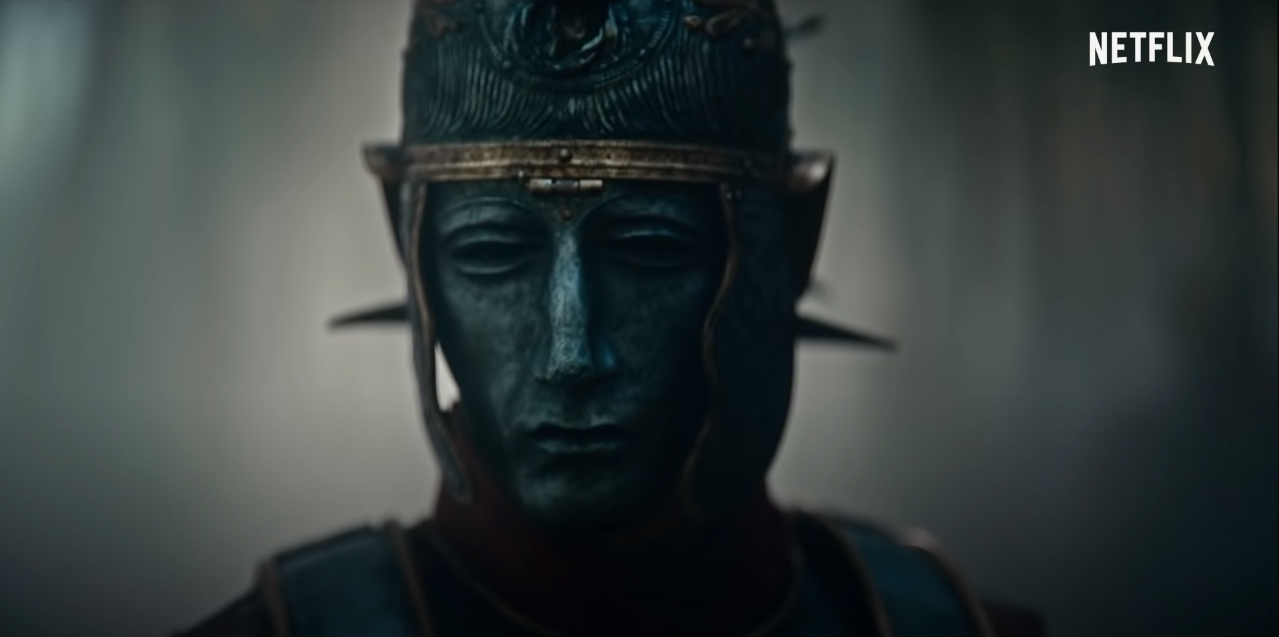
Barbarians, based on the very stingy teaser trailer dropped by Netflix a few days ago, retells one of the most famous stories from ancient Rome—the Battle of the Teutoburg Forest. Fought in what is now northwestern Germany in AD 9, the battle destroyed three Roman legions in a trap sprung by an ostensible ally, the Roman-educated Germanic chieftain Arminius. The Romans’ German allies under Arminius lured the army, which was commanded by an inept general named Varus, into a militarily indefensible position and then turned on them. Ambushed while strung out in column through the dense, marshy forest, the Romans were picked apart and annihilated in detail. The emperor Augustus, only five years from his death at the age of 75, supposedly cried in anguish for Varus to “Give me back my legions!”

In keeping with my usual format for trailer reactions, a few notes and observations:

  • The teaser certainly focuses on the battle aspect. IMDb tells me this is a six-episode series, so Netflix is definitely trying to sell us on the action first. I’ll be curious to see how much more of Arminius’s story the series tells. Let’s hope for a proper trailer soon.

  • The Romans’ weapons and armor look surprisingly good although, again, this teaser doesn’t give us much. Most of the infantry are shown in what modern historians call the lorica segmentata, remains of which have indeed been found on the battlefield. The Kalkriese face mask, found on the battlefield by modern archaeologists and conjectured to be a ceremonial Roman cavalry mask, makes an appearance. I geeked out.

  • But then there are some Germans with horns on their helmets. If we owed nineteenth century opera costumers royalties on this hooey they’d have some very, very rich descendants.

  • Not a fan of the Uruk-hai facepaint. This may be based on an offhand observation about one Germanic group in Tacitus’s book Germania (see below), but that’s describing a tribe that lived in modern-day Poland, not the region the battle actually took place in. The wideshot of Arminius and his serried ranks of Germanic warriors standing at the edge of the forest looks like a shot from the beginning of Gladiator, which is not a good thing.

  • Lots of inexplicable fire in the rather abstract battle shots we get in the trailer. We’ll see. Let’s just hope they don’t include any fire arrows.

  • Even worse is the inclusion of a standard-issue Hollywood warrior chick (cf. Knightley, Keira in Arthur, King). This is one of the great sword-and-sandal action movie clichés of the last thirty years—second only to fire arrows. Germanic women did play an important role in battle, but it wasn’t as kickass fourth wave feminists covered in mud. It’s tiresome and silly. Stop it.

  • Lots of fur, rough fabrics, unkempt hair, and subdued colors for the Germans. Let’s hope this is just due to the selection of clips for the teaser, most of which come from the battle itself. Otherwise, given the other items above, this is looking like another ancient movie full of mass-produced Movie Barbarians™. But I hope not. My ancestors may have run around naked, sacrificed people, and worshiped trees, but they did like bright colors and personal grooming.

  • Much, much better, and definitely working to the movie’s advantage, is the atmosphere. The gloom and murk of the forest are exactly as described by the Romans, and the miserable weather that always played a role in Rome’s campaigns in Germany looks to be on full, glorious display here.

  • Related: I love what we see of the cinematography here. Again—gloom, atmosphere, shallow depth of field. Bring it on.

  • So far I haven’t mentioned that this is a German movie, in German—and Latin. As far as I can tell the German is modern Hochdeutsch, though. Still great to have a polyglot movie to reflect this aspect of the ancient world.

  • That this is a German production is interesting in itself, and makes me wonder how precisely they will handle the Arminius story. Arminius has been used as a heroic symbol of German nationalism since the 19th century, and heroic nationalism is not something Germans do nowadays. This teaser has, as another site has put it, “serious Gladiator vibes.” I wonder if they will tread carefully in this regard, trying to avoid potentially stirring up old nationalistic images of the barbarian warlord, or attack into the ambush, so to speak, telling the story as straightforwardly action-packed and heroic without drawing direct attention to the Pan-German uses to which the story has been put. We’ll see, but this is a meta level of historical interest that could make Barbarians extra rewarding.

So there’s definitely some Hollywood stuff in here, even glimpsed in snatches in this very short teaser, but there’s also a lot of great-looking material. If the authenticity of the setting, costumes, and reconstruction of the battle are top notch and, very importantly, crafted to support a well-written—and, hopefully, accurate—story dramatized through good performances, it could more than outweigh the nonsense.

Barbarians has potential. Here’s hoping.

More if you’re interested

In the meantime—while we wait for a proper trailer and for the show itself—a few reading and viewing recommendations:

Wikipedia actually has a good list of primary and other ancient sources on the battle. Among the most detailed are the accounts of Tacitus, Cassius Dio, and Paterculus. Tacitus also wrote about the Germans more generally in Germania, sometimes regarded as the first ethnographic study. These are good reading. As I tell my students, ancient historians are still good to read because, unlike the authors of modern textbooks, they were obliged to be interesting.

The Battle that Stopped Rome, by Peter S. Wells is one of the authoritative books on the subject, with comprehensive but lucid explanations of the archaeological evidence that helped historians find the original battlefield and a good explanation of the significance of Arminius’s victory in Roman history.

The story of the location of the battlefield after almost 2,000 years is a fascinating one in itself. Here’s a short version of the story from Smithsonian.

Osprey Publishing has two excellent books on the subject: Teutoburg Forest, AD 9, by Michael McNalley, and Roman Soldier vs. Germanic Warrior: 1st Century AD, by Lindsay Powell, part of Osprey’s Combat series that offers detailed comparisons of the two belligerent sides and a series of illustrative case studies. Both books feature gorgeous, lavishly detailed paintings by Peter Dennis, along with the trademark maps, photographs, and informative sidebars of Osprey guides.

For a blast from the past, you can also watch the History Channel’s “Decisive Battles” episode on the Teutoburg Forest, recreated using the Rome: Total War gaming engine, on YouTube here.

CS Lewis on angels in art

Adjustments.jpeg

Yesterday I ran across the following meme. I can’t remember exactly where I found it—somewhere deep, deep within a rich mine of contrarian anarcho-trad neo-reactionary memes—but it made me laugh out loud:

 
120227811_10159005841797682_9088517295172210970_o.jpg
 

That was a laugh partly at the joke and partly of recognition, because this meme makes a point identical to one made by CS Lewis in his 1961 preface to The Screwtape Letters. Speaking of traditional descriptions or images of angels, Lewis moves from the symbols to their representation in art:

These forms are not only symbolical but were always known to be symbolical by reflective people. The Greeks did not believe that the gods were really like the beautiful human shapes their sculptors gave them. In their poetry a god who wishes to “appear” to a mortal temporarily assumes the likeness of a man. Christian theology has nearly always explained the “appearance” of an angel in the same way. It is only the ignorant, said Dionysius in the fifth century, who dream that spirits are really winged men.

In the plastic arts these symbols have steadily degenerated. Fra Angelico’s angels carry in their face and gesture the peace and authority of Heaven. Later come the chubby infantile nudes of Raphael; finally the soft, slim, girlish, and consolatory angels of nineteenth century art, shapes so feminine that they avoid being voluptuous only by their total insipidity—the frigid houris of a teatable paradise. They are a pernicious symbol. In Scripture the visitation of an angel is always alarming; it has to begin by saying “Fear not.” The Victorian angel looks as if it were going to say, “There, there.”

The literary symbols are more dangerous because they are not so easily recognized as symbolical. Those of Dante are the best. Before his angels we sink in awe. His devils, as Ruskin rightly remarked, in their rage, spite, and obscenity, are far more like what the reality must be than anything in Milton. Milton’s devils, by their grandeur and high poetry, have done great harm, and his angels owe too much to Homer and Raphael. But the really pernicious image is Goethe’s Mephistopheles. It is Faust, not he, who really exhibits the ruthless, sleepless, unsmiling concentration upon self which is the mark of Hell. The humorous, civilised, sensible, adaptable Mephistopheles has helped to strengthen the illusion that evil is liberating.

An illusion now firmly fixed in place, I think.

I like this passage for a lot of reasons—not least its forceful and beautiful praise of Dante, which I think of every time I encounter the power of his angels and the sick wickedness of his devils—and it always prompts me to reflect on how a symbol can either teach or mislead a reader. I can only wonder what Lewis would have made of Touched by an Angel, the apex of the therapeutic angels that were a mid-90s fad, or other, more recent and yet more twisted depictions.

This preface—inexplicably, criminally—has not been included in Screwtape since the first Harper paperbacks that came out when I was in college. I have redundant copies of the book solely so that I can keep a physical copy of this preface on hand. You can find it in most older editions of Screwtape; I have it in the 1996 Touchstone/B&H edition, which my parents bought me from our church bookstore in middle school. You can read the whole preface in a rather clunky Internet Archive version here.

In searching for the full text I ran across this fascinating piece revealing that, apparently, Lewis had originally conceived of Screwtape’s correspondence as having been discovered and translated by his friend Elwin Ransom. Probably better that he went another direction with the introductory note to the Letters, but a fun idea.

I return to Screwtape often, and it vies with The Great Divorce as my favorite of Lewis’s books. I’ve written about it here before—specifically, about hell’s preferred form of humor.

Pericles and September 11

Pericles: “The entire world is the tomb of ilLustrious men.”

Pericles: “The entire world is the tomb of ilLustrious men.”

Last year on September 11 I happened to be reading How to Think About War, a new collection of speeches excerpted from Thucydides’s History of the Peloponnesian War, selected and translated by Johanna Hanink. That day, just before my afternoon Western Civ class, I read the famous funeral oration of Pericles.

Some context: Pericles was an Athenian demagogue and a fervent anti-Spartan who, through the power of his oratory and his popularity among the demos, the mob of Athens, helped provoke war with Sparta. Pericles gave this speech—or a version of it, as this is Thucydides’s reconstruction—at a public mass funeral for the first Athenian dead of the war.

thucydides.jpg

It was a coincidence to have read that speech with that anniversary on my mind, but it proved a gut punch. I started class that day by reading the selection below, which I dedicated to those men and women who, on the morning of September 11, 2001, turned toward danger and gave their lives for others. I hope you’ll read this 2400-year old text with men like that in mind.

Having begun his speech with a lengthy explanation of what makes Athens unusual and worth fighting for (Athenian exceptionalism?), Pericles pivots to his eulogy for the dead hoplites of the city:

That, in fact, is the reason I have gone on at such length about the city: as a lesson in why this struggle means something different to us than it does to those who have no such good things to lose, and also to establish that there are manifest proofs for the eulogy that I am delivering over these men.

My most important points have now been covered, for it is the virtues of these men, and of others like them, which shed luster on those aspects of the city that I have praised.

In other words, rather than these men being heroes simply because they came from Athens, Athens is praiseworthy because it produces such men.

There are very few Greeks who would be capable of actually living up to their reputation as these men did. I think that what befell them offers both the first indication and the final confirmation of their worth, as it is only fair that valor displayed in war waged for the fatherland outweigh all other shortcomings. This right has cancelled out any past wrongs, for the service that they rendered collectively means more than any harm they did as individuals.

Their bodies stood fast in action and, in one brief and fateful moment, they gave up their lives at the very height not of fear but of glory.

None of these men’s resolve grew weak at the thought of their wealth and the sustained pleasures it promised, nor did any of them attempt to stave off danger because of poverty and their aspirations of one day escaping it and becoming rich. Instead they desired, more than anything else, to have vengeance against their enemies. And because they saw the risk that this would require as the most glorious one of all, with that thought in mind they resolved to seek their satisfaction and put off any other concerns. They consigned the uncertainty of success to hope and decided it best to have faith in themselves in the matter that was at hand. Understanding full well that their lot was one of resistance and suffering and not one of survival purchased by surrender, the one thing they fled was dishonor itself. Their bodies stood fast in action and, in one brief and fateful moment, they gave up their lives at the very height not of fear but of glory.

And later, on the same theme:

Though they gave their lives together, they each receive undying praise and the most conspicuous of all tombs—I do not mean the tomb in which they lie, but the one where their glory remains always unforgotten, whenever the occasion for words or deeds arises. For the entire world is the tomb of illustrious men, and it is not only the inscriptions on monuments at home that attest to this. Even in foreign lands there dwells an unprinted memory, carved not in stone but in people’s hearts.

This day, for me at least, has only grown more sobering the farther these events have retreated into the past. A lot has changed since then—much for the worse, if I’m being honest. But we have the tombs, the monumental memory, of the policemen, firefighters, EMTs, soldiers, and even ordinary civilians who gave their lives saving others that day. Now more than ever, as Pericles continues, we

must aspire to these men’s example: understand that happiness is freedom and freedom courage, and do not shrink from [danger]. After all, it is not true sacrifice when the dispirited lay down their lives, for they have already abandoned hope. Instead, the finest sacrifice issues from those who wager their continued happiness and have the most to lose if they fail. To a sensible man, at least, the disgrace incurred by cowardice is far more painful than death which comes imperceptibly, at a moment of great might and shared aspirations.

Do not abandon hope, and live in courage rather than fear. Hope and courage produced heroes like those who died nineteen years ago today. They can produce them again.

YouTube readings of Griswoldville

I’m pleased to announce that I’ve created a YouTube channel, where I’ve uploaded two readings from Griswoldville. I don’t plan to become a YouTuber—at least not on the level of some of the more active ones—but you can subscribe to the channel for readings from my books and other reading and writing related videos. I am working on short recordings from each of my novels and hope to have some more up in the following weeks.

In the meantime, I’ve embedded my first two in the post below. They come from parts I and II of Griswoldville, including scenes from the homefront while Georgie’s father is away fighting in Virginia and in the rear of the Confederate army in Georgia itself once Georgie and his grandfather and cousins Wes and Cal have been called up to the militia. I hope y’all enjoy.

Here’s a longish passage from Part II:

And here’s a couple of chapters I have read several times at public events, passages covering Georgie’s grim, dusty summer on the road with the militia during the battles for Atlanta:

As always, thanks for listening—or, in this case, watching—and please check Griswoldville out if you like what you’ve seen. You can find out more at the book’s page on my website or at Amazon.com, where you can purchase it in both paperback and Kindle formats.

Heimweh

77464_10151261150282682_272747225_o.jpg

The photo above is one of the best I’ve ever taken. I snapped it during a flight with my dad over Rabun County, and it shows, from a position just southwest of Lake Burton, the lake, Charlie, Glassy, Tiger, and Black Rock Mountains, and other points north just as golden hour settles in over the folds of the mountains. Just looking at it gives me a powerful case of Heimweh.

I’ve been rereading the Odyssey for the first time in years in preparation for a podcast. The Odyssey is the story of Odysseus’s nostos—his homecoming. This Greek word, combined with the suffix -algia (from algos, pain), gave us nostalgia, the pain and suffering felt when wanting to go home. The word nostalgia was coined in a medical school dissertation in 1688 as a scholarly form of the German Heimweh—literally “home-woe,” later borrowed and Anglicized in our tongue as homesickness.

Note that nostalgia and Heimweh were therefore medical terms. Indeed, nostalgia—homesickness—was regarded as a literal sickness until relatively recently. The original patients zero for Heimweh were Swiss mercenaries who, having left the fastnesses of their mountain homeland, often came down with the otherwise irremediable illness and had to take leave in order to recover. Without at trip home they would pine away, and even die. Being myself a child of the mountains, and having been at times homesick enough to feel it as a genuine illness, I’ve always felt a deep kinship with those long ago pikemen. I feel it even now. I ache to go home.

The word nostalgia today is a weak, bastardized ghost of what it once meant, and is the easy target of criticism. Nostalgia, we continuously hear, elides, obfuscates, or deliberately lies about the past, or offers cheap, commodified, kitsch versions of a tidied up past that is as good as a lie. There is indisputably some truth to this, but it is not the whole truth, and the corollaries that critique of nostalgia almost inevitably leads to—that there were no good old days, that the past must be remembered with scorn or a know-it-all attention to its failings, that there is only the present, that even the present is inadequate compared to the future toward which we march—are genuinely dangerous.

But the Odyssey gets nostalgia right. I have been struck, on this read-through, by Odysseus’s continuous, vocal Heimweh. But his pain and his desire to go home are not rooted in cheap reproductions of the past or self-aware cosplaying of previous decades, but in the real, concrete goods that he has lost—is losing—so long as he remains a maroon on a goddess’s island.

 
Mine is a rugged land but good for raising sons—
and I myself, I know no sweeter sight on earth
than a man’s own native country. . . .
So nothing is sweet as a man’s own country,
his own parents, even though he’s settled down
in some luxurious house, off in a foreign land
and far from those who bore him.

Rereading the Odyssey now has been a revelation. Now, with sons I pray fervently to raise well and settled in a luxurious house (much nicer than I ever expected to live in at this stage of life, anyway) in a foreign land, far from those who gave me life in the rugged place where I was born… What is this pang in my chest? This sudden melancholy? Why do I feel so listless? Why does even a hazy glimpse of the mountains on the horizon, seen from a highway in the Piedmont, overpower me so?

Nostalgia can be false, undoubtedly. But real nostalgia, real Heimweh, is a sweet pain that can lead you back to goodness. It’s the call of rootedness, of the past and the future together in chorus, of restoration. Homer ably dramatizes that in the Odyssey, which, perhaps, is why Western literature, in the nostos of the canon, keeps trekking back to it.

The translation above is that of the late great Robert Fagles for Penguin Classics. I highly recommend it. The lines quoted after from Book IX, ll. 30-41 in Fagle’s translation.

Bede on a medieval Scrooge

From Bede’s Ecclesiastical History of the English People, V, xii, a chapter in which he relates the story of Dryhthelm:

About this time, a noteworthy miracle, like those of olden days, occurred in Britain. For, in order to arouse the living from spiritual death, a man already dead returned to bodily life and related many notable things that he had seen, some of which I have thought it valuable to mention here in brief. There was a head of a family living in a place in the country of the Northumbrians . . . who led a devout life with all his household. He fell ill and grew steadily worse until the crisis came, and in the early hours of one night he died. But at daybreak he returned to life and suddenly sat up to the great consternation of those weeping around the body, who ran away; only his wife, who loved him more dearly, remained with him, though trembling and fearful. The man reassured her and said: ‘Do not be frightened; for I have truly risen from the grasp of death, and I am allowed to live among men again. But henceforward I must not live as I used to, and must adopt a very different way of life.’ Then he rose and went off to the village church, where he continued in prayer until daybreak. He then divided all his property into three parts, one of which he allotted to his wife, another to his sons, and the third he retained and distributed at once to the poor. Not long afterwards, he abandoned all worldly responsibilities and entered the monastery of Melrose, which is almost completely surrounded by a bend in the river Tweed. There he was given the tonsure and entered a separate part of the house allotted him by the abbot, where he entered upon a life of such physical and spiritual penance to the day of his death that, even if he had kept silence, his life would have witnessed that he had seen many dreadful and many desirable things that remained hidden from others.

First, because I am me, I cannot read Bede’s account of Dryhthelm’s shocking return to life without thinking of Ray Stevens and his Uncle Fred.

Second, one of the stranger lines of criticism I have heard of Dickens’s Christmas Carol is that no one, especially not a hardened moneygrubbing capitalist like Ebenezer Scrooge, would change his ways because of one night’s bad dreams. This critique has always struck me as odd—and is probably more ideological than artistic anyway—but in case any proof were needed that Dickens’s fable has some truth to it, here is a real world example. Even if you explain away Dryhthelm’s death and resurrection and his vision—which I am disinclined to do, though this story seems tailor made for the kind of pop debunking common today—we’re still left with someone who radically reordered his entire life on the basis of what he saw over the course of one night. And Bede goes on to tell us that Dryhthelm “forwarded the salvation of many by his words and life.”

One side note—a big difference between Dryhthelm and Dickens’s Scrooge is their starting point, as Dickens takes pains to show just how much of a wretched miser Scrooge is while Bede notes that Dryhthelm already “led a devout life with all his household.” A good example of how the devout are not necessarily holier than anyone else, just more aware of their own need for repentance—as Dryhthelm would have been the first to admit.

If you want to find out what, exactly, Dryhthelm saw of hell, purgatory, and heaven during the hours he lay dead, you can read the rest of this passage at Project Gutenberg here. It’s striking. The translation above is that of Leo Sherley-Price for Penguin Classics, from which I’ve quoted here before.