What I watched in quarantine

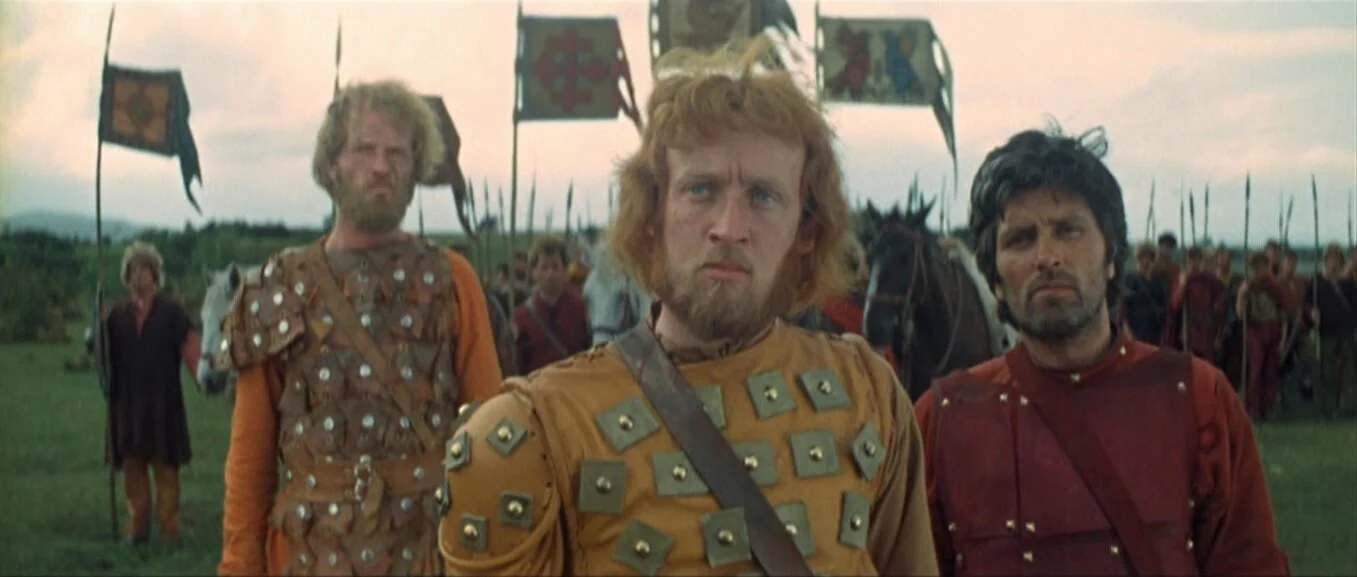
SeriOusly, what are you wearing? The noblemen of Wessex “armed” for battle in Alfred the Great (1969)

SeriOusly, what are you wearing? The noblemen of Wessex “armed” for battle in Alfred the Great (1969)

As I noted in my previous post, near the end of March I caught COVID and had to spend two weeks in quarantine. Despite the illness and fatigue I got a lot of reading done, which I covered in that post. I was also able to watch or rewatch quite a few movies, documentaries, and TV shows, some of them I’d been hoping to see for a long time, some new to me, and most of them good or great. But not all of them.

Here, for your edification, is what I watched in quarantine:

Milius

This feature-length documentary on the life and career of screenwriter and director John Milius was a delight. It’s brisk, informative, surprisingly moving, and features an amazing stable of interviewees speaking remarkably candidly—Steven Spielberg and George Lucas are two standouts, since they were quite close to Milius for a long time, and Francis Ford Coppola, Michael Mann, Walter Murch, James Earl Jones, Clint Eastwood, Oliver Stone, Arnold Schwarzenegger, and many, many other big names put in appearances.

milius.jpg

Milius does a good job outlining the man’s career, from film school, where he first developed the Milius persona—confident, gun-toting, anarchistic, full of tall tales, dedicated wholly to artistic integrity, and brooking no nonsense about any of the above—through the many ups and downs of his career and personal life. And what a career! Screenwriter for Apocalypse Now, Jeremiah Johnson, Magnum Force, and Clear and Present Danger; creator of HBO’s Rome; director of The Wind and the Lion, Conan the Barbarian, and Red Dawn. He penned the lines “I love the smell of napalm in the morning” and Conan’s answer to “What is best in life?” and Quint’s haunting Indianapolis speech in Jaws.

Virtually all of the interviewees comment on Milius’s talent for dialogue, particularly the big speech. One of the producers of The Hunt for Red October reveals that Sean Connery, who had worked with Milius in the 70s, insisted that Milius rewrite all of his dialogue specifically for him; among the results was Connery’s Hernan Cortes speech. Indeed, after the controversy surrounding Red Dawn—a considerably more ironic and tragic movie than the received wisdom portrays it, in my opinion—sent Milius’s career into a tailspin, he developed a sideline in script polishing and dialogue rewrites for his old friends.

It’s that personal dimension that makes Milius surprisingly poignant. Schwarzenegger quite movingly credits Milius with the first big boost of his career; he had been told that because of his body and his accent he would never be a leading man, but Milius saw potential in him and brought that out for the first time in Conan. Spielberg is visibly upset to describe the stroke that nearly killed Milius, a stroke that, even though Milius survived it, robbed him of speech: “The worst thing that has ever happened to a friend of mine,” Spielberg says.

At the time Milius came out he had partially recovered from his stroke and was continuing work on a passion project, a film about Genghis Khan. That project is still in development. Time will tell. But until then, Milius stands as a great tribute to a strange and wonderfully interesting man and filmmaker.

Haywire

All the laboratory-and-focus-group-concocted Strong Female Heroes that Hollywood has thrown at us the last couple years have nothing on Mallory Kane, the heroine of this underrated espionage action thriller from Steven Soderbergh. When the Gina Carano tempest brewed up in the social media teapot a month or so ago—remember it?—I recalled enjoying this movie when it came out and decided to give it a second look.

Carano plays Kane, a former Marine now working as an intelligence contractor for government types that are up to… something. I’m not convinced that the conspiracy that is slowly revealed to us is completely coherent. But that’s not really the point. This is a lean, economical, fast-paced action film that emphasizes tension, practical stuntwork, and startlingly brutal fighting, and Carano’s Mallory plays a genuinely strong female action hero who is, even better, believable. I don’t believe for a minute that Brie Larson, as Captain Marvel, could win a fight with anybody; I believe 100% that Gina Carano, as Mallory Kane, could.

Haywire also has a great cast including Michael Douglas, Antonio Banderas, and Ewan McGregor. Three standouts: Channing Tatum as another special ops type, who seems like a brutish thug at first but is allowed to have a surprising arc; the late Bill Paxton, showing subtle cleverness as Mallory’s father; and Michael Fassbender as the smooth, handsome contact for an operation that goes wrong. This is the movie that made Fassbender my favorite for the next Bond.

This is not a deep movie, but it’s extremely well crafted, not to mention fun and effective, especially if you like your action rooted in reality. Worth your while.

The Grand Tour

I was a big fan of “Top Gear” some years ago, but stopped following it when Clarkson, Hammond, and May left for Amazon and only occasionally dipped into their new show, “The Grand Tour.” I finally got around to watching a good bit of it while I was sick, concentrating in particular on the multipart specials in which they go on long road trips—a two-part trip through the deserts of Namibia, which has stood in for Iraq in a number of movies if that gives you a sense of the terrain involved; a two-part trip through Colombia; and their most recent feature-length specials, Seamen, in which they pilot boats from Cambodia to the mouth of the Mekong, and A Massive Hunt, which follows them on a ridiculously contrived treasure hunt from Réunion to Madagascar.

It was all a hoot—beautifully shot scenery, interesting locations, a nonstop parade of mechanical troubles, and of course the appeal of hanging around with these three. The show is fun and hilarious and even manages to gin up a real frisson of adventure, and their wry British humor and the merciless ribbing they give each other always hit me exactly right. These were the best laughs I got for two weeks.

Journey’s End

journeys end.jpg

Based on a stage play from the 1920s, Journey’s End is a character-driven war drama about the officers British infantry company during their week on the front line. Rumor has it that the Germans are preparing a big push—the big push—and even fixes a date for the attack. We follow freshly minted Lt. Raleigh through his first days in the combat zone, where he eagerly reunites with an old school friend, Captain Stanhope, now the company commander, and finds him a horribly changed man. Other small dramas play out, and always the rumor of attack hangs over them.

This is really excellent character study and features fine acting by a lot of great British actors. Asa Butterfield is realistically young and babyfaced for a new lieutenant in 1918 (recall that CS Lewis reached the front line as an infantry lieutenant on his nineteenth birthday) and his struggle to cope with his new surroundings and the changed Stanhope is affecting. Stephen Graham is solid in a supporting role as another platoon commander, as are Toby Jones as the cook for the officer’s mess and Sam Claflin as Stanhope, now a tormented alcoholic coming apart at the seams. But my favorite character was the fatherly “Uncle,” an older man offering stability and sobriety at a crucial juncture in the war and played with exactly the right measure of warmth and intelligence by Paul Bettany.

Journey’s End is not without action or suspense—a fatal trench raid scene is particularly tense—but its strengths are its evocation of the weary world of the front lines and its examination of character under stress. A very good movie.

Dillinger

Having watched Milius not long after one of his overlooked films, Farewell to the King, I was interested in checking out a few more of his movies that I hadn’t gotten around to. Dillinger was one of those. Milius’s first directing job, Dillinger stars Warren Oates as the titular bank robber and has a solid supporting cast including Ben Johnson as a way-too-old Melvin Purvis, Harry Dean Stanton as Homer van Meter, and a very young pre-Jaws Richard Dreyfus as Babyface Nelson.

Don’t go to Dillinger looking for accuracy. While it broadly follows the outline of Dillinger’s career of robbery, Milius freely invented or even inverted real events. As in Michael Mann’s more recent Public Enemies, the chronological order of events is out the window. But what Milius captures in Dillinger that makes it worth watching is the spirit of the thing; this movie feels like Dillinger’s career should, unlike the cold and clinical Mann movie, and has a huge personality—fast-paced, boisterous, over-the-top, with some ugly quirks that are neither apologized for nor explained away, and just subtly tongue-in-cheek—not unlike the title character. And Oates looks so much like Dillinger it’s spooky.

I don’t know if we’ll ever get an accurate movie about this particular wave of bank robbery and interstate crime, but Milius’s Dillinger is the one I’d go to for the feel of the period and the man himself.

13 Minutes

A movie I’d looked forward to for a long time, 13 Minutes was directed by Oliver Hirschbiegel, director of Downfall, and tells the story of Georg Elser, a lone-wolf assassin who almost killed Hitler at the very beginning of World War II.

13 minutes.jpg

13 Minutes opens with Elser’s attempt on Hitler’s life. An industrial worker with a complicated past, Elser had devised and constructed his own bomb using stolen or homemade parts and explosives smuggled out of the quarry where he worked at the time. He designed the complex timing mechanism himself and planned to fit the bomb inside one of the roof-supporting pillars inside Munich’s Bürgerbräukeller, the beer hall where every year Hitler would return to commemorate his first failed attempt to seize power in Germany. Elser snuck into the building after hours for several weeks, slowly hollowing out a space inside the column behind the speaker’s platform. Elser finally planted the bomb, set the complicated clockwork mechanism for a time several days hence and in the middle of Hitler’s scheduled speech, and attempted to flee to Switzerland. The bomb exploded precisely as designed, bringing down a large part of the beer hall’s roof, killing seven people outright and injuring over eighty. Elser was caught at the Swiss border.

During his interrogation he found out that he had failed. Hitler had left the beer hall uncharacteristically early and in the middle of his speech—thirteen minutes before the explosion. Elser had missed his target, and his imprisonment had begun. He would remain there until the very end of World War II, when he was shot in Dachau.

13 Minutes dramatizes all of this very well, though it never quite recovers the excitement of the opening scene. The rest of the film leaps back and forth between Elser’s interrogation—realistically brutal and often hard to watch—and Elser’s past. We learn that Elser was a charmer, a ladies’ man, a man who voted Communist but didn’t want to join the Party, a lapsed Protestant who nevertheless relied upon prayer, and we see as well at least one of his love affairs and how life in his small town was reordered and corrupted by the rise of the Nazis. All of this gives us some glimpse of who this complicated man was and why he might have attempted what he did without trying to explain it fully—a wise choice.

Some of Elser’s background, particularly related to his love life, is fictionalized or simplified for the film, but 13 Minutes hews closely enough to the facts to be worth watching—especially since it’s also a well-acted, suspenseful thriller and procedural. It tells an important and compelling story well and, like another movie I’ll review below, doesn’t flinch from the unpleasant and disturbing truth of its subject matter.

The Lighthouse

lighthouse.jpg

An incredible artistic achievement, from its moody and beautiful black and white film cinematography to its eerie and ominous sound design and its authentic 19th century New England dialogue, marvelously acted by both Willem Dafoe and Robert Pattinson, and compulsively, deliberately, quietly creepy, like The Shining. Director Robert Eggers builds an all-pervading, hypnotic gothic atmosphere that draws you in and keeps you there. It’s excellent. It’s also way, way too weird for its own good.

While I love and appreciate gothic settings—and The Lighthouse checks all the boxes: isolated, dark, windy, foggy, rainy, full of tales and secrets, possibly haunted, possibly the regular hangout of supernatural creatures, possibly the site of a hidden murder, &c.—the thick thematic larding of Freud and his simplistic, dirtyminded humbug led the film off in directions that just weren’t interesting. All the psychosexual and homoerotic stuff feels cheap. And the hunt for phallic symbols is the easiest game in the world to play; enlist a middle school boy sometime and you’ll be telling him to shut up inside ten minutes. And while I like and enjoy ambiguity, especially where the uncanny and spooky are concerned, ambiguity for its own sake—in this case, a storyteller introducing, developing, and repeatedly revisiting questions to which there are no answers because he doesn’t have any himself—is a weakness.

So I wanted to love The Lighthouse but could only admire it. It’s a masterpiece of mood and atmosphere that incompletely explores themes unworthy of its execution. But I’m still looking forward to Eggers’s next film, set in Viking Age Iceland—familiar territory for me.

Mr Jones

A beautifully shot, atmospheric, and grippingly told dramatization of Welsh journalist Gareth Jones’s investigation into Stalin’s manmade famines in the early 1930s. James Norton plays Jones, a former adviser to David Lloyd George, who uses his connections and his clout from once having gained an interview with Hitler to visit Russia in hopes of interviewing Stalin. How, Jones wants to know, has Stalin wrought his miraculous program of modernization? How has he created all the widely ballyhooed progress and prosperity? And where is all of the money for these programs coming from? Jones will be stunned by the answers—or non-answers—that he discovers and dedicate the rest of his life to getting the truth out.

Though streamlined and lightly fictionalized (e.g. Jones visited the Soviet Union three times, not once, was not arrested, and probably never met George Orwell, who appears throughout as a kind of Greek chorus), Mr Jones does a good job presenting the stranglehold Stalin kept not only on his people but even on the Western media during his reign, especially with active collaborators—like New York Times Moscow bureau chief Walter Duranty, vividly played as an oleaginous pervert by Peter Saarsgard—colluding to cover up the mass starvation of Ukrainians and smear the reputations of journalists like Jones or Malcolm Muggeridge, who very briefly appears. It’s often a hard movie to watch, but a worthwhile one.

This film not only evokes the evil and paranoia of Stalinist Russia and Depression-era leftism but also offers a sustained indictment of would-be revolutionaries’ willingness to turn a blind eye to the damage that they’ve done—and continue to do—in the name of their unrealizable ideals.

Alfred the Great

An incredibly corny late 1960s epic starring David Hemmings as the only English king styled “the Great,” this film may leave you wondering why anyone would call him that. The costumes veer between interesting and terrible—especially the armor and weaponry—and “dark ages” stereotypes abound, but where the film really fails is in finding some way to make Alfred comprehensible to its audience. The filmmakers try some kind of psychologically tormented business—Alfred seems to spend more of the movie (comically) struggling against his own horniness than against the Vikings—but it’s inconsistent, incoherent, and falls flat. (Compare Patton, produced about the same time, which pitched Old Blood and Guts as a rebel to its counterculture audience and succeeded.)

Nevertheless—I found Alfred the Great immensely entertaining. Not always for the reasons the filmmakers intended, but from start to finish nonetheless. It has beautiful landscapes nicely shot, some striking visuals including a large-scale recreation of one of England’s chalk horses, and a few good scenes of medieval Saxon politicking in the king’s hall. Maybe, like John Dillinger, King Alfred is someone Hollywood just can’t get right. But this is a commendable effort, clumsy as it is.

The 12th Man

12th man.jpg

Den 12. mann is a Norwegian film telling the true story of Jan Baalsrud, a Norwegian commando who fled the Nazi occupation and, in 1943, tries to infiltrate his home country with eleven other men. The plan fails immediately, leading to the German interception of their fishing boat, its scuttling, and their capture. Only Baalsrud escapes—soaked to the skin, with only one shoe, and, after the Germans shoot at him as he flees, the big toe on his bare foot shot off. The other eleven men, tortured and interrogated, are eventually executed. Only the twelfth man remains to be captured, a task to which SS officer Kurt Stage, whose reputation is on the line, dedicates himself totally.

What follows is an astounding survival story, as Baalsrud swims between islands in below-freezing seawater to escape, makes hesitant contact with sympathetic locals, and, in a scene guaranteed to make stress sweat pop out on your forehead, performs surgery on himself to save his foot from gangrene. He is both sheltered and shuttled along from hiding place to hiding place by the locals, small acts of bravery with very, very high stakes. And the initial failure of Baalsrud’s mission isn’t the only thing that goes horribly wrong—for just one example, if you’ve ever thought surviving an avalanche would be no big deal, prepare for an education. It’s amazing Baalsrud survived everything he went through.

The 12th Man is well-acted, has beautiful location cinematography in the fjords and snowy mountain plateaus of Norway, and exciting and realistic action. It also makes clear how aggressively the Nazis would move to repress resistance, showing what a real resistance movement entails and how badly it can and often does turn out for its scattered and vulnerable members. But The 12th Man also shows what it takes to succeed, especially courage and tenacity—the sheer guts to endure.

This is an excellent movie that I highly recommend, and it was a good movie to end my quarantine on.

Conclusion

With a couple exceptions, this was a good batch of movies. My favorites of the bunch were Haywire, 13 Minutes, and The 12th Man—with a nod of appreciation to The Lighthouse for its craft—but I thoroughly enjoyed all of them and am thankful to have had the chance to watch them while I was out sick. I hope y’all will find something good to watch here, and if you view and enjoy any of these let me know what you thought!

Thanks again for reading. Stay healthy!

Further notes on bureaucratese

Last week I wrote here about Chesterton and Orwell’s objections to long words, especially the typically Latin-rooted jargon of the bureaucrat or the man with something to hide. I’m currently reading Prit Buttar’s history Battleground Prussia: The Assault on Germany’s Eastern Front 1944-45, and, via some reading adjacent to that book, came across a perfect example of the kind of obfuscating bureaucratese that Chesterton and Orwell had in mind.

Buttar has mentioned Soviet propagandist Ilya Ehrenburg several times so far, always in the context of Ehrenburg’s popularity among Red Army troops and the influence his writing—in Soviet rags like Krasnaya Zvezda—had on the troops. Look Ehrenburg up on Wikipedia and you will find this in the article’s introductory paragraphs:

His incendiary articles calling for vengeance against the German enemy during the Great Patriotic War won him a huge following among front-line Soviet troops, but also caused controversy due to perceived anti-German sentiment.

Emphasis mine.

Both Chesterton and Orwell note how the roundabout, euphemistic vocabulary of the bureaucrat or journalist—or Wikipedia editor?—can obscure simple truths we’d rather not acknowledge. So how much can be obscured by a phrase like the one italicized above? Here are some of the passages from Ehrenburg’s pamphlets and columns that Buttar quotes.

Writing in Krasnaya Zvezda in 1942:

We know all. We remember all. We have understood: the Germans are not human beings. From now on the word German means to use the most terrible oath. From now on the word German strikes us to the quick. We shall not speak any more. We shall not get excited. We shall kill. . . . If you kill one German, kill another—there is nothing more amusing for us than a heap of German corpses. Do not count days, do not count kilometers. Count only the number of Germans killed by you. Kill the German—that is your grandmother’s request. Kill the German—that is your child’s prayer. Kill the German—that is your motherland’s loud request. Do not miss. Do not let up. Kill.

And from a leaflet distributed to the Red Army in October 1944:

Kill! Kill! In the German race there is nothing but evil; not one among the living, not one among the yet unborn is anything but evil! Follow the precepts of Comrade Stalin. Stamp out the fascist beast once and for all in its lair! Use force and break the racial pride of these German women. Take them as your lawful booty. Kill! As you storm onward, kill, you gallant soldiers of the Red Army.

“Perceived anti-German sentiment,” indeed.

Buttar cites the latter passage in connection with the atrocities committed at Nemmersdorf in East Prussia the same month. The Red Army would go on to rape as many as two million German women, an estimated quarter million of whom died as a result.

What I read in quarantine

quarantine reading banner 3.png
 
Will you think me affected if I number a small illness among the minor pleasures of life? Work is impossible and one can read all day for mere pleasure with a clear conscience.
— CS Lewis to his father, 1926
 

Having opened with that line from Lewis, which came back to me again and again as I quarantined with COVID a few weeks ago, let me offer two caveats: First, COVID was no joke. My throat burned, my head ached, I coughed until I threw out my back. (Oddly, I never lost my senses of taste or smell, the one symptom almost everyone experiences.) It was a small illness in the ultimate sense—I was never in danger of death or even hospitalization—but still painful and wearying. I’m still working against the fatigue from it. Second, I couldn’t read with a totally clear conscience. Unlike the thirty-year old Lewis who wrote this letter, I have a wife and three kids, and it was a struggle to listen to her feeding, keeping up with, and cleaning up after them in another part of the house and do nothing.

But I did read—and read and read. And that was a pleasure.

I read eleven books while I was in quarantine at home. I include here the nine works of fiction I read in hopes there will be something here to pique your interest if—God forbid—your quarantine time ever comes.

HHhH, by Laurent Binet

This novel dramatizes the assassination of Reinhard Heydrich, one of the most evil and feared men in the SS, the man Hitler himself praised as “the man with the iron heart,” in Prague in 1942. HHhH is also a novel about the author’s interest in, research into, and despair over the story, and how he grapples to make it comprehensible as a novel. Compulsive, suspenseful, hypnotically written, and—for something so postmodern—sincerely and surprisingly moving. One of the best novels I’ve read so far this year. I wrote a full review on the blog here.

A Man at Arms, by Steven Pressfield

The latest from one of my favorite novelists, Steven Pressfield, author of Gates of Fire. This novel revisits Telamon, a minor character who recurs across several of Pressfield’s other books regardless of time or place: Telamon shows up in the Peloponnesian War, in the campaigns of Alexander, and even in a speculative future in which an American Caesar returns from abroad to take over as dictator. Here, Telamon is an ex-legionary at large as a mercenary in first century Judaea, where he finds himself pulled into a mission to track down and stop a messenger sent by the notorious Paul. The messenger carries a letter with subversive contents, and Telamon’s pursuit, capture, and his dramatic change of attitude toward his mission clips along at a very fast pace.

There is vintage Pressfield here—the blunt violence, the evocation of a faraway time and place, the vivid sensory quality of his descriptions of heat, exhaustion, and pain—but in its pacing, its spareness, and its willingness to keep the characters mysterious to us it also reads like late Cormac McCarthy. This is a good thing. I enjoyed A Man at Arms immensely, and if a cross between Ben Hur, Gates of Fire, and No Country For Old Men sounds good to you, you probably will, too.

52 Pickup, by Elmore Leonard

Harry Mitchell, a prosperous factory owner, a veteran who worked his way to the top, cheats on his wife once and suffers the consequences—blackmail. And it gets worse from there. The blackmailers have film, they have the girl, and they make it clear that they have no qualms about killing. But they’ve also underestimated Harry and how hard he’ll fight back.

52 pickup.jpg

The setup doesn’t sound terribly original, but Leonard’s execution is impeccable. This is one of the best and most suspenseful of his crime novels that I’ve read. It’s also the sleaziest, as it takes its hero into the underbelly of 1970s Detroit in his search for the blackmailers. These are a uniformly wicked lot—stoners and pornographers and murderers-for-hire—who, like so many of Leonard’s teams of bad guys, eventually fall foul of each other through jealousy, backbiting, and greed. Eventually, they start murdering each other. Only the most evil of them will remain, by that point a desperate and deadly threat to Harry and his wife. When the various strands of plot developed through the novel come together at the end, the tension is magnificent.

In the insightful University Bookman review that first convinced me to check Leonard’s work out, writer Will Hoyt notes Leonard’s focus on “moments of truth” in his fiction as well as the influence of Leonard’s Catholic upbringing on his work, an influence one can feel palpably in his Westerns, to be sure, but elsewhere once you’re attuned to it. Read 52 Pickup with the sacrament of confession in mind—and what is confession but a literal moment of truth?—look at the role that the confession of sin plays in the plot—not only for our compromised hero Harry but for the other characters as well—and you begin to understand why Leonard’s highly commercial crime fiction can also be so thematically rich.

This is a great work of genre fiction and, like all of Leonard’s best work, it’s elevated by his style—his sound—and the difficult proving that he puts his characters through.

Later, by Stephen King

A young boy who can see ghosts, a mother at her wits’ end, messages delivered from beyond the grave, and a crisis that must be resolved—to the possible detriment of the boy himself. Later is The Sixth Sense as told by Stephen King. This is not a put-down; it’s vividly imagined and the scenarios dreamed up by King are engaging, with the narrator’s gifts always employed or used in inventive ways.

But the story lagged or proved predictable in places, especially the climax, and I found myself most interested in the middle chunk of the plot, in which the narrator’s mother—a literary agent teetering on the brink of bankruptcy owing to the 2008 crash—recruits him to take dictation from a recently deceased author who died with the final book of his series left unfinished, a long episode that proved genuinely original and even funny. I was also annoyed by some of the inevitable Stephen King attitudes he just can’t help throwing into the mix: the too-breezy narration he’s relied on for the last twenty years, a galumphing structure, and especially the simplistic characters. For example, you know one character is bad because she owns a gun, once harbored suspicions about Obama’s birthplace, and likes John Boehner (has anyone ever liked John Boehner?). Further, the narrative voice, so often a strong suit in King’s first-person narration, slips from believability all too often; I just did not believe the narrator was a teenage boy of the early 2010s.

It also—and I doubled back to make sure I mentioned this—has an utterly atrocious surprise revelation at the end. It’s not really a twist as it’s not plot-related, but it’s so ludicrous and has implications so appalling that King’s casual handling of it, an “Oh, by the way” approach incommensurate with what he’s revealing, is the biggest surprise of all.

But Later was still a fast-paced and enjoyable read. I blitzed through it in two days and didn’t regret it, even with King’s annoying tics on display and that terrible final act surprise.

Animal Farm, by George Orwell

I last read Animal Farm my freshman year of college, in the fall of 2002. I reread it in an evening. A masterpiece. This novella is richer and more meaningful, more deeply steeped in history and human nature than I could possibly grasp at the time, and is probably the best-conceived and executed allegory in modern English literature. Furthermore, Orwell’s message—and it is a message novel—is still relevant in our age of wannabe revolutionaries.

The Great Gatsby, by F Scott Fitzgerald

I somehow made it to the age of 37 without ever having read The Great Gatsby, which, if not the Great American Novel, is certainly the Great American High School Reading Assignment.

Do I need to summarize the plot? Probably not. But I approached it already knowing the broad outlines and was still drawn in thanks to the economy and power of Fitzgerald’s writing and especially thanks to the world he evokes, the tides of emotion and personal history flowing through each character as part of a larger scene. It’s evidence that a good story is essentially spoiler-proof.

In a way, I’m glad I didn’t read it until now, as Fitzgerald is doing things here that I’m not sure high schoolers can fully comprehend at their age and with their lack of experience. A friend on Instagram suggested that the best parts of Gatsby would be lost on them, and I suspect he’s right. This is a carefully crafted and powerful novel, beautifully and evocatively written, and I can understand now why it has become a classic.

The Eighth Arrow: Odysseus in the Underworld, by J Augustine Wetta, OSB

The best surprise and perhaps most enjoyable read of my quarantine, The Eighth Arrow follows Odysseus in a last-chance bid to escape Hell. Yes, that Odysseus, and yes, that Hell.

eighth arrow.jpg

The novel begins just after Dante and Virgil have passed by Odysseus and his old comrade Diomedes where they burn together in the circle of the frauds. A mysterious woman, a Parthenos but explicitly not Athena, responds to Odysseus’s cry for deliverance and the pair find themselves back at the gate of Hell, armed and armored. For food they have a bag of bread that the denizens of Hell—be they the damned or the demons guarding them—all react to violently. All they know, thanks to one fallen angel, is that “It isn’t just bread.” It also has the strange property of restoring to bodily form any of the shades who eat of it. And the Parthenos sends them on their way with one command: to prefer mercy over justice.

There’s a lot going on here.

The Eighth Arrow draws deeply on Homer, on Dante, and on Christian theology in this energetic and wildly inventive new story of grace and salvation. Odysseus barely knows what’s happening to him, why he has gotten this second chance and to what end he is being drawn, and he only slowly becomes aware of the transformation taking place in him as he climbs lower and lower, a man of violence and guile forced to work differently and slowly, through no power of his own, becoming able to.

This is one of the best fictional depictions of grace at work that I’ve ever come across. But it’s not just a theological treatise, a basket of Easter eggs for mythology nerds, or another iteration of a great Christian allegory. The Eighth Arrow is also a blast—a gripping adventure story, a brilliantly imagined fantasy, and a profoundly moving meditation on death, loss, and our relationships to each other. Odysseus’s reunion with Penelope moved me almost to tears, and the Odysseus and Diomedes of this novel are one of the best realized male friendships I’ve come across in fiction.

A great novel on many levels. I hope y’all will check it out.

Under the Lake, by Stuart Woods

This novel came recommended on the basis of its setting—an artificial lake in the northeast Georgia mountains, a setting with which I am intimately familiar. And I have heard rumors that the fictional Lake Sutherland in Woods’s novel was inspired specifically by Lake Burton in my home county. I don’t know if that’s true or not, but Woods writes well enough that I could see his imagined lake and even smell the old cabin his protagonist retreats to at the beginning of the story.

under the lake.jpg

The setting is well done, as is the setup. A Pulitzer-winning former newspaper reporter takes an unwanted commission to write the memoirs of a fried chicken restaurateur and heads to the lake to work on the project. As soon as he arrives, strange things happen. He is greeted brusquely by the grand old man of the town, who is no kind and gentle soul but seems unnecessarily hostile. He hears bits and pieces of rumor from various folks in town, none of which they are willing to elaborate upon. He recognizes a young secretary at the sheriff’s office as an up and coming Atlanta reporter. A friendly gas station employee lets slip that he wouldn’t be caught at that cabin after dark. A blind albino repairs the cabin’s piano, the boy’s mentally handicapped brother brings him firewood, and both speak mysteriously of their mama and her powers. And, late one night, he has a vision of a young girl standing in his cabin, staring out at the cove beyond the cabin’s dock.

This is a brisk page-turner, and though it transforms from a Southern Gothic tale—Woods really lays this on thick at the beginning, as you can probably tell—into a pretty standard detective story about midway through, there’s still enough of the eerie and uncanny to keep you reading. The characters are interesting but largely one-dimensional, and I didn’t for a minute believe that so many nubile and licentious young women would throw themselves at the balding middle-aged protagonist the way they did. And the final act goes totally off the rails, with twist upon twist coming one after the other and revelations so over-the-top that I just couldn’t believe it any more. At this point it becomes a melodramatic potboiler and doesn’t look back.

But even with its silly final act—including, oddly, a revelation with parallels to that in King’s Later above—Under the Lake was a fast and enjoyable read. I’ll probably check out more of Wood’s fiction one of these days.

The Son of Laughter, by Frederick Buechner

One of the best for last. I’ve recommended Buechner’s fiction here before. His novels Godric and Brendan shaped my artistic sensibilities at a pivotal moment, and I got The Son of Laughter years ago meaning to read it. I’m sorry it took COVID to make me get around to it, but I’m not sorry to have read it when I did or to have ended my quarantine reading on such a high note.

son of laughter.jpg

The Son of Laughter retells the biblical story of Jacob. That’s all I’ll say about the plot. If you know Genesis you know Isaac, Jacob, and Joseph. This is a multigenerational character study and an exploration of a family’s covenant with the Fear—which is how Buechner’s Jacob refers to God throughout. It’s incredibly powerful, and succeeds especially well at perhaps the most difficult challenge facing a novelist who dares retell such a familiar story—it makes the story strange, unexpected, and surprising again. It even made me admire Esau, something I never would have expected.

The strangeness especially is crucial. These characters are not flannelgraph cutouts or 1950s Hollywood types in bathrobes. These are flesh and blood people from an utterly alien time and place doing what people of that time and place must—fighting, sacrificing, making vows, marrying and procreating, and, especially, working—and all under the promises made to them by the Fear. Buechner brings this world to life in vivid detail, from the omnipresent idols to the startling way men seal their vows to one another, making this story real and powerful in a way I haven’t before experienced. Especially powerful is his emphasis on—to repeat myself—the flesh-and-blood lives of these people. A late section in which Jacob suddenly realizes that the rowdy brood he is raising, offspring of four women and begotten on the backside of the desert, is the Fear’s promise moved me to tears. Jacob’s three reunions—first with Esau, then with his father, and finally with Joseph—are equally moving.

This is only the third of Buechner’s novels that I’ve read, but it may be the best. I highly recommend it, especially if you’d like to see an old story in a new way or desire a vision of how God uses real people, flawed as they are.

Conclusion

So of the nine works of fiction I read during my two weeks of coughing, sleeping, and drinking Earl Grey, the following are the three best: HHhH, by Binet; The Eighth Arrow, by Wetta; and The Son of Laughter, by Buechner. Animal Farm and The Great Gatsby are classics that it feels pointless to judge against the others. 52 Pickup and A Man at Arms, in the middle tier, are solid entertainments that offer a bit more substance to them than you might expect. Under the Lake and Later stand at the bottom, though I enjoyed and read rapidly through both. Perhaps I should say you aren’t missing anything if you miss those, but you’d be foolish not to read the ones at the top.

Thanks for reading! I’m glad to be mostly recovered from that bout with the ‘rona and grateful to have been able to read so much. I hope y’all have enjoyed these short reviews and that you’ve found something here you’ll enjoy.

Moore and Dante on the state of the modern church

Virgil and Dante encounter Ugolino and Ruggieri in this engraving by Gustave Dore

Virgil and Dante encounter Ugolino and Ruggieri in this engraving by Gustave Dore

Russell Moore of the Southern Baptist Convention’s Ethics and Religious Liberty Commission recently shared an incisive, searing post regarding the current state of the church. Moore is responding to the results of a recent Gallup poll that showed church membership in the United States has fallen below 50% for the first time since demographers began collecting those data.

Data, as I am always at pains to point out to my students, are one thing. Figuring out why this has happened is another. This happens to be something I have a lot of thoughts about, but let’s stick to Moore. His searing and quite clearly pained critique—a voice crying in the wilderness—stems from the church’s failure to live up to its own ideals, to walk the walk. A not uncommon critique, but well expressed and coming from an authoritative voice.

But there was one passage near the beginning that stood out to me in particular. Writing of his own adolescent crisis of faith, a crisis rooted in the obvious mismatch between many Christians’ stated beliefs and their actions, particularly where politics and the culture war are concerned, Moore notes:

I heard prediction after prediction after prediction tying current events to Bible prophecy that was all “just about to happen.”

But nobody ever said, “Remember when I said ‘Gog and Magog’ of the Bible is the Soviet Union? I was wrong about that” or “Mikhail Gorbachev, I told you was probably the antichrist, but, my bad” or “Now that I also am using these supermarket scanners, maybe they’re not the Mark of the Beast after all.” These folks just moved on with the next confident assertions, as though the last never happened at all. 

Moore only notes this in passing as he relates his own story and returns to the why of America’s decline in church membership, about which he has many sharply observed and compelling things to say. But this passage stood out to me in particular because it harmonizes with so much of my own life story.

I remember wondering as a kid where the Gog and Magog connection with Russia came from. It’s just not there in Revelation. But I never got a clear answer; it was simply a given that Gog and Magog were Russia. I was too young for the barcode freak-out, but I do remember the introduction of the BI-LO Bonus Card and the high dudgeon of a few when a handful of the cards happened to have 666 in the long number printed on the back. I wondered why, if the advent of the Mark of the Beast meant Jesus was coming back, we were trying to stop the Mark of the Beast. I heard the Onion article that generated the entire Harry Potter controversy read from the pulpit. And I remember very, very well the day my private Christian high school showed us an end times prophecy video in class, a video in which the preacher, building to what was meant to be a dramatic and chilling climax, noted that “the fasted growing currency in the world today is the German mark!” We watched this video in 2001, two years after Germany had officially switched from the Deutsche Mark to the Euro.

You can say that these are fringy or outside the norm. Certainly they do not reflect anything actually in the Bible. But as Moore goes on to argue, people lose their faith over this stuff—either because they infer from this nonsense that the entire Christian message is nonsense or because, like Moore, like myself, they believe so fervently in the truth that the nonsense creates an irresolvable tension within our belief. It’s even more discouraging if some well-meaning person takes you aside and tells you you’re just “thinking too much.” True story.

But we’ve been here before. After I read Moore’s post last week I pondered over it for a while and went on my way. But a few days later, three lines from Dante that have stuck with me for years came unbidden to my mind:

 
Christ did not say to his first company:
‘Go, and preach idle stories to the world’;
but he gave them the teaching that is truth.
— Dante, Paradiso XXIX, 109-11
 

The scene is heaven, the primum mobile, the outermost reaches of God’s creation, shortly before Dante moves into the presence of God himself. The speaker is Beatrice, Dante’s beloved, giving one of Paradiso’s many speeches on topics both temporal and eternal—because the two are intertwined. In the middle, she goes off on a rant against foolish earthly preachers and the damage they do. The fuller context, which I quote at length to make a point:

“…below [i.e. on earth], though not asleep, men dream,
speaking in good faith or in bad—the last,
however, merits greater blame and shame.
Below, you do not follow one sole path
as you philosophize—your love of show
and thought of it so carry you astray!
Yet even love of show is suffered here
with less disdain than the subordination
or the perversion of the Holy Scripture.
There, they devote no thought to how much blood
it costs to sow it in the world, to how
pleasing is he who—humbly—holds it fast.
Each one strives for display, elaborates
his own inventions; preachers speak at length
of these—meanwhile the Gospels do not speak.
One says that, to prevent the sun from reaching
below, the moon—when Christ was crucified—
moved back along the zodiac, so as
to interpose itself; who says so, lies—
for sunlight hid itself; not only Jews,
but Spaniards, Indians, too, saw that eclipse.
Such fables, shouted through the year from pulpits—
some here, some there—outnumber even all
the Lapos and Bindos Florence has;
so that the wretched sheep, in ignorance,
return from pasture, having fed on wind—
but to be blind to harm does not excuse them.
Christ did not say to his first company:
‘Go, and preach idle stories to the world’;
but he gave them the teaching that is truth,
and truth alone was sounded when they spoke;
and thus, to battle to enkindle faith,
the Gospels served them both as shield and lance.
But now men go to preach with jests and jeers,
and just as long as they can raise a laugh,
the cowl puffs up, and nothing more is asked.”

A familiar situation: pride, ostentation, cheeseball humor, dogmatism on topics where the Scriptures are silent, prioritization of pet theories over the Gospel, and pointless—and erroneous—scientific arguments. Who hasn’t heard the “NASA found Moses and Joshua’s missing day” myth at church at some point? (Here’s Answers in Genesis if you’re skeptical of Snopes.) And the results are the same: ignorant believers, “fed on wind.” And the ignorant are vulnerable to other, yet more dangerous winds.

Some people were surprised to learn that American Christians are so susceptible to conspiracy theories. I wasn’t.

It’s easy to despair over the situation the Gallup poll reveals, but both Moore and Dante point to possible solutions—indeed, the only solutions we can trust. Moore:

I came through it with my faith not just intact but deepened. That’s due, ultimately of course, to the grace of God. But, in terms of secondary causes, it’s due to the fact that I found a copy of C.S. Lewis’ Mere Christianity on a bookstore shelf and, having read to the point of memorization The Chronicles of Narnia as a child, I recognized his name. 

And it’s due to the fact that listening to Christian music led me to a Christian bookstore where I found, amidst all the kitsch, a copy of Christianity Today magazine, where I found columns by Philip Yancey and J.I. Packer and John Stott and Chuck Colson. These people seemed to take the reader seriously as someone who could think, and they seemed to be filled, not with anger and outrage and manipulation, but with what I recognized as the fruit of the Spirit—peace, joy, kindness, gentleness, self-control, etc. There seemed to be something there that bore witness to a Jesus who was not a means to an end but who was the Alpha and Omega of everything. 

And Dante, as in that passage from Ephesians I linked to above, distills Moore’s insight into one word: truth. A casual relationship with the truth is perhaps the area in which American Christians have conformed most closely to the world and departed furthest from God, who, after all, is truth. For a terrifying word study, just search for “truth” in the Gospel of John and 1 John. Consider as well God’s attitude toward those who authoritatively make incorrect predictions.

A scrupulous attendance to whether things are true or not, whether it is convenient for us or not, must be a fundamental part (“the teaching that is truth” above is, in Dante’s Italian, verace fondamento) of any hoped for revival of the American church.

Read the entirety of Moore’s newsletter reflections on the Gallup poll and the state of American Christianity here. The long passage of Dante quoted above is from Paradiso, XXIX, ll. 82-117. The translation is Allen Mandelbaum’s, which you can read here.

Chesterton and Orwell on long words

GK Chesterton (1874-1936) and George Orwell (1903-50)

GK Chesterton (1874-1936) and George Orwell (1903-50)

In Orwell’s celebrated essay “Politics and the English Language,” which I’ve revisited several times recently, he concludes by offering the writer a set of six “rules that one can rely on when instinct fails.” Among them is:

ii. Never use a long word where a short one will do.

Orwell’s concern here is with clarity—both of expression and of thinking.* Earlier in the essay he writes:

The inflated style is itself a kind of euphemism. A mass of Latin words falls upon the facts like soft snow, blurring the outlines and covering up all the details. The great enemy of clear language is insincerity. When there is a gap between one’s real and one’s declared aims, one turns as it were instinctively to long words and exhausted idioms, like a cuttlefish spurting out ink.

Compare this passage from Chesterton (in Orthodoxy Chapter VIII, “The Romance of Orthodoxy”), which I’ve just rediscovered thanks to my Facebook memories:

But in truth the chief mark of our epoch is a profound laziness and fatigue; and the fact is that the real laziness is the cause of the apparent bustle. Take one quite external case; the streets are noisy with taxicabs and motorcars; but this is not due to human activity but to human repose. There would be less bustle if there were more activity, if people were simply walking about. Our world would be more silent if it were more strenuous. And this which is true of the apparent physical bustle is true also of the apparent bustle of the intellect. Most of the machinery of modern language is labour-saving machinery; and it saves mental labour very much more than it ought. Scientific phrases are used like scientific wheels and piston-rods to make swifter and smoother yet the path of the comfortable. Long words go rattling by us like long railway trains. We know they are carrying thousands who are too tired or too indolent to walk and think for themselves. It is a good exercise to try for once in a way to express any opinion one holds in words of one syllable. If you say “The social utility of the indeterminate sentence is recognized by all criminologists as a part of our sociological evolution towards a more humane and scientific view of punishment,” you can go on talking like that for hours with hardly a movement of the gray matter inside your skull. But if you begin “I wish Jones to go to gaol and Brown to say when Jones shall come out,” you will discover, with a thrill of horror, that you are obliged to think. The long words are not the hard words, it is the short words that are hard. There is much more metaphysical subtlety in the word “damn” than in the word “degeneration.”

Chesterton and Orwell’s concerns neatly overlap here.** And the example provided by Chesterton also helps make clear (I almost wrote “clarify”) another of Orwell’s rules:

v. Never use a foreign phrase, a scientific word or a jargon word if you can think of an everyday English equivalent.

I’ve heard this rule dismissed as “linguistic chauvinism,” an odd charge to make against a man like Orwell, but the truth is that most of our bureaucratic jargon, especially the legalese and pseudoscientific managerial talk that passes for political discourse and social critique now, comes into English from other languages. To take just one example, Latinate words, which tend to be longer, with more syllables to go rattling by, have been an occasional feature of English since before the Conquest,*** but have grown like wisteria all over the solid oak of the language’s basic Germanic grammar and vocabulary. It can certainly be pretty, but if there’s too much of it it will obscure the tree underneath—and even kill it.

And our brains know this: Old English words are gut words, bone words, the words we learn at our mother’s breast, while the multisyllabic vocabulary ported into English from specialist fields—medicine, science, law, theology—tends toward the abstract. It is clinical language. Phrases like capital punishment, lethal injection, execution of sentence all hold the fact that a man is being killed at arm’s length. And consider how much the adjective of the decade, systemic, muddles and covers up.

I could go on, but Orwell’s own famous example is enough. In his essay, he quotes Ecclesiastes 9:11:

I returned and saw under the sun, that the race is not to the swift, nor the battle to the strong, neither yet bread to the wise, nor yet riches to men of understanding, nor yet favour to men of skill; but time and chance happeneth to them all.

And reimagines it as a modern man might be tempted to express it:

Objective consideration of contemporary phenomena compels the conclusion that success or failure in competitive activities exhibits no tendency to be commensurate with innate capacity, but that a considerable element of the unpredictable must invariably be taken into account.

None of which is to say never to use Latin-rooted words. It’s impossible—which is itself of Latin origin. But if you want to write clearly and forcefully, you’ll hew as closely as possible to the clear, hard Germanic words we learn first, as babies.

And to kick it back to Chesterton, in a passage from The Everlasting Man that I’ve written about here before, “No wise man will wish to bring more long words into the world.”

Footnotes or, if you prefer Latin, citations:

*I’ve written about Orwell’s rules here before, examining their overlap, especially that concern with clarity, with the rules of two other celebrated but quite different writers—Elmore Leonard and CS Lewis. Read that here.

**Interestingly, Orwell’s first published essay appeared in Chesterton’s own newspaper, GK’s Weekly, in December 1928.

***The Norman Conquest gave us the first big spate of French and Latinate vocabulary in English, but lots of theological jargon had already made its way in. One example: bishop is a modern spelling of bisceop, which is what you get when an Anglo-Saxon cleric tries to pronounce the Latin episcopus, which had already been borrowed from the Greek ἐπίσκοπος.

HHhH

phonto.jpeg

HHhH is an unusual novel. The title is the first hint. An abbreviation of a German phrase purportedly current within the upper echelons of the Third Reich, HHhH stands for Himmlers Hirn heißt Heydrich—Himmler’s Brain is called Heydrich. The Heydrich in question is Reinhard Heydrich: disgraced naval officer; violinist, champion fencer, and connoisseur of the arts; model Aryan; object of admiration from no less than Hitler himself; head of the Gestapo, Criminal Police, and Security Service, and other powerful instruments of Nazi order; and one of the architects of the Final Solution. He is one of the most powerful and evil people who ever lived, and HHhH tells the story of his assassination by agents of the Czech resistance.

Sort of.

The author, French novelist Laurent Binet, begins with an image of one of the assassins, Slovak commando Jozef Gabčík, trying to sleep in his safehouse in Prague ahead of the assassination attempt. From there the novel backtracks, backtracks all the way to Heydrich’s family and birth, his upbringing and abortive naval career—cut short after he seduced the daughter of Admiral Raeder—and his entry into the world of Nazism and the SS. The novel tracks, in often surprising detail—crucial context, the author assures us, and he’s right—the career of Heydrich and his steady, implacable rise. From the annexation of the Sudetenland and the subsequent dismantling and takeover of Czechoslovakia and its transformation into the Reich Protectorate of Bohemia and Moravia, to the invasion of Russian and the deployment of the Einsatzgruppen—mobile death squads that could shoot over 30,000 Jews at a time at places like Babi Yar outside Kiev—to Heydrich’s scourging of even the mildest resistance and his hosting of the infamous Wannsee Conference, over and over again he is the right man at the right place at the right time to take advantage of new developments, of new positions, of the frequent changes in the Nazi hierarchy, and he uses his positions to advance the cause of Nazism ruthlessly. And the nicknames he garnered along the way reveal much: Himmler’s Brain, The Butcher of Prague, and, from Hitler himself, The Man With the Iron Heart.

By the midpoint of the book Binet brings us back to the assassins, the Slovak Gabčík and his Czech partner, Jan Kubiš. Having escaped Europe by circuitous routes—which Binet notes would make smashing adventure novels of their own—they find themselves training in England and assigned to Operation Anthropoid, the plot to drop into Bohemia, infiltrate Prague, and murder Heydrich.

From this point forward the novel, already compulsively readable, proves difficult to put down. It’s over 300 pages and I read it in two days. Binet deftly interweaves the stories and, even with asides, detours, admittedly unrelated information, and reflections on the craft of historical fiction (about which more below), HHhH thunders along like a freight train—or like Heydrich’s Mercedes convertible on that fatal day in 1942. We know what’s coming from the beginning, and it approaches inexorably, with mounting dread and, yes, excitement.

HHhH.jpg

But here’s where the “sort of” above comes in. HHhH not only tells the story of the assassins and of Heydrich’s life but the story of the author himself: how he came to the story, how his interest grew and deepened, and, throughout, how he decided to write this story, decided he couldn’t, and decided he must regardless. The result is a very postmodern combination of historical fiction, memoir, and commentary on historical fiction and memoir.

A sample: Binet steps back at one point to comment on the title of his manuscript, the manuscript that became the novel I read and that you’re reading about now:

Whenever I talk about the book I’m writing, I say, “My book on Heydrich.” But Heydrich is not supposed to be the main character. Through all the years that I carried this story around with me in my head, I never thought of giving it any other title than Operation Anthropoid (and if that’s not the title you see on the cover, you will know that I gave in to the demands of my publisher, who didn’t like it: too SF, too Robert Ludlum, apparently).

Later, in a passage that makes up the entirety of the novel’s Chapter 205, Binet reflects that, “I think I’m beginning to understand. What I’m writing is an infranovel.”

The distance, the authorial intrusion, the holding of one’s craft at arm’s length—all these deconstructive or self-consciously “meta” effects usually irritate me. Usually. But you might have picked up as well on Binet’s utter sincerity, the quality most often lacking in postmodern fiction. Where the last few generations of literary novelists handle fiction like a bauble they are inspecting for flaws, finally judging the enterprise meaningless, Binet is grappling with the tools at hand for the best way to tell a story that needs to be told. What he wants to do, however much his world, the French literary establishment, has called the very idea of fiction into question, is pay tribute to Gabčík and Kubiš and everyone who helped them on their way and suffered for it.

In other words, to pay tribute to heroes.

That motive infuses HHhH with heart. For all its self-consciousness, postmodern literary effects, its pauses to reflect on everything from trips to museums to love affairs to actors who have played Heydrich on film, and its open admission that the author is not up to the task, HHhH is a riveting, suspenseful, uncommonly rich, and finally—in relating the sad fates of Lidice, a village incorrectly implicated in the assassination, or of the parachutists who took on Heydrich and of everyone who helped them—profoundly moving. HHhH is an excellent example of what an historical novelist, moved by the proper love of his subject, can still accomplish in the postmodern age, and I highly recommend it.

More if you’re interested

HHhH was adapted into a film called The Man With the Iron Heart, starring Jason Clarke as Heydrich and Rosamund Pike as his ardent Nazi wife Lina. I haven’t seen more than clips from it, but it looks decent. That film came out a year after Anthropoid, which focuses on Gabčík and Kubiš, played by Cillian Murphy and Jamie Dornan respectively, and on the plot itself, relegating Heydrich to an ominous background presence. Anthropoid is excellent, an overlooked masterpiece, and even if you don’t read HHhH you should do yourself the favor of watching Anthropoid at least once. Here’s the meticulously reconstructed assassination scene, an extraordinarily tense three minutes.

Related: I have written here before, in this blog’s early days, about the film Conspiracy, which Binet ponders over early in the novel. Conspiracy dramatizes the Wannsee Conference in real time, with Kenneth Branagh playing Heydrich. Binet: “Branagh’s portrayal of Heydrich is quite clever: he manages to combine great affability with brusque authoritarianism, which makes his character highly disturbing.” Read my examination of the film here.

Lukacs on how not to talk about Hitler

Hitler in conference with senior commanders of the Eastern Front, March 1943

Hitler in conference with senior commanders of the Eastern Front, March 1943

From the late John Lukacs’s 1997 historiographical study The Hitler of History, which I quote from at length because it is so good:

I must devote a few lines to a grave misunderstanding that has affected historians less than it has people at large. This is the popular view that Hitler was mad. By asserting—and thinking—that he was mad, we have failed twice. We have brushed the problem of Hitler under the rug. If he was mad, then the entire Hitler period was nothing but an episode of madness; it is irrelevant to us, and we need not think about it further. At the same time, this defining of Hitler as “mad” relieves him of all responsibility—especially in this century, where a certification of mental illness voids a conviction by law. But Hitler was not mad; he was responsible for what he did and said and thought. And apart from the moral argument, there is sufficient proof (accumulated by researchers, historians, and biographers, including medical records) that with all due consideration to the imprecise and fluctuating frontiers between mental illness and sanity, he was a normal human being.

This brings me to the adjective (and argument) of “evil.” (Again, there are people who are interested in Hitler because they are interested in evil: the Jack the Ripper syndrome, if not worse.) Yes, there was plenty of evil in Hitler’s expressed wishes, thoughts, statements, and decisions. (I emphasize expressed, since that is what evidence properly allows us to consider.) But keep in mind that evil as well as good is part of human nature. Our inclinations to evil (whether they mature into acts or not) are reprehensible but also normal. To deny that human condition leads to the assertion that Hitler was abnormal; and the simplistic affixing of the “abnormal” label to Hitler relieves him, again, of responsibility—indeed, categorically so.

It is not only that he had very considerable intellectual talents. He was also courageous, self-assured, on many occasions steadfast, loyal to his friends and to those working for him, self-disciplined, and modest in his physical wants. What this suggests ought not to be misconstrued, mistaken, or misread. It does not mean: lo and behold! Hitler was only 50 percent bad. Human nature is not like that. A half-truth is worse than a lie, because a half-truth is not a 50 percent truth; it is a 100 percent truth and a 100 percent untruth mixed together. In mathematics, with its rigidly fixed and immobile numbers, 100 plus 100 makes 200; in human life 100 plus 10 makes another kind of 100. Life is not constant; it is full of black 100s and white 100s, warm 100s and cold 100s, 100s that are growing and 100s that are shrinking. This is true not only of the cells of our bodies but of all human attributes, including mental ones. In sum, God gave Hitler many talents and strengths; and that is exactly why he was responsible for misusing them.

This is exactly right. I have cautioned my students for years against thinking of or describing Hitler—or other figures like him—as insane or monstrous. Lukacs lays out the best case against this line of attack—if Hitler was mad then his evil is merely pathological and it is pointless to investigate, much less criticize it. This attempt to condemn Hitler ends by exonerating him. Furthermore, treating Hitler as in some way morally exceptional ends the same way.

If I can dare gloss what Lukacs has to say here, an additional danger is that calling Hitler mad or a monster lets us off the hook. The temptation to call Hitler mad, to label him a monster, places him in a separate category from ourselves—which I think is often the root of the temptation. Hitler is, to our consciences, less scary as a monster, because there is a universe of separation between us and him. He believed and said X, did Y, killed Z millions of people; we never could, never would, cannot even understand it. We thank the Lord that we are not as other men, even as this dictator.

And suddenly we are guilty of the sin of pride.

It is uncomfortable in the extreme to consider that we are capable, under the right circumstances, given the right temptations, and presented with the right choices, of doing the things Hitler and the members of his regime, from its most ideologically committed leadership right on down to ordinary men in the ranks, were capable of doing—and did. It’s easy to deny this, but it’s important not to.

Lukacs died two years ago aged 95. I’ve written in appreciation of him here before. The Hitler of History is excellent so far, if you’re into historiography as much as I am, but let me recommend Lukacs’s book The Duel: The Eighty-Day Struggle Between Churchill and Hitler to you if you’d like something a little more approachable to read. It’s excellent.

The National Medal of Honor Heritage Center

IMG_0367.jpg

Last week was my spring break, and my wife and I took the kids to Chattanooga for a long weekend. We had two sites we wanted to make sure to visit: Chickamauga battlefield, about which more later, and the Tennessee Aquarium. We also obeyed the classic command to see Rock City and, as an extra treat, visited Chattanooga’s National Medal of Honor Heritage Center.

The museum

The Charles H Coolidge National Medal of Honor Heritage Center, named for a Chattanooga native who is currently the only living Medal of Honor recipient from the ETO during World War II, is a stellar little museum. We visited on a whim following our morning at the Tennessee Aquarium; the Heritage Center is located right next door on the same plaza.

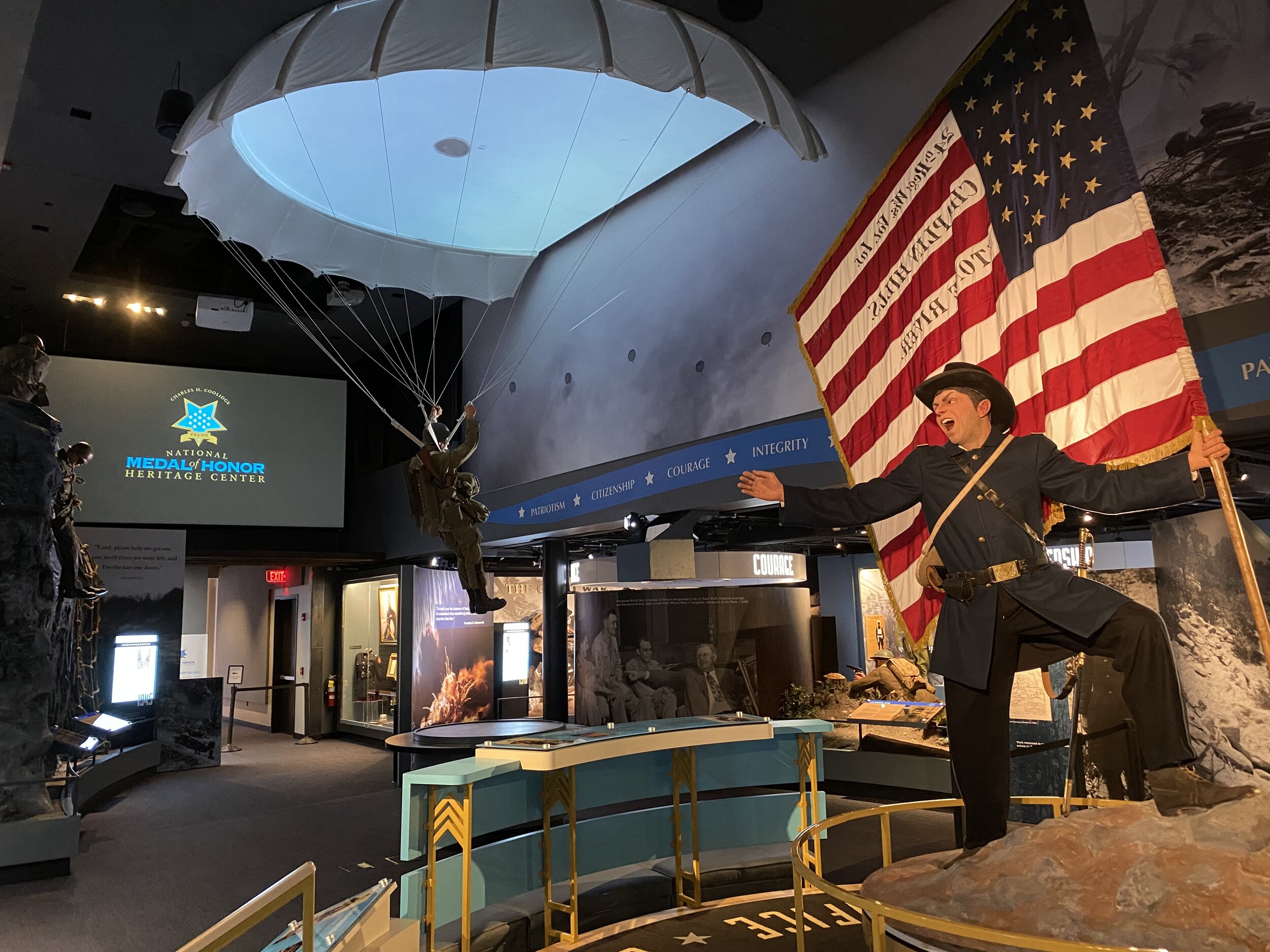
After paying a modest entrance fee the tour begins upstairs with an interactive media room. Computers set into tables allow visitors to search a database of Medal of Honor recipients, and digital banners on the walls display continuously changing photos of recipients both well known and obscure. My favorite feature of this room was a wall-sized touchscreen display featuring a 3D globe dotted with the locations of Medal of Honor actions, each of which you could tap on to bring up a box with a photo of the recipient, the date of the incident, and the citation. The clusters of dots, especially around the battlefields of all theatres of the Civil War and in western Europe in both World Wars, as well as scattered across the Pacific and other often surprising out-of-the-way places, gives you a graphic sense of where the United States’ wars have been fought, as well as the scale of the fighting.

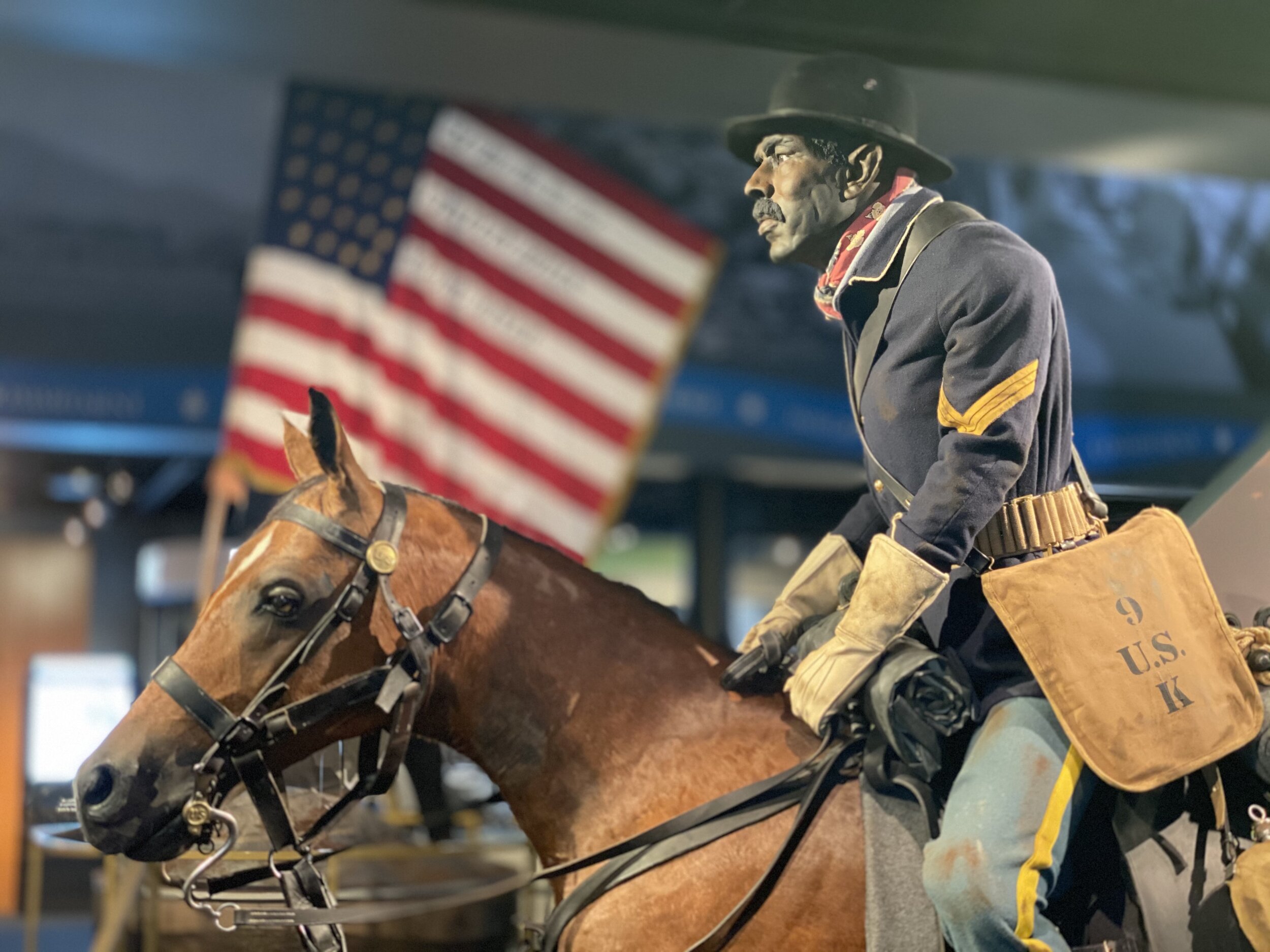
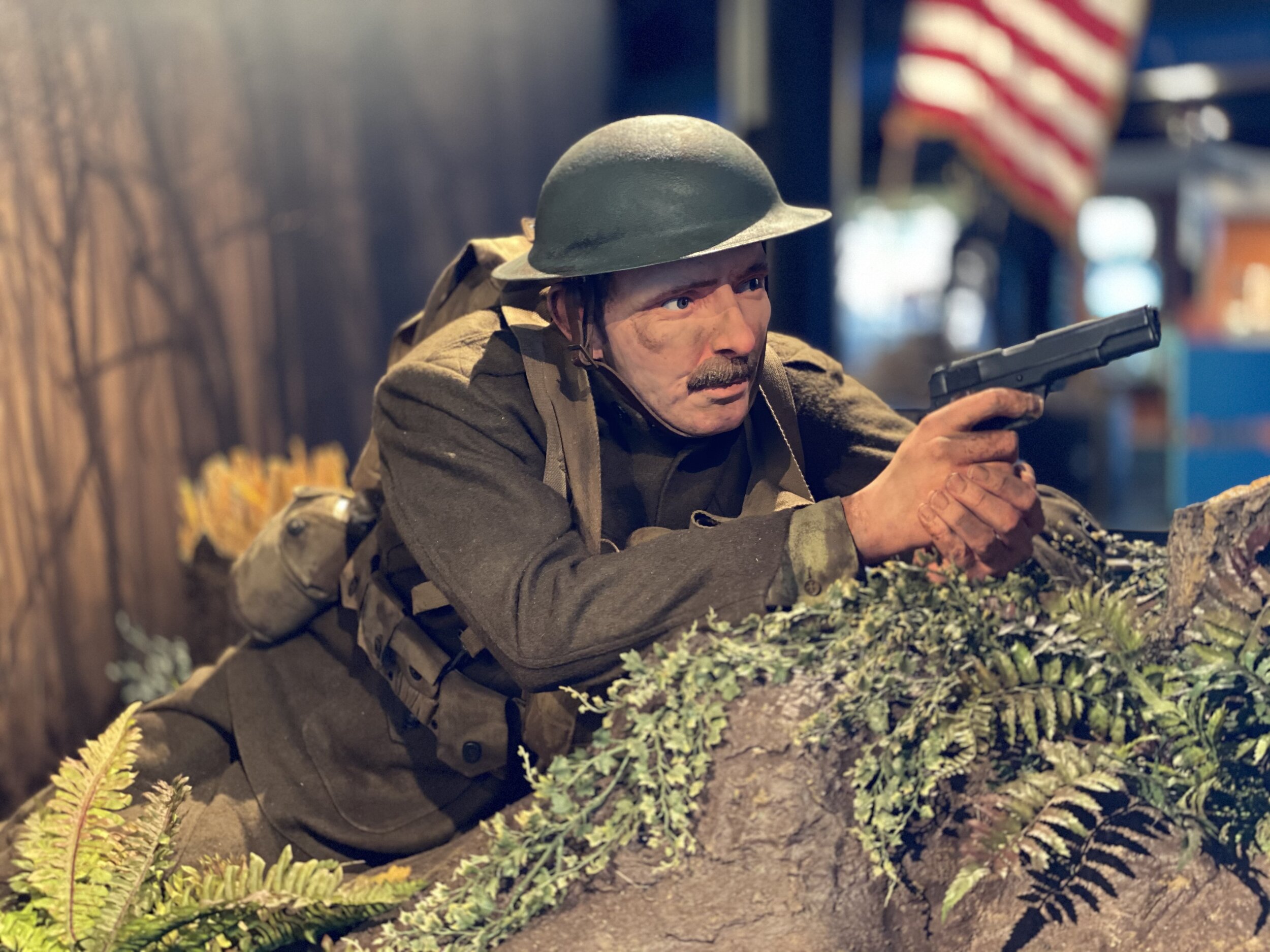
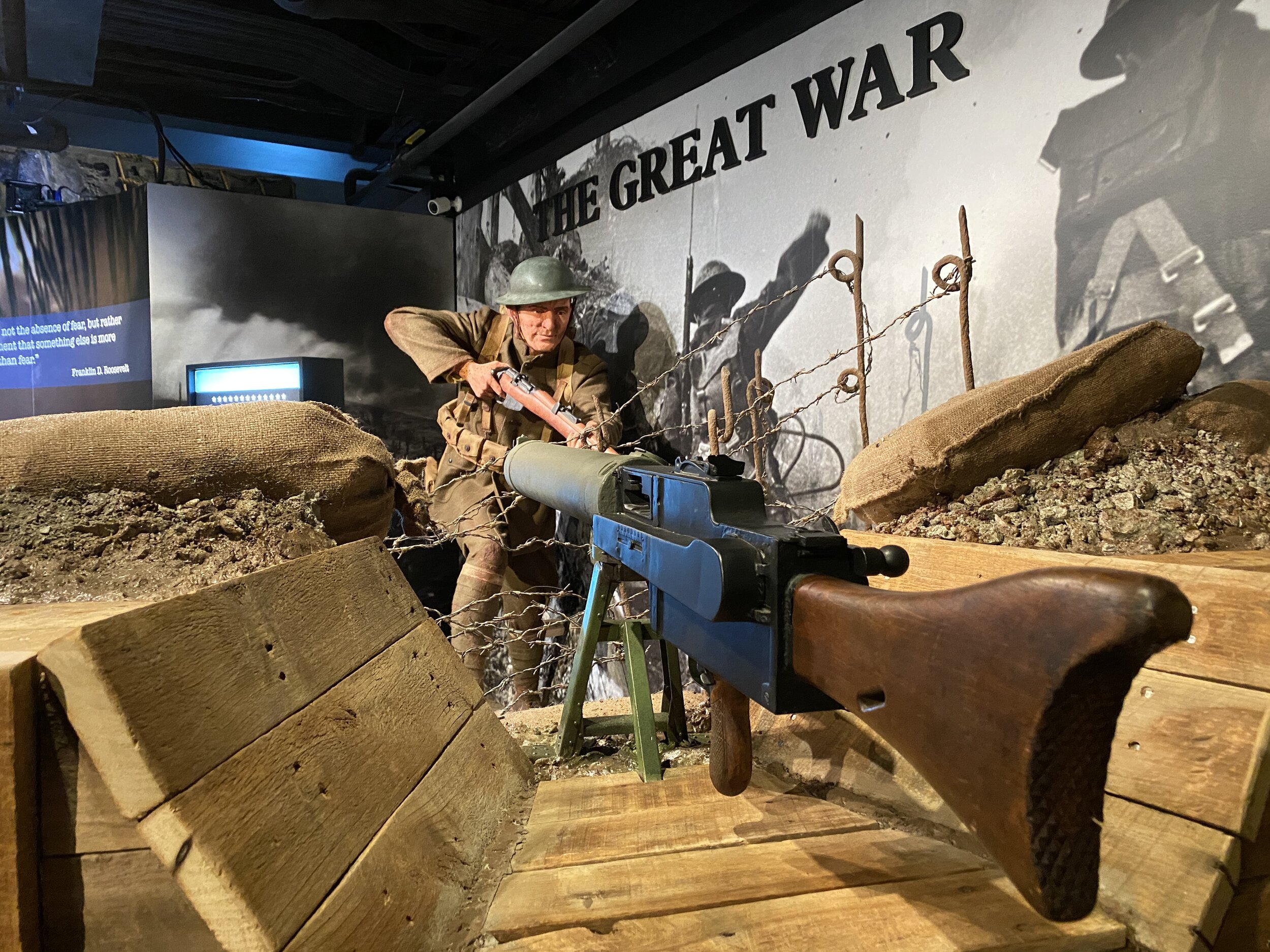
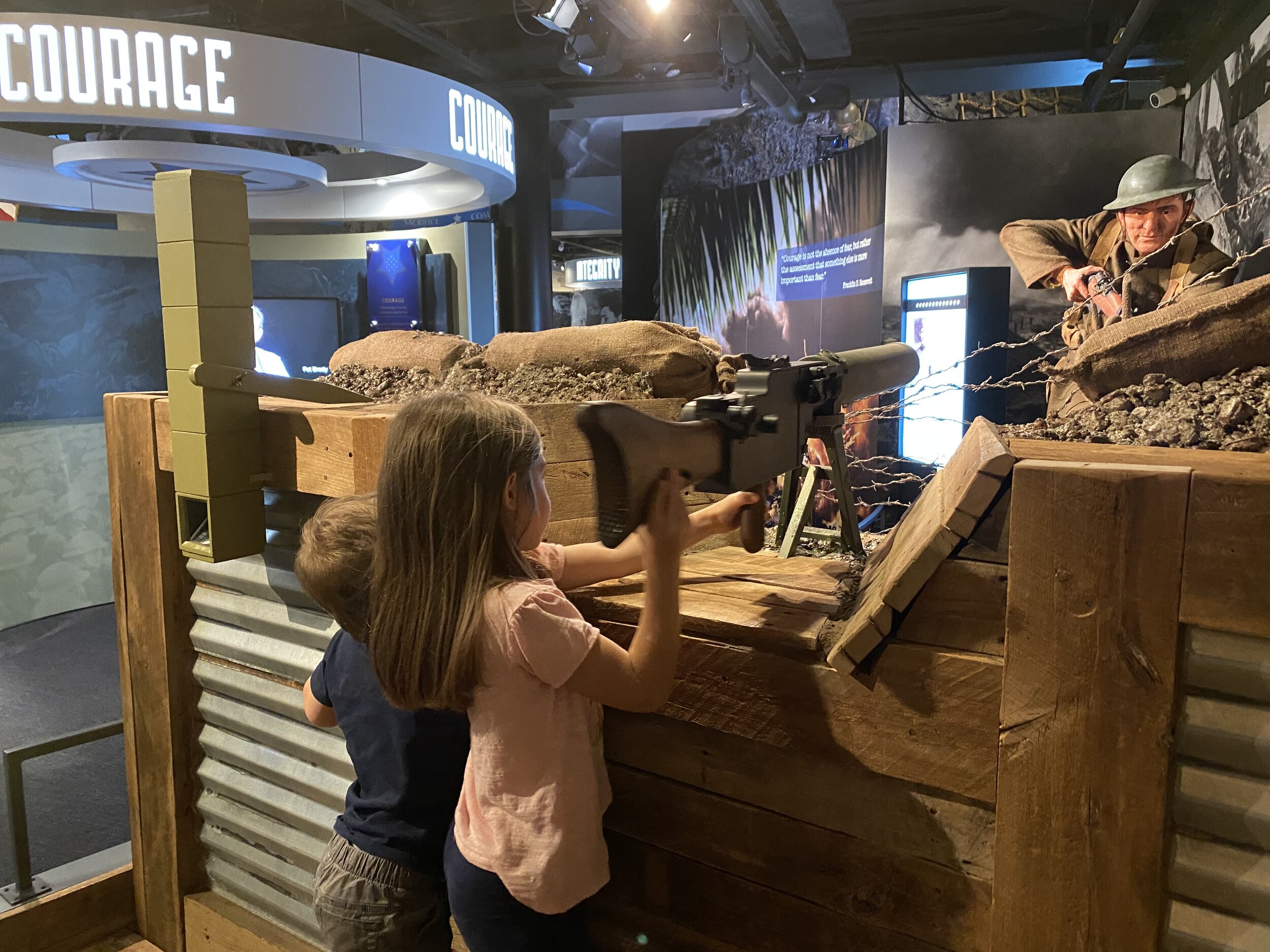
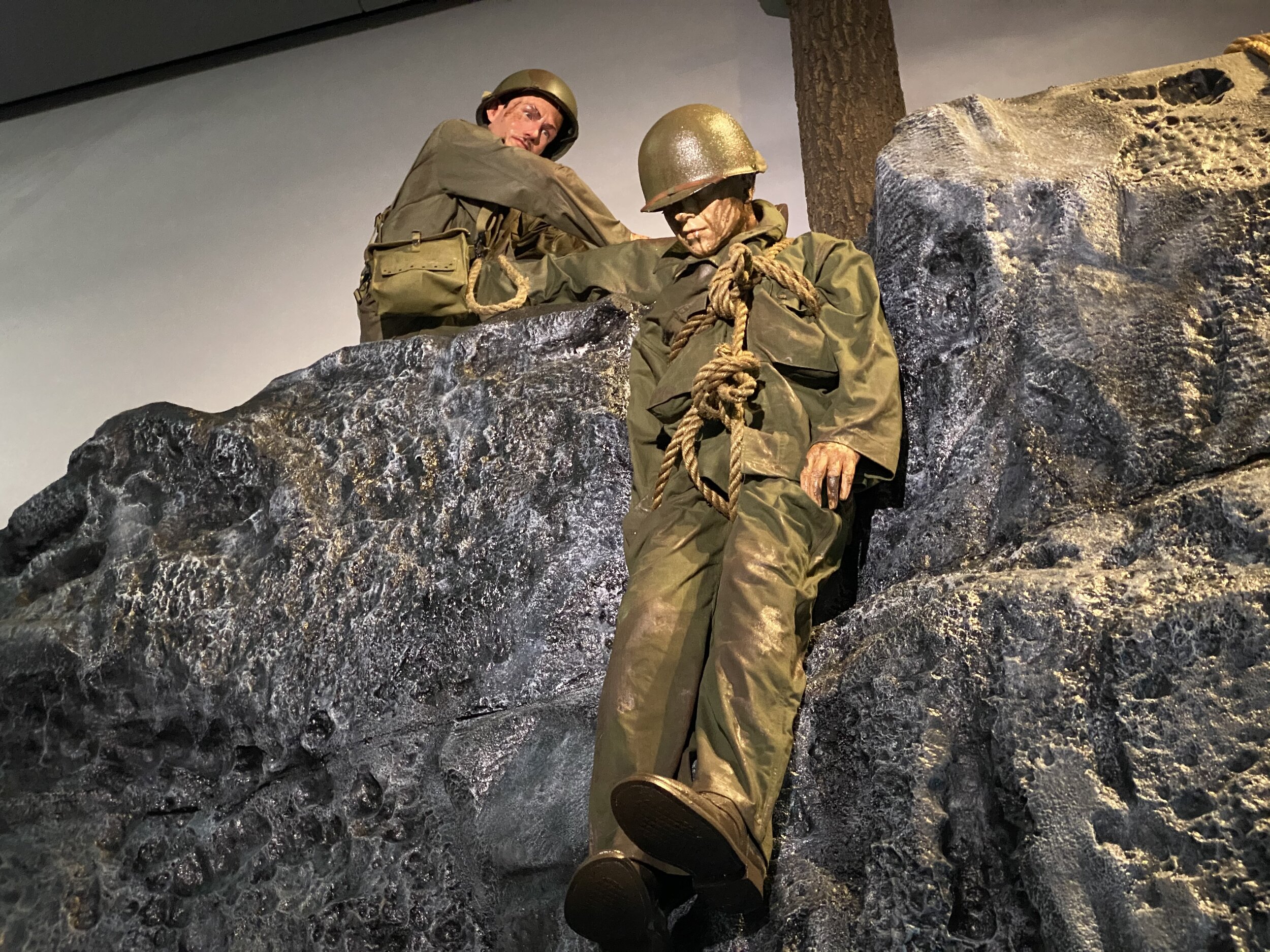
From the interactive room you enter a theatre for a short film about the Medal and its history. From here, you continue through the best part of the museum, a carefully designed series of exhibits walking you through American wars since the Civil War. Each exhibit has a life-size diorama of two or three Medal of Honor recipients from the conflict. These are exceptionally well done, with great attention to detail. Others are featured in large-scale photographs or well-designed displays with uniforms, artifacts—the museum preserves over 6,000 items related to the Medal of Honor—and some element of the environment in which those profiled earned the medal: the cliffs at Hacksaw Ridge, a sandbagged hootch for three Vietnam recipients, a dusty road for one who fought in Iraq. A few have video reenactments that play in screens set into the walls, and at several points a multimedia station features interviews with living Medal of Honor recipients.

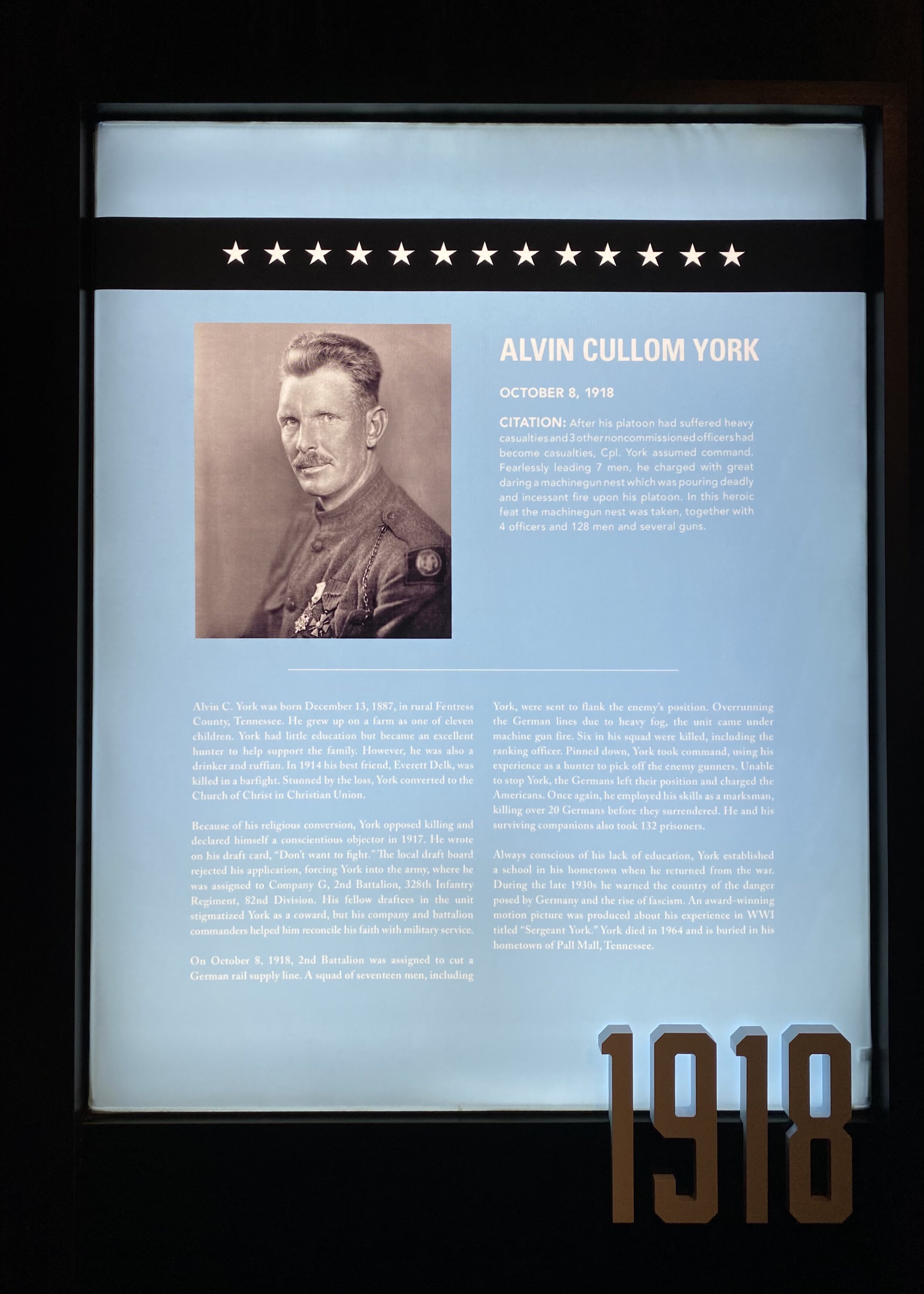
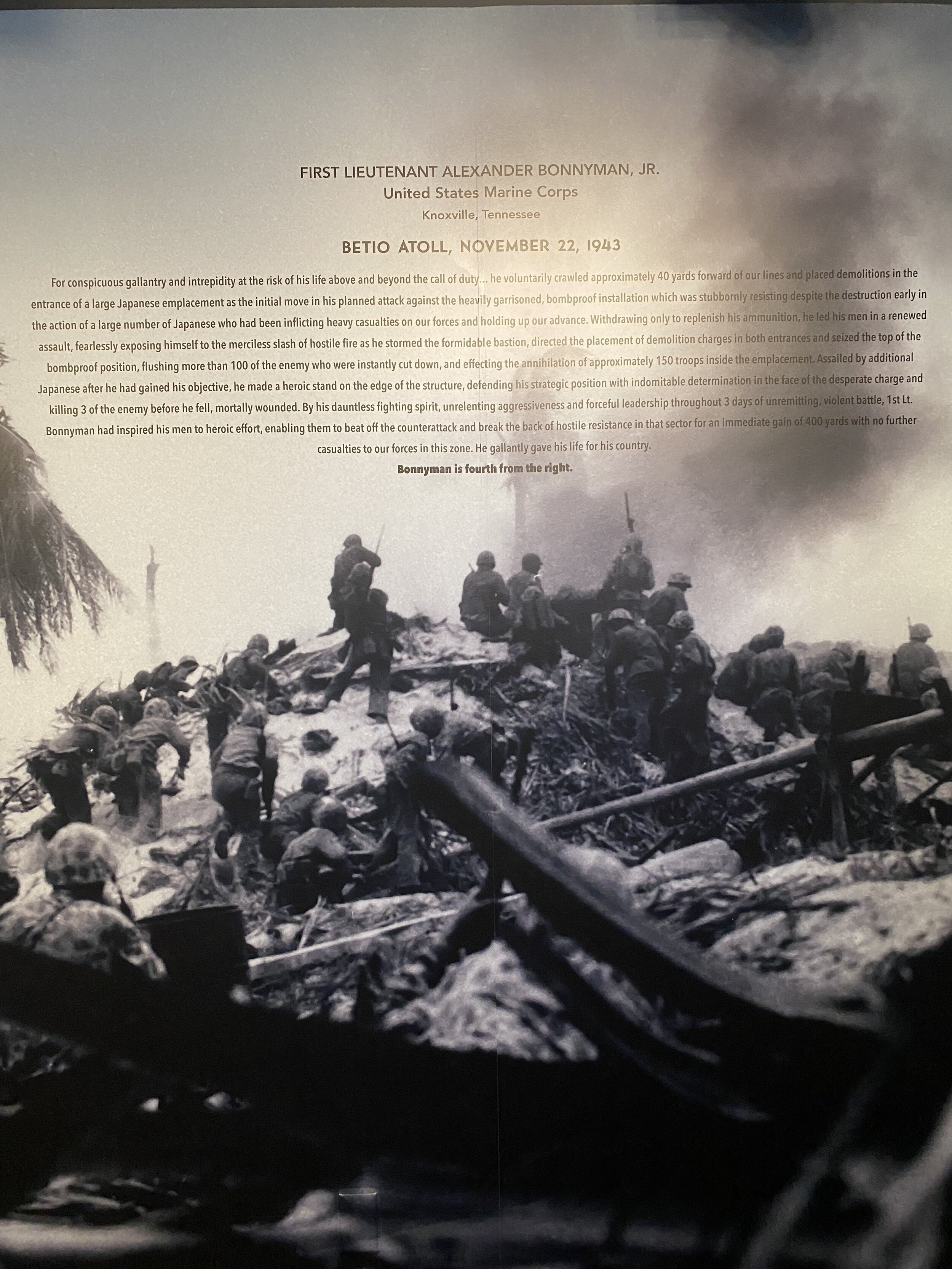
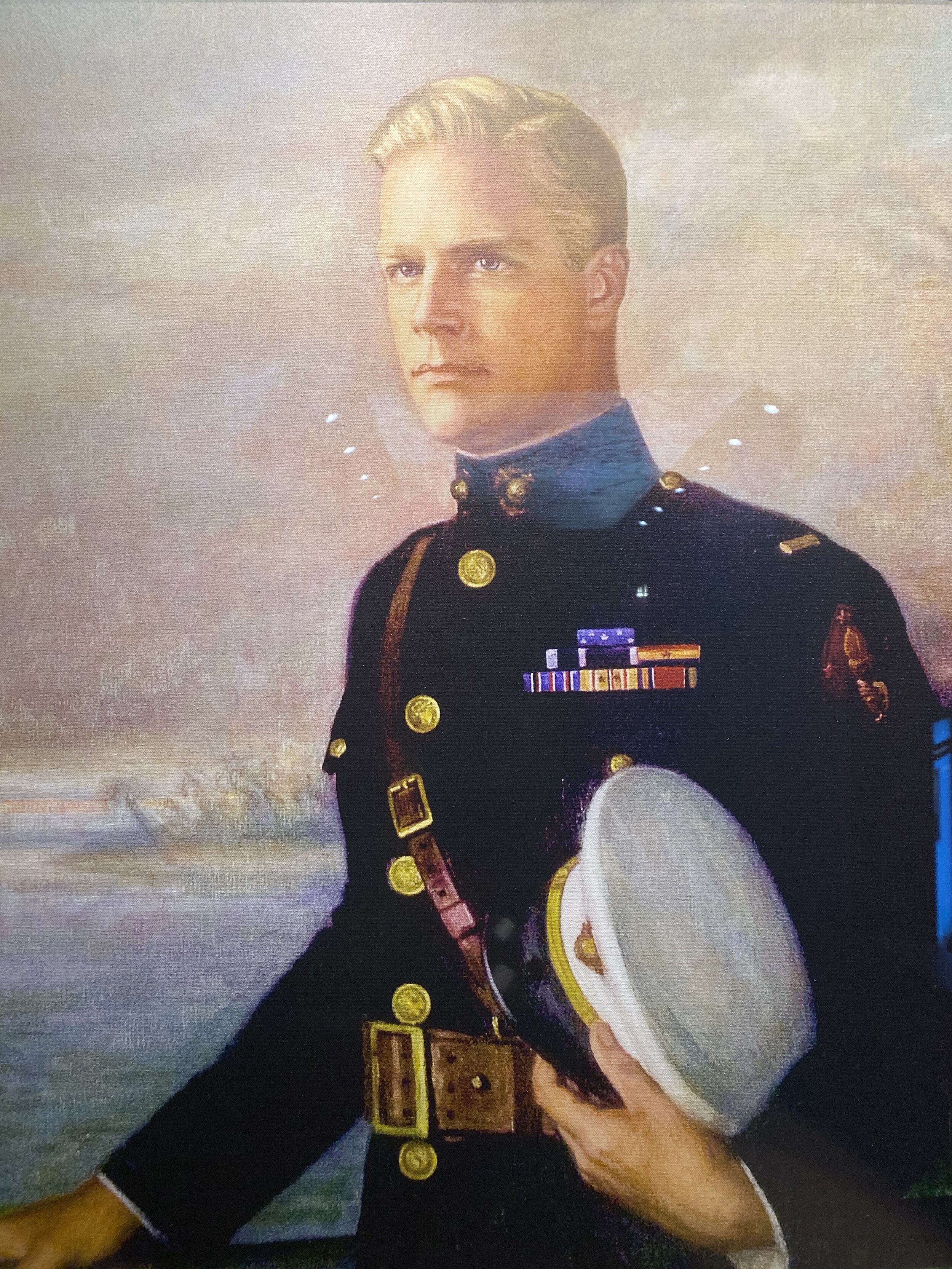
Among those profiled are Dr Mary Walker, the only female Medal of Honor recipient; Civil War officers James Andrews (of the Great Locomotive Chase) and Arthur MacArthur (father of Douglas); Buffalo soldier George Jordan; World War I soldiers Charles Whittlesey, Joseph Adkison, and Alvin York; conscientious objector turned medic Desmond Doss; Marine officer Alexander Bonnyman; and Kyle Carpenter. There are a great many others as well.

While I didn’t have the luxury of stopping to read every sign or piece of information—touring with a six- and a four-year old keeps you moving—the displays offered lots of opportunities to tell stories and talk to the kids about what they were seeing. It’s hard to know what sticks, but they came away seeming to appreciate more what being brave and sacrificing for others means.

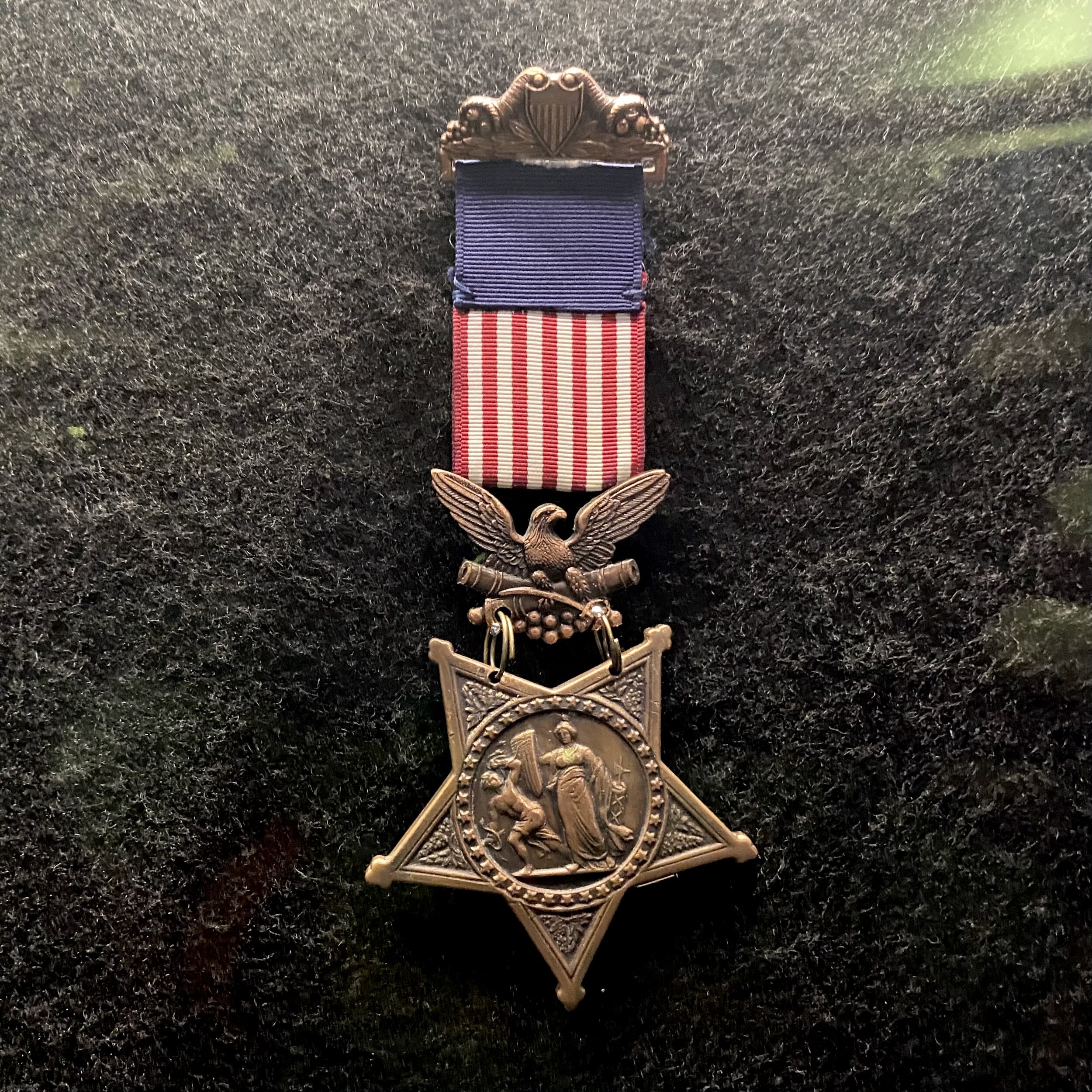
This was especially true of the Vietnam display. While many of those profiled in the dioramas lived to fight again or to tell their stories to future generations, the men whose stories were selected to represent Vietnam—Marine Rodney Davis and Navy corpsman David Ray—were killed in action, both by taking the blast of enemy grenades in order to save others. A recurrent theme of the museum, a quotation displayed in several places, is John 15:13: “Greater love hath no man than this, that a man lay down his life for his friends.” The museum shows vividly what this means on the battlefield.

Other notes

The museum has a good gift shop with well-selected items that are relevant to the museum’s topic and don’t reduce its theme to kitsch (something you can’t always count on with museum gift shops). There’s an especially good selection of books; I picked up Sergeant York: His Own Life Story and War Diary, which I’ve been looking forward to reading since it was reissued for the centennial of his actions in the Meuse-Argonne offensive.

The staff and volunteers were friendly, helpful, and very accommodating to a dad touring with two children six and under. I especially appreciated their work; they represented the museum and its mission well.

In conclusion

The Medal of Honor Heritage Center offers an excellent introduction to US military history and the virtues the medal represents: patriotism, citizenship, courage, integrity, sacrifice, and commitment. While informative and moving for adults, it’s also a good place for kids to visit—the dioramas are helpful visuals, and the stories, while presented soberly and realistically, are not prohibitively graphic. I highly recommend visiting if you’re ever in the Chattanooga area.

Breakout at Stalingrad

German prisoners march out of the ruins of Stalingrad, January 1943.

German prisoners march out of the ruins of Stalingrad, January 1943.

Three years ago I read Unknown Soldiers, by Väinö Linna, one of the best and most powerful war novels I’ve ever come across. Unknown Soldiers follows a company of Finnish machine gunners through the Continuation War, a three-year war against the Soviets that ran parallel to the German invasion of Russia. Following some initial successes and some years of sitting tight in trenchlines, in the final third of the book the war turns against the Finns and the story becomes one of pell-mell retreat, of sacrifice to buy time and save lives, and ever increasing desperation. The characters suffer, fight and run, scrape together whatever they can to survive, and all too frequently die.

Take that feeling of desperation, the weight of unavoidable, inescapable impending defeat, stretch it out to six hundred pages, and shift the scene from a largely forgotten war to one of the most famous battles in history, and you have Heinrich Gerlach’s Breakout at Stalingrad.

Encirclement

Gerlach’s novel tells the story of a handful of men from the intelligence section of a German division’s staff. The most prominent among them is Lieutenant Breuer, whom we meet in the first chapter as he returns to the front outside Stalingrad after a trip to the rear. Through Breuer we get to know various other officers in the middle rungs of divisional leadership, and through his driver, the kindhearted and optimistic Lakosch, we meet a number of the enlisted men who work as drivers, cooks, and mechanics for headquarters. The cast is large and wide-ranging, including the divisional commander, a newly promoted colonel; haughty Sergeant Major Harras, a man more concerned with the finery of his uniforms than with discipline or combat effectiveness; Padre Peters, a hardworking chaplain; and the officers who distribute food and pay and who command the division’s small contingents of tanks, antiaircraft guns, and other defensive measures. The commander of the Sixth Army himself, General—later Field Marshal—Paulus, even appears a few times, as does Hitler, a faraway figure in more than one sense, a man detached from and cold to the reality of what is about to happen at Stalingrad.

Our meeting with Breuer comes at an inauspicious time—mid-November 1942. The rumor, to which Breuer is privy as a member of the division’s intelligence section, is that the Russians are massing their forces along the Don River north of the city with the apparent intent of cutting off the German army there and encircling them.

durchbruch.jpg

Exactly that happens. The Russians attack in overwhelming numbers, and despite manful resistance, Breuer and the rest of the German army begin a constant retreat. In a skillfully described series of incidents through the middle of the book, Gerlach describes the Germans pulling up stakes and falling back to new defensive lines only to have these collapse, leading them to repeat the process. Little things go awry, and thanks to the slow accumulation of details with each retreat, we first sense and then see these tactical withdrawals turn into chaotic routs.

The Russians complete their encirclement quickly and the supply lines fail. The Germans run short of food, ammunition, and medical supplies. They eat their draft horses and every farm animal they come across before turning to civilians’ pets and strays. The Luftwaffe attempts an airlift that proves only partially successful, bringing in not nearly enough supplies and flying out only the most desperately wounded, the most important, and the most devious. As the Russians close in on the airfields the planes themselves come under attack, and even getting a pass to board a flight out is no guarantee of escape. At one point Breuer, having been wounded in the eye, finally has a chance to get out via cargo plane, and the suspense and desperation of the scene is unlike anything I’ve read in other war novels.

The final act of the novel takes place in Stalingrad itself, which Breuer and company have slowly withdrawn toward for weeks before they actually enter. The city is a tomb, full of the shells of buildings, which are themselves full of wounded and dying men. The conclusion plays out here, in these contested ruins, and even the clearly approaching end of the siege can prove no comfort—the men go on dying right up to the moment they are captured, even after the city’s surrender. Plans to escape, using German-allied Romanian troops or Russian collaborators for cover, come to nothing. The wounded linger and die. Soldiers freeze to death in their foxholes. Others go insane. And those that live to be captured can look ahead and see nothing but Soviet captivity.

What makes Breakout at Stalingrad great

You might notice that, while I describe a broad sequence of events above, I do not exactly summarize a plot. Like many other war novels, Breakout at Stalingrad is episodic, a reflection of the actual experience of these events—about which more below. What makes this a great novel is not its plotting, but Gerlach’s attention to three things.

First, Gerlach peoples this novel with vivid and interesting characters. Breuer, the character with whom we spend the most time, is an effective everyman, a dedicated soldier without much interest in politics and a whole lot to live for, and who is nevertheless burdened by terrible premonitions. His driver, Lakosch, is a hopeful true believer in the Nazi cause—which, as he understands it, is anti-Bolshevism, a cause to which he is committed owing to his miserable youth as the child of Socialist parents. The disillusionment of both characters—symbolized by different things for each man, like the moment Lakosch has to abandon his beloved but now broken down Volkswagen field car—provides two of a dozen or so fully realized character arcs in the novel.

A few of these arcs prove surprising. In the final chapters of the novel, Breuer finds himself awaiting his fate with an officer of a much more ideological mindset than himself, and in the quiet before catastrophe they have a chance to reflect that their conversation would have been impossible for both of them when the siege began. Stalingrad has changed both of them, a wry realization. But not all of these arcs are redemptive or result in any kind of epiphany. Sergeant Major Harras leads a two-month career of utter villainy, and like him some of the convinced Nazis among the German officers only fall lower and lower as the siege gets worse and they commit themselves more and more totally to either victory or annihilation.

The most powerful and haunting character to me was the chaplain, Padre Peters, a rare religious character in this kind of fiction who is treated seriously and depicted as sincere, who works himself to exhaustion and psychological collapse. The incident that awakens him from his fugue state near the end of the novel is one of the most moving and haunting depictions of religious devotion and the power of the scriptures and the sacraments that I’ve ever read.

Second, Breakout at Stalingrad abounds in vivid, carefully selected details, which is the lifeblood of realistic fiction. Gerlach’s descriptions of combat, of the sudden appearance of Russian tanks or the steady approach of a horde of Russian infantry across the snow, of the wounds and frostbite and infections and ramblings of the pitiful final survivors of the battle, of the way a half-mad crowd of men press forward toward the hatch of a cargo plane, and—throughout—the rapidly changing mental states of these exhausted and overextended men are gripping. This novel does what all the best war novels do—shows what it was like—and does it exceptionally well.

Finally, Breakout at Stalingrad is full of terrible irony. This is not to say that Gerlach’s tone is cynical, though he certainly presents the entire story as a bitter critique of Hitler’s leadership, Nazism, and the whole Nazi project. The characters, who are so vividly drawn, will be marked by this experience for life, provided they survive.

Gerlach’s irony does not stem from his tone or treatment of the story but from the story itself. Unwelcome surprises and awful turns of events occur throughout. A general who is thankful that his pilot son is flying cargo planes in some other part of Europe, Lakosch and his love for a stray dog he has adopted and keeps miraculously well fed, Harras and his attempt to blow up a wrecked aircraft to deny its use to the Russians, the trust of the more fervently Nazi or simply patriotic officers in their leaders back home—all have terribly ironic outcomes brought about by the situation at Stalingrad itself. Even the very first chapter, in which we meet Breuer and Lakosch driving through the night, is by the end an ironic memory: their trip down that road is the last time that that road into—or out of—Stalingrad will be open to any of them. It’s masterfully done, and the irony with which Gerlach generously sews the story only adds to the weight of the characters’ impending doom.

The story of Gerlach’s novel

A final, external factor that makes Breakout at Stalingrad interesting is the story of the novel itself. Gerlach was, like Breuer, a low-ranking intelligence officer at Stalingrad and was among the hundreds of thousands of men captured when Paulus capitulated. Held in prison camps in Russian for years even after the war’s end, Gerlach spent time with many other survivors of the siege and, by the end of his captivity in 1950, he had written the manuscript of Breakout at Stalingrad. But before he could be released and repatriated, the Soviets went through his papers. They confiscated the manuscript.

Following his return, Gerlach eventually decided to write his novel again, and used hypnosis to assist his recall of the original manuscript. This second “remembered” version of the novel was published in Germany as Die verratene Armee in 1957, as The Forsaken Army in 1958. It was a hit, and enjoyed great success throughout his lifetime. He died in 1991.

Then, in 2012, a German professor of literature doing research on leftist German writers in a Moscow archive stumbled upon something remarkable—the confiscated original manuscript of Gerlach’s novel. The professor, Carsten Gansel, edited and published the newly rediscovered novel in 2016, a quarter century after Gerlach’s death.

The English translation I read includes a 150-page appendix by Gansel recounting Gerlach’s wartime experiences and imprisonment and discussing the rediscovery of the manuscript itself. The chief draw of Breakout at Stalingrad is and must be the novel itself, and so while you won’t be missing anything if you don’t look into this remarkable background story, it is worth reading for its own sake. I, for one, am thankful that Gansel happened across the manuscript and that he saw it into print.

Conclusion

Is Breakout at Stalingrad an anti-war novel? I don’t know. Certainly no one would choose to live through the things Gerlach describes, and certainly Gerlach depicts the battle as a waste of brave men caused by the cruelty of far-off leaders. But the strength of whatever message Gerlach has for us lies in its story, in its characters and the things that happen to them. It condemns the war without sermonizing, like Johnny Got His Gun or All Quiet on the Western Front in its more hamfisted moments; shows the disintegration of human minds and souls without filling the story with men who are already degenerates, like The Thin Red Line or The Naked and the Dead and their casts of perverts and psychopaths; and brings us into moments of extraordinary pathos, tragedy, camaraderie, and—just occasionally—heroism without the cloying phoniness or sentimentality of so many war movies.

As I mentioned above, Breakout at Stalingrad accomplishes one of the most important things a novel of any kind, but most especially a war novel, sets out to do: create that dreamlike state of vicarious experience that conveys what it was like. Drawing on his own experiences and those of his fellow survivors of Stalingrad, Gerlach carefully constructed this novel around a diverse set of believable characters and freighted their stories with shocking and often bitterly ironic incidents that show us, the readers, the brutality and waste of the battle. Like Linna’s Unknown Soldiers, the result is not only a great war novel, but a great novel, a story we could all stand to learn from—and can be grateful we didn’t live through.

The danger of do-gooders

Helen Andrews, whose very good Lytton Strachey-inspired book Boomers I read just last week, has an energetic and fantastically cutting review of a new biography of Eleanor Roosevelt at the Claremont Review of Books. The review, entitled “Do-Gooder in Chief,” begins with an anecdote about Hillary Clinton’s attempt to contact Mrs Roosevelt via medium and leads into the subject with this incisive paragraph:

The irony of Eleanor Roosevelt, feminist political icon, is that her career was a 50-year vindication of every misogynist cliché about women in politics. Her politics were sentimental rather than rational. She was impulsive and easily swayed, a busybody who meddled in every issue under the sun without bothering to master anything intellectually. She honestly believed we could end poverty and war by all being a little nicer to each other.

While nodding to Eleanor Roosevelt’s better qualities, such as her self-sacrificial longsuffering and concern for others, which would have been commendable if put to other uses, Andrews catalogs her chain of blithely attempted failures—social, political, philosophical, and even, in her marriage to Franklin and her mismanagement of the White House, personal and domestic—and the doggedness with which she pursued solving intractable real world problems despite having no insights of any particular value to offer. All she had was a sentimental pity for the downtrodden and the optimism to try things, not to mention a name and position that afforded her plenty of guinea pigs. Andrews:

Her inability to graduate from sentimentality to principle meant that Eleanor was easily blown hither and yon by the gust of events. When Neville Chamberlain signed the peace deal at Munich, she applauded as a pacifist. When her husband advocated war against Hitler, she applauded as a humanitarian, with no sense of inconsistency.

So what? one might ask. Today Eleanor Roosevelt functions primarily as a talisman—like the portraits of Hillary Clinton and Madeleine Albright that Leslie Knope, another insufferable do-gooder, kept in her office—and an icon of sentimental goodwill, and there are certainly more pernicious activist figures one could invoke. Here are kids’ books about John Brown and Che Guevara, and a YA graphic novel about Emma Goldman.

But when all one has to offer is compassion and innocent goodwill, and these mere inclinations are never subjected to hard questions or challenged by the wisdom of experience, the results can be worse than if no one had meddled in the first place and all the more far-reaching precisely because they seem to be, in the person of the do-gooder, so unobjectionable. And worst of all, the do-gooder is an easy mark, something that every panhandler and swindler knows.

All of which brought to mind this passage from Erik von Kuehnelt-Leddihn’s Leftism, a book perhaps even more scathing than Andrews’s review:

Was Mrs. Roosevelt deeply imbued with pro-Communist ideas or merely naive? Probably both. Witness an article she published in McCall’s (February 1952) about the President’s unease with Stalin at the Teheran Conference. “My husband was determined to bend every effort to breaking those suspicions down, and decided the way to do it was to live up to every promise made by both the United States and Great Britain, which both of us were able to do before the Yalta meeting. At Yalta my husband felt the atmosphere had somewhat cleared, and he did say he was able to get a smile from Stalin.” Indeed, how many people would not sell millions into slavery to get a smile from that dear old man?

Per Andrews, Franklin Roosevelt was a “glib charmer whose emotional default was to take and take without giving back,” a quality exemplified by his relationships with Churchill, the American people, and Eleanor herself. Between Franklin’s reliance on superficial charm to get by and Eleanor’s warm-and-fuzzy nicety, they were the perfect marks for an aloof and canny con-man like Stalin, and it was Eastern Europe that paid the price.