Toad ex machina
/For the last couple months I’ve been slowly reading The Wind in the Willows to the kids before bedtime. Last night we finished the penultimate chapter, in which Toad, having escaped from prison and reached Rat’s riverbank hole after a madcap cross-country chase in disguise, learns that Toad Hall has been taken over by the stoats and weasels who live in the woods. They’re living off the fat of Toad’s patrimony and wrecking his house, and, what is more, have guards posted and regular patrols around the perimeter of the property.
Rat and Badger rule out a direct attack. The stoats on guard duty will warn the weasels, who will be ready and waiting—provided Toad and company ever get past the guards. Despite Rat’s passion for weaponry of all kinds, they’re outnumbered and outgunned by opponents who have no scruples. How will they ever get in and reclaim Toad Hall?
Then we read this exchange and revelation:
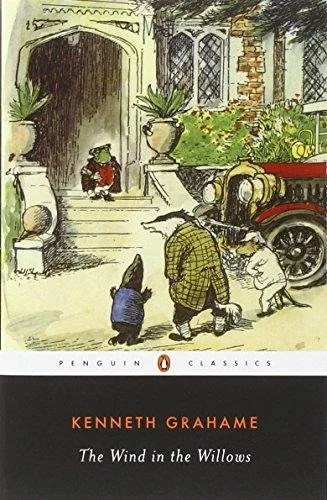
“Then it’s all over,” sobbed the Toad, crying into the sofa cushions. “I shall go and enlist for a soldier, and never see my dear Toad Hall any more!”
“Come, cheer up, Toady!” said the Badger. “There are more ways of getting back a place than taking it by storm. I haven’t said my last word yet. Now I’m going to tell you a great secret.”
Toad sat up slowly and dried his eyes. Secrets had an immense attraction for him, because he never could keep one, and he enjoyed the sort of unhallowed thrill he experienced when he went and told another animal, after having faithfully promised not to.
“There—is—an—underground—passage,” said the Badger, impressively, “that leads from the river-bank, quite near here, right up into the middle of Toad Hall.”
“O, nonsense! Badger,” said Toad, rather airily. “You’ve been listening to some of the yarns they spin in the public-houses about here. I know every inch of Toad Hall, inside and out. Nothing of the sort, I do assure you!”
“My young friend,” said the Badger, with great severity, “your father, who was a worthy animal—a lot worthier than some others I know—was a particular friend of mine, and told me a great deal he wouldn’t have dreamt of telling you. He discovered that passage—he didn’t make it, of course; that was done hundreds of years before he ever came to live there—and he repaired it and cleaned it out, because he thought it might come in useful some day, in case of trouble or danger; and he showed it to me. ‘Don’t let my son know about it,’ he said. ‘He’s a good boy, but very light and volatile in character, and simply cannot hold his tongue. If he’s ever in a real fix, and it would be of use to him, you may tell him about the secret passage; but not before.’”
Now for an odd comparison:
One of the great weaknesses of Ready Player One is that every time narrator Wade Watts meets some hitherto unprecedented challenge, something that should pose a problem and complicate his quest, he waves dismissively to the reader and lets us know he actually mastered whatever skill is required to complete it—playing an obscure arcade game, watching every episode of some trash 80s sitcom multiple times, memorizing every line of Monty Python and the Holy Grail—ages ago. No biggie. Very convenient.
Wade has a stash of knowledge and skills he only mentions once it becomes relevant. Ordinarily something like this should be set up or at least mentioned beforehand, as in a fair-play mystery. (Contrast this with the best Harry Potter novel, The Prisoner of Azkaban, in which Rowling performs dazzling sleight-of-plot with all but a few key elements plainly visible from the beginning.) What Ready Player One does is not exactly deus ex machina, but it feels both contrived and lazy and it’s all too common in bad fiction.
Badger’s revelation in Wind in the Willows, on the other hand, which similarly introduces a solution to a thorny problem just as it seems impossible, works. It works because the way the information is revealed is rooted in the characters. We know Toad all too well by this chapter—of course if there were a secret passage no one would tell him. And we know Badger both through his actions and his reputation among the other animals—of course if there were a secret passage he would be the best person to trust with the secret. It feels natural and therefore credible not because the secret passage was set up beforehand, but because of what we have seen of the characters all the way through.
The other animals looked hard at Toad to see how he would take it. Toad was inclined to be sulky at first; but he brightened up immediately, like the good fellow he was.
“Well, well,” he said; “perhaps I am a bit of a talker. A popular fellow such as I am—my friends get round me—we chaff, we sparkle, we tell witty stories—and somehow my tongue gets wagging. I have the gift of conversation. I’ve been told I ought to have a salon, whatever that may be. Never mind. Go on, Badger. How’s this passage of yours going to help us?”
That Kenneth Grahame is able to get some laughs—again, rooted in character—out of this plot point is just the icing on the cake.
A weird, unique, brilliant, funny, and fun little novel, and so much better written and plotted than a lot of fiction today. (This climactic section is also quite consciously modeled on the Odyssey, something even my kids picked up on. Perhaps material for a future post.) I’m glad I’m finally reading it and hope to finish it tonight.