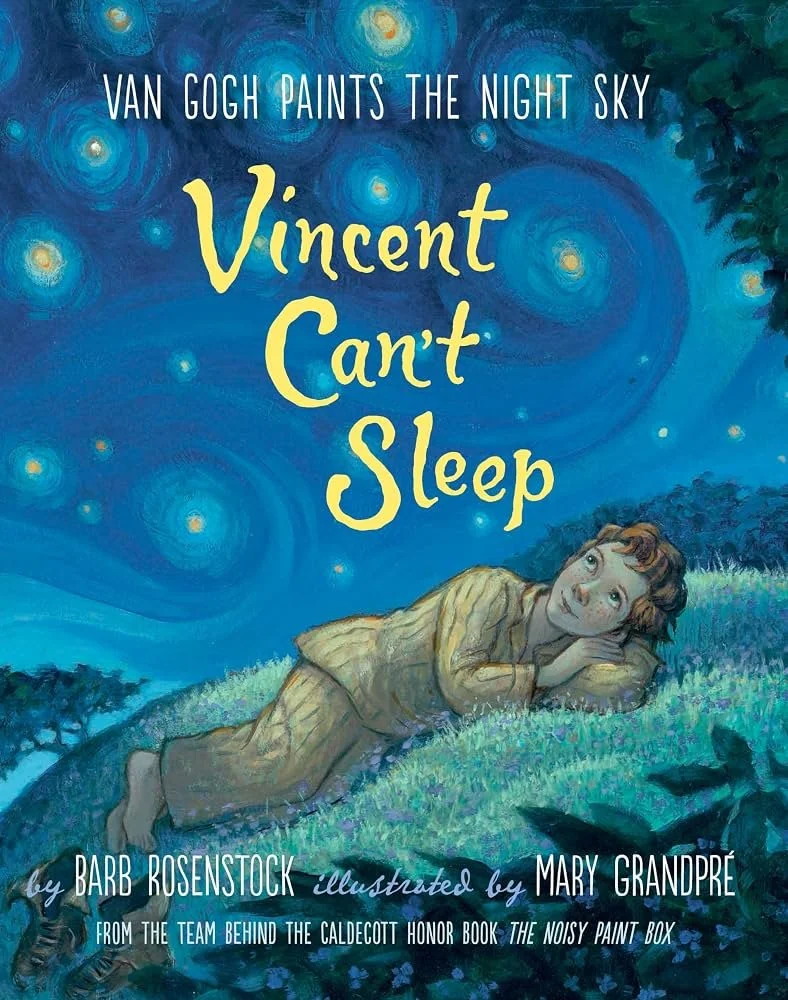
Vincent Can’t Sleep
/I ran across VIncent Can’t Sleep: Van Gogh Paints the Night Sky at the library two years ago and checked it out to read to my kids. It simply but movingly tells the story of Van Gogh’s lifetime struggle with insomnia, hints at his broader problems with mental health, and suggests the role these played in his unique work. I enjoyed it, the kids enjoyed it, and we returned it to the library.
Two things have happened since then that have deepened my appreciation of the book, though. First, shortly after first reading Vincent Can’t Sleep to the kids I read Russ Ramsey’s Rembrandt is in the Wind, which includes a chapter on Van Gogh and his difficulties, and the followup, Van Gogh Has a Broken Heart, which is very specifically about pain and hardship in the making of art. Both made me think more seriously about Van Gogh’s life and work and especially his suffering.
Second, as I’ve mentioned before, early this year I got plumb worn out. I was tired and depressed and—the worst of my symptoms—I couldn’t sleep. I’ve had trouble sleeping before and even worked it into one of my novels, but this year I had real insomnia.
I’m thankful to say I’m much better—and perhaps I can tell the whole story of this bad winter and spring someday—but revisiting Vincent Can’t Sleep this week I had a much deeper understanding of the story it tells and, as moved as I was the first time, it meant even more to me.
The author, Barb Rosenstock, begins with Vincent’s childhood in Zundert, where, in the attic room he shares with his devoted younger brother Theo, he often struggles to sleep. He wanders at night, once going on a long midnight walk that inadvertently takes him across the border into Belgium. The night sky comforts him in ways daytime human company cannot. The story follows him to boarding school and his first job in his uncle’s art gallery. He is lonely, creative, and volatile. Because he scares his uncle’s customers he tries his hand at other work before settling into the life of a drifting artist.
Art helps him confront his sleeplessness. In a beautiful illustration of an adult Vincent staring into the sky above his Café Terrace at Night in Arles, Rosenstock tells us that “He discovers that darkness is not plain black.”
On the next page, Vincent lies in bed, “shut tight in a hospital,” the monastery asylum where he was confined for a year. This could be the darkest moment of the story, and yet it is here that Vincent, inspired by the view from his window and his lifetime of looking at the night sky, paints his most famous painting. Completing it, he can finally—in the book’s beautiful final image—rest, absorbed into and at one with the night sky.
The story is good but the glory of the book, what makes the story work so powerfully, is the art by Harry Potter illustrator Mary GrandPré. She successfully evokes Van Gogh’s style throughout, recreating some of his most famous landscapes as part of the storybook settings and giving cameos to other Van Gogh paintings in the background. It’s a beautiful book on every level.
But it’s that final image, the restless man at peace, having created something from his unrest, that moves me so much now. At the worst moment of this spring I couldn’t write—I could think of nothing to write and couldn’t muster the will to try. Then, slowly, writing became the best way to handle what I was feeling. Even dashing off a blog post here—“all this nothing,” in the words of You’ve Got Mail, another melancholy story, that has meant more than “so many somethings”—eased my mind. There were many nights through the spring when what made me sleep best was not meds or valerian root tea or the tight control I began exercising over caffeine and screentime, but simply having written.
I am no Van Gogh, but Vincent Can’t Sleep, in its simple way, has helped me understand him and my own life better, and to even more deeply appreciate God’s gift of creativity and how it can heal. Darkness is not plain black.