Chesterton on controversy

…or the lack thereof. Alan Jacobs, in a post called “insincere controversialists” at his blog Snakes and Ladders, brought this passage from What’s Wrong With the World back to my attention this morning:

GKC 1904.jpg

Genuine controversy, fair cut and thrust before a common audience, has become in our special epoch very rare. For the sincere controversialist is above all things a good listener. The really burning enthusiast never interrupts; he listens to the enemy’s arguments as eagerly as a spy would listen to the enemy’s arrangements. But if you attempt an actual argument with a modern paper of opposite politics, you will find that no medium is admitted between violence and evasion. You will have no answer except slanging or silence. A modern editor must not have that eager ear that goes with the honest tongue. He may be deaf and silent; and that is called dignity. Or he may be deaf and noisy; and that is called slashing journalism. In neither case is there any controversy; for the whole object of modern party combatants is to charge out of earshot.

I’ve quoted a selection from this passage here before, in “Chesterton on arguing,” about his more charitable approach to arguing, back last summer. Chesterton published What’s Wrong With the World in 1910—four years before the First World War, in a different world entirely—but the situation has only deteriorated in the eleven intervening decades.

Without being too topical, and trying not to pick on any one person or group (for there is none righteous), I intentionally ignored the State of the Union Address last night. I had more important and meaningful things to do—children to feed and take care of, an old friend to meet up with, a wife to talk to, books to read. But I couldn’t help noticing that, all afternoon, the News app on my phone desperately wanted me to read some selections from Stacey Abrams’s forthcoming rebuttal to the forthcoming State of the Union. With assertions and responses already thus prearranged, with the “party combatants” thus arrayed for battle, would anyone actually be listening to the speech? Or to the other side at all?

I don’t think I have to provide an answer. Don’t bother listening to your opponents—which would actually be engaging with them—but valiantly attack into the safe space of your ideological bubble and give bold speeches about your side’s bravery and the enemy’s duplicity. I can’t improve on Chesterton’s wonderful phrase above:

 
there [is no] controversy; for the whole object of modern party combatants is to charge out of earshot.
 

Despite everything you see on the news—and, God help us, social media—we don’t actually have much controversy any more, but it’s not for lack of noise and strife. Our politics and combat are noisy because we’ve lost the ability to listen.

They Shall Not Grow Old

“Mind the wire.”

“Mind the wire.”

Last night I finally got to see They Shall Not Grow Old, a First World War documentary directed by Peter Jackson. It was magnificent—the best World War I documentary I’ve seen. Nothing I can say to recommend the film is as powerful as watching it, so: Go see it.

There are a couple of directions you can take a documentary on a topic as big as World War I. The one I think most of us are used to, courtesy of Ken Burns and the History Channel (once upon a time, anyway), is a God’s eye view, with talking heads by historians, maps, photos and sometimes reenactments and, depending on the subject, real historical footage. This approach mirrors the top-down narrative approach of most historical books on topics this big and historically remote.

They-shall-not-grow-old-poster.jpg

They Shall Not Grow Old takes a different tack, one I’ve appreciated more and more since discovering Sir John Keegan in grad school. In his seminal, discipline-changing book The Face of Battle, Keegan sought to explore not the cause-and-effect relationships leading to entire wars or even particular battles, but instead the “what was it like?” experience of combat. This gives us a grunt’s eye or worm’s eye view, a view in which the concrete details of daily existence—or the end of existence—are the focus, as they were for the people living through it. What was the weather like? How did it feel to be there? How much could you see? How did you sleep? What did you eat? And when? Did your boots rub and make blisters? How did a trench smell? What did it sound like? Perhaps most importantly—who were these soldiers?

They Shall Not Grow Old narrows its focus from the entire war to the lived experience specifically of British soldiers on the Western Front. Jackson, in a special behind-the-scenes feature that played after the end credits at the showing I attended, said his aim was to present “an accurate but generic depiction of combat” for this subset of soldiers. The film is the better for it, I think, in the same way that Dante or Jane Austen have told us so much about the human condition by minutely examining and dramatizing their tiny corner of the world. The effect of a film like this would not have been as powerful had it tried to encompass all the nations that fought.

The big draw is the scrubbed up and colorized footage from the war, and rightly so. Jackson and his team have done something really remarkable here. By slowing the old film’s framerate, stabilizing shrunken and jittery old film prints or negatives, and repairing scratches and dust, the footage ceases to be an artifact and becomes footage again—a view of people, like us, going about their business, like we do. It’s a cliche, but this hundred year old footage comes to life.

Jackson, assisted by foley artists, has also added sound to the film, further enhancing the sense of what it was like. Perhaps the most impressive feat is adding voice to the silent footage. Jackson enlisted forensic lipreaders to discern what, exactly, the men in the footage were saying (my favorite: “Hi, mum!”) and then, in some impressive historical detective work, figured out what regiments the men belonged to and hired actors from those respective parts of Britain to record the dialogue. Mutters, giggles, coughs, exclamations, jokes, and even mundane talk—a sergeant pointing out where to lay down a load, an officer reading a pep talk to his company—all make it real.

Finally, the film features no talking heads by academics or novelists, no narration by voiceover artists, but instead an audio montage of actual World War I veterans recorded during the 1960s and 70s. You’re seeing the world they saw, as much as they saw it as Jackson could manage, and hearing them describe it themselves. It’s a profoundly unselfish way to tell the story, stepping back as much as possible and bringing the audience to the past, not subjecting the past to the present.

The end result is impressive and profoundly moving. Even those of us who have been moved by these photos and jumpy old newsreels have never experienced them like this. Over the course of the film, you feel like you get to know some of these anonymous faces; something of the character, the feel of the British tommy comes through, and when they suffer and die you feel it with them. The audience I watched the film with laughed with the soldiers, chuckled at their antics, cringed at their injuries, and cried when tragedy struck.

This film presents the kind of understanding—of these men, of their lives, of what they lived through—that you can otherwise only get from memoirs and makes it graphically real. Jackson and his team deserve all the praise they’re getting.

They Shall Not Grow Old is a fitting monument to a vanished generation. Go out and see it as soon as you can.

Local Author Expo recap

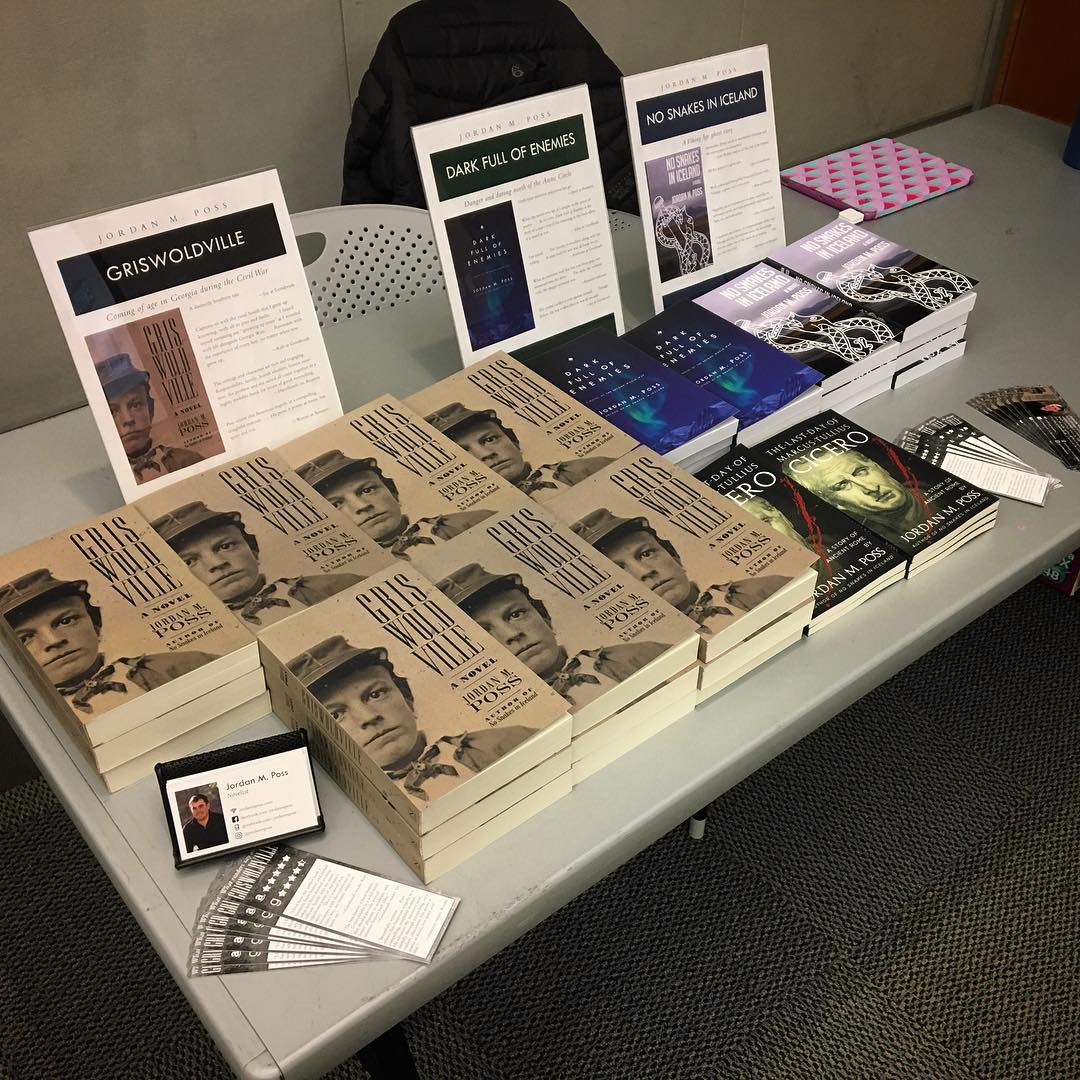
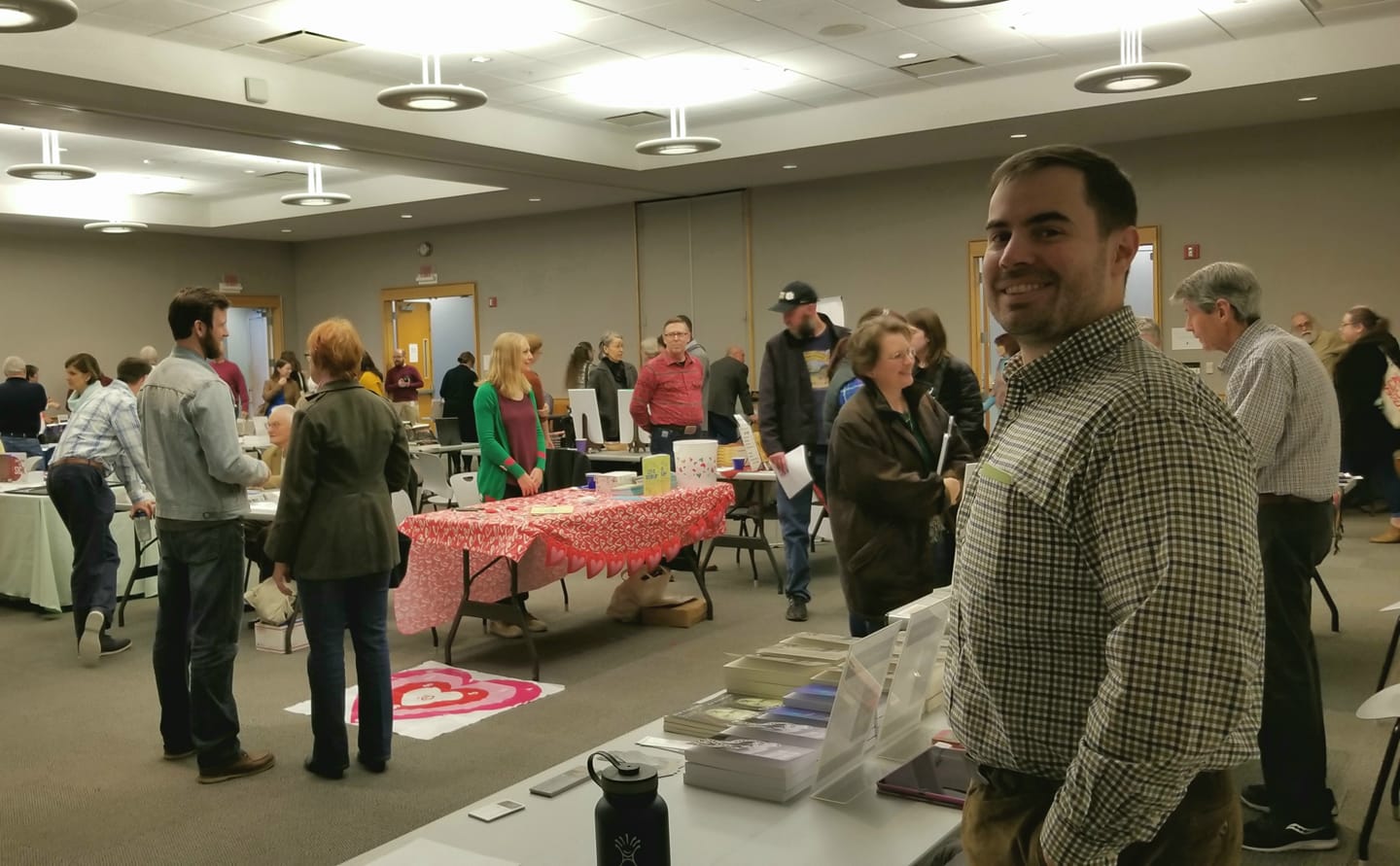
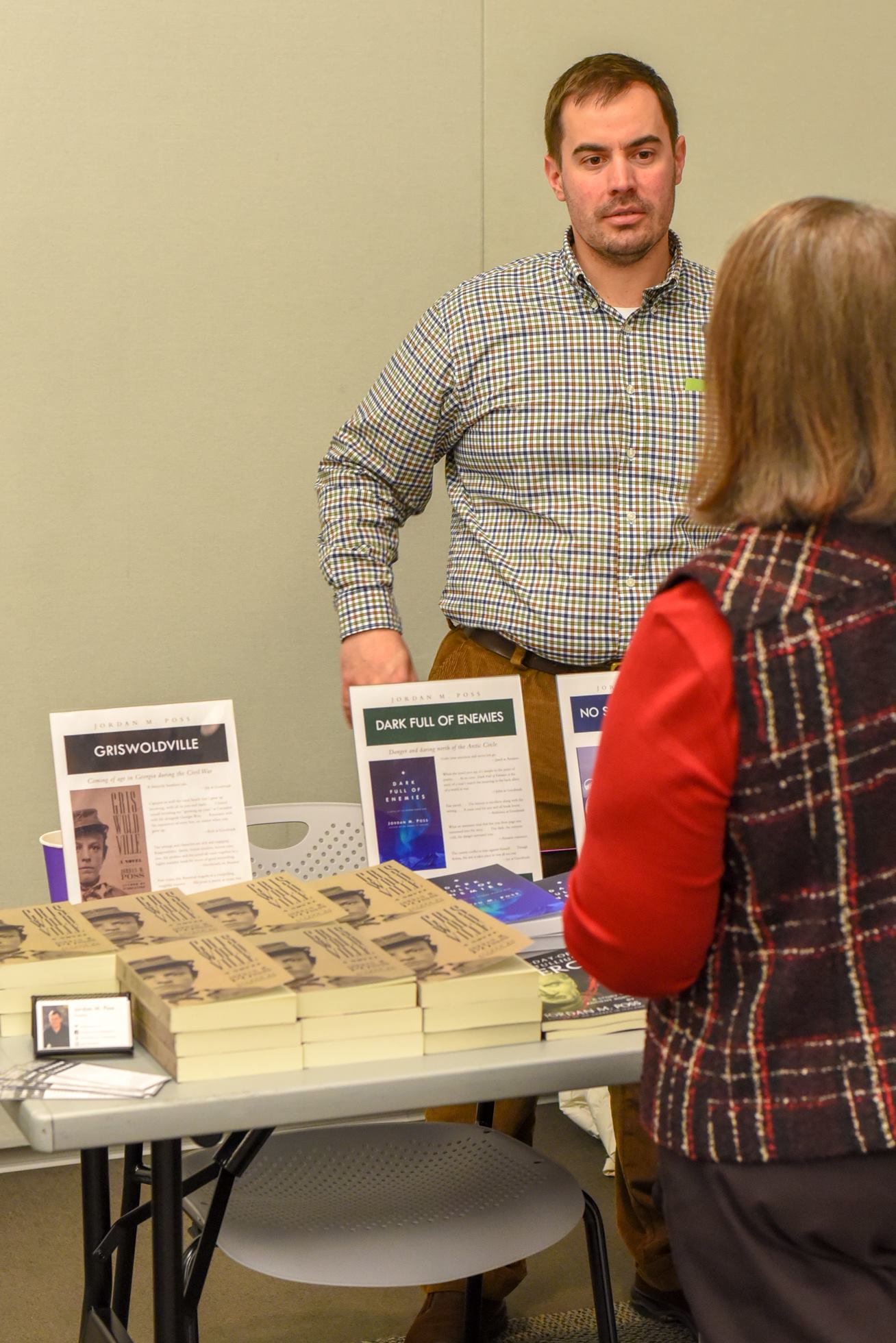
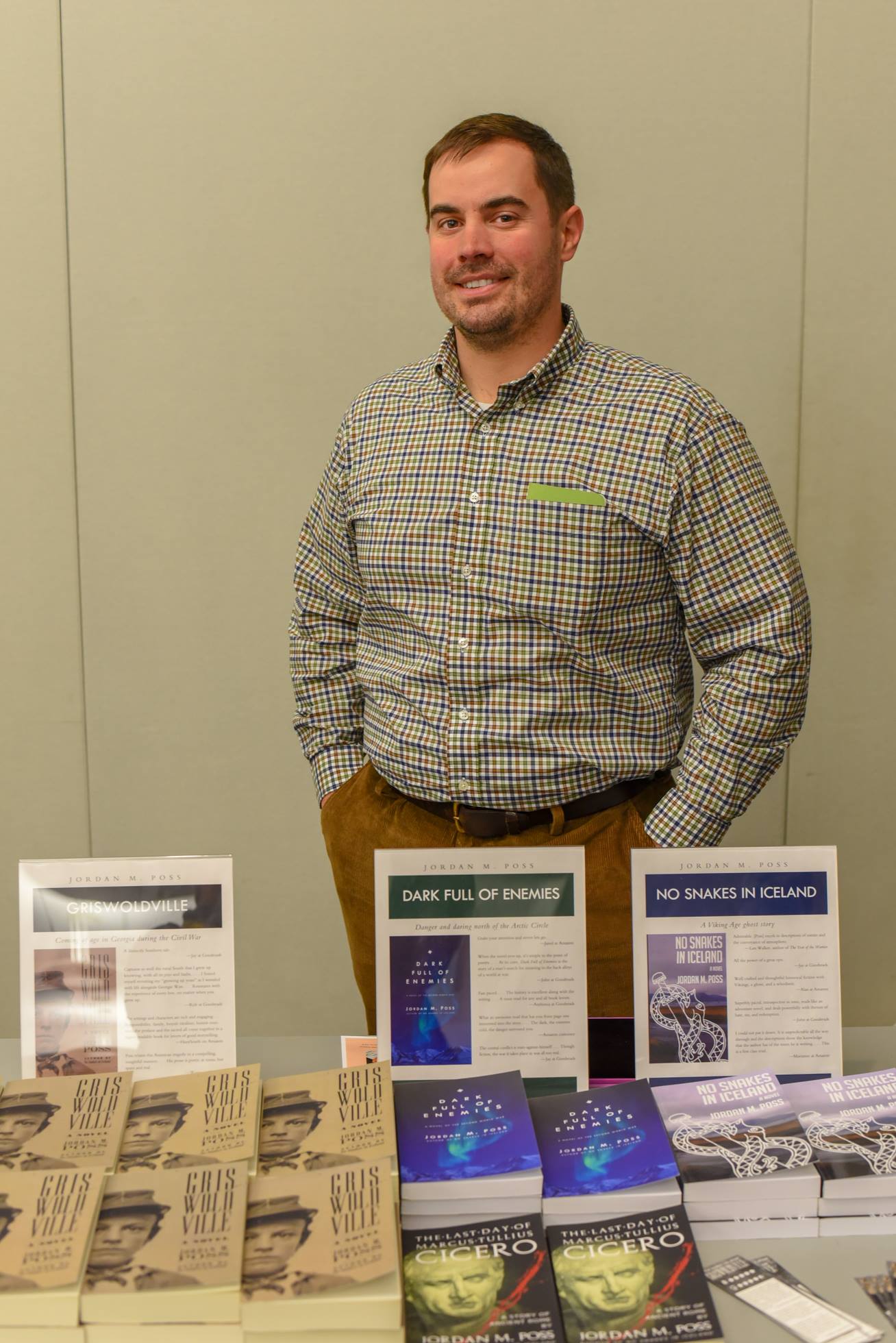
Saturday afternoon was the Greenville Library’s Local Author Expo. I was thrilled when I was invited to join it and looked forward to it for months. It’s hard to believe it’s come and gone now! I set up a table where I sold and signed books, gave away a lot of Griswoldville bookmarks, and got to meet a lot of local readers.

The whole thing was heartening, but perhaps the greatest encouragement was meeting other people doing what I do in the same place I live. Among them were G.P. Hutchinson, an author of westerns—and fellow admirer of Elmore Leonard—whom I’ve been following for a while on Goodreads, and Rebecca Kenney, whose Secrets of the Fae trilogy is a young adult fantasy romance series based on Irish mythology. I also met local poets, memoirists, authors of creative non-fiction, and fellow novelists. It proved a wonderful experience.

Aside from one or two readings or lectures, this was my first real author event and I learned a lot from it. It was also my first time selling books personally. Special thanks go to my father-in-law, who works in retail POS systems, for encouraging me to check out Square, which I used for card payments.

As I’ve said before, I’m grateful to the Greenville Library System for hosting this event and helping ensure its success. Thanks as well to everyone—old friends and new—who came out!

Here’s a small gallery of the event, or at least my corner of it. My parents came from Georgia to check it out, so all credit for the photos to them.

A sick man's appetite

Epic entrance: Ralph Fiennes as Gaius Marcius confronts the plebs in Fiennes’s film adaptation of Coriolanus

Epic entrance: Ralph Fiennes as Gaius Marcius confronts the plebs in Fiennes’s film adaptation of Coriolanus

Kevin Williamson wrote an interesting piece recently on the acquiescence of major news organizations to the realities of Twitter mobs. He begins with a meditation on one of Shakespeare’s less well known plays, Coriolanus, and the amazing entrance of its title character, the Roman general Gaius Marcius Coriolanus.

In Scene I, Act I, Coriolanus confronts an angry mob of plebeians— “mutinous Citizens” armed “with staves, clubs, and other weapons,” according to Shakespeare’s stage directions—who threaten to riot over the price of bread. Though hostile to Coriolanus—no more than five lines into the play they call him the “chief enemy to the people”—upon his appearance they hail him as “noble Marcius.” Already having the measure of the mob, he responds with a putdown, and when their leaders say “We have ever your good word,” trying to initiate an exchange of flattery, Coriolanus launches into the first of his several short but savage speeches:

He that will give good words to thee will flatter
Beneath abhorring. What would you have, you curs,
That like nor peace nor war? The one affrights you,
The other makes you proud. He that trusts to you,
Where he should find you lions, finds you hares;
Where foxes, geese: You are no surer, no,
Than is the coal of fire upon the ice,
Or hailstone in the sun. Your virtue is
To make him worthy whose offence subdues him
And curse that justice did it. Who deserves greatness
Deserves your hate; and your affections are
A sick man’s appetite, who desires most that
Which would increase his evil. He that depends
Upon your favors swims with fins of lead
And hews down oaks with rushes. Hang ye! Trust Ye?
With every minute you do change a mind,
And call him noble that was now your hate,
Him vile that was your garland. What's the matter,
That in these several places of the city
You cry against the noble senate, who,
Under the gods, keep you in awe, which else
Would feed on one another? What's their seeking?

Williamson’s interest in his piece, prompted by this New York Times article and especially journalist Masha Gessen’s comments in it, is the capitulation of news organizations to social media mobs. The “morality clauses” discussed there seem to be—by the most charitable interpretation I’m capable of—legal mechanisms for covering a news organization’s butt, at the expense of its writers, in the event of a Twitter outrage mob. While I agree this is a risible, even craven trend which will only encourage online rabblerousers and Williamson argues his point eloquently, something else in Coriolanus’s introductory speech, something related but tangential to Williamson’s angle, stuck with me.

Near the middle of his harangue, Coriolanus tells the mob of angry citizens that “your affections are / A sick man’s appetite, who desires most that / Which would increase his evil.”

Can there be any better metaphor for our social media addiction?

Barring the word addiction itself—which is more literal than metaphorical now anyway—I don’t think so. We have a lot of electronic opiates available to us—games, memes, videos, gossip, pornography, and more, all of it soaked in one form of satisfied self-affirmation or another and a retreat from the world. But the most dangerous electronic drug has to be outrage, because unlike any of those others it imparts to the addict a sense of purpose and moral uprightness and, worst, an illusion of caring about the real world. And the more we indulge, the worse it gets.

I’ve been mulling over two examples for some time: one recent, one ancient history (by internet standards).

The first is last weekend’s Covington Catholic incident at the March for Life in Washington, DC, a story everyone, whether they like it or not, should be familiar with. I can’t add much to the discussion there—the misinformation, the superheated Twitter mob, the public pillorying, the death threats were all despicable, the more so for being a kneejerk reaction—but keep this example in mind.

The second example I observed by accident on Facebook a few months ago. A post from a Florida sheriff’s department popped up in my newsfeed because a friend from college—a Florida native serving in the Marines—commented on it. The headline was certainly attention grabbing: a Florida man (“Har har,” says the entire Internet instantaneously) had been reported to and arrested by this heroic sheriff’s department after he was observed having sex with a miniature horse. He immediately confessed. The post included details, a mugshot of the offender (a pretty ordinary looking 21-year old man), and—of course—a picture of the horse.

Fortunately, before simply clicking away in disgust, I decided to see what my friend had written in the comments. There were hundreds, and the story had been shared and “liked” nearly a thousand times. He asked, pretty simply, why the sheriff’s department was bothering to publicize this story. As replies stacked up under his comment, I realized there was more to the story than the sensationalism provided by the sheriff’s department: the suspect had severe mental handicaps requiring medication and had lived alone since his mother’s suicide.

In response to my friend’s honest and justifiably pointed “Why?” one commenter wrote: “To let us know what is going on I’d assume.” His reply: “What does this news do for you?”

What I realized in observing this exchange was that a sick man, having already lived through 21 years of difficulty and pain, was being paraded to the public by the authorities for clicks. What’s worse, as the responses to my friend made clear, the prurient Facebookers could justify their leering and hooting by invoking a vague “right to know.” The Victorians had their freak shows, something that should turn the stomachs of all of us; but we have Facebook, and we’re ready with the “likes.” Our response to a real life tragedy converted to electronic stimulus is mere consumption. The tiny number of commenters who were actually familiar with the situation expressed only sympathy, not outrage, disgust, or Bojack Horseman memes.

To return to Covington Catholic and the incident at the Lincoln Memorial, the best piece I’ve read so far on that debacle is this short essay by Julie Irwin Zimmerman at The Atlantic. Zimmerman was among the outraged as the story developed last weekend. She even began castigating her own kids—tellingly, via text message—about the story as it developed. Within two days, as a fuller picture emerged, her view changed and to her credit she repented. She writes:

Take away the video and tell me why millions of people care so much about an obnoxious group of high-school students protesting legalized abortion and a small circle of American Indians protesting centuries of mistreatment who were briefly locked in a tense standoff. Take away Twitter and Facebook and explain why total strangers care so much about people they don’t know in a confrontation they didn’t witness. Why are we all so primed for outrage, and what if the thousands of words and countless hours spent on this had been directed toward something consequential?

The same sentiment my friend had expressed, two months later and in entirely different circumstances. If there’s an upside to this shameful display, it’s that it's very publicity could make it a widely understood example, something we can learn from. But I doubt it.

Williamson, for his part, published a complementary piece this week that unpacks a little bit of what keeps the outrage snowball rolling: self-radicalization, self-selection (creating bubbles or echo chambers), extremism, and, perhaps most crucially, the absence of a hierarchy of credibility. “[T]he only hierarchy that remains,” he writes, “is the crude hierarchy of popularity.” Think of the likes, shares, and jocular comments on that pitiful personal tragedy in Florida trumpeted to the masses on a sheriff’s Facebook page. “Rage and extremism build audiences, especially on social media.” Think of Covington Catholic—or any one of hundreds of similar examples in the last few years. Anyone remember Justine Sacco?

And while it would be tempting, especially for those of us inclined to Luddism, to blame Twitter or smartphones, the truth is that we can’t just blame our technology “The news is there for people who want it,” Williamson writes. “The problem is: Most don’t.” We have to want the right things, and we don’t.

We are, as we try very hard to forget, the real problem. Shakespeare, through Coriolanus, anticipated this. “What’s the matter,” he asks in that first speech,

That in these several places of the city
You cry against the noble senate, who,
Under the gods, keep you in awe, which else
Would feed on one another?

The urge to outrage and mob violence and scapegoating is always there, but the beliefs, institutions, and practices that keep those urges at bay—religion, family, honor, government, law enforcement, established and credible news sources, personal virtue—are not, as we’ve learned. We are no longer awed by anything. How could we be? We have spent decades tearing them down and enjoying it. Now we live for our fix, to give in to our appetites. We’re sick. And absent a recovery of the qualities that keep our will to gawk, to leer, and to participate in others’ public calamities, we will only increase our evil.

As more and more examples make clear, the mutinous citizens, armed with their phones and Twitter and Facebook accounts, are more than willing to feed on one another.

A Night at the Garden

a night at the garden.jpg

This year’s Oscar nominations dropped without me noticing or caring that much. Most of what I liked last year didn’t get nominated, and I’m okay with that. The Oscar ceremony is as meaningful as a given State of the Union address—not very much, and grandiose and overlong to boot.

But as I looked through the nominees in the Oscar categories this morning I was arrested by one nominee in the Documentary Short field: “A Night at the Garden.” I recognized the poster art immediately—a still photo of the stage, complete with American flags and a colossal George Washington, during a 1939 rally of the Amerikadeutscher Volksbund or German American Bund, an organization of Nazis. The Bund held this rally in Madison Square Garden. 20,000 people attended.

While the film is short and clearly meant to suggest Troubling Parallels, the filmmaker wisely lets the images themselves do the talking. (He explains his approach in the website’s Q&A.) This keeps the film from drifting into any of the outright foolishness characterizing our current political discourse. The film will make ideal classroom viewing and should prompt plenty of discussion, from the aesthetics of the rally itself—which worked gangbusters in Germany but mostly attracted curiosity in the US, if not the scorn it did in Britain—to First Amendment protections and the use of force by the police. One could also, if one really wanted to play with fire, start a discussion about why Nazis were fine with the Pledge of Allegiance.

The short runs seven minutes and is available in its entirety on the film’s official website. I highly recommend watching it, and I’m grateful that this is available now. No student that I’ve had in the last six years has known that there was an active and very noisy (if in reality rather weak) pro-Nazi organization in the US before World War II, and when I tell them about this rally they can’t believe it. This footage, paired with a good contextual talk, should come in handy.

What readers say about Griswoldville

Griswoldville has been out for a little over three months now, since the beginning of September, and the first reader reviews are coming in! It currently has 4.5 stars on Goodreads and five at Amazon. Here’s a little of what readers have said in their reviews:

Wayne, who is not only the first reviewer to post on Amazon but also the descendant of a soldier killed in the Battle of Griswoldville, calls the novel “beautifully written and compelling.” He writes:

Although I often have been disappointed with historical fiction, and generally read non-fiction, I decided to give Griswoldville a try. The historical background is familiar to me, particularly since I lost a 55 year old great-great grandfather in that tragic battle. [Jordan] Poss relates this American tragedy in a compelling, insightful manner. He advances the narrative wonderfully through compelling, very realistic characters. His prose is poetic at times, but spare and real.

Griswoldville_Cover_for_Kindle.jpg

Jay, friend of the site and frequent fellow guest on Sectarian Review, reviewing Griswoldville on Goodreads, calls it “particularly readable” and “a distinctly Southern tale,” “a solid novel that should provide several hours’ pleasure to academic and amateur history buff alike.”

Rob, a South Carolina native reviewing the book on Goodreads, enjoyed “how the author took a footnote from history and turned what has been deemed an insignificant ‘battle’ into the most significant point of one man's story.” He writes that Griswoldville “captured so well the rural south that I grew up knowing, with all its joys and all its faults”:

Growing up as a young southern boy I often fascinated over what I would have done had I lived during the Civil War, and I was drawn to the gallantry and the heroism of soldiering, of war, and of battle. Poss does a great job of recognizing that thinking within all boys as he creates the character of Georgie Wax. It was easy for me to put myself in the shoes of Georgie with all of his thoughts and uncertainties. I love how Poss develops this character throughout the novel. I found myself revisiting my "growing up years" as I wrestled with life alongside Georgie Wax. This was a novel that resonates with the experience of every boy, no matter when you grew up.

He also enjoyed “the biblical theme of redemption which “was woven beautifully into the narrative” as well as Georgie’s relationship with his grandfather, Fate: “This relationship is important to me because it was my relationship with my own grandfather that was the most significant of my young life. The beauty of this relationship brought tears to my eyes!”

Amazon reviewer HuntSouth writes that “it was difficult to set this book aside” and that they loved “the readability of this book, the beautiful word smithing, and the challenge it lays out to me—to discover more about the events and the books described within it.” HuntSouth particularly appreciated Georgie and Fate, the narrator and his grandfather:

The realities of farm life and the rigors of army life, Georgie’s love of all things chivalrous, heroic and adventuresome combine to make Georgie a wholly believable militiaman, by the time he is thirteen. You will love him, his family and the nobility with which Jordan Poss imbues him. Poss is so descriptive—without being wordy—that you will carry the picture of this north Georgia setting with you, fondly. His vast vocabulary and knowledge of unique Southern practice and history come through seamlessly on every page. Responsibility, family, boyish idealism, honest emotion, the profane and the sacred all come together in a highly readable book for lovers of good storytelling.

I’m grateful for these readers, the time they invested in my story, and their kind, generous reviews, and thankful as well for everyone who has told me in person how much they enjoyed the book. Please leave a review for Griswoldville if you’ve read it, and if you haven’t, please pick up a copy! It’s available in both paperback and Kindle formats at Amazon. Enjoy!

BUY GRISWOLDVILLE IN PAPERBACK
BUY GRISWOLDVILLE FOR KINDLE

Chesterton on bigotry as failure of imagination

Bigot has become one of our culture’s favorite devil terms—a “potent but vague” word that carries overwhelmingly negative baggage. The power of the devil term is such that if you can throw it at someone and make it stick even a little bit, they can be ruined. Often, the mere accusation is enough. I shouldn’t need to supply recent examples.

Unfortunately, the very vagueness of devil terms and the inevitable process of escalation in political rhetoric almost always lead to their promiscuous use and abuse. While bigot may be a rhetorical sidearm—second choice after the blunt-edged claymore of racist—these two and the even vaguer prejudice are frequently used as if they mean the same thing. They don’t.

Prejudice is a bit of a bugaboo, of course—we all have prejudices, our reason’s experience-based shorthand, so they need not be negative—and I don’t intend to peer into the dumpster fire that is the definition of racism. But bigot bridges the latter two in being, like racist, definitively bad and undesirable, and, like prejudice, so vague that it is often used to mean something else.

Here’s GK Chesterton, in a 1910 essay called “The Bigot,” on what bigotry actually means:

 
Bigotry is an incapacity to conceive seriously the alternative to a proposition.
 

And, from later in the same essay:

It is admitted, even in dictionaries, that an example assists a definition. I take an instance of the error of bigotry out of my own biography, so to speak. Nothing is more marked in this strange epoch of ours than the combination of an exquisite tact and sympathy in things of taste and artistic style, with an almost brutal stupidity in the things of abstract thought. A principal critic on the "New Age" made a remark about me a little while ago which amused me very much. After saying many things much too complimentary but marvelously sympathetic, and offering many criticisms which were really delicate and exact, he ended up (as far as I can remember) with these astounding words: "But I can never really feel a man to be my intellectual equal who believes in any dogma." It was like seeing a fine Alpine climber fall five hundred feet into the mud.

Bigotry [is] the failure of the mind to imagine any other mind.

For this last sentence is the old, innocent, and stale thing called Bigotry; it is the failure of the mind to imagine any other mind. My unhappy critic is among the poorest of the children of men; he has only one universe. Everyone, of course, must see one cosmos as the true cosmos; but "he" cannot see any other cosmos, even as a hypothesis.

Chesterton—who, as I’ve noted here before, didn’t mind a good argument—elaborates on this theme quite a lot in his work. There’s his famous line about open minds: “The object of opening the mind, as of opening the mouth, is to shut it again on something solid.” There’s this passage from “The Bigotry of the Rationalists,” published the same year as “The Bigot”: “There is no person so narrow as the person who is sure that he is broad; indeed, being quite sure that one is broad is itself a form of narrowness.”

From “The Bigot” again:

 
True liberality, in short, consists of being able to imagine the enemy.
 

Bigotry, in Chesterton’s view, is first and foremost self-deceit through pride. The bigot cheats himself out of the whole picture, out of the truth. Forget empathy—a favorite god term nowadays—bigotry is a failure of imagination. But mere “openmindedness,” tolerance’s lazy schoolmaster, is not the solution:

The free man is not he who thinks all opinions equally true or false; that is not freedom, but feeble-mindedness. The free man is he who sees the errors as clearly as he sees the truth.

A self-regarding insistence on one’s own broadmindedness is in fact as exclusive and narrow as an insistence that all members of X group behave in Y way, or that all adherents of X religion will themselves think Y about Z. The bigoted exist in Edwin A. Abbott’s Pointland: alone, dimensionless, with “no cognizance even of the number Two,” and content “to be vile and ignorant.”

But perhaps the most pervasive form of bigotry today is even worse for its dim awareness of other points of view: imagining the vast bigotry of our opponents and congratulating ourselves on our empathy and perspicacity, unaware, in our self-satisfaction, that we’re locked in an intellectual prison—one whose doors lock from the inside.

Greenville Library Local Author Expo

local-author-expo banner.jpg

I’m pleased to be participating in this year’s Local Author Expo sponsored by the Greenville Library System. Come out Saturday, January 26 to the Hughes Main Library in downtown Greenville, where local authors will be selling and signing books. I’ll have all of my novel-length works available—No Snakes in Iceland, Dark Full of Enemies, and Griswoldville.

The library will also host three panel discussions—one on mystery writing, another on young adult literature, and the last on getting published. The expo will be open to the public from 12:30-3:30. For more info, including lists of the panelists for the three discussions, see the Greenville Library’s website here.

I’m thrilled to take part and grateful to the Greenville Library for making this event possible. Please stop by! I’ll be glad to see y’all.

Infernal topography

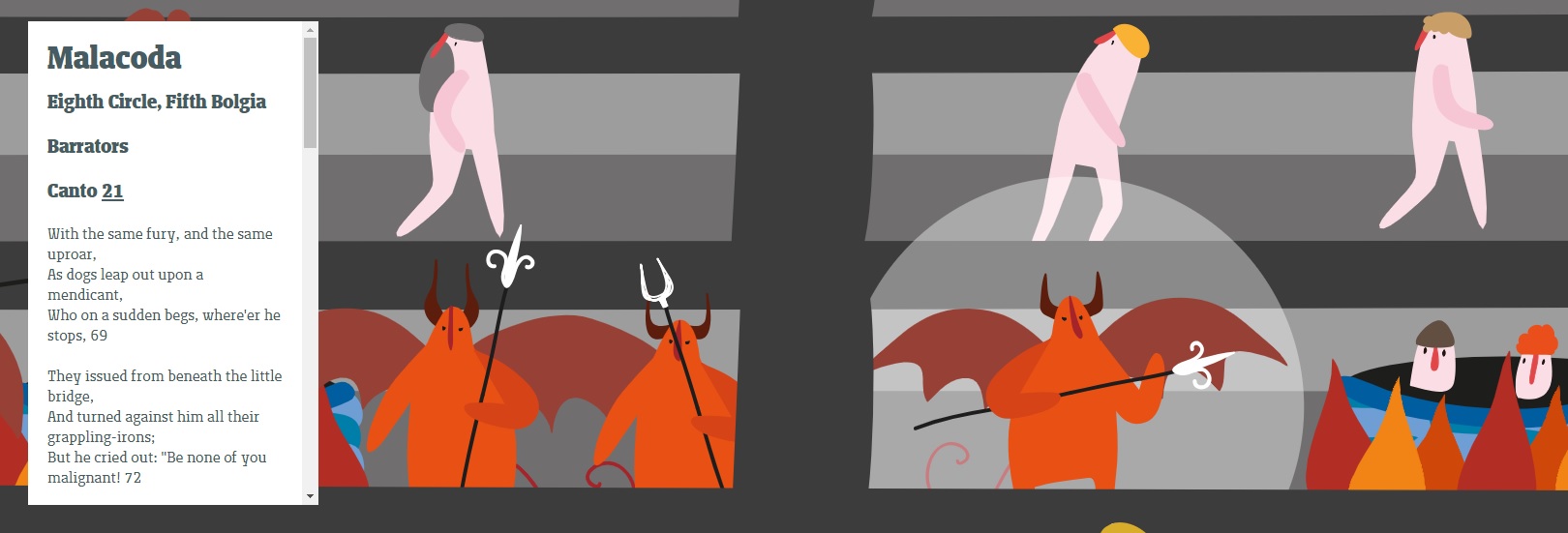
Malacoda, everyone’s favorite farting demon, in Alpaca and Molotro’s “Infernal Topography” interactive map

Malacoda, everyone’s favorite farting demon, in Alpaca and Molotro’s “Infernal Topography” interactive map

Yesterday I ran across this great interactive map of Dante’s Inferno, the first third of his Commedia. Developed by Alpaca and Molotro, two Italian design companies, with the support of the Società Dante Alighieri, “Infernal topography” allows you to scroll through Hell from top to bottom, visiting most of the major characters along the way.

inferno whole.png

The map has a lot of excellent and intuitive explanatory features. Clicking on a character highlights them, and their name and a portion of the relevant passage of Inferno (in either the original or Henry Wadsworth Longfellow’s English translation) pops up in a sidebar. The sidebar also displays information about each circle, who is punished there, and which cantos of the Inferno you can find it in. Another helpful graphic brackets and labels each particular level as you proceed downward toward “the bottom that devours Judas and Lucifer.” This might prove particularly helpful to students navigating the eight circle, with its subdivision into bolgia filled with different kinds of frauds.

There are also an alphabetical list of the characters in the book, a topographical breakdown of every level of Hell, and a clickable list of the 34 cantos which will take you to the relevant section of the map.

It’s not complete, but it’s really good. The article through which I discovered this describes the design as a “charming, children’s-book-graphic visual presentation” that “ditch[es] accurate human anatomy and horrific violence for a cartoonish video game romp through hell that makes it seem like a super fun, if super weird, place to visit.” I think that’s a little ungenerous. I think the visuals suggest the horrors of Hell well enough and are minimalist enough not to distract from the story itself. More detailed attempts to chart Dante’s Hell, like this famous one by Botticelli, skew toward being too busy to make sense of.

(You can argue that this makes artistic sense, as one of the defining traits of Hell is its pervasive, top-to-bottom noise and confusion, but that’s not usually an asset in visual art.)

It’s a trade off. When trying to reduce a vision as intricate and detailed as Dante’s Commedia to a single visual representation like a map, you can have a detailed but confusing image or an elegant but incomplete one. I love what Alpaca and Molotro have achieved here and appreciate their accomplishment—especially since I love maps, cross-sections, schematics, and illustrated guides as a tool for learning—and I hope this will encourage new readers to encounter the Commedia, students to stick with what can be a challenging, arcane work, and old readers to revisit it.

I just hope that they’ll make similar maps for Purgatorio and Paradiso (now there’s a visual challenge). In the meantime, take a few minutes to browse this map, which you can view in either English or Italian here. And here’s another Open Culture post about other attempts to map the Inferno, from Botticelli to a pretty twee 8-bit version.

2018 in Books

reading banner 2018 b.jpg

Even if not for movies, 2018 turned out to be a great year for reading. Per my accounting on Goodreads, I read 95 books—a personal record. Most of it was good, a few things were great, and very few stinkers made it into my reading. You can see everything I counted toward my Goodreads reading challenge here.

For this year-in-review rundown of my reading, I’m going to try to keep things positive and focus on favorites. I use the word favorites purposefully—I’m not declaring these the “best” books of the year, but the ones I enjoyed, benefited from, or stopped to think about the most, with plenty of overlap in those three categories.

I will address the two worst books I read this year, but I’m going try to keep it brief. Because that’s all they deserve.

I’ve sorted things into three broad categories: fiction, non-fiction, and kids’ books. And because I can’t keep these things to a set number, you’ll find a top ten—in no particular order—with a few runners up in most of them. I also have a list of things I revisited.

Enjoy! If y’all are looking for something good to read in 2019, I hope you can find something in these lists.

Ten fiction favorites:

last stand at saber river.jpg

Last Stand at Saber River, by Elmore Leonard. An excellent western, pitting a Confederate veteran returning from the war with his family against a pair of brothers attempting to steal his land with the Union as their excuse—all of which an amoral storekeeper works to manipulate to his advantage. This might sound like a collection of western staples, but the plotting, pacing, characterization, and the strength of Leonard’s writing set this apart. A really good good guy, some really bad bad guys, and a wonderfully realized western setting. I enjoyed this immensely.

The Line that Held Us, by David Joy. A gripping tragedy set in the mountains and hollers of Jackson County, North Carolina. Dark and suspenseful but with some hope of redemption. This is one of the best novels I read this year; I’ve picked up Joy’s two previous books and hope to read them soon, too. Read my full review here.

Unknown Soldiers, by Väinö Linna, trans. by Liesl Yamaguchi. One of the best war novels I’ve read, Unknown Soldiers follows a Finnish machine gun company through the Continuation War against the Soviets (1941-44) and has a huge flock of finely drawn, interesting characters. Linna evokes every bit of the pathos and tragedy of modern warfare in a moving and action-packed novel. Read my full review here.

Freaky Deaky, by Elmore Leonard. It is apparently the incorrect opinion among Leonard fans, but so far I don’t actually like his crime novels as much as his westerns. This is the exception—and I loved it. Freaky Deaky follows a pair of ex-hippie ex-lovers who try to revive their Weather Underground-style terrorism for fun and profit. A parallel plot follows Chris Mankowski, former Detroit bomb squad technician turned sex crimes investigator, as he begins a new relationship and crosses paths with the terrorists. It’s hard to summarize, but it’s wonderful to read and really funny. Here’s Leonard himself reading the first chapter.

Above the Waterfall, by Ron Rash. Perhaps my new favorite novel by Rash. Read my full review here.

The Loved One, by Evelyn Waugh. Think Barton Fink crossed with Bernie. One of the funniest, blackest, most shocking comedic novels I’ve read, a blistering send-up of Americans’ unhealthy refusal to confront death. This was just the second book I read this year, and it was never in danger of being unseated from among my favorites. Read my full review here.

The Exorcist, by William Peter Blatty. I don’t think I’ll ever make myself watch the movie, but an old episode of the First Things podcast featured an interesting segment on the spiritual power and sacramental physicality—often manifested as grossness—in this novel. It’s not the best written piece of fiction you’ll pick up, but it’s gripping and powerfully creepy, building a deep sense of dread because of human weakness in the face of supernatural evil. Father Karras’s struggles with his own faith should prove familiar to a lot of readers, and the subtle grace that comes through and finally offers salvation and redemption makes the book moving as well. To summarize from my short Goodreads review: “Brutal, gross, terrifying, and—surprisingly—uplifting.”

The Book of the Dun Cow, by Walter Wangerin Jr. The most delightfully and wonderfully weird book I’ve read in years. Part Chaucer, part Narnia, part Lovecraft, the novel follows Chauntecleer, king of a barnyard full of animals, in a struggle against Wyrm, an ancient force that threatens to wreck creation. A strange and gripping meditation on good and evil, love, beauty, creation, leadership good and bad, and populated with strange and memorable characters. Perhaps my favorite is Mundo Cani, a depressed dog almost pathetically devoted to Chauntecleer but who possesses a surprising reserve of courage. If you want to read a fresh, beautifully written fantasy that is by turns charming and dark, but beautiful and weird throughout, definitely pick up The Book of the Dun Cow.

The Red Badge of Courage, by Stephen Crane. A classic. I had only read the abridged, illustrated version as a kid and finally got around to the real thing this summer. That’s probably providential; it’s so good that if I had read it before I wrote Griswoldville I might not have tried. Read my full Goodreads review here.

Favorite of the year:

good shepherd.jpg

The Good Shepherd, by C.S. Forester. I picked this up because it’s the basis of Tom Hanks’s forthcoming film Greyhound. I’d never read anything by Forester—creator of Horatio Hornblower—and was blown away by this book. The story, set in World War II, follows Commander Krause, captain of a US Navy destroyer on convoy duty in the north Atlantic during the height of U-boat activity. As the novel begins, he comes to the bridge after a few scanty hours of rest. After his convoy blunders into the middle of a wolf pack, Krause will barely sit down, much less sleep, for the next several days.

The novel is intensely interior, with almost no characterization or backstory for anyone else on the ship. Even his own backstory—with a dead end position in the navy, a tragically failed marriage, and a transfer from San Diego—doesn’t come in until over halfway into the book. Things come to the reader as they come to Krause. Throughout, the reader thinks through what’s happening with Krause, doing the hard work of calculating speed, fuel, distance, the number of ships and depth charges remaining, where the U-boats are, how fast their torpedoes can travel—and on and on. It’s an incredibly cerebral novel that is also physically exhausting. I was tired when I finished it, a sensation I haven’t experienced since reading Deliverance ten years ago. It’s a rare accomplishment for a work of fiction.

The Good Shepherd is a great look at the guts and endurance it took to ferry supplies across the Atlantic during World War II, but the primary reason to read it is that it’s an excellent and unusual novel. It also has some wonderfully evocative religious overtones, as scripture springs uninvited into the devoutly religious Krause’s mind, sometimes in the middle of torpedo attacks. Check it out if you’re at all interested in the underappreciated side stories of World War II, or if you plan to see Tom Hanks’s film adaptation this spring.

Runners up:

scoop.jpg
  • Scoop, by Evelyn Waugh. A withering satire of the modern press, c. 1938, Scoop follows William Boot, a young man mistaken for his fashionable novelist cousin and sent to the impoverished African state of Ishmaelia to cover a war. Scathing in its critique of the media, modernism, statism, and propaganda, and also laugh-out-loud funny. Comparable to the earlier Black Mischief, which is also blisteringly satirical toward European hubris, but even funnier.

  • A Handful of Dust, by Evelyn Waugh. Waugh in a more morally serious mode, dramatizing the disasters unleashed on both the innocent and the guilty by selfishness and infidelity. Read my full review here.

  • The Shepherd, the Angel, and Walter the Christmas Miracle Dog, by Dave Barry. A hilarious dose of lighthearted, touching Christmas nostalgia from a kid’s-eye perspective—if that kid is young Dave Barry. A lot of fun to read aloud; I had to stop a few times to catch my breath, I was laughing so hard.

  • Fools and Mortals, by Bernard Cornwell. An interesting departure for Cornwell, from sociopathic historical hardasses to the world of Shakespeare. Engaging, a brilliantly detailed historical world, a good plot, and, importantly, a lot of fun. I’ve previously blogged about it here.

  • Gunsights, by Elmore Leonard. I believe this is Leonard’s last western, and he goes out with a bang. Exciting action and suspense, believable character-centered conflict, and a realistically detailed and well-realized historical setting, plus some barbed commentary on the way the media attempts to shape events in the name of coverage.

Ten non-fiction favorites:

Reading Dante: From Here to Eternity, by Prue Shaw. An excellent look at Dante’s work by a scholar with a lifetime of experience, winsomely presenting Dante’s genius and beautifully written.

The Norse Myths: A Guide to the Gods and Heroes, by Carolyne Larrington. An excellent guide and introduction to the religious and mythic landscape of the Norse, with a careful presentation of often tricky or widely misinterpreted material by a good scholar. The best book of its kind that I’ve come across. Read my full review here.

Semmes: Rebel Raider, by John M. Taylor. A shorter version of Taylor’s biography of Raphael Semmes, a commerce raider for the Confederate navy whose activities severely disrupted Northern shipping and business. I enjoyed this little biography so much I wrote a very long review of it here last month.

12+rules.jpg

Why Liberalism Failed, by Patrick Deneen. A strong, much-needed, perceptive diagnosis that most of our proposed cures for the illnesses of our time are actually just part of the illness. Deneen daringly questions Lockean liberalism, especially the concept of the autonomous individual, and convincingly argues that both “sides” of our political divide today are fighting over the same vanishing patch of turf. I’ve previously blogged about this book here.

A Great and Terrible King: Edward I and the Forging of England, by Marc Morris. A detailed and deeply researched new biography of Edward I. Worthwhile if you’re at all interested in High Medieval Britain, Scotland and Wales, or medieval kingship and military history at all. Read my Goodreads review here.

A Time of Gifts, by Patrick Leigh Fermor. A lyrical, wistful recounting of the author’s youthful walk across Europe from the English Channel to Constantinople. (This volume, the first of three, ends with his journey into Hungary.) Especially interesting as Fermor made his trip just as the Nazis rose to power, so this travelogue takes the reader through a lost world in more ways than one. You can read my thoughts on the book while I was reading it, with some generous excerpts of my favorite passages, here.

Elizabeth I: A Study in Insecurity, by Helen Castor. An excellent entry, brief but insightful, in the Penguin Monarchs series. Read my full review here.

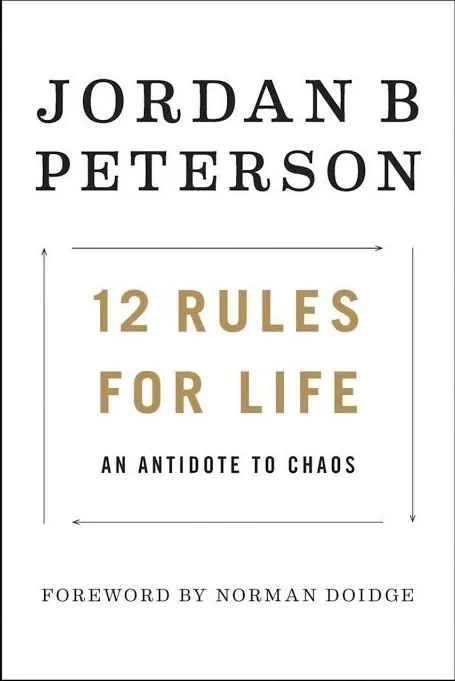
12 Rules for Life: An Antidote to Chaos, by Jordan B. Peterson. I mean to review this more fully at some point, but this is a rewarding dig into what makes human beings tick and how to resolve some of the issues that plague anxious modern people. 95% common sense, eloquently expressed, supported, and argued for, with about 5% Jungian hoodoo that is nevertheless interesting. I think it says more about our culture than Peterson that he has become controversial.

Disruptive Witness: Speaking Truth in a Distracted Age, by Alan Noble. A much needed meditation on Christian accommodation of the prevailing culture, resulting in a thin, shallow, brittle, commercialized, commodified faith that will not disrupt the world but follow after it, pulling on its apron strings. Concludes with calls for “disruptive” habits—personal habits, including even simple things like prayer before meals, and church habits, like more regular and more heavily emphasized sacraments and giving greater space to solemnity, reclaiming worship from the rock concert. Resonated quite a lot with what I had already read by Deneen (see above) and Scruton (see below), and with James K.A. Smith’s You Are What You Love, which I read a few years ago. Noble gave me a lot to think about, especially as troubled as I’ve been by the state of American Christianity for some time.

Favorite of the year:

How to Be a Friend, by Cicero, trans. Philip Freeman. In the words of Albert Finney’s elderly gamekeeper in Skyfall: “Sometimes the old ways are best.” This is a new translation, in a nice bilingual edition from Princeton UP, of Cicero’s essay De Amicitia (On Friendship). I’ve been meaning to do a full review and recommendation since I read it, but unfortunately I finished it at about the busiest time of the semester. Suffice it to say that Cicero offers a lot of wisdom here that we could stand to recover or, at least, refresh ourselves on. True friendship is a discipline, something purposeful, and cannot demand evil, immorality, or injustice in its name. True friends should help each other to virtue—iron sharpening iron—which means that they should be devoted to something larger than themselves: truth. Good friendships, in Cicero’s estimation, must be founded on truth. In our “post-truth” age, this ancient message is the healthy counterprogramming we need. Pick this up and read it as soon as you can.

Runners up:

scruton.jpg
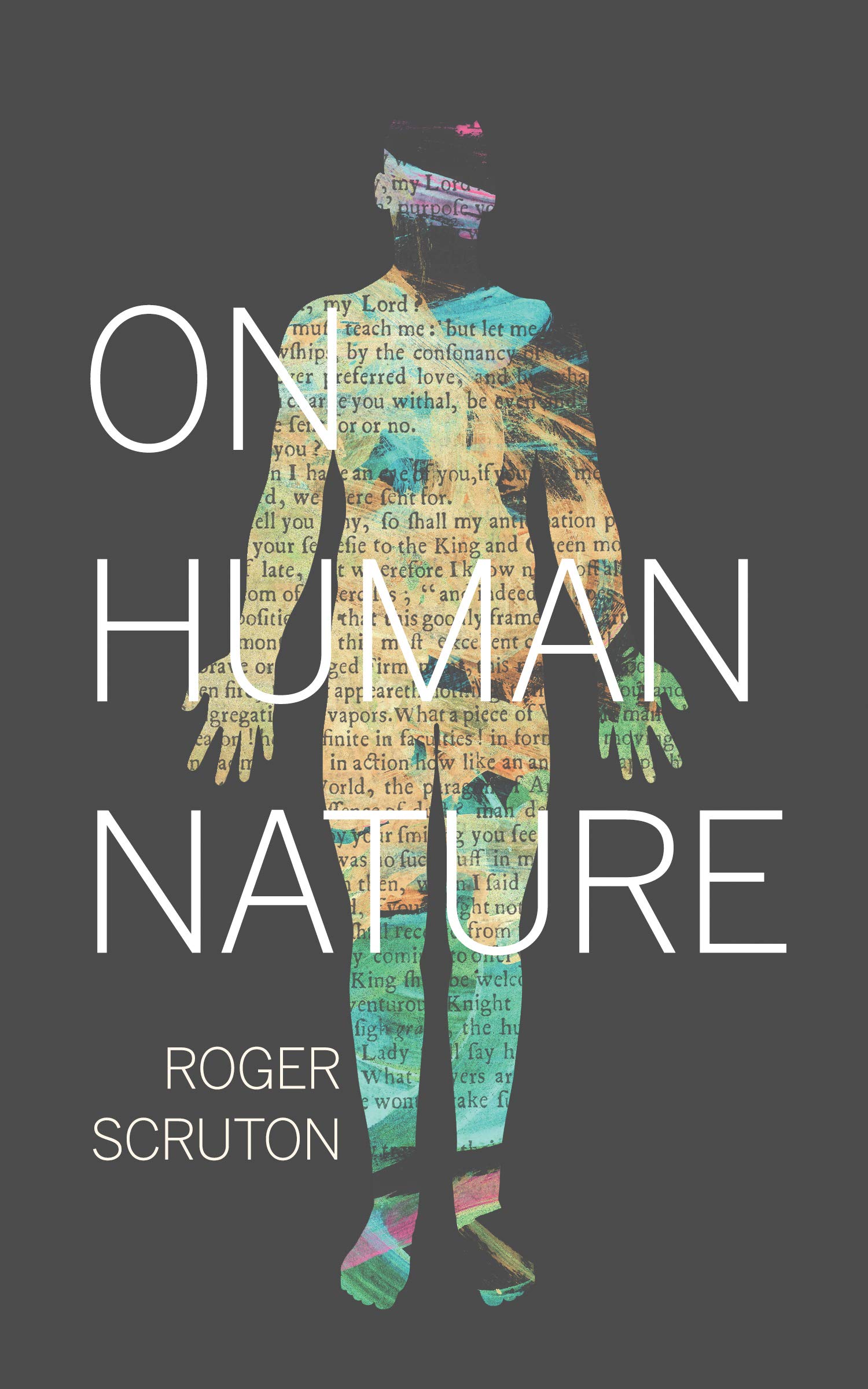
  • On Human Nature, by Roger Scruton. An excellent series of lectures examining what it means to be human—that is, crucially, a person—and what obligations that places upon us. Insightful and especially relevant.

  • The Demon in Democracy, by Ryszard Legutko. A powerful one-two punch with Why Liberalism Failed, Legutko’s book expands on Deneen by examining Western liberalism and Communism as rivals for the same basic ground, philosophically and politically speaking, which is why both tend toward tyranny, authoritarianism, and the suppression of traditional institutions.

  • The Year of Our Lord 1943, by Alan Jacobs. An interesting look at the lives and thought of five Christian writers and their responses to the pressures of the Second World War. Read my Goodreads review here.

  • Doors in the Walls of the World: Signs of Transcendence in the Human Story, by Peter Kreeft. A freewheeling discussion on our intuitions of transcendence through our lived experience. Read my Goodreads review here.

  • Finnish Soldier versus Soviet Soldier: Winter War 1939-40, by David Campbell, illustrated by Johnny Shumate. A brisk, informative, lavishly illustrated examination of what combat was like during the Winter War. Read my Goodreads review here.

Worst reads of the year:

Ready Player One, by Ernest Cline. This book is garbage. A “hot mess” or a “dumpster fire” for the meme-addled. It’s a judgment on our culture that it’s become as popular as it has. Lazy, poorly written, overindulgent, philosophically and morally bankrupt, with insufferable characters, a contrived plot, and a completely phony moral platitude tacked on at the end, this book has skated by on the black ice of its pop culture “references,” the most vacuous and ephemeral brain candy available. Read some of my early reactions in my Goodreads review here. In April I was a guest on the Sectarian Review for a discussion of Ready Player One—primarily the film version; you can listen to that here.

terminal list.jpg

The Terminal List, by Jack Carr. I wanted to enjoy this book, because it’s in a genre I’ve enjoyed and I was intrigued by the fact that it was written by a former SEAL. While true, its author’s service was essentially a gimmick used to sell the book, along with the handful of passages redacted by the Department of Defense. The “too hot for TV!” tactic. Unfortunately, this is a poorly written and plotted mess, with serious pacing, characterization, and tone problems, loads of typos (in a professionally edited and published book!), and sometimes incomprehensible description.

The biggest problem for me, though, was its complete lack of reflection on the meaning of its story. SEAL James Reece miraculously survives an ambush that wipes out everyone in his entire unit but himself and a buddy. Upon making it home, the buddy mysteriously commits suicide and Reece starts getting ominous results on medical tests. Then Reece’s family is murdered and he sets out for revenge. Turns out that the ambush was a setup to wipe out SEALs and other special forces personnel who had been illegally used for pharmaceutical testing, a project sending kickbacks to a powerful, ambitious, high-ranking female politician with her sights set on the White House. Doesn’t sound familiar enough? Well her husband is also a former politician who was disgraced because of sexual scandal. Hm.

Turns out everyone—including the SEAL commanding officer—was in on the plot, and Reece laboriously kills all of them, working from a list kept on the back of one of his dead daughter’s crayon drawings. Not only is it obvious and manipulative, it’s a chore to read.

This was a bad enough book for artistic reasons but it crossed the line into morally bad territory. What The Terminal List and Ready Player One have in common is a gross indulgence in fantasies that simply affirm or titillate the reader. In Ready Player One it’s an affirmation that all the ephemeral video game crap you love matters—matters more than anything else in the world! It then titillates its reader with the adulation and glory heaped upon its protagonist. In The Terminal List, it’s an affirmation that all your darkest suspicions about elites and globalists are true. The titillation comes in the elaborate and gleefully relayed revenge killings.

Carr invites us to participate in Reece’s campaign of gruesome revenge, which is otherwise fairly standard for a thriller, but by making his villains obvious proxies for real world people, he’s inviting the reader into an obsessively imagined murder spree—and invited them to enjoy it along with him. That’s not a good habit of mind to cultivate, and in Carr’s book the resentment—of the Clintons, of Washington insiders, of the objects of paranoia like Big Pharma, and even of fellow SEALs who just haven’t seen as much action as Reece—drips from every page. It’s not just a bad book, but an ugly one.

Read my much shorter Goodreads review here.

Rereads:

confederacy.jpg

Old favorites that I reread this year. Several of these I revisited after more than a decade (or two). Others I listened to on my commute. All were worth it—check any of these out. They’re great.

  • The Aeneid, by Virgil, trans. by David Ferry. A solid new translation in blank verse. I read this shortly after my grandfather died, just before Christmas 2017, and it resonated powerfully with me, something I blogged about here (the most popular post of the year, incidentally).

  • The Earliest English Poems, ed. and trans. by Michael Alexander. A great collection of Old English verse, including riddles, epic (The Battle of Maldon), religious poems (The Dream of the Rood), elegies (The Seafarer and The Wanderer), and much more. Good translations with good scholarly apparatus like notes and introductions. Alexander’s translation of Beowulf is also worth seeking out.

  • Lord of the Flies, by William Golding. Reread for the first time since high school, when I read it because Stephen King featured it so prominently in Hearts in Atlantis. Far, far more powerful than I gave it credit for back then. Justly regarded as a classic. Read my Goodreads review here.

  • The Screwtape Letters and The Four Loves, by C.S. Lewis. I listened to both of these as audiobooks. The Four Loves is an early version of the talks that eventually became the longer, expanded book of the same title, read by CS Lewis himself in recordings made for American radio during the 1950s. He’s great to listen to. The Screwtape Letters was the second audio version I’ve listened to, after John Cleese’s wonderfully manic and wrathful recording (now very hard to find). This version was read by prolific British actor Joss Ackland, whose wry, self-satisfied bass gave a new spin to Screwtape as the smug bureaucrat who can only be roused to wrath out of self-interest. A great performance of a great book.

  • A Confederacy of Dunces, by John Kennedy Toole. Also an audiobook, brilliantly performed—accents and all—by Barrett Whitener. Reading the book is indispensable—no performance can be as funny as how Toole’s book will play out in your head—but this was really enjoyable.

  • The 39 Steps, by John Buchan. I reread this for the first time in ten years in preparation for a podcast discussion of Alfred Hitchcock’s film adaptation. The 39 Steps still works—a fast-paced adventure thriller that you can read in one or two sittings. You can listen to our discussion of the film, with reference to the book as well, here.

  • The Perilous Road, by William O. Steele. Reread for the first time since perhaps fourth grade. My copy still had an old Garfield bookmark and a sheet of stickers in it. Anyway, a very good Civil War novel for children, capturing some of the messiness in the South, particularly in areas politically divided between secessionists and unionists. Read my Goodreads review here.

Favorites kids’ books:

Every night before bed I read a chapter or two to my wife from a book we’ve selected—something fun and relaxing, with a dash of adventure, often for kids or young adults. I also read a lot of picture books to my kids, which has been a refreshment after the last few years of Serious Adult Literature. These are the best of this year’s lot, in no particular order:

door in the wall angeli.jpg
  • The Door in the Wall, by Marguerite de Angeli. This was a nice surprise—a novel neither my wife nor I had heard of, that we only discovered while looking through a list of Newbery Medal winners (1950). This is the story of a spoiled noble boy crippled by illness who learns humility through acceptance of his condition and his submission to the practice of an art. Also nice as a medieval novel for young readers that doesn’t present a lot of Dark Ages stereotypes, but brings the reader into that world on its own terms. Read my Goodreads review here.

  • Hatchet, by Gary Paulsen. A gripping adventure story, part Robinson Crusoe, part Jack London (take your pick), part Lord of the Flies. Hatchet tells the story of a boy, already stressed by his parents’ divorce, who finds himself stranded in the Canadian wilderness following a plan crash. I blitzed through this in a few days during breaks at work—it’s excellent.

  • The Hawk of the Castle, by Danna Smith, illustrated by Bagram Ibatoulline. A medieval picture book about falconry, following a falconer and his daughter on a hunting trip. Based on the author’s own experience with falconry, and lovingly—and beautifully—illustrated. Read my Goodreads review here.

  • The Voyage of the Dawn Treader, by C.S. Lewis. For whatever reason, I’m just now getting around to reading all of the Chronicles of Narnia, and this stands out as one of the best entries in the series (though my favorite is probably still The Silver Chair). An epic sea voyage with allegorical, chivalric overtones—one part Faerie Queene, one part Odyssey. It’s great. Reepicheep, the embodiment of honor and chivalry, is perhaps my favorite character, but everyone has a chance to shine in this one and some parts are profoundly moving.

  • In Grandma’s Attic, by Arleta Richardson. A wonderfully fun, funny, and gentle collection of frontier stories presented as the reminiscences of a grandmother. Reminded me somewhat of Little House on the Prairie, but more episodic and with a nice dash of more specific religiosity. My wife’s grandmother read these to her growing up. There are ten in the series, so there’s plenty more to enjoy. Read my short Goodreads review here.

  • Shakespeare’s Spy, by Gary Blackwood. The final volume of a trilogy following a young boy, originally tasked with stealing a well-protected copy of Hamlet, through his apprenticeship and finally membership in Shakespeare’s company of players. A fun, kid-friendly introduction to Shakespeare, drama, and the Tudor world. I’ve blogged about this series here before, in this post about Cornwell’s Fools and Mortals.

Favorite of the year:

John Ronald’s Dragons, by Caroline McAlister, illustrated by Eliza Wheeler. A beautifully illustrated picture book about the first half of JRR Tolkien’s life, from his childhood, through World War I, to his professorship at Oxford and the creation of The Hobbit. I’ve previously reviewed this wonderful book on the blog here.

Looking ahead:

I was going to conclude with a section on my two favorite new writers—meaning dead guys I’ve just discovered—of 2018, but this post is quite long enough. I’ve set myself a lower bar for my Goodreads challenge this year, for three reasons: my wife and I expect our third child this year, which will, naturally, affect my time—and sleep schedule; I aim to read a few longer, heavier books I’ve been meaning to get to; and I want to set aside time to work on new writing projects. We’ll see how all that goes this time next year. In the meantime, I’ll keep posting.

Thanks for reading! Happy new year!