Ruritanian notes

A few years ago I realized that, for the most part, I don’t actually like time-travel stories. I, who spend most of my waking life thinking about what it was like in the past! I finally decided it was because a lot of time-travel stories, under the influence of various kinds of nitpicking, get so fixated on the mechanics of time travel and its resulting theoretical problems like the grandfather paradox that actually visiting the past—traveling through time—ceases to be the point.

Something similar is at work in Ruritanian fiction. Ruritania is the imaginary Central European kingdom invented by Sir Anthony Hope for his great adventure novel The Prisoner of Zenda. Hope’s story was so popular that it spawned a long-lasting subgenre of adventure fiction, the “Ruritanian romance.” Note the word romance carefully there. We’ll come back to that.

Last night I finished The Dark Frontier, Eric Ambler’s first novel, published in 1936 when he was 27. It’s at least partly a parody of British spy fiction at the time—including the work of John Buchan—and follows a mild-mannered English physicist who, having revisited some pulpy spy novels on a trip, gets into a car accident and wakes up thinking he’s a spy. He winds up involved in industrial espionage in the Eastern European republic of Ixania, a corrupt state that has just developed the first atomic weapons.

There’s a lot of interesting stuff here, but despite my love of Ambler I didn’t enjoy it very much. Even as I was reading the climactic action I was wondering why The Dark Frontier and Ixania weren’t working when Ambler’s Judgment on Deltchev and its unnamed, fictional Eastern European state did. Then I started thinking about all the Ruritanias I’ve visited over the last few years, and which ones I enjoyed and which ones I didn’t.

Here are several novels set in fictional countries that worked, and worked well (links will take you to reviews here on the blog):

  • The Prisoner of Zenda, by Sir Anthony Hope (1894, Ruritania)

  • Castle Gay, by John Buchan (1930, Evallonia)

  • Black Mischief, by Evelyn Waugh (1932, Azania)

  • Scoop, by Evelyn Waugh (1938, Ishmaelia)

  • Judgment on Deltchev, by Eric Ambler (1951, unnamed Eastern European country somewhere near Bulgaria)

Here are several that did not work:

And here’s an outlier, a novel that I think illustrates both the weaknesses of Ruritanias and how they’re best overcome:

I’ll stipulate here that when I talk about Ruritanias, I mean fictional countries that nevertheless are meant to exist in our world, not a fantasy world or alternate universe. Much of what I lay out below could also be helpful in thinking about fantasy worlds—though I have no time for alternate universes, much less multiverses—but that isn’t the subject here.

In mulling these stories after finishing The Dark Frontier last night, I found something in common between those that actually work. Judgment on Deltchev, the most obvious point of comparison being a later Ambler novel, is an indictment of Soviet show trials and Western acquiescence to the Stalinist takeover of Eastern Europe, all acted out through one confused, put-upon reporter’s moral struggle with the situation he’s been placed in. Ambler doesn’t even name the country in question. In a quite different vein, Black Mischief and Scoop are savage, blistering satires of modern journalism and efforts to “modernize” African nations. Castle Gay, which takes place in Scotland but concerns the upheavals of the faraway Evallonia, is straightforwardly a story of moral transformation through hardship. And the ur-text of the genre, Hope’s Prisoner of Zenda, is an adventure testing a man’s honor, loyalty, physical courage, and moral strength. In all cases, you get just enough detail about the fictional country to make it believable, but the heart of the story are the characters’ moral and ethical conflicts.

In short, the best Ruritanian stories work because Ruritania is not the point—it’s a convenient setting where real-world locations won’t distract and that allows the outworking of moral or character drama and action. Ruritania is a device. The “romance” or adventure comes first. Tellingly, all of these novels work as genre stories: Deltchev is suspenseful, Black Mischief and Scoop are unbelievably funny, Castle Gay and Zenda are fun and exciting.

When Ruritanias don’t work it’s because the nitty-gritty details take over from the characters. Following the climax of The Dark Frontier we get several pages about the events of a peasant revolution in Ixania, including which leaders took control of which government ministries and how many army officers were placed under arrest, and I realized I just didn’t care. And I didn’t care because I was not sufficiently invested in the main characters—physicist-turned-master-spy Professor Barstow and his sidekick American reporter Carey. (The first half of the novel, which is more character-driven, is much more interesting.) Likewise with Buchan’s House of the Four Winds, which has isolated episodes of thrills but mostly staggers along through over-detailed explanations of Evallonia’s tottering interwar government and the uncertain role of its populist movements. Buchan is telling a similar story of moral formation, but that gets lost in the details.

To bring the fantasy genre back in, you might recognize some of what bedevils these novels as “world-building.” This is the danger of making the world you’re building more important than the story, or of having a story too weak to support the world you invent for it to take place in.

The Courts of the Morning, the Buchan novel I suggested straddles the good-bad divide in this genre, is an instructive counterexample. As noted even at the time it was published, it occasionally bogs down in explanations of the geography, industry, and economy of Olifa, the South American republic where it takes place. But it balances this with a strong, intricate plot of great moral weight and redemptive arcs for several characters, all of whom are vividly realized. These mostly work well, and mostly counteract the overwhelming effect of industrial sabotage and train schedules.

This is by no means the last word on such a topic—the novels that don’t work have problems beyond their setting, for instance, and there are plenty of other Ruritanias I haven’t traveled to—but consider this post notes toward a fuller understanding of how best to use a fictional country in a story.

Martin and Lewis, envy and fascism

No, not that Martin and Lewis!

This morning a friend passed along an insightful Facebook post from science fiction author Devon Eriksen regarding George RR Martin’s Song of Ice and Fire. The series, Eriksen argues, is unfinishable because what Martin wants to do with it clashes with the form. His story naturally inclines in a direction he refuses to take, leading to the current yearslong stall-out.

And why does Martin refuse to follow his story where the form leads it? “Because he’s a socialist,” Eriksen writes. “And a boomer.”

This combination, part deliberate, part instinctual, gives Martin an inflexible cynicism toward heroes and heroism, a cynicism that has always clearly marked his work. And not just cynicism: people like Martin

want to convince themselves that anything which appears good is secretly evil, actually, and that anyone who makes them feel or look bad is obviously evil because reasons. So when they see a hero, they tend to call him a fascist. . . . [I]n George's world, heroism must be a sham or a weakness, because then George's own bad character is wisdom and enlightenment, instead of just lack of moral virtue.

I seem to remember some very old admonitions against calling good evil and evil good.

I’m less convinced by the generational dimension of this critique—generational labels being a kind of materialist zodiac as far as I’m concerned—but I think Eriksen is onto something with regard to Martin’s vocal leftwing politics. One line in particular struck a chord with me: “Socialism’s motivational core is envy, and its one underlying rule is ‘thou shalt not be better than me’.”

This brought to mind one of the concluding lines of CS Lewis’s essay “Democratic Education,” which was published in April 1944, at the height of World War II: “Envy, bleating ‘I’m as good as you’, is the hotbed of Fascism.”

Envy also leads to bad art, or to no art at all.

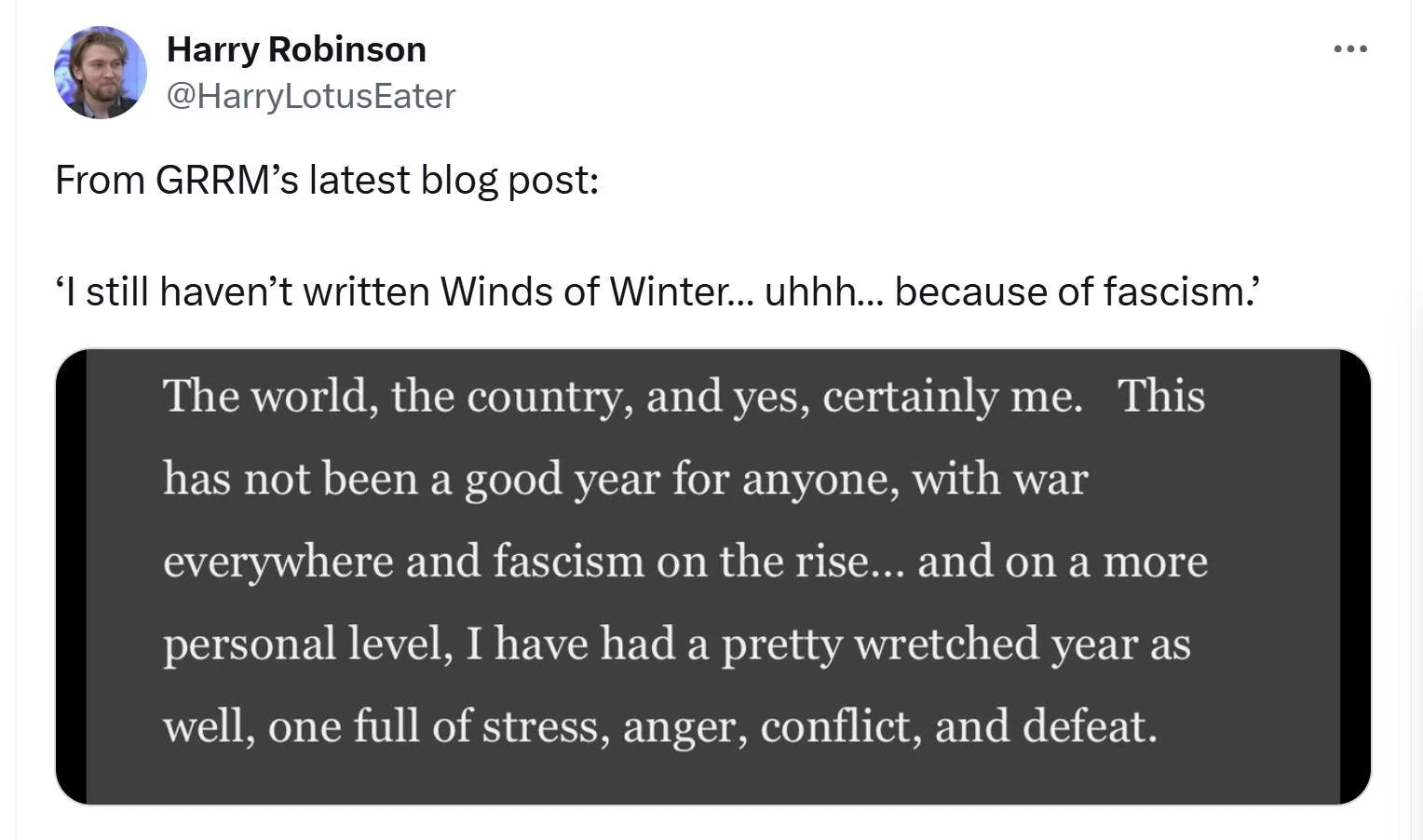
Lewis’s insight is especially ironic given what prompted Eriksen’s post in the first place. In a blog post from late August, Martin lamented “war everywhere and fascism on the rise,” leading to this slightly unfair but funny riposte:


Dissidents in the Soviet Union composed entire books in their heads until they could scribble them down on toilet paper and smuggle them out despite the threat of torture and imprisonment. But then again, writers like Solzhenitsyn were geniuses, and actually believed in something.

You can find Lewis’s “Democratic Education” online or in the slim paperback Present Concerns: Journalistic Essays, which is one of my favorite collections of his work. And for a writer with a stellar work ethic, who got his books done 350 words at a time come hell or high water (or fascism, presumably), here’s historian Thomas Kidd on the slow-burn success of Mick Herron, whose Secret Hours I’m about halfway through right now. As if to underscore the contrast between Herron and what we’re considering here, Kidd titled his post “Writing When You Have No Time to Write.”

Summer reading 2024

Though I’m thankful to say that, compared to where I was at the end of the spring, I’ve wrapped up the summer and begun the fall semester feeling refreshed and rejuvenated, my reading has still been unusually fiction-heavy. That’s not necessarily a bad thing—all work and no play, after all—but I do mean to restore some balance. I look forward to it.

“Summer,” for the purposes of this post, runs from approximately the first week or two of summer classes to today, Labor Day. Since there’s a lot more fiction and non-fiction this time around, I mean to lead off with the smattering of non-fiction reading that I enjoyed. And so, my favorites, presented as usual in no particular order:

Favorite non-fiction

While I only read a handful of non-fiction of any kind—history, biography, philosophy, theology, you name it—almost all of them proved worthwhile. They also make an unusually idiosyncratic list, even for me:

An Illustrated History of UFOs, by Adam Allsuch Boardman—A fun, wonderfully illustrated picture book about UFOs and all sorts of UFO-adjacent phenomena. Not deep by any means and only nominally skeptical, this book is surprisingly thorough, with infographic-style tables of dozens of different purported kinds of craft, aliens both cinematic and purportedly real, and brief accounts of some legendary incidents from Kenneth Arnold and the Roswell crash to Betty and Barney Hill’s abduction, Whitley Strieber’s interdimensional communion, and the USS Nimitz’s “flying Tic Tac.” If you grew up terrified to watch “Unsolved Mysteries” but also wouldn’t think of missing it, this should be a fun read. See here for a few sample illustrations.

Histories and Fallacies: Problems Faced in the Writing of History, by Carl Trueman—A concise, sensible, and welcoming guide to some of the pitfalls of historical research and writing. Trueman is especially good on the dangers of historical theories, which naturally incline the historian to distort his evidence the better to fit the theory. There are more thorough or exhaustive books on this topic but this is the one I’d first recommend to a beginning student of history. I mentioned it prominently in my essay on historiography at Miller’s Book Review back in July.

Three Philosophies of Life, by Peter Kreeft—A short, poetic meditation on three Old Testament wisdom books: Ecclesiastes and Job, two of my favorite books of the Bible, and Song of Songs, a book that has puzzled me for years. Kreeft presents them as clear-eyed dramatizations of three worldviews, the first two of which correctly observe that life is vain and full of suffering, with the last supplying the missing element that adds meaning to vanity and redemption to pain: God’s love. An insightful and encouraging short book.

Homer and His Iliad, by Robin Lane Fox—Who was Homer and what can we know about him? Was he even a real person? And what’s so great about his greatest poem? This is a wide-ranging, deeply researched, and well-timed expert examination of the Iliad and its author, thoroughly and convincingly argued. Perhaps the best thing I can say about Lane Fox’s book is that it made me fervently want to reread the Iliad. My favorite non-fiction read of the summer. Full-length review forthcoming.

Always Going On, by Tim Powers—A short autobiographical essay with personal stories, reminiscences of Philip K Dick, nuts and bolts writing advice, aesthetic observations, and philosophical meditations drawing from Chesterton and CS Lewis, among others. An inspiring short read.

The Decline of the Novel, by Joseph Bottum—An excellent set of literary essays on the history of the novel in the English-speaking world; case studies of Sir Walter Scott, Dickens, Thomas Mann (German outlier), and Tom Wolfe; and a closing meditation on popular genre fiction—all of which is only marginally affected by a compellingly argued but unconvincing thesis. I can’t emphasize enough how good those four case study chapters are, though, especially the one on Dickens. Full dual review alongside Joseph Epstein’s The Novel, Who Needs It? on the blog here.

Favorite fiction

Again, this was a fiction-heavy summer in an already fiction-heavy year, which was great for me while reading but should have made picking favorites from the long list of reads more difficult. Fortunately there were clear standouts, any of which I’d recommend:

On Stranger Tides, by Tim Powers—An uncommonly rich historical fantasy set in the early years of the 18th century in the Caribbean, where the unseen forces behind the new world are still strong enough to be felt and, with the right methods, used by new arrivals from Europe. Chief among these is Jack Chandagnac, a former traveling puppeteer who has learned that a dishonest uncle has cheated him and his late father of a Jamaican fortune. After a run-in with seemingly invincible pirates, Jack is inducted into their arcane world as “Jack Shandy” and slowly begins to master their arts—and not just knot-tying and seamanship. A beautiful young woman menaced by her own deranged father, a trip to Florida and the genuinely otherworldly Fountain of Youth, ships crewed by the undead, and Blackbeard himself further complicate the story. I thoroughly enjoyed On Stranger Tides and was recommending it before I was even finished. That I read it during a trip to St Augustine, where there are plenty of little mementos of Spanish exploration and piracy, only enriched my reading.

Journey Into Fear, by Eric Ambler—An unassuming commercial traveler boards a ship in Istanbul and finds himself the target of a German assassination plot. Who is trying to kill him, why, and will he be able to make it to port quickly enough to survive? As much as I loved The Mask of Dimitrios back in the spring, Journey into Fear is leaner, tighter, and more suspenseful. A wonderfully thrilling read.

The Kraken Wakes, by John Wyndham—Another brilliant classic by Wyndham, an alien invasion novel in which we never meet or communicate with the aliens and the human race always feels a step behind. Genuinely thrilling and frightening. Full review on the blog here.

Mexico Set, by Len Deighton—The second installment of Deighton’s Game, Set, Match trilogy after Berlin Game, this novel follows British agent Bernard Samson through an especially tricky mission to Mexico City and back as he tries to “enroll” a disgruntled KGB agent with ties to an important British defector. Along with some good globetrotting—including scenes in Mexico reminiscent of the world of Charles Portis’s Gringos—and a lot of tradecraft and intra-agency squabbling and backstabbing, I especially appreciated the more character-driven elements of this novel, which help make it not only a sequel but a fresh expansion of the story begun in Berlin Game. Looking forward to London Match, which I intend to get to before the end of the year.

LaBrava, by Elmore Leonard—A former Secret Service agent turned Miami photographer finds himself entangled in an elaborate blackmail scheme. The mark: a former Hollywood femme fatale, coincidentally his childhood favorite actress. The blackmailers: a Cuban exile, a Florida cracker the size of a linebacker, and an unknown puppet master. Complications: galore. Smoothly written and intricately plotted, with a vividly evoked big-city setting and some nice surprises in the second half of the book, this is almost the Platonic ideal of a Leonard crime novel, and I’d rank only Rum Punch and the incomparable Freaky Deaky above it.

Night at the Crossroads, by Georges Simenon, trans. Linda Coverdale—Two cars are stolen from French country houses at a lonely crossroads and are returned to the wrong garages. When found, one has a dead diamond smuggler behind the wheel. It’s up to an increasingly frustrated Inspector Maigret to sort through the lies and confusion and figure out what happened. An intricate short mystery that I don’t want to say much more about, as I hesitate to give anything at all away.

Epitaph for a Spy, by Eric Ambler—A stateless man spending some hard-earned cash at a Riviera hotel is, through a simple mix-up, arrested as a German spy. When the French police realize his predicament and his need to fast-track his appeal for citizenship, they decide to use him to flush out the real spy. Well-plotted, suspenseful, and surprising, with a great cast of characters. My favorite Ambler thriller so far this year. There’s also an excellent two-hour BBC radio play based on the book, which Sarah and I enjoyed on our drive back from St Augustine.

The Light of Day, by Eric Ambler—One more by Ambler, which I also enjoyed. Arthur Simpson, a half-English, half-Egyptian smalltime hood involved in everything from conducting tours without a license to smuggling pornography is forced to help a band of suspicious characters drive a car across the Turkish border. He’s caught—and forced to help Turkish military intelligence find out what the group is up to. Published later in Ambler’s long career, The Light of Day is somewhat edgier, but also funnier. It’s more of a romp than a heavy spy thriller, with wonderfully sly narration by Arthur himself. I greatly enjoyed it. Do yourself a favor, though, and read it without looking at any summaries, even the one on the back of the book. My Penguin Modern Classics paperback gave away a major plot revelation. I still enjoyed it, but have to wonder how much more I might have with that important surprise left concealed.

Runner up:

Swamp Story, by Dave Barry—A wacky crime novel involving brothers who own a worthless Everglades bait shop, potheads trying to make their break into the world of reality TV, a disgraced Miami Herald reporter turned birthday party entertainer, a crooked businessman, Russian mobsters, gold-hunting ex-cons, and a put-upon new mom who finds herself trying to survive all of them. Fun and diverting but not especially funny, which some of Barry’s other crime thrillers have managed to be despite going darker, I still enjoyed reading it.

John Buchan June

The third annual John Buchan June included five novels, a short literary biography of one of Buchan’s heroes, and Buchan’s posthumously published memoirs. Here’s a complete list with links to my reviews here on the blog:

Of this selection, my favorite was almost certainly The Free Fishers, a vividly imagined and perfectly paced historical adventure with a nicely drawn and surprising cast of characters. “Rollicking” is the word Ursula Buchan uses to describe it in her biography. An apt word for a wonderfully fun book. A runner up would be Salute to Adventurers, an earlier, Robert Louis Stevenson-style tale set in colonial Virginia.

Rereads

I revisited fewer old favorites this season than previously, but all of those that I did were good. As usual, audiobook “reads” are marked with an asterisk.

Conclusion

I’m looking forward to more good reading this fall, including working more heavy non-fiction back into my lineup as I settle into the semester. I’m also already enjoying a couple of classic rereads: Pride and Prejudice, which I’ve been reading out loud to my wife before bed since early June, and Shadi Bartsch’s new translation of the Aeneid. And, of course, there will be fiction, and plenty of it.

I hope my summer reading provides something good for y’all to read this fall. As always, thanks for reading!