Nolan’s Odyssey
/I dashed off some initial thoughts on the first teaser trailer for Christopher Nolan’s adaptation of The Odyssey just before Christmas. I concluded with this: “Even from this teaser it’s clear that [Nolan has] put his unmistakable stamp on the story. My hope is that, even without material fidelity to the original’s world, Homer himself will once again prove so strong that his power will shine through despite the filmmakers.”
This is more or less exactly what I thought of the film, which I finally saw this Wednesday. Homer’s power and that “despite” both feature strongly in my opinion.
I won’t bother to summarize the story. Everyone knows a little bit of it and if you’re here, bothering to read this, you probably know it even better than most.
To begin with what I liked, The Odyssey is hugely entertaining. That’s the basic standard a good movie must meet, and as a movie The Odyssey is astonishing. (Its quality as an adaptation of a great work of literature is a separate question, which we’ll return to.) The film is technically accomplished, the IMAX cinematography and the staging of the many action scenes expertly done, and the special effects seamless. The vast, cast-of-thousands scale of sequences like the Fall of Troy is overwhelming in the best sense. And for all his practical effects street cred, Nolan wisely used CGI in a number of appropriate places, a lesson seemingly learned from the underwhelming attempt to mimic the atomic bomb with a practical gasoline explosion in Oppenheimer. And I’ll go ahead and say here that I think The Odyssey is a much better movie than that one.
The film’s pacing is strong but not flawless. I’ve heard a lot of people say the movie didn’t feel three hours long. That wasn’t my experience—it actually felt enormously long to me, but in a way that conveyed the scope of the story rather than simply being boring. The Odyssey’s strongest sections are, unsurprisingly, those depicting Odysseus’s wanderings. The cyclops scene is a small masterpiece, tense, terrifying, and suspenseful, and makes the familiar one-eyed giant strange and scary again. Likewise the passage between Scylla and Charybdis and, in an episode from the poem I always forget about, the monstrous Laestrygonians, depicted here as plate-armored giants who can turn the very trees against intruders. The most disturbing scene in the movie is certainly that involving Circe, whose transformation of Odysseus’s men using half-glimpsed body horror is both frightening and unspeakably gross.
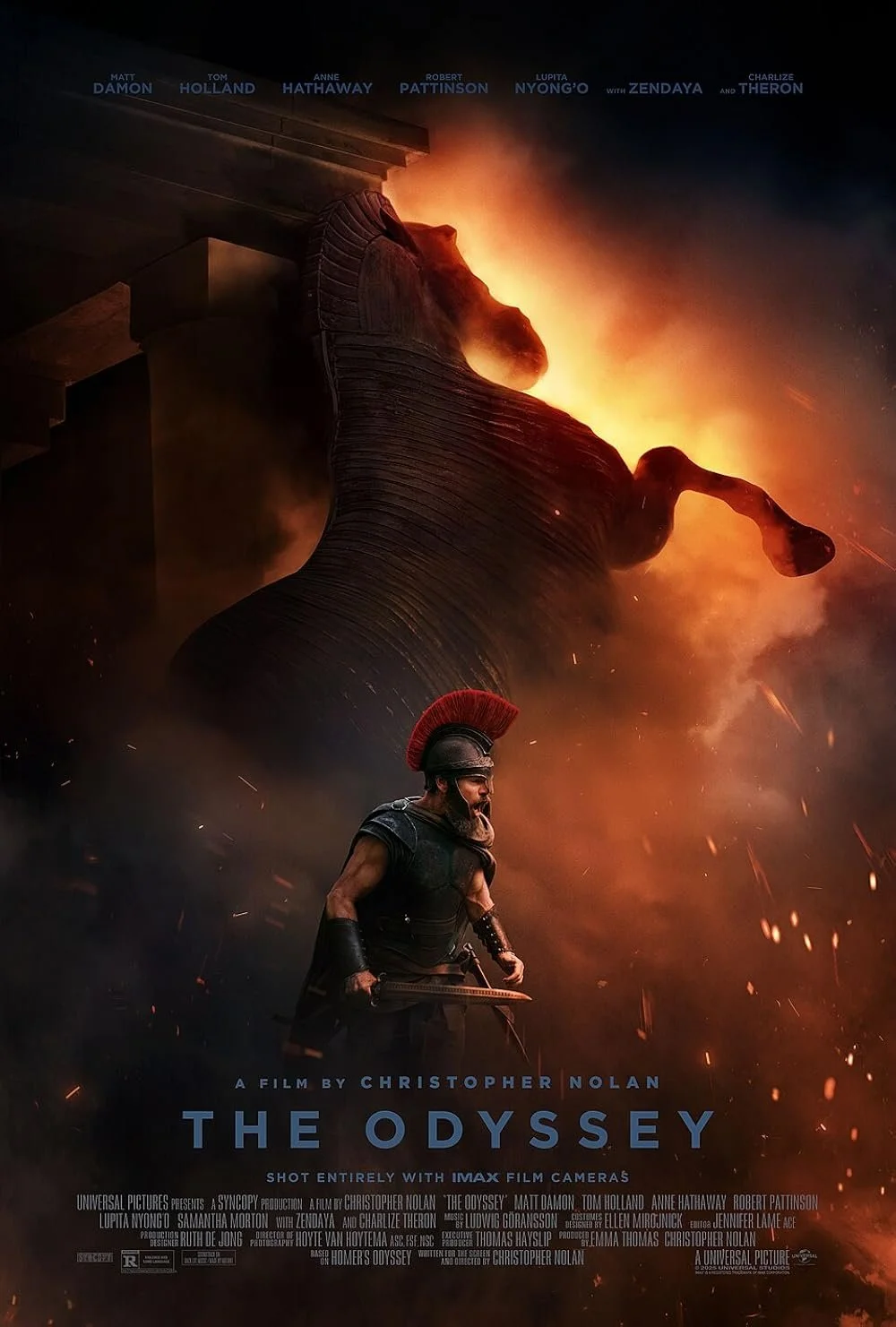
My favorite sequences were certainly Odysseus’s encounter with the cyclops and his journey to Hades to speak to the shade of Tiresias. In mood, atmosphere, and technical execution they were flawless and totally absorbing. These sequences were also allowed to breathe, lingering and building tension in a way some others, though exciting, were not.
Another favorite, coming at the climax, is Odysseus’s slaughter of the suitors. Though not the film’s best action scene, it draws together many expertly prepared strands of the story—Odysseus’s bow, Antinous’s treachery, Telemachus’s arc toward manhood, and the utter loathsomeness of the suitors—in a satisfying explosion of violence. When Odysseus, having revealed himself to the crowd gathered in his palace by stringing his bow and shooting through the twelve axes, puts his next arrow into the throat of the first suitor to die, the audience at my showing clapped and cheered.
This climactic resolution is a good example of the dimension is which Nolan has most successfully adapted the Odyssey to the conventions of film—structure and resolution. The setups and payoffs necessary for a film to make sense and satisfy as a narrative are well done, likely his best work in this regard since The Prestige.
But easily the best aspect of Nolan’s Odyssey is just how much of the original is in here. It’s impressive for a movie that, though long, still comes in under three hours. While in most cases deviating from the plot of ancient literature in adaptation is accepted as necessary, Nolan hews very close, including things left out of other adaptations (the Laestrygonians, the sirens, Odysseus’s dog Argos) and leaving out little. Some of these omissions, like Nausicaa and the Phaiakians and the almost total absence of the gods, require reshuffling of other plot elements. We’ll return to this, but as an adaptation Nolan has chosen mostly wisely and with attention to narrative concision without sacrificing much.
As for The Odyssey’s flaws: with a couple exceptions I was unimpressed with the acting. Tom Holland had a welcome earnestness as Telemachus but felt stiff much of the time, and Zendaya performs Athena like a slightly less angry version of Chani in Dune, all frowns and glares. Matt Damon and Anne Hathaway were good in their roles as written by Nolan, but—again, a point we’ll return to—the cunning and wiliness of this eminently well-matched couple was missing. Damon’s Odysseus has blunt-force persistence but not much in the way of guile, and he lacks the glory-seeking and boastfulness that attract the destructive attention of Poseidon. Homer’s Odysseus had charisma. Damon’s is dogged, but one is not left wondering why his men would rebel against his authority.
The two exceptions—scene-stealers both—are John Leguizamo as Eumaeus and Robert Pattinson as the suitor Antinous. These two elevate the film, and Pattinson, who imbues Antinous with an awful oleaginous magnetism, is largely responsible for how satisfying Odysseus’s slaughter is.
The material culture I was so uncertain about in my trailer reaction didn’t end up bothering me much. Yes, the armor is ridiculous fantasy Greek armor (that also doesn’t seem to stop or turn aside any weapons whatsoever), and yes, the ships are all wrong (they are literal Viking ships, the largest of which I got to look at in Mystic, Connecticut some years ago). The film’s approach to material culture is to shrug and say “whatever,” which makes it no different from any of the other Odyssey or Trojan War epics made since the silent era. I wish we had gotten a movie more firmly rooted in the Bronze Age of Odysseus, but we didn’t and that’s fine.
Which raises the dread spectre of the controversies surrounding Nolan’s Odyssey, including “historical accuracy.” It is not, as some internet types congratulate themselves for believing, ridiculous to want the film’s ships, sets, and costumes to reflect either the world of the Trojan War or the world Homer may have imagined in his own context. Just because Homer’s Odyssey is fiction—at least, that’s how we think of it—doesn’t mean its original context is valueless.
That’s not the path Nolan chose, unfortunately, but it is also true that the Nolanesque look he decided on isn’t inherently wrong, either. It’s worth judging on its own merits, and I think his brutalist matte black tactical imagination is somewhat self-limiting—a theme to which we’ll return. The look of The Odyssey is fine, but not a surprise. A surprise, whether rigorously historically sourced or even more archly fantastical, like 300, would have been nice.
However, Nolan himself undermines the argument that accuracy of whatever kind doesn’t matter by including numerous mentions of the Sea Peoples, mysterious raiders from the central and western Mediterranean who relentlessly attacked the east and brought on the Bronze Age Collapse. This is an unnecessary gesture toward real historical context that doesn’t mesh with the fantastical elements and doesn’t work historically—Homer’s characters wouldn’t have been aware of impending civilizational collapse and Homer himself didn’t include it because, though he lived in its long aftermath, he didn’t know about it. A strange choice but one clearly made for thematic reasons.
As for the casting controversies that generated a seriously annoying amount of internet bloviation: they proved a massive nothingburger. I’ll focus on Helen of Troy here. On one hand, as Homer translator Daniel Mendelsohn put it recently in a Rest is History Club episode, “it’s a little disingenuous to assume that Nolan wasn’t being consciously provocative in his choice” of Lupita Nyong’o as Helen. It’s not ridiculous—much less racist—to notice. On the other hand, Helen appears only briefly, and I didn’t find her presence jarring at all given what I’ve already said about the film’s historically unmoored approach. Something else bothered me much more.
The worst flaw of Nolan’s Odyssey reminded me of the recent adaptations The Green Knight and All Quiet on the Western Front. In both of those cases, I wrote much longer than normal reviews—as here—trying to strike a balance between appreciating the filmmaking and decrying the vandalism of the originals. The Odyssey is a much better movie than either of those and more faithfully presents the events and even the structure of the original, but it still fails to understand and present the original’s worldview.
In place of the deep concern with piety and hospitality in Homer’s poem, something almost every incident from the cyclops and Laestrygonians (uncivilized bad host, civilized bad hosts) to the Phaiakians (the ideal of civilized good hosts) illustrates, Nolan’s film foregrounds what he calls “Zeus’s law,” a watered down form of hospitality that amounts to the Golden Rule—almost directly quoted at one point—and a strange nonviolence. Despite what the suitors have spent years doing to Odysseus’s wife, son, servants, and palace, Odysseus for some reason can’t retaliate without going into exile. (Exiled by whom? I saw someone ask online. Is he not the king?) One of the few major departures from Homer is the film’s ending, in which Odysseus and Penelope, rather than restoring Ithaca through Athena’s help, leave, sailing west as in Dante and, later, Tennyson, but for twenty-first century reasons.
This strange, confused theme grows out of the film’s larger point about war and violence and the destruction of civilization. This is where the Sea Peoples come in—at the end, Penelope explicitly connects their threat with the Greek victory in the Trojan War. And for Odysseus himself, this is manifested in his guilt and trauma over the sack of Troy. Nolan’s Odyssey is about processing trauma and atoning for sin.
This leads to a running undercurrent of resentment. Antinous’s wickedness stems from his resentment of Odysseus and Telemachus much more than greed, Circe vents years, possibly centuries of resentment on Odysseus when thwarted, Sinon, in Hades, grouses at Odysseus for leaving him ignorant of his designs, and everyone resents Agamemnon. The biggest problem with Nyong’o’s Helen isn’t Nyong’o, it’s the seething resentment at being returned to Menelaus that Nolan has imparted to her.
This is not unique to this film, of course. I’m struck that in updating or making relevant an old story, the go-to modern method is to import and emphasis grudges and resentments. This reveals more about us than Homer, certainly.
Like Nolan’s matte black and concrete visual style, all of this is both ultramodern and—worse—uninteresting.
It’s strange, but The Odyssey makes the same mistake here as the The Return, which squandered a brilliant performance by Ralph Fiennes—whose Odysseus had obvious cunning—in simplifying and deconstructing the story. The Odyssey is a far better movie than The Return, but its psychologizing and therapeutic themes have the same flattening effect, a fact noted by no less a light than Emily Wilson, whose iambic pentameter translation I would not recommend but has been unfairly blamed for what a lot of online rage-baiters perceive as Nolan’s failings. Per Wilson: “The film presents an Odysseus who feels very bad about things that he’s done in war, and is struggling to process them in a very modern, psychiatrized way—and needs drugs to do so!” Fuss about helmets, ships, and casting all you like—this is the real, most serious departure from Homer.
Do we need another PTSD therapy fable? Is there not something in the alien world Homer’s imagination has kept alive for 2700 years that speaks to us without thinking we have to modernize it? Homer is brilliant on his own—dramatic, funny, terrifying, suspenseful, and moving by turns. It’s a fool’s errand to think one can improve him by making him relevant.
So this is not Homer’s Odyssey; it’s Nolan’s, for better and for worse. It’s riveting entertainment on a massive scale and worth seeing just for that. It also succeeds better than any other film version at covering most of the epic’s plot and events. But its worldview is not the original’s, and what it substitutes—or, rather, clumsily adds onto—is predictable and unsatisfying.
And yet, whatever misgivings one might have about Nolan’s imprint on the story, he was smart enough to get as much of Homer into the film as he could, and that’s the film’s saving grace. As I had hoped back in December, Homer’s power is much greater than any limitation or miscalculation on Nolan’s part, and so The Odyssey excites and moves precisely where it’s truest to the poet.