The Northman trailer reaction

Update: You can read my full review of The Northman here. In my review, I don’t address all the nitty-gritty bullet-point stuff that I note in this trailer reaction, but the film is loaded with good details. It exceeded my expectations and was well worth the wait.

I’ve only gotten seriously excited about two movie trailers this year. The first was one I wasn’t expecting—The Batman, starring Robert Pattinson as Bruce Wayne, the trailer for which genuinely surprised me with its atmosphere and cold-wet-asphalt visuals. It also helped that, putting the stink of the Cullens further and further behind him, Pattinson has impressed me over and over as a fine actor. I’m looking forward to The Batman.

But I’m here to talk about the other trailer I’m excited about, one I’ve been anticipating for a long time—The Northman. The first trailer arrived this afternoon.

The Northman is writer/director Robert Eggers’s third film. His first feature, The Witch, stunned me not only with its genuinely creepy atmosphere and grim plot, but its attention to period detail, not only in costumes, sets, and props but even in the way the characters spoke and thought. His second, The Lighthouse, was somewhat too content with non-answers and fart-sniffy archetypal and Freudian mumbo jumbo to suit me, but was nonetheless a visual masterpiece and Eggers’s care for the look, feel, and sound of a period was again in strong evidence. When I learned that his next project was a Viking-era drama inspired by the sagas, I was excited—and somewhat trepidatious. Anyone with a serious interest in the Vikings or the Early Middle Ages more generally is used to being disappointed.

And now that the first trailer is here, I still feel largely the same. Excited. Trepidatious. But considerably more excited.

The Northman appears to tell the story of the son of a Scandinavian king or warlord. After the king is betrayed and murdered by his evil brother, the son goes on the run with the goal of one day returning for revenge. So far so good—classic saga material. You could probably count the sagas that don’t involve revenge on one hand. The son, who as an adult is played by Alexander Skarsgård, seems to spend a while as a captive or slave before allying with a volva or sorceress played by the ever-spooky Anya Taylor-Joy. Here you’re getting some solid stuff from the legendary sagas. And there’s plenty of material that spans both the more nitty-gritty, realistic sagas and the legendary material, especially a few shots of Skarsgård and company wearing wolfskins as they attack some kind of fortification. Is this the climactic battle? Somewhere in the middle, as our Northman fights his way toward his uncle? It’s unclear. But the wolfskins mark him as an ulfheðinn or wolf-shirt, a form of dangerous rogue warrior conceptually similar to a berserkr.

Beyond that—who knows? The trailer is long on atmosphere and striking images but thankfully leaves much of the plot unexplained. I was left wanting more, so the trailer is definitely doing its job.

Other thoughts/observations:

  • First and foremost, I’m not seeing any tattoos or fashy haircuts. Already major points in The Northman’s favor. Instead we’ve got heavily bearded but largely well-kempt men and women, as befits a culture famously concerned with appearance and especially coiffure.

  • As for other forms of adornment, there are some sensible necklaces and brooches and plenty of rings, and it’s good to see the hero with arm-rings in a couple of scenes. These were the badges of serious warriors across many early medieval Germanic cultures.

  • Weapons and armor (about which more below) look interesting, though I couldn’t examine every shot. The hero seems to be wearing a long seax (imagine a Germanic bowie knife) diagonally across his waist in his scenes as an ulfheðinn. A nice touch, one that doesn’t make it into a lot of medieval movies. I’m mostly thankful that the helmets in the trailer look good based on what we know (which isn’t much) and that other armor seems limited to mail shirts. That’s accurate. No anachronistic plate armor or ridiculous leather getups here, thank heavens. See the still from Alfred the Great here to see how badly this can go wrong.

  • “You must choose between kindness for your kin or hate for your enemies.” A Viking Age moral dilemma, one not uncommon in the sagas, and a call to be a drengr. (Which, not coincidentally, seems to be the last word chanted in the trailer.)

  • Great scenery, especially the glacier in Iceland and some of the sweeping landscapes. Eggers is always very attentive to the environments in which his stories take place, an undervalued aspect of modern storytelling.

  • Here’s an iffy one: While what we get in the trailer largely sticks with the muddy doom-and-gloom aesthetic of most medieval movies, it is welcome to see the characters largely wearing nice fabrics (as opposed to burlap or outright rags) and colors. Not just the Norse but everyone throughout the medieval world enjoyed colorful clothing just as much as we do. The Northman’s palette is pretty muted, presumably for artistic reasons as much as that ineradicable image of the Middle Ages as drab, but the young hero’s red tunic and Taylor-Joy’s blue shift were nice touches. I hope there’s more of that.

  • Related: When evil uncle Fjolnir (Claes Bang) arrives to kill the hero’s father, he’s wearing a “goggle” helm with attached wraparound mail typical of the Vendel period, which directly preceded the Viking Age. A touch of archaism or ceremony for the uncle, then? Also, the drab color palette could be especially purposeful here, as several sagas refer to characters ritually dressing in black to prepare for a premeditated killing. If this is intentional, it shows Eggers has done a ton of homework. I’m hopeful.

  • Further related to the Vendel era stuff: Is that Oðinn we get a glimpse of by the fire near the end? His one visible eye appears cloudy. Further, he’s wearing a helmet typical of scenes depicted on Vendel art, which are often interpreted as mythological scenes. Here’s a really similar one. Notice the rods or staffs. Some kind of staff was apparently important for the practice of seiðr, a form of magic or divination that was typically associated with women (see Taylor-Joy’s “cunning” woman) and shameful for men to perform—though Oðinn, notably, practiced seiðr. Is that what’s going on in the trailer? Is that why no one in the scene is wearing pants? Who’s to say at this point, but again, that it suggests these possibilities shows that Eggers isn’t going for the superficial Hollywood image of Vikings.

  • Speaking of Hollywood Vikings, there appear to be no shield-maidens, female warriors, or other Hollywood Warrior Chicks™ in the trailer, which is astounding. Hollywood cannot resist throwing that bit of Norse fantasy in. (And I do mean fantasy: here’s a summary of the most prominent example from the legendary sagas.) The only exception here seems to be a valkyrie, about which more below.

  • Also: rather more wire-fu than I prefer, especially that over-the-top axe blow at approximately 2:05. Hoping the movie doesn’t go off the rails when the warriors draw their weapons, but there’s little enough here that I’m not too worried yet.

  • Other notes on combat: Lots of sneaking in small numbers, especially under cover of darkness. Definitely rings true if you’ve read the sagas at all.

  • A few shots I’m particularly eager to see more of: speaking of stuff straight from the sagas, we get what is clearly a glimpse of the burning of a turf long-house. (See the still at the top of this post.) Several other shots seem to show fighting inside the hall, presumably before the whole thing is torched.

  • Creepy but 100% realistic detail: Two shots near the end of the trailer appear to show a valkyrie riding through the sky. In the first shot, as she screams, you can see black streaks across her teeth. Numerous skulls from Viking Age burials have exactly this kind of grooving filed laterally across the teeth. Some kind of badge of honor for a warrior? Medicine or magic? Mere personal decoration, like a rapper’s grill? No one knows for sure, but it was cool to see that make it into the movie.

  • Eggers loves his dreams and nightmare visions, and I’m guessing the valkyrie and Oðinn—if that is indeed him—might factor into them.

  • Finally, I haven’t said much about the cast, but they look great. I’ve liked Skarsgård in whatever I’ve seen him in but remember him primarily as Sergeant “Iceman” Colbert in the mini-series “Generation Kill.” Here he seems to be channeling some of his version of Tarzan, particularly in the ulfheðinn scenes, which look like they’re calculated to show off his abs. Good for him, I guess. Ethan Hawke looks great as a good, wise king and father; Claes Bang—who has suddenly appeared in a bunch of recent American movies, none of which I’ve seen—as a quietly threatening evil uncle. Scar to Hawke’s Mufasa? Taylor-Joy was exceptional in both The Witch and, in something completely different, Emma, and should be excellent here as well. I’m especially interested in Willem Dafoe, whose role is mostly just teased here but, considering Dafoe’s caliber, should be important and not a little weird.

So—The Northman looks like a Viking revenge story taking place on two levels, the first a potentially quite authentic and realistic historical world and the other a dimension of dreams, visions, or the supernatural. That’s my initial reaction, anyway, with a few thoughts, observations, and wonderings. Considering what we get in the trailer, and considering the talent involved, I’m guardedly optimistic. We’ll see. Like I said, medievalists are used to being disappointed (see Knight, The Green), but based on these two and a half minutes, I’m here for it.

Check out the trailer and see for yourself! The Northman comes to theaters April 22 and I guarantee I’ll be there.

Addendum: If you can’t wait for April, as I imagine I may have a hard time doing, please do check out my novel No Snakes in Iceland, which is set in the same world but deals with ghosts and grief and mystery rather than dynastic betrayal.
Two great reads on history, memory, and fun

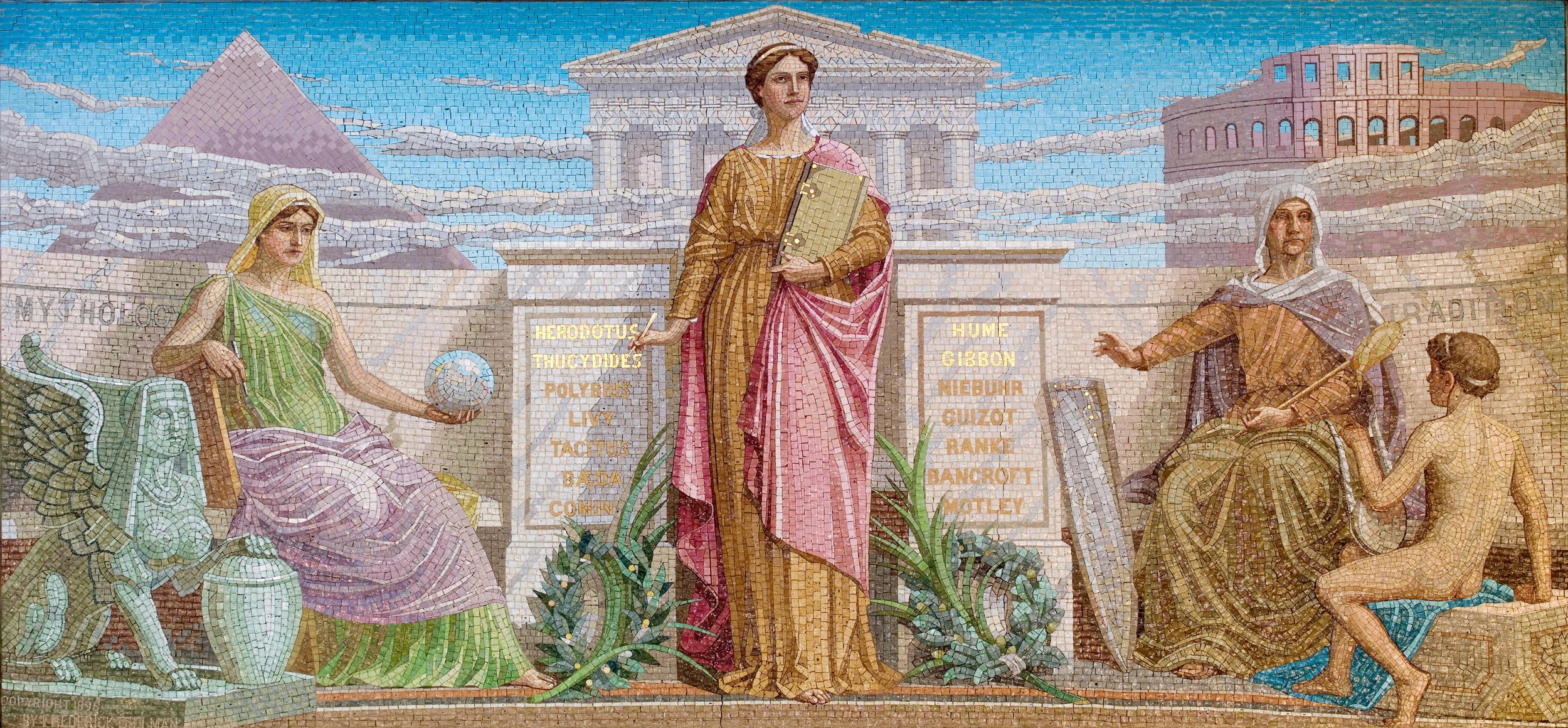
History, by Frederick Dielman, in the Library of Congress Thomas Jefferson Room

I don’t know about y’all, but I occasionally need a reminder of why I do what I do. This is especially the case at the end of a long and busy semester. Here are two pieces on the purpose and value of history that gave me precisely the reminders I needed, and which I want to endorse and recommend:

The Claims of Memory,” by Wilfred M McClay

Wilfred McClay’s is the longer and more philosophical and meditative of these two pieces, and was originally delivered as First Things magazine’s 34th Erasmus Lecture this October.

History, for McClay, is not simply a list of dates to memorize (the high school football coach method) or a jumbled rush of unrelated discrete events (“one damned thing after another”), but a form of memory that transcends and enlarges individual human memory—an attitude dating back at least to Cicero, who wrote that “Not to know what happened before you were born is to be a child forever.” (I have this line on my office door.) McClay agrees, and develops the metaphor further, arguing that not only is memory essential to maturation, but loss of memory is fatally debilitating not only to the individual but the society. He invokes Alzheimer’s as an example of how the loss of one person’s memory can affect multitudes. Recall the concept of transactive memory I wrote about earlier this year.

But memory is also tricky, subject not only to ageing and degradation but to vaguery and distortion, and simply amassing more and more empirically determined data may only make that worse. Drawing on another example of memory gone wrong, a Russian psychological patient who could recall literally everything he had ever seen but could not organize those things into coherent, generalized understanding (what would probably happen to a real Will Hunting), McClay also makes room for the necessity of forgetting. “What makes for intelligent and insightful memory,” he argues, “is not the capacity for massive retention, but a balance in the economy of remembering and forgetting.”

But, McClay notes, “there are crucial differences” between individual memory, even in senility, and history as a profession and a cultural tradition:

No one can be blamed for contracting Alzheimer’s disease, an organic condition whose causes we do not fully understand. But the American people can be blamed if we abandon the requirement to know our own past, and if we fail to pass on that knowledge to the rising generations. We will be responsible for our own decline. And our society has come dangerously close to this very state. Small wonder so many young Americans now arrive at adulthood without a sense of membership in a society whose story is one of the greatest enterprises in human history. That this should be so is a tragedy. It is also a crime, the squandering of a rightful inheritance.

This squandering “goes far beyond bad schooling and an unhealthy popular culture” to a censorious, “imperious” and “ever-grinding machine of destruction and reconstruction” that “makes it difficult to commemorate anything that is more than a few years old.”

The whole proposition of memorializing past events and persons, particularly those whose lives and deeds are entwined with the nation-state, has been called into question by the prevailing ethos, which cares nothing for the authority of the past and frowns on anything that smacks of hero worship or filial piety.

Invoking pietas is really speaking my language. McClay is here describing what Roger Scruton called a “culture of repudiation,” and McClay offers incisive critiques of the way academic faithlessness toward the duty to preserve memory translates into popular indifference or, for the “woke,” outright hostility toward the past.

[W]e are rendering ourselves unable to enjoy such things, unless some moral ­criterion is first met. That inability arises, I fear, from guilt-haunted hearts that are unable to forgive themselves for the sin of being human and cannot bear their guilt except by projecting it onto others. The rest of us should firmly refuse that projection and recognize this post-Christian tyranny for what it is.

This is an excellent, wide-ranging, and thoughtful examination of a problem I care a lot about, and I hope you’ll read it. You can find the whole piece here. A recording of the lecture is also available on Vimeo, though I haven’t been able to play it on my machine. I hope y’all will have better luck.

McClay wrote Land of Hope, a one-volume narrative history of the United States that was one of my favorite books of 2020—a year when our need for appreciative but not uncritical memory became especially apparent. I quoted a longish excerpt in which McClay makes the case for narrative history here.

Make History Great Again!” by Dominic Sandbrook

British historian Dominic Sandbrook’s piece is the shorter and punchier of the two, and begins with a question near to my heart: “Why don’t today’s children know more about history?”

I’ve cared about this topic for a long time—first as I figured out how I came to love history as a kid, then as I figured out how to get my students to love history, and now, even more pressingly, as I figure out how to pass on my love of history and even some of my own history to my own children. It’s an important question for all the reasons McClay lays out in his piece.

Sandbrook suggests that the problem is that history, roped off and quarantined lest anyone catch cooties from old ideas we don’t approve of, has been made uninteresting to children—not only in terms of content, presenting “issues” and “forces” rather than events and personalities, but because of the tone with which this history is presented:

In recent years, the culture around our history has been almost entirely negative. Statues are toppled, museums ‘decolonised’, heroes ‘re-contextualised’, entire generations of writers and readers dismissed as reactionaries. When Britain’s past appears in the national conversation, it’s almost always in the context of controversy, apology and blame. . . .

Against this background, who’d choose to study history? For that matter, who’d be a history teacher? Even selecting a topic for your Year 4 children seems full of danger, with monomaniacal zealots poised to denounce you for reactionary deviation. And all the time you’re bombarded with ‘advice’, often in the most strident and intolerant terms.

This presentation is “at once priggish, hand-wringing and hectoring, forever painting our history as a subject of shame.” It also oversimplifies, and the oversimplified is always deadly dull. Complexity excites, especially once a student is immersed enough in a particular time and place to get the thrill of piecing seemingly disparate parts of a narrative together. But that requires imagination, which rebels at dullness.

Part of this dull simplicity is the prevalence of one permissible narrative, a vision or set of emphases to which it is morally imperative that all others be subordinated. Sandbrook invokes the manner in which the UK’s National Trust suggests educators use England’s stately old country houses to cudgel unsuspecting students:

The National Trust’s much-criticised dossier about its country houses’ colonial connections opens by talking of the ‘sometimes uncomfortable role that Britain, and Britons, have played in global history’, and piously warns the reader that our history is ‘difficult to read and to consider’. The Trust’s Colonial Countryside Project encourages creative writing about ‘the trauma that underlies’ many country houses. In other words, drag the kids around an old property and make them feel miserable. Maybe I’m wrong, but I doubt that’ll make historians of them.

He’s not wrong. Admiring the house and its long-lasting beauty and imagining yourself living there—the natural impulses of a healthy child in an excitingly the concretely alien place—would seem to invite punishment.

Sandbrook examines as well the way American-centric concerns have taken over even the British imagination, all in the name of giving children something actionable and, well—a word I’ve inveighed against here before: “Behind this lurks the spectre of ‘relevance’, a word history teachers ought to treat with undiluted contempt.” Hear hear!

History isn’t about you; that’s what makes it history. It’s about somebody else, living in an entirely different moral and intellectual world. It’s a drama in which you’re not present, reminding you of your own tiny, humble place in the cosmic order. It’s not relevant. That’s why it’s so important.

As much as all of the above had me pounding my desk in approval, it is all preparatory to Sandbrook’s positive recommendations on how to make children interested in history again: story, setting, and people—the narrative elements we are wired to respond to, to build our lives around and to emulate, all of which begins in the molding of the affections and the imagination. And that begins in childhood:

So how should we write history for children? The answer strikes me as blindingly obvious. As a youngster I was riveted by stories of knights and castles, gods and pirates. What got me turning the pages wasn’t the promise of an ‘uncomfortable’ conversation. It was the prospect of a good story. Alexander the Great crossing the Afghan mountains, Anne Boleyn pleading for her life on the way to the scaffold, Britain’s boys on the beaches of Dunkirk, Archduke Franz Ferdinand taking the wrong turn at the worst possible moment... that’s more like it, surely?

Add to all of this “an attitude,” specifically that of an open-minded traveler visiting alien lands—about which more below—with the first and most obvious benefit of travel as his goal:

Exploring that vast, impossibly rich country ought to be one of the most exciting intellectual adventures in any boy or girl’s lifetime—not an exercise in self-righteous mortification. Put simply, it should be fun.

Three cheers.

I’ve quoted extensively from this piece because it’s so good, but there’s more, and Sandbrook’s recommendations at the end are excellently put. Read it for those at least. You can read the whole piece at the Spectator here.

Sandbrook has published several volumes of history both for adults and children. I’m sorry to say I haven’t read them, though I’m awaiting the arrival of his children’s Adventures in Time volume on World War II. He is also—with the great Tom Holland, whose Dominion was my other favorite historical work of 2020—a host of the podcast The Rest is History.

Conclusion

Something that struck me in these pieces is that, at one point in each, both invoke LP Hartley’s celebrated line that “The past is a foreign country.” I use that line, as well as the one on memory and maturity by Cicero above, to open every course I teach, every semester. I find it gets my approach across pretty well and primes the students for our study of the past to amount to more than names and dates.

Nevertheless, CS Lewis wrote in The Abolition of Man, a book especially concerned with the hollowing out of the purportedly educated, that “The task of the modern educator is not to cut down jungles but to irrigate deserts.” It’s true. But the desert is so dry and the digging so relentless that I end most semesters not just weary but exhausted. Spent. Nearly despairing. This semester was no exception.

So I’m grateful to McClay and Sandbrook for breathing some life back into me and reminding me not only of what’s at stake, but how much fun real, good history can be—and should be.

Chesterton on the danger of historical films

Over the weekend I made an unexpected 36-hour trip to Texas and back. On my way home I listened to the latest episode of Bill Simmons’s Rewatchables podcast, a two-hour discussion of Oliver Stone’s JFK. The two hours was more than welcome in the pre-dawn flatlands of northern Louisiana where I listened to it, and fully the first hour turned out to be a thought-provoking discussion of a topic that has been on my mind for weeks and that I’ve been generally concerned about for years: falsehood in historical films.

Simmons and his guests spent a lot of time discussing and comparing the streamlining and condensation inevitable in a historical film with the outright fabrication—especially of major characters—that Stone does throughout, but what really caught my attention and got me thinking was a description very early in the episode of JFK as “provocative, if not wildly irresponsible.” How much responsibility does a filmmaker have, whether to the facts, his audience, or both?

All of which brought to mind the following passage, from “On the FIlms,” a newspaper essay collected in As I Was Saying in 1936, the year of Chesterton’s death:

The second fact to remember is a certain privilege almost analogous to monopoly, which belongs of necessity to things like the theatre and the cinema. In a sense more than the metaphorical, they fill the stage; they dominate the scene; they create the landscape. That is why one need not be Puritanical to insist on a somewhat stricter responsibility in all sorts of play-acting than in the looser and less graphic matter of literature. If a man is repelled by one book, he can shut it and open another; but he cannot shut up a theatre in which he finds a show repulsive, nor instantly order one of a thousand other theatres to suit his taste. There are a limited number of theatres; and even to cinemas there is some limit. Hence there is a real danger of historical falsehood being popularized through the film, because there is not the normal chance of one film being corrected by another film. When a book appears displaying a doubtful portrait of Queen Elizabeth, it will generally be found that about six other historical students are moved to publish about six other versions of Queen Elizabeth at the same moment. We can buy Mr. Belloc’s book on Cromwell, and then Mr. Buchan’s book on Cromwell; and pay our money and take our choice. But few of us are in a position to pay the money required to stage a complete and elaborately presented alternative film-version of Disraeli. The fiction on the film, the partisan version in the movie-play, will go uncontradicted and even uncriticized, in a way in which few provocative books can really go uncontradicted and uncriticized. There will be no opportunity of meeting it on its own large battlefield of expansive scenario and multitudinous repetition. And most of those who are affected by it will know or care very little about its being brought to book by other critics and critical methods.

I find Chesterton’s cautions here compelling. Movies, being visually stimulating and, of necessity, simplified, go down easy. People believe them. Furthermore, movies borrow liberally from each other, meaning that a successful but inaccurate movie’s falsehoods will be reproduced indefinitely. (Think, for example, or the trope of medieval longbowmen firing unaimed volleys into the air as indirect fire, an absurdity that started with Laurence Olivier’s Henry V and continues right down to the present.)

And that’s also assuming a good faith effort on the part of filmmakers to tell what they think is a true story. But filmmakers both then and now often feel no obligation to do so. One odd trend that I’ve noticed in recent years is taking a real historical figure and giving them wholly fabricated homosexual love lives, as with baseball player and renaissance man Moe Berg in The Catcher Was a Spy, Queen Anne in The Favourite, and paleontologist Mary Anning in Ammonite. In the latter case, the director made it explicit that he had appropriated a real person’s life story as revenge for “queer” stories that had been “straightened.” There’s not much an artist with such a sense of grievance won’t do to score points against them, whoever “they” are.

But real people are not just counters in a game artists play to make a point, or elements in a composition that can be rearranged to suit the artist’s taste. They’re real people. And real things are intractable. Toy with them too much, bend and twist and reshape them to fit a prefabricated plot arc or accepted genre conventions, and they may end up unrecognizable—and fatally cliched. (Here’s one notable case.)

Furthermore, a “doubtful portrait,” a Chesterton puts it, of a real person isn’t just inaccurate, it can damage real reputations. Four cases I happen to know about:

  • Boxer Max Baer, a kind-hearted man bothered by the deaths of two former opponents due to head injuries, was depicted in Ron Howard’s Cinderella Man as a pompous thug proud of killing two men in the ring and who makes sexual advances toward James Braddock’s wife. Audiences, oblivious to the character assassination, “whooped and hollered” when Braddock took Baer down at the end. Baer’s son, Max Baer Jr. (of “The Beverly Hillbillies” fame), responded to the movie with “If Howard and [Russell] Crowe were sitting here, I’d hit them.”

  • In the 1964 film Zulu, Private Henry Hook, who earned a Victoria Cross for his actions at the Battle of Rorke’s Drift, is depicted as a drunk, thief, and shirker who makes good in a moment of desperation—a screenwriter’s invention purely for dramatic purposes. The real Henry Hook was a Methodist lay preacher and teetotaler with a spotless disciplinary record. His elderly daughters walked out of the film’s premier.

  • American Gangster, a 2007 movie directed by Ridley Scott (whose presence should always sound warning sirens for historical accuracy), softened drug lord Frank Lucas to make him more palatable and invented adulterous affairs and a bitter child custody battle for detective Richie Roberts, who in real life did not have kids—and was still alive when the film came out.

  • William McMaster Murdoch, First Officer of the Titanic, is depicted by James Cameron (more warning bells) in the 1997 film Titanic as shooting passengers during a stampede for the lifeboats before turning his gun on himself in remorse. The evidence this is based on is sketchy, and, like Henry Hook above, Murdoch had living relatives who took exception, not to mention a hometown with an educational fund in Murdoch’s memory. Cameron and his studio never formally apologized but threw £5000 to the memorial fund. (Titanic made $2.2 billion worldwide.)

Public ignorance and mistaken or outright careless filmmakers are threats to the truth, but I think Chesterton is right in pointing out that it is film’s monopolistic effect that is the gravest danger. The kinds of films audiences flock to and, more importantly, remember are too complicated and expensive to make competition—correcting the record—viable. And so a Zulu comes along and the handful that really know and care about the memory of Henry Hook spend the next sixty years trying to get the real story out.

Of course, anyone who enjoyed the movie can always be directed to a more detailed, comprehensive, and accurate book on the subject. I’ve done this a thousand times if I’ve done it once. But how many people actually take those recommendations? I’m guessing one in a thousand is optimistic. How many people are going to read Andrew Roberts’s 700-page biography of George III when they can yuk at him in Hamilton instead?

Per Chesterton, immediately following the passage quoted above:

 
A false film might be refuted in a hundred books, without much affecting the million dupes who had never read the books but only seen the film.
 

This is something I think about a lot, but I’m not sure I have any answers or solutions to the problem beyond a renewed commitment to truth and a sense of responsibility among filmmakers. Because telling a true story well is not impossible, and those films that successfully fit a true story—inevitably streamlined and simplified but in such a way as to hint at the real story’s complexity—to the medium of film are my beaux ideal. (Here’s one I’ve written about before.)

As for the guys on the Rewatchables podcast, they concluded their deep, thoughtful discussion of Oliver Stone’s paranoid, grievance-driven tissue of distortions and fabrications by agreeing—emphatically—that LBJ and the CIA were behind Kennedy’s assassination. So much for that.

Chesterton vs Brooks

Two quotations on progress, presented without comment.

From David Brooks’s essay “What Happened to American Conservatism?” (AKA “Conservatism is Dead”) in The Atlantic:

 
If [the Democratic Party’s] progressive wing sometimes seems to have learned nothing from the failures of government and to promote cultural stances that divide Americans, at least the party as a whole knows what year it is.
 

Which brought to mind this line from GK Chesterton in an interview with the New York Times, 1923:

 
My attitude toward progress has passed from antagonism to boredom. I have long ceased to argue with people who prefer Thursday to Wednesday because it is Thursday.
 

Pickled monarch

I’m currently a little over a hundred pages into Andrew Roberts’s 700+ page The Last King of America: The Misunderstood Reign of George III. It’s excellent so far, and full of surprises. Here’s one.

This is the twenty-year old George, Prince of Wales writing to his tutor and “dearest friend,” John Stuart, 3rd Earl of Bute in 1758:

What a pretty pickle I should be in a future day if I had not your sagacious counsels.

To “be in a pickle” is not an expression I would have imagined being current in the 1730s, so it surprised to me both 1) that the expression is so old and also 2) that it’s survived to the present. Most such casual idioms go stale pretty quickly—and the more specific they are the more so. I don’t imagine much of anything written nowadays will be intelligible by the end of the century.

But notice that what I at first took to be an oddity of grammatical structure actually suggests the idiom has changed a bit: George says “what a pretty pickle I should be,” not “I should be in.” I can’t be certain that this isn’t just a twenty-year old expressing himself imprecisely (though the volume, style, and erudition of George’s letters suggests otherwise), but if not, the idiom as used by George makes himself the pickle. And in this period, the pickle could be either something soaked in brine or something served up covered in a particular salty sauce. Here’s the Online Etymology Dictionary:

The meaning “cucumber preserved in pickle” first recorded 1707, via use of the word for the salty liquid in which meat, etc. was preserved (c. 1500). Colloquial figurative sense of “a sorry plight, a state or condition of difficulty or disorder” is recorded by 1560s, from the time when the word still meant a sauce served on meat about to be eaten.

Served up garnished and ready to eat—an altogether more precarious image than even that suggested by our continued use of the phrase, and one appropriate to the situation George found himself in following the death of his father but before the death of his hostile and mean-spirited grandfather. At any rate, this figurative sense is much older than the more specific meaning of a pickled cucumber, a usage that was still pretty recent in George’s youth. Presumably, to be “in a pickle,” in which you are the hapless victim of a bad situation, is a mutation based on the baseball/tag game.

Another odd example—from the infinite and labyrinthine cellars and archival storage closets of English—of what makes even seemingly unexceptional aspects of the language fun and diverting.

I wrote about Roberts’s approach to history about a year ago. You can read that here.

Addendum: Speaking of historical oddities and surprises, here’s an offhand observation and ironic note from the very first chapter:

The Prince and Princess of Wales’s Court was a close-knit group that made its own amusements. In 1748, Lady Hervey noted that the young Prince George and the other royal children were playing ‘at baseball, a play all who are or have been schoolboys are well acquainted with.’ She added that ‘the ladies as well as the gentlemen join in this amusement.’ It was a form of rounders that later became popular in America—a game that, ironically, George III played but George Washington did not.

Poe, seashells, and measures of success

I get monthly e-mails from Clemson’s dissertation and thesis service reporting new downloads of my master’s thesis. There are a few dozen every month, which I’ve always found kind of interesting. I’ve even, out of curiosity, turned up blog reviews of that paper online. It’s gratifying to know that all that research is of interest to someone and that people are learning from it. I know I did.

But what I realized at some point in the last year is that all those downloads make my master’s thesis probably—excluding a handful of blog posts that have found their way pretty high into Google’s algorithm—the most widely read thing I’ve ever written. Downloads of that paper outstrip sales of my best-selling novel by a factor of ten.

This doesn’t bother me, by any means—I just find it curious, and even amusing. I certainly don’t think about that thesis as often as I think about my novels and plans for future ones. But it has gotten me thinking about how you measure your own success.

So I was interested to learn from The Reason for the Darkness of the Night, the Edgar Allan Poe biography I referred to last month and hope to review when I get some time, that Poe’s bestselling book in his lifetime, and his only book to get a second edition in his lifetime, was… The Conchologist’s First Book, an introductory textbook on molluscs for which he received no royalties.

If this annoyed or discouraged Poe, there’s no evidence of it. Which points to one of his strengths, even when doing hack work as a writer-for-hire—simply plugging away at the work, moving on to the next project.

While The Conchologist’s First Book has an interesting genesis (read The Reason for the Darkness of the Night for an account of how Poe came to translate/compile/write this book) and Poe actually ended up making serious contributions to the emerging field of conchology, the book is largely forgotten today. When I looked it up on Project Gutenberg I was only the 28th person to download it in the last thirty days. For comparison’s sake, the second volume of the Works of Edgar Allan Poe got nearly 8400 downloads in the same timeframe.

You might not be immediately popular for the work you care most about, but you might end up remembered for the work you do. Food for thought.

“The Tell-Tale Heart” on City of Man Podcast

I’m excited to have hosted City of Man for the Christian Humanist Radio Network’s annual Halloween crossover again. This year the shows are all covering selected stories by Edgar Allan Poe. On this episode of City of Man, David Grubbs, Mathew Block and I discuss the story that began my own lifelong love of Poe’s work, “The Tell-Tale Heart.”

We discuss Poe’s life and work overall, the tragedy that dogged him for forty years, the story itself, the immense craft put into it, how it compares to a similar story from Poe’s corpus, and whether “The Tell-Tale Heart” really deserves its lofty spot in the canon of American short fiction.

N.b.: early in the episode, when I say Poe picked a fight with Nathaniel Hawthorne, I mean Henry Wadsworth Longfellow. Poe would have my hide for that.

This was a great discussion of a great story and I’ve had a good time listening to it again. I hope y’all enjoy, and that you’ll check out some of the resources we recommend at the end.

You can listen to this episode of City of Man on iTunes, Stitcher, or other fine podcasting platforms. Give City of Man a visit at the show’s Facebook page or the Christian Humanist Radio Network’s main site. Be sure to subscribe to the show—and the other shows on the CHRN—so you can catch up on previous episodes and won’t miss future episodes. Coyle’s a hardworking guy and has made City of Man one of the best shows in my podcast feed, and I’m grateful that he asked me to host the crossover again this year.

Thanks for listening!

Dune

Paul AtreiDes (timotheé Chalamet) and Lady Jessica (Reb Ferguson) encounter a sand worm by night

Paul AtreiDes (timotheé Chalamet) and Lady Jessica (Rebecca Ferguson) encounter a sandworm by night in Denis Villeneuve’s Dune

Here’s a movie review I didn’t expect to write. I read Frank Herbert’s novel Dune a few years ago, and while I enjoyed it and it impressed me with its mass of involving detail, I honestly didn’t see what all the fuss was about. When news of Denis Villeneuve’s film adaptation arrived, I was interested—I’ve liked all of Villeneuve’s movies that I’ve seen so far, especially Sicario—but not at all eager. I’d catch it eventually.

Fortunately for me, a good friend insisted we see it at the first available opportunity, and in IMAX. That was last night. Here I am the morning after to tell you to go see it.

Dune depicts the travails of House Atreides, a noble family in a galactic empire 8,000 years from now. The Atreides have been mortal foes of House Harkonnen, a family of sybaritic grotesques who combine love of power with ruthless self-interest. As Dune begins, we learn that the Atreides, led by Duke Leto (Oscar Isaac), have just been given the planet of Arrakis in fief by the emperor, ousting the Harkonnens after generations of monopoly control of the planet and its single valuable resource—spice, a substance with medicinal and hallucinogenic properties that also enables intergalactic space flight. Leto and his wife, Lady Jessica (Rebecca Ferguson) and son Paul (Timothée Chalamet) are unhappy with the move but answer the emperor’s call.

Arrakis is an all-desert planet, hot, inhospitable, and lethal without careful and precisely calibrated technological controls in place. Not only its climate but its native life post a threat, specifically the Fremen, hostile tribal bands that have somehow found a way to eke out a living in the desert, and—towering above all in size and significance, and the source and guardian of the precious spice—the sandworms. Leto’s task now, as the newly appointed lord of Arrakis, is to harvest the spice, defend the harvesters from the sandworms, and defend everything from the attacks of the Fremen. His solution is to adapt his noble family’s traditional techniques to a new environment—rather than the air and sea power they enjoyed on their homeworld, they will develop desert power by gaining the trust of the much-abused Fremen and allying with them.

But despite their best efforts, the Atreides and their followers catch on quickly that they’ve been presented with an unmanageable situation, trying to meet quotas with outdated and poorly maintained equipment and with assassins secreted in the walls of their palace. The Harkonnens have a long reach and clearly want Arrakis back, and, worse, it appears the Emperor is on their side, having set the Atreides up to fail and provide a pretext for a Harkonnen strike. The clash that comes midway through the movie is the beginning of a breakneck series of attacks, flights, and attempts merely to survive that culminates in Paul’s duel to the death with a Fremen challenger.

Does that sound like a lot? It’s the simplest I could make it, and my summary still obscures the fact that it is Paul, the teenaged scion of House Atreides, who is the main character. There is also the forbidding all-female Bene Gesserit cult to which Lady Jessica belongs, a sort of Goddess Illuminati manipulating the noble houses of the empire according to plans of their own; a band of savage imperial mercenaries hired on by the Harkonnens; and Arrakis’s resident ecologist, who is legally obligated to remain a neutral functionary of the empire but chooses to take sides.

And more. And more. And more.

That’s the greatest accomplishment of Villeneuve’s Dune—taking a vast world of intricate politics, religion, trade, ecology, and mythology and making it comprehensible. I had to explain all of that background. In the film, most of it is shown; we pick up on it just by watching, the way movies are supposed to work. While in a few places the filmmakers do cave and have a video lecture instruct Paul directly on particular aspects of Arrakis’s zoology or culture, those places are few and far between. Furthermore, even as we’re learning about this strange, fantastical, and complicated world through the first half, the story keeps moving. This is a two-and-a-half hour movie that, despite the weight of weird information it has to convey, never slows down and goes by in a flash.

It’s also well-cast and acted, with an especially strong supporting cast. My favorites among those were Jason Momoa as Duncan Idaho, Paul’s tutor in the arts of war, and Javier Bardem as the weary but canny Fremen leader Stilgar. Stellan Skarsgard’s obese voluptuary Vladimir Harkonnen is legitimately scary and revolting, a hard combination to pull off. (Near the end I told a buddy in the theater with me that if we got one more scene with the Harkonnens I just might puke.)

Furthermore, the leads are all very good. Oscar Isaac and Rebecca Ferguson, one of my favorite actresses, are excellent as an oddly matched pair of nobles united by their love and duty toward their son. And Timothée Chalamet, an actor I’ve never, ever liked in anything I’ve seen him in (recall that he gave us a “punchable” Henry V in The King), is outstanding here—naively eager, devotedly learning from his father and tutors (when was the last time you saw a kid learning from his elders in a movie?), and rising to the occasion when the crucial moment arrives. He was very good, buoyed by a terrific supporting cast, and actually made Paul more likeable, to me, than the cipher in the book.

Dune is also technically brilliant, with a rich variety of exotic but believable sets, amazing but not impractical costumes and props, and an attention to detail, protocol, and ritual in the way the characters interact that made this feel like a real, lived-in, limitless world. Herbert’s novel accomplished this total immersion cumulatively—by the time you reach the end, the wealth of detail and brilliantly evoked locations and events make you feel like you’ve spent years in this fictional world. The film accomplishes this through texture. All of its visuals are brilliantly tactile. It all feels so real and so right that, near the end, I had grown intolerably thirsty, felt like I had grit in my clothes, and had a nagging worry about inhaling the spice that drifts sparkling through the frame whenever the characters enter the desert. I haven’t felt this physically involved in a movie’s images since Saving Private Ryan.

If I have any complaints, they’re relatively minor. The film is heavily frontloaded with exposition, but gets moving immediately and levels out in the first ten minutes. Zendaya felt out of place as Chani, the Fremen girl Paul has visions and dreams of. She works well enough as the subject of a vision or dream, staring ethereally at Paul just before he wakes, but once she arrives in the flesh her line delivery sounded stiff and forced. Hopefully she’ll be better in the sequel. Also, while the movie looks stunning and is mostly well-shot, night-time scenes near the end are entirely too gloomily lit by cinematographer Greig Fraser, with faces sometimes entirely in shadow and the iconic sandworm in one scene (see the screenshot above) hard to make out. I had a hard time even telling who was who in one crucial scene.

I’ve also heard one complaint elsewhere that I’ll push back on. The title card at the beginning of the movie reads, pointedly, Dune: Part One. The movie gets us about halfway through the book. At least one critic has complained of the abruptness of the ending, but I actually found the place and the moment in the story where the filmmakers chose to leave off appropriate and satisfying, a natural break in the story. I certainly left looking forward to part two.

There’s much more I could point out—the excellent score by Hans Zimmer; the eerie sound design; the skillful use of IMAX for particular scenes; the stunning real life locations, including Jordanian desert where parts of Lawrence of Arabia were also shot—but what I intended as a short review has gotten long enough. (Addendum: I will also point out that, if intense, Dune is refreshingly clean. This is a brand new sci-fi epic you could watch with your kids.)

Dune is a well-crafted, well-acted, thoughtful, and exciting movie that takes place in a fantastical but grounded and believable world, and takes its time to tell a story and tell it well. And not only that, but the characters, plot, and themes all have substance. That makes a film like Dune vanishingly rare nowadays, and I was heartened not only to be surprised by it, but to watch it in a theatre full of other people who also clearly enjoyed it. Whether you’re an old fan of the books or just like good movies, Dune is well worth your time.

Learning the wrong lessons from architecture

Twitter used to have an occasional trending hashtag inviting people to “confess your unpopular opinion.” Here’s one of mine, offered as a follow-up thought to yesterday’s post on traditional vs. modern architecture.

In the City Journal piece I linked to and quoted from, Catesby Leigh writes:

All three branches of the federal government are headquartered in classical buildings: the U.S. Capitol, the White House, and the Supreme Court. Apart from a three-decade interlude of eclectic Victorian confusion between the Civil War and the mid-1890s, classicism predominated from the Founding until World War II. And it has served the nation brilliantly, defining civic architecture in the public mind.

Later:

Jefferson, good lawyer that he was, was won over by the artistic significance, as authoritative precedents, of ancient buildings—especially the Pantheon, perhaps the Roman Empire’s most influential architectural landmark, and also a gorgeous Roman temple in the southern French city of Nîmes on which he modeled his Virginia Capitol in Richmond. (“Here I am, Madam, gazing whole hours at the [Nîmes temple], like a lover at his mistress,” Jefferson wrote to a Parisian lady while serving as the American minister to France.)

Architecture, and classical architecture in particular, is a language—with vocabulary, syntax, multiple styles, and even regional dialects—and language is an instrument of adornment, narration, declaration—and instruction.

Me, personally, I’m a half-timber and gothic man (with a serious soft spot for traditional Southern farmhouses), and I also love and adore classical architecture for all the reasons I laid out yesterday. But precisely on the grounds that architecture, Goethe’s “frozen music,” silently instructs, I think housing the three branches of the federal government in what we instinctually recognize as temples has been a mistake.

And it is a typically Jeffersonian and American mistake—to think you can mimic sacred architecture without the ghost of an overawing polytheism hanging around, to think you can rationalistically borrow form without keeping the meaning. We intuitively know when we’re in sacred space, and I think two centuries of Americans have learned the wrong lesson from this architecture. Witness the overtly religious rhetoric denouncing the January 6th riot. And don’t get me started on this literal temple to an all-powerful god, colossal enthroned idol and all.

A small point, but not an unimportant one.

Modern architecture—there to be demolished

From the late Sir Roger Scruton’s documentary “Why Beauty Matters,” which I wrote about last year:

When the public began to react against the brutal concrete style of the 1960s, architects simply replaced it with a new kind of junk: glass walls hung on steel frames, with absurd details that don’t match. The result is another kind of failure to fit. It is there simply to be demolished.

You can watch this illustrated with depressing simplicity in this short video on YouTube.

Two recent articles on the topic:

This longish piece by art and architecture critic Catesby Leigh takes Donald Trump’s lame duck mandate of classicism as “the preferred and default style” for federal architecture, especially in DC, as a jumping off point. Leigh then examines a flap over architectural style at the University of Virginia that, years before, prefigured the dustup over Trump’s reform. Leigh strikingly compares the self-consciously “exogenous” and “visually abrasive” modernist buildings at UVA—and many, many other places—with classical architecture, noting that while the classical “is not a ‘style’” properly speaking,

It is a visual language of enduring, objective forms wedded to a coherent syntax, a language whose flexibility has permitted stylistic variations in federal architecture ranging from Palladian classicism to art deco. Classical buildings are composed in a manner analogous to the human body, with an organic hierarchy of parts comprising a legible, resonant whole. We are instinctively drawn to such buildings. The same cannot be said of modernist architecture’s dehumanized forms.

From Scruton again (beginning at 49:27 here):

The same kind of criticism [of classical, representational art] is aimed at traditionalists in architecture. One target is Leon Krier, architect of the Prince of Wales’s model town of Poundbury. Designing modest streets, laid out in traditional ways, using the well-tried and much-loved details that have served us down the centuries, Leon Krier has created a genuine settlement. The proportions are human proportions. The details are restful to the eye. This is not great or original architecture, nor does it try to be. It is a modest attempt to get things right by following patterns and examples laid down by tradition.

Modest, well-tried, much-loved, genuine, restful, and human are, as it happens, virtual antonyms of modern architecture.

In his essay, Leigh goes on to note the roots of the preference for classical architecture in America’s early history: the inspirations from still-standing (I’ll come back to that) Greek and Roman examples, the influence of America’s first ally, France, and the values and virtues the proportion, dignity, and order of the style and its variations were meant to embody and encourage.

Nevertheless, Leigh notes, while “Architecture can have a political role—to ennoble the institutions it houses . . . it runs deeper than politics. Goethe famously referred to it as ‘frozen music.’”

Another important line of argument that Leigh develops—important in this ruthlessly and unimaginatively pragmatic age—is that of cost and return on investment.

During last year’s EO controversy, the AIA regurgitated the misleading argument that classical design “can increase the cost of a project (to up to three times as much)” in a letter to Trump. Many laypeople are taken in by this canard, but the truth is that modernism’s proclivity for abstract, unornamented surfaces and details means construction elements must be dimensioned very precisely to keep the weather out. And that is expensive. Classicism allows for greater tolerances because joints can be concealed by pilasters, belt courses, cornices, and so on. Modernist designs can also be harder to make weather-resistant because of their frequent eschewal of time-tested local usages of materials and details. “The end result when compared apples-to-apples (in terms of quality, details, and finished execution),” a gifted classical architect wrote to me not long ago, “is a modern[ist] building will be more expensive, it will have a shorter lifespan, and it will also require higher maintenance and upkeep costs.” This can and should be verified.

Modernist buildings, as Scruton, Tom Wolfe, and others have observed, do not last.

On that point, here’s the second piece that recently caught my eye. At The Critic, Andrew Hunt looks at ugly modernist buildings and their consequences—not only aesthetic and human, but environmental. Hunt:

[Modern politicians] fetishise house-building, but fail to notice that building even a two-bed house creates 80 tonnes of carbon and uses 150 tonnes of materials—the same amount of landfill as an average household creates over 300 years! By comparison, powering your house produces about 2 tonnes of CO2 per year. Even if you could build a truly net zero home tomorrow (which you can’t), it would take forty years to break even.  

A big part of the problem is modern construction materials. Producing concrete (180kg of CO2/tonne) and steel (1.85tonnes of CO2/tonne!) are two of the most ubiquitous and environmentally destructive industries on the planet.

Badly designed and built of poor materials at great cost both financially and in terms of pollution and carbon output, modernist buildings are unloved and rapidly superannuate:

Pre-stressed concrete meanwhile has a lifespan of 50-100 years, meaning many of the first concrete structures have already crumbled into carcinogenic dust. . . . [B]adly built eyesores are being torn down barely a generation after their construction: tower blocks from the 60s, council offices from the 70s and shopping centres from the 90s. That’s billions of tonnes of fossil fuels and mining degradation ending up as landfill.

Hunt links the above to this article, “The problem with reinforced concrete,” and also contrasts problems with modern building materials with the styles and building materials of the past:

sandstone has a carbon footprint of just 77kg/tonne, and wood can be CO2 negative as it locks in carbon. Those old materials last longer as well. There are stone buildings that have been knocking around for more than a millennium—Rome’s Pantheon is 1900 years old. If treated properly, wooden buildings can last almost as long. The world’s oldest inhabited house in the Faroe Islands is 900 years old and built from wood. China’s ornately carved Nanchang Temple has been welcoming Buddhists since the 8th century.

And the kicker, the most striking paragraph in the essay to me, perhaps the most ironic and certainly the bitterest:

Isn’t it odd? Our ancestors built stunning buildings that were environmentally sustainable, have lasted for centuries and are admired and cherished. Almost all of them managed it—Greeks and Romans, Ottomans and Venetians, Tudors and Georgians. Yet they had none of the technology or machinery we have today. In every other sphere of life, we are thrashing our forebears. Why is construction the odd one out? And why have we accepted it for so long?

One hopes we won’t have to for much longer. But, given the vested interests—political, cultural, ideological—noted in both pieces, I’m not holding my breath.

For a gleeful mid-1970s jaunt through modern architecture that slaughters all kinds of sacred cows, starting with the vandals at Bauhaus and continuing through Le Corbusier and accomplices, read Tom Wolfe’s short book From Bauhaus to Our House sometime. In the meantime, watch Scruton’s documentary wherever you can find it, and appreciate the fitting, the settled, and the human wherever it still stands in your neighborhood.