Bird dreams
/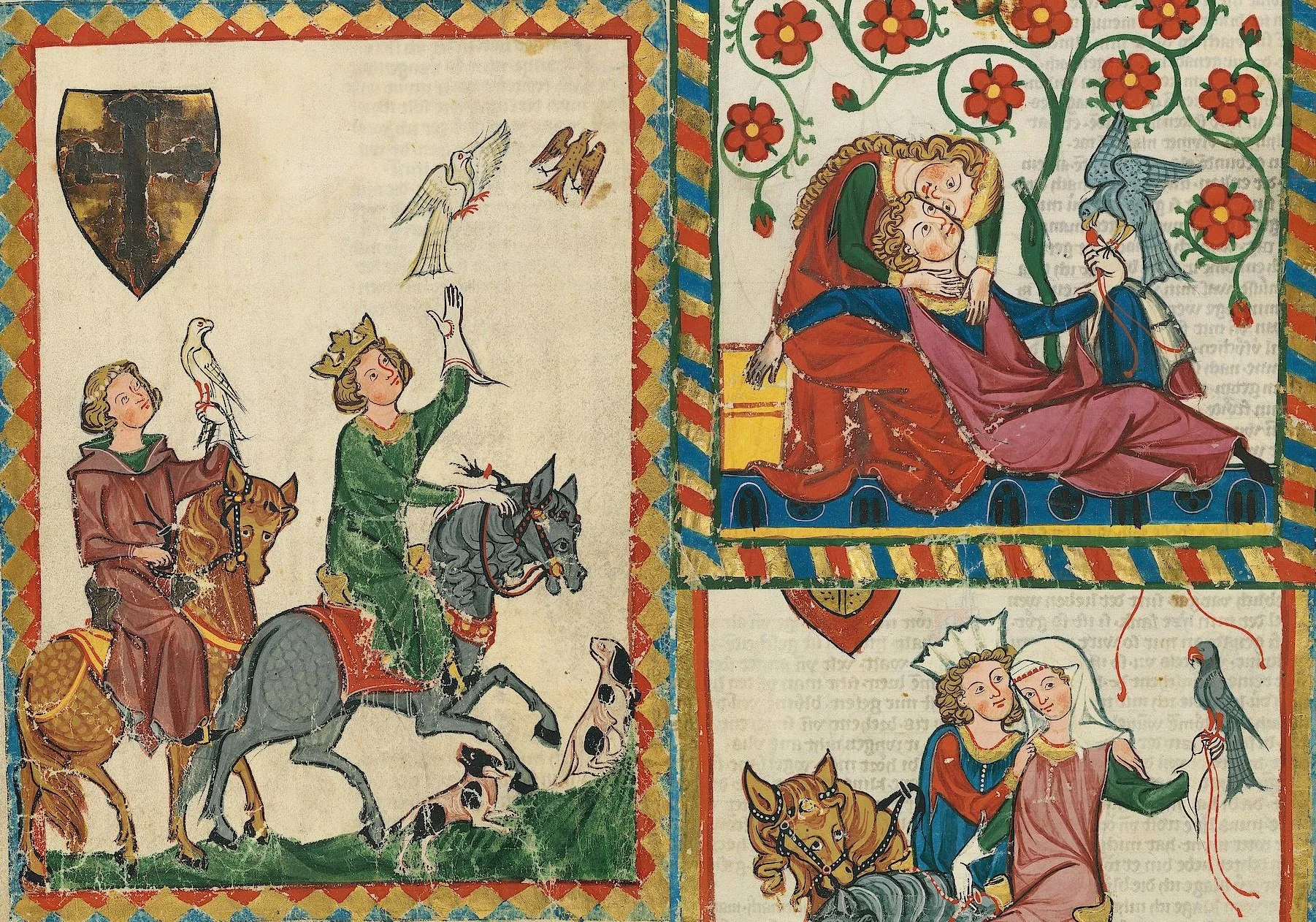
Falconry in the Codex Manesse
Last night I took Catherine Hanley’s recent book about Philip Augustus and the Plantagenets Nemesis: Medieval England’s Greatest Enemy down from the shelf for (possibly) my next read. While leafing through it again, I paused over the epigraph Hanley chose, a passage from Gerald of Wales:
A certain monk, lying in his bed, was thinking a great deal about the sons of King Henry, three such outstanding knights and the fourth and younger likewise, and how there was no ruler on earth who enjoyed such offspring, and what would be their future. Eventually he slept, and it seemed to him that he saw on the bank of the river four birds sitting, namely males of the ducks who the common people call mallards. And although those birds are by nature very beautiful, a voice said to him: ‘Do you see those birds? They are the sons of King Henry, whom you were thinking about. And do you want to see their future? Look up for a moment.’
When he did this, he saw the bird called the falcon above in the sky flying on swift wings, and immediately those four birds, one after the other, suddenly submerged themselves in the water of the river as if in fear of that bird, and afterwards appeared no more. And at once the voice added: ‘Do you wish to know who is that bird flying overhead? Assuredly, it is Philip, son of the king of France.’
Dreams are, of course, a constant in my life and a preoccupation of mine, so I found this an interesting choice to open the book. The nature of the dream also struck me. Likely thanks to Donald and Daffy ducks don’t seem portentous animals to us, but they feature quite dramatically as prey here. A further curiosity: in modern stories dreams are often left uninterpreted for maximum mystery and foreboding. Here the dreamer gets an interpretation before he’s even woken up.
Compare the Nibelungenlied, stanzas 13-14 in the opening “Adventure” or canto, which works as a kind of prologue introducing the beautiful Krimhild and foreshadowing her tragic life, here translated by Burton Raffel:
Living surrounded by splendor Krimhild dreamed a dream:
she had trained a falcon, glorious, strong-winged, fierce, and wild,
and a pair of eagles tore it apart in front of her eyes.
No pain, no sorrow in all the world could be worse than what she’d seen.
She went to Lady Otta and told her mother the dream.
Otta could only find a single truthful meaning:
“The falcon you train must be some noble heroic man,
but if God will not protect him, you will be sure to lose him soon.”
Here you get raptor-on-raptor violence and again, even if it is not in-dream like Gerald’s story, an immediate interpretation.
An interesting parallel, and I’m sure I know at least one other dream about birds that I can’t recall now (likely in Dante). Their largely vanished cultural significance—falconry being a favorite pastime for medieval nobility—also strikes me. Birds as both predator and prey crop up in medieval poetry a lot, but I can’t think of the last time I had a dream about birds.