Machine Man and the danger of AI
/Max Barry is an Australian sci-fi novelist. My friend JP Burten introduced me to Barry during college when he recommended Jennifer Government, Barry’s satirical near-future comedy in which the world is governed (more or less) by big businesses. I fondly remember reading Barry’s followup, Company, another satire in which an office drone discovers that the company he works for produces nothing—it’s a lab for the publisher of business management books to field-test new techniques. I still think about some of the scenarios Barry came up with for that one.
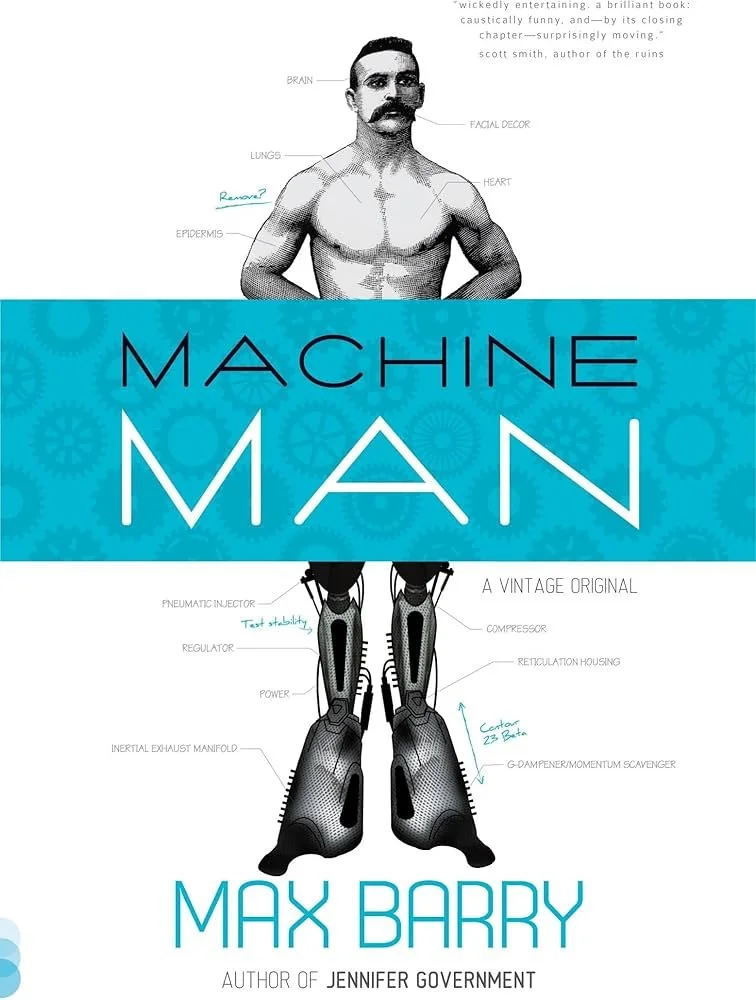
But the novel that both amused and moved me is Barry’s 2011 Machine Man. The following is a more detailed version of an appeal I made to some of my online students earlier this summer.
Machine Man concerns Charles Neumann, a scientist developing advanced cybernetic prosthetics. One day he loses a leg in a lab accident and, after recovering, builds himself a sophisticated robotic leg. The leg proves so good and, Charles thinks, so superior to his biological leg that he voluntarily amputates the other and replaces it with an identical model.
This begins a cycle of Charles replacing his organic body parts with seemingly more powerful, efficient mechanical ones, tinkering and tweaking as he goes. His physical therapist and love interest, Lola Shanks, looks on in mounting apprehension. In Charles’s final “improvement,” he dispenses with his physical body entirely and ends the novel as a small black box with an output screen for text. LOLA I MISS YOU, he says through the text output. But of course he has sacrificed the gift of embodiment—everything he needs even to touch Lola.
Barry wrote Machine Man when the transhumanist movement, which, in most forms, sought to “improve” humanity by shedding the limited, physical, and human, had temporarily peaked. This is a comedy and Barry has some thematic fun with the names: Charles (from Karl, “man”) Neumann (German: “new man”) and Lola Shanks (an archaic word for “legs”). There is also some corporate satire that I probably scoffed at at the time but that feels increasingly realistic, perhaps even too optimistic.
That Machine Man starts off funny makes the tragedy all the more pointed. I remember the agony of reading Charles’s voiceless LOLA I MISS YOU vividly. I’ve thought about Machine Man a lot since I read it over a decade ago, but never more often than in the last few years as more and more of the writing I grade is instantly recognizable as AI generated. The pity and horror of Charles’s descent fits just as well in the age of increasing AI dependence.
The intellect, I told my students, is one of the things that makes us human. If you’re religious, it is one of the most important parts of the Image of God from Genesis. And every time you outsource your judgment to AI instead of using it to think and learn and remember, you sacrifice part of your intellect. Inevitably, whether, as with Charles’s robotic legs, it seems easier or more powerful or you buy into the cutting-edge allure of the technology, you give up more and become dependent. Sooner or later, depending on your reasons for using AI in the first place, the dependence is so strong that you give up your intellect voluntarily, bit by bit, and replace it with a bot. By the time you realize you miss it, it may be too late.
And if you use AI to cheat, you only compound the intellectual damage you do to yourself with vice and dishonesty.
Barry’s Machine Man is an excellent and prophetic warning. I take a hard line on AI in my courses not because I’m a spoilsport or a Luddite—though I can certainly be both in other areas—but because I don’t want to see that happen to anyone. Making things easier, faster, or more efficient is not always an improvement, and certainly not with the things that make us human, our bodies and minds.