A Lodge in the Wilderness
/
Last week I reviewed a unique entry in John Buchan’s bibliography—the only children’s book he published in his lifetime. This week John Buchan June continues with another unique item, this one more a curiosity than anything: part novel, part philosophical dialogue, part political treatise, the 1906 book A Lodge in the Wilderness.
The book first introduces us to eccentric multi-millionaire Francis Carey, who after making his fortune in various business and government concerns throughout the British Empire, has established himself in a lavish country house in Kenya called Musuru. Every summer Carey invites eighteen people—nine men and nine women—to join him at Musuru for dinners, hunting, and intellectual conversation about the pressing issues of the day. A Lodge in the Wilderness is an account of one of these events.
Buchan briefly describes all eighteen of Carey’s guests, including a Conservative lord, a big game hunter, an ex-soldier with long experience of the Empire, a journalist, a Jewish financier, and a representative of the intelligence service. The female characters are mostly the wives of influential men but show themselves politically well-connected and informed and, as both Buchan biographers Andrew Lownie and Ursula Buchan point out, their contributions to Carey’s conversations are taken seriously. Nevertheless, most of the characters are ciphers and, after a chapter or two, become hard to distinguish. They are, as Lownie puts it, “merely mouthpieces for the book’s ideas.”
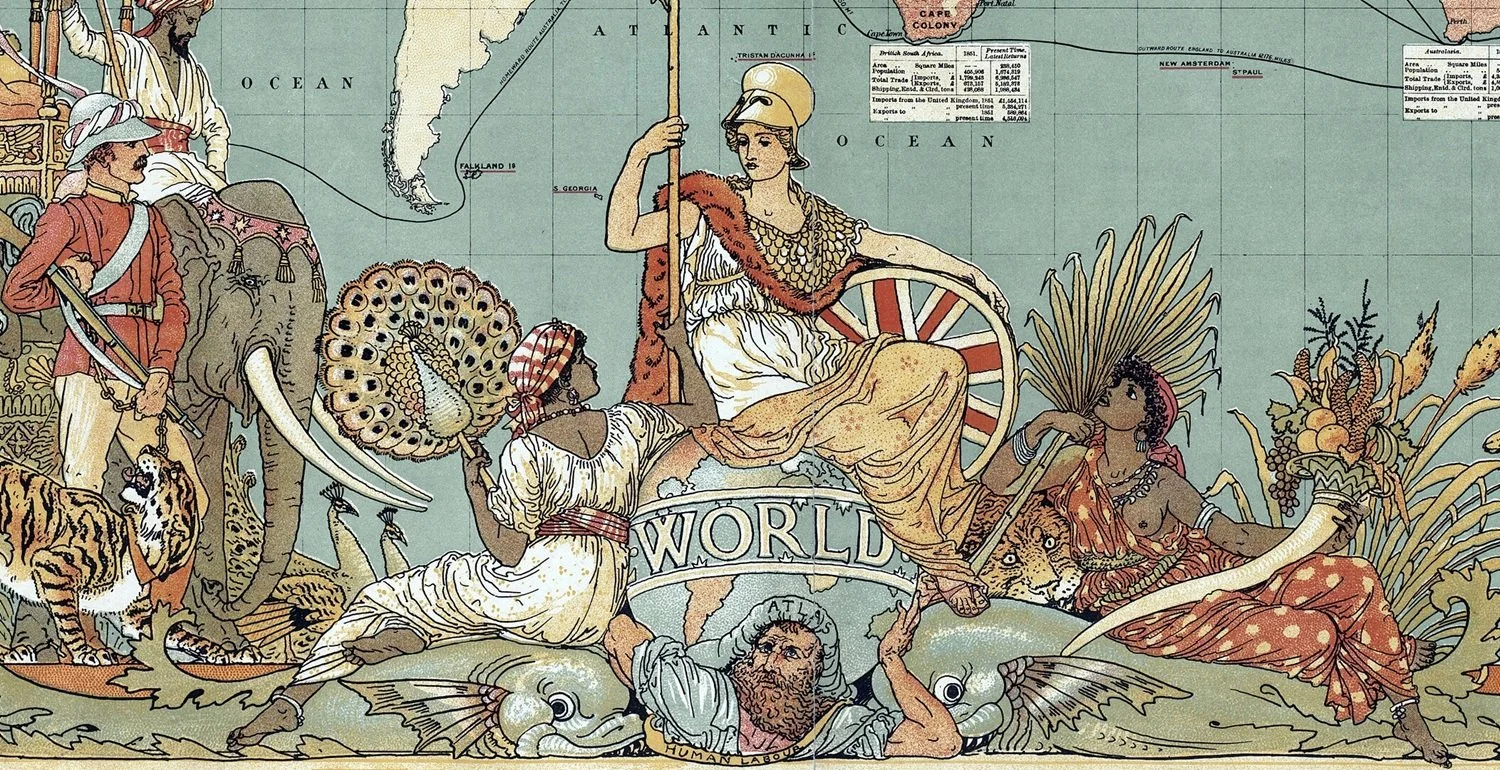
The two that give the story personality are Hugh Somerville and Lady Flora Brune, apparently based on Buchan himself and Susie Grosvenor, whom he would marry a year after the book’s publication. Hugh and Lady Flora become friends and the first hints of a romance kindle between the two, and their flirtations and conversations, which serve as interstitial episodes between the long dinner-time discussions, provide the most story A Lodge in the Wilderness has to offer.
Over the course of a month or so, Carey treats his guests to lion hunts, tours of his beautiful and seemingly endless mountainside gardens, field trips to missions and other colonial points of interest, and many intensely academic discussions of Empire.
And that’s about all there is to it. Though A Lodge in the Wilderness makes concessions to the novelistic form, especially small episodes of excitement like Hugh’s near-miss during the lion hunt, nothing resolves. I was prepared for this in the philosophical dimension of the book—which can only raise questions and suggest ways forward, and to which I’ll return shortly—but it was disappointing that, having developed Hugh and Lady Flora’s young romance so successfully, they do not get any kind of last-chapter send-off suggesting what will become of their relationship. A rare loose end for Buchan.
This is a reminder that the entire purpose of the book is philosophical and political. Written in Buchan’s early thirties after his return from the Transvaal in South Africa, where he had served as private secretary to colonial governor Lord Milner, A Lodge in the Wilderness is a response to changing policy and cultural attitudes toward the Empire back home. Better attuned critics than I, especially those who were alive at the time, have seen in the book’s characters stand-ins for real-life political figures, not least Cecil Rhodes. Buchan’s goal in the book is to lay out and examine the problems facing the British Empire as it stood during the Edwardian period, charitably work through opposing ideas, and suggest an ideal to strive toward—an ideal both of form and function.
Among the topics of discussion are the political basis of the Empire, its potential future structure and the role subject peoples will play democratically, and even—perhaps most interestingly—the aesthetic effects of imperialism on British culture. All of this is examined in excruciating detail. I wrote above that A Lodge in the Wilderness is “part philosophical dialogue,” and Hugh even reads Plato in the garden at one point, but there is really very little back-and-forth at dinner. The characters mostly make speeches, sometimes reading long poems or newspaper articles aloud to the whole party, with occasional pushback from someone else and an eventual attempt at synthesis. (Hegel is invoked more than once, an infallible sign one is in danger of being bored.)
Buchan seems to have known that not everyone would enjoy this. Halfway through, Lady Flora tells Hugh, “I do so wish . . . that they wouldn't all talk in paragraphs.” One sympathizes, as well as appreciating the self-aware laugh.
Some recent readers, to judge by reviews on sites like Goodreads, take some of the characters’ viewpoints as Buchan’s own and object to what they see as promotion of eugenics or a lust for conquest. Buchan, charitable to a fault, allows his characters to have opinions he disagreed with in order to offer a better alternative. His own views are sometimes difficult to parse but a number of important points show through clearly.
The view of the Empire that Buchan presents is benevolent and idealistic but hard to understand in the specifics. Negatively, he explicitly rules out conquest for its own sake, the equation of largeness and territorial size with goodness, the suppression and subordination of subject peoples, and the exploitation of the Empire for profit. Violence in an empire is inevitable but not to be sought out, enjoyed, or glorified. He also makes it clear that any backwardness or primitivism among non-European peoples is due not to race but to culture and opportunity, and he cautions against both denigrating native peoples and exaggerating their primitiveness as unspoiled goodness. He is neither jingo nor Social Darwinist.
What Buchan envisions instead is an ennobling enterprise that will make high moral, spiritual, and even physical demands of the imperialists, who will set an example for the complacent bourgeoisie at home. (Buchan’s critique of the middle class as apathetic and compromised is surprisingly sharp.) The purpose of the Empire is the spread of improvement—technologically, economically, and morally—and the eventual advancement and participation of all the peoples within its reach.
This view is essentially globalist, undergirded by a whiggish view of history. What sets Britain’s apart from other imperial projects, he suggests, is its long accidental development of the rule of law and the importance accorded to liberty. Having come into world power without plan or direction, the Empire is Britain’s opportunity deliberately to spread the good of liberty through order. In a phrase of Chesterton’s—who, no imperialist, would probably disapprove of me using it—the Empire at its best would “make room for good things to run wild.”
All of this should suggest to you that A Lodge in the Wilderness is now almost entirely of historical significance. It’s the only Buchan book I’ve read that I’d call a slog. (It doesn’t help that the cheap paperback I read has numerous text-recognition errors and formatting problems. If you do check this book out, avoid the edition whose cover I used above.) A Lodge in the Wilderness is informative as the dream of empire held by one principled, hopeful, well-intentioned man, and interesting as a strange outlier among Buchan’s fiction, but it is unsatisfying as a novel and will be unrewarding for the casual reader. I’m glad I read it but I very much doubt that I will ever revisit it.