The pods bursting in air
/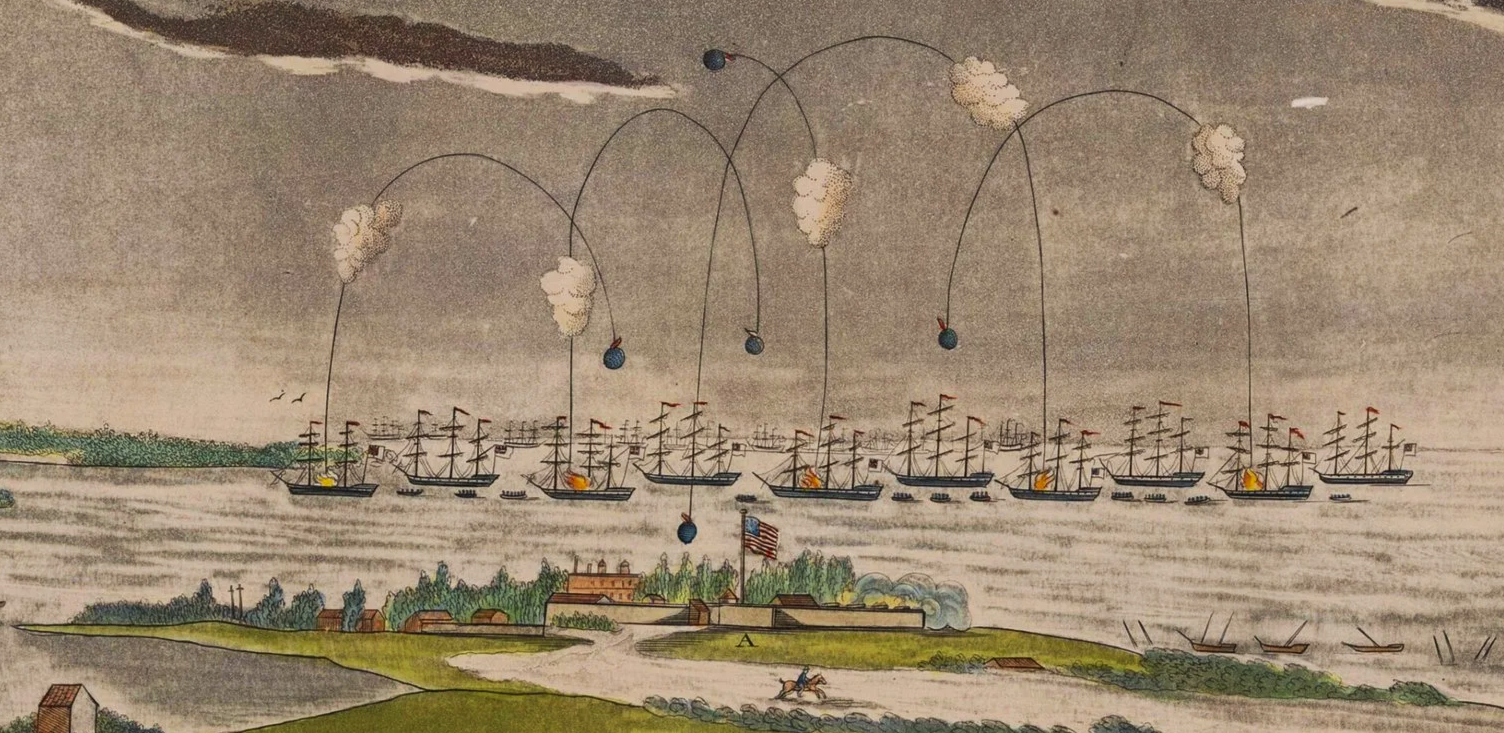
Detail of A View of the Bombardment of Fort McHenry by John BOwer
I was returning from vacation when they dropped, but I’ve enjoyed catching up on The Rest is History’s series on national anthems so far. The episode on the “Deutschlandlied” was especially good, and though I enjoyed Holland and Sandbrook’s discussion of “The Star-Spangled Banner,” I do have two notes I have to get out of my system. (I almost titled this post “Key notes.”)
For context, they do a good job with the poem’s origin as an account of the unsuccessful British naval bombardment of Fort McHenry during the War of 1812. Eyewitness Francis Scott Key’s poem was published as a broadside ballad under the title “The Defence of Fort McHenry,” a title that might helpfully clue modern singers in to what’s going on in Key’s contorted verse but doesn’t catch the imagination quite like “The Star-Spangled Banner.”
Holland and Sandbrook, however, turn the bulk of the episode into yet another discussion of American slavery due to the presence, in Key’s seldom-remembered third verse, of the lines “No refuge could save the hireling and slave, / From the terror of flight, or the gloom of the grave.” This line has provoked its share of controversy (less, I’m guessing, than the words “the land of the free,” but that’s not our focus here), including the suggestion that the song “glorifies slavery.”
Sandbrook quotes a Key biographer who pointed out that the word hireling is a giveaway—the phrase “hireling and slave” refers to paid soldiers and mercenaries in the service of a tyrant. This is pretty obvious to anyone who knows the period and the importance of the citizen-soldier image to a newborn republic. In parsing the intent of the poet himself, Sandbrook notes that Key, a Marylander, was a slaveowner but also represented slaves in suits for freedom but also opposed abolitionism and also that the invading British in 1812 fielded a regiment of runaway slaves that Key may have been aware of. So he and Holland conclude that the contested line probably has at least some tangential but problematic connection to slavery-slavery, not simply the metaphorical slavery of British soldiers.
One thing neither host does is quote the entire third stanza:
And where is that band who so vauntingly swore
That the havoc of war and the battle’s confusion,
A home and a country should leave us no more?
Their blood has washed out their foul footsteps pollution.
No refuge could save the hireling and slave,
From the terror of flight, or the gloom of the grave,
[Refrain]
This is clarifying. Read in its entirety, Key’s poem is a narrative, albeit a convoluted one. Where the first two stanzas narrate the worry and aftermath of the unsuccessful bombardment, the third sees the British in retreat and their unwanted presence expunged. Every line supports this reading. The fourth, which is the only other stanza the average person might know, wraps up the story with a reflection and peroration.
Sandbrook and Holland concede entirely too much to the argument that the third stanza is about literal slavery, for what I think are two reasons:
First, they seriously underrate not only the importance of the citizen-soldier image to Americans but also the contempt with which paid soldiers were held at the time and the suspicion of Americans toward professional armies. Remember that people haven’t always admired soldiers. Read the Anti-Federalists and their hostility toward a paid standing army in the employ of the President stands out as one of their most important objections to the Constitution. And the myth of Hessians as bloodthirsty warriors-for-hire, a myth important enough and provocative enough to be explicitly invoked in the Declaration of Independence, persists to this day. That aspect of the Revolution is still taught with a whiff of disdain for people who would hire themselves out as mercenaries, a disdain that survives in popular culture (as in The Crossing, a mostly good TV movie about Washington at Trenton).
Second, the excessive focus on Key’s personal and political opposition to abolitionism in the second half of the episode leads Holland and Sandbrook into the trap of assuming—or at least talking as if—only two positions were available on the issue: support for slavery and abolitionism. This is hard to keep in mind and even harder to get students to understand, but especially in the early decades of the 19th century, before the fringe positions of radical, John Brown-style abolitionism and James Henry Hammond-style support for slavery came to dominate the debate, there were lots of intermediate, moderate positions. Many of the Founders favored gradualist plans of slow emancipation, as did figures from Key’s generation like Henry Clay—also a slaveowner—and Key supported the colonization movement, which Sandbrook mentions but pooh-poohs. That’s a mistake. Colonization enjoyed widespread favor despite proving unworkable and being written out of the story by the radical abolitionists valorized in the present. Key’s opposition to abolitionists was opposition to extremism and public disorder, not the end of slavery itself.
Again, a good and mostly enjoyable episode, but skewed in its coverage by a couple crucial points where Holland and Sandbrook’s usual nuance is missing. Perhaps, per Alan Jacobs, another anti-American blindspot? Or is it just that Brits will necessarily have to work harder to get into the would-be Roman republican mindset of this era?