Tron: Ares

Scientists at Disney generate a sequel to Tron and Tron: Legacy

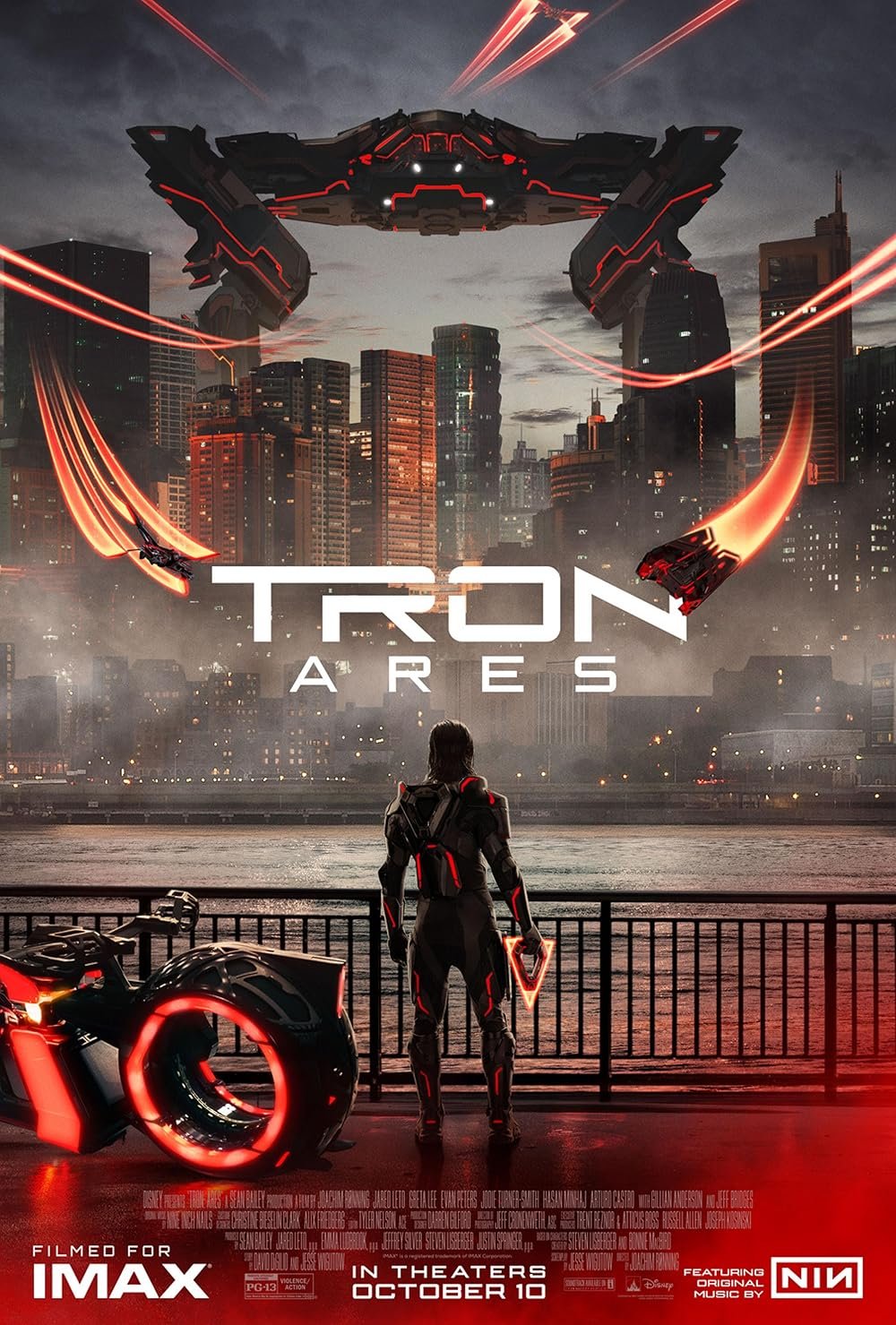
I was one of the handful of people who saw Tron: Ares in theatres last fall. I love and enjoy Tron: Legacy beyond its merits and have shared it with my kids, who revere it, and if Tron: Ares had turned out to be good I planned to take them. I never did—not because it wasn’t good but because it was neither good nor bad enough for me to make up my mind about. I decided to give it another look at home when it came out on Blu-ray. That finally happened this month.

The plot, in brief: Tron: Legacy ended with the escape of a purely digital person into flesh-and-blood reality, and the new film’s very loose connection to that one is in the vast potential latent in the ability to transfer digital assets to reality. Kevin and Sam Flynn’s old company Encom is trying to develop this power to solve all the problems in the world. Old Encom rival Dillinger Systems wants to 3D-print weapons, vehicles, and expendable soldiers to sell to the military. Both are headed by Wunderkind CEOS: Encom by Eve Kim, who struggles to keep her idealistic sister’s dream of ending scarcity alive, and Dillinger by the ruthless Julian Dillinger, under the watchful but impotent eye of his mother Elisabeth.

Into this computer arms race steps the Ares of the title. Ares is a combat program created by Dillinger and trained on countless cycles of simulated combat, death, and regeneration. Dillinger shows him off to investors as the crowning achievement of his project. The problem is that Ares—and everything else generated from the system—only lasts twenty-nine minutes in the real world before disintegrating. This fact drives both Kim and Dillinger’s pursuit of “the permanence code.”

Through a little friendly corporate espionage, including the use of Ares to penetrate and exploit Encom’s servers in search of the code, Dillinger learns that Kim may have recovered it from old files hidden away by her sister. From this point forward it’s a race for Kim to bring the code safely back to Encom, for Dillinger to stop her and take it—through increasingly desperate means—and for Ares, who has begun questioning his programming, to decide what action to take.

Tron: Ares has a number of weaknesses, the chief of which is that the villain is much, much more interesting than either of the heroes. Eve Kim and friends are annoying do-gooders whom the screenwriters have worked too hard to make plucky and likeable, and Ares, as played by Jared Leto, is too convincingly robotic. Evan Peters’s Julian Dillinger, on the other hand, shows cunning and intelligence from his first scene and an amoral pragmatism barely restrained by the influence of his mother, played with chilly and ambiguous control by Gillian Anderson. The moment Julian has an opportunity to take decisive but irreversible action against his greatest rival, he struggles, but only so much. His lifetime of seizing every opportunity that will benefit himself has led to this, and even though he knows it’s wrong and we know that he’ll choose it, we see and feel the weight of the temptation crush him. Peters is likely the best thing in the movie.

This imbalance affects the entire film. It may be a cliche to point out how bad Jared Leto is since everyone online has been dogpiling him for months, but some cliches become cliches because they’re true. (My kids also insist I point out that he has weird hair. In a more artistic vein, my daughter noted that Ares, as a character, is more interesting in the first few minutes when he wears a mask. The moment Jared Leto’s vapid face is revealed, the mystery dissipates. A sharp observation, I’m proud to say.)

That said, the plot, which is simple but effective despite the banality of the movie’s heroes and escalates nicely heading into the final act, the production design and look of the film, the music, the special effects, and the action scenes make up for a lot. Despite the complexity of some of what the movie is offering, it’s intuitively presented—my kids had no trouble following it. I’ve seen director Joachim Rønning take some flak for Tron: Ares as an unimaginative hired gun, but I think the visual storytelling and style of the film serve the story well. I don’t find Nine Inch Nails’ electronic score as enjoyable by itself as I still do Daft Punk’s incredible Tron: Legacy score, but it works well within the movie.

No one should go into a Tron movie looking for deep ideas. As much as I love Tron: Legacy, its Kevin Flynn is given to some silly opining about how much his video game world will challenge the foundational thought of all of civilization. Spoken like a true techbro. Kim and Dillinger, at least, are less prone to philosophizing. (There is an irony in how this movie asks us to root for the good AI overlords against the bad ones; I found myself wishing both could fail. A touch of tonedeafness on the part of the producers.)

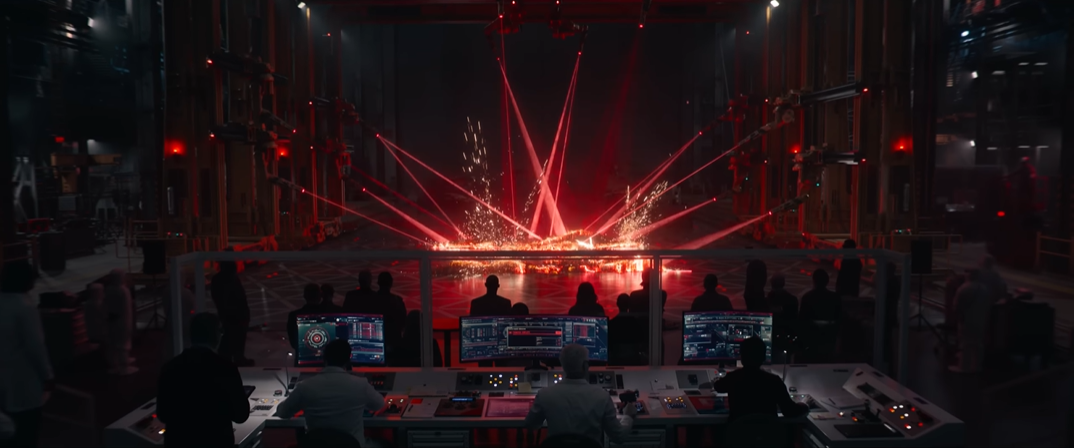
But Tron: Legacy and now Tron: Ares do deliver some great action. My kids found the buildup to the climactic sequence, in which Dillinger, having lost control of his own programs, sees his facility print and dispatch lethal weapons tech into the city in pursuit of Kim and Ares, unbearably suspenseful. It’s well-set up and well-executed, and the Terminator-like indestructabilty of Dillinger’s chief henchman posed an intense added threat.

Tron: Ares does not measure up to Tron: Legacy, but it tries to develop one small element of the latter in interesting ways and has satisfying, enjoyable Tron-flavored action. One can’t help but wonder how much better it might have been with a few tweaks, including someone in the title role with more visible depth than Jared Leto (which wouldn’t have happened, as he produced the movie). Having waited several months to rewatch it with my kids, I found myself liking it much more the second time around, not least since they responded so strongly to it.

Impressing kids is not everything, but it’s not nothing, and—following on from The Fantastic Four: First Steps—I’m pleased to have shared it with them. If there are more flawed but enjoyable and workmanlike adventures out there, we’ll take them.

Three items on learning by doing

Item: This morning Alan Jacobs shared a short post on Allan Dwan, who happened into the director’s chair by accident in 1911 and directed his last film in 1961. Along the way he gave Lon Chaney his break, discovered Carole Lombard, and—like many such early filmmakers—innovated both artistically and technically, those two aspects being deeply intertwined in filmmaking. Jacobs:

It’s fascinating to see how this industry—this art form—developed when nobody knew how to make movies. Dwan himself was the first to figure out that you could dolly a camera backwards, putting it on rails or a truck and backing up. (This actually disoriented viewers at the time, made them feel woozy). He helped D.W. Griffith figure out how to do a crane shot for Intolerance. All such techniques had to be improvised—and when an improvisation worked it became an invention. You basically had to think like an engineer, and Dwan was an engineer.

Item: Also this morning, Ted Gioia shared an essay on children and music lessons with a special focus on why so many kids quit not only the lessons but the instrument. In his own experiences with lessons, despite hating and quitting his piano them he kept playing on his own. Then:

I made up my own songs. I learned other songs I liked by ear. I actually played the instrument more after those awful lessons had been terminated. . . .

So I developed without jazz teachers, both as a musician and as a music historian. There’s some irony in that. I had access to amazing professors at illustrious universities, but jazz wasn’t part of the curriculum. In the field in which I made my reputation, I had to teach myself.

I’m not especially proud of that. Too much of what I’ve done in life has happened outside official channels. I’ve missed things by not accessing the right teachers at the right time. Things I did learn, I might have learned faster with proper guidance.

On the other hand, you learn very deeply when forced to invent your own pedagogy. And I take some comfort in knowing that there were almost no jazz teachers for the generations that came before me. Many of the jazz pioneers learned by doing—and they turned out okay.

The improvisatory, trial-and-error quality of both stories is fascinating, and both Jacobs and Gioia more or less directly point out that learning this way takes a long time—but one learns “very deeply.” Think of one of the greats in any field—filmmaking, music, writing, painting, science, even law, politics, and war—and they will almost certainly have started at the bottom, learning the nuts and bolts. Here’s a short list of directors who started off as gofers on the crew of low-budget director Roger Corman, for example.

But when you learn by doing, once you’ve mastered your art—insofar as that is possible in any art—a funny thing happens: your expertise translates into style. Which leads me to this third and final piece:

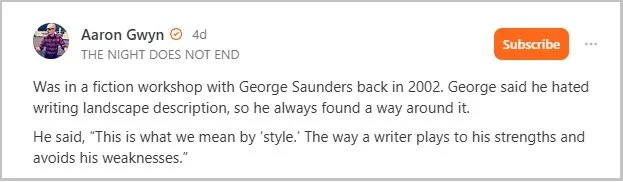
Item: Last week I saw this interesting Substack note from novelist Aaron Gwyn (whose excellent novella The Cannibal Owl I’ve just read and loved):

We all love a stylish writer, whether mannered and showy like Faulkner and Cormac McCarthy or “invisible” like Elmore Leonard. But how will a writer or artist of any kind know what his strengths and weaknesses are without doing the work?

I remember learning once, when our kids were small, that playtime dangers are not to be avoided but embraced. Climbing trees, going up slides the wrong way, jumping off of swings, doing pretty much anything on a trampoline—these are how children learn what their bodies are capable of. It both teaches them limits and gives them confidence in what they can do. But they have to do it.

This is what I hate most about AI “writing”: by offering finished products without the process, it robs writers of all kinds—whether novelists, students, or office drones drafting e-mails—of the work. It tricks people into thinking they’re able-bodied adults while bypassing the whole childhood playground experience. It’s not only instrumental and pragmatic, it weakens the person who uses it without their even realizing it. But perhaps worst of all, the work, the nuts and bolts, is not only how you master the craft and art of writing, it’s one of the most fun parts of it.

Perhaps more thoughts on that later. But for now, read all the items above and note especially the importance of play and enjoyment in Gioia’s post on music lessons, and consider how AI advocates consistently portray writing—or whatever the process in question—as time-wasting drudgery. Someone is lying.