Numbers come from somewhere

Yesterday on Substack, a young Orthodox Substacker whose work I usually appreciate, feeling perhaps a bit too eager to pause over and reconsider what felt like an epiphany, shared the following:

Caesar was declared divine for killing a million Gauls and enslaving a million more. In the pagan world, Hitler would have been numbered among the gods.

There are a lot of factual problems (not least that this is not why Caesar was divinized) and dubious assumptions built into this note, which is framed as an even more dubious hypothetical (“would have”) anyway, and it was handled pretty thoroughly by responses like this one.

But what proved unexpectedly helpful to me was its use of the one million figure. I’ve seen this statistic repeated over and over again by people trying to paint Caesar as a war criminal—a category that would have been nonsensical in the ancient world—or guilty of genocide, which is itself a loaded and dubious term. I’ve idly wondered where they’re getting this number, statistics from the ancient world being so totally, notoriously unreliable. This time I decided to look into it.

The claim that Caesar “kill[ed] a million Gauls and enslav[ed] a million more” ultimately comes from three passages in sources that post-date Caesar by a generation or more. Here are all three relevant portions in approximate chronological order:

  • Valleius Paterculus (19 BC-AD 31), Roman History, II, 47: “During this period, including the years which immediately followed and those of which mention has already been made, more than four hundred thousand of the enemy were slain by Gaius Caesar and a greater number were taken prisoners.”

  • Pliny the Elder (c. AD 23-79), Natural History, VII, 25: “In addition, too, to the victories gained by him in the civil wars, one million one hundred and ninety-two thousand men were slain by him in his battles. For my own part, however, I am not going to set it down as a subject for high renown, what was really an outrage committed upon mankind, even though he may have been acting under the strong influence of necessity; and, indeed, he himself confesses as much, in his omission to state the number of persons who perished by the sword in the civil wars.”

  • Plutarch (c. AD 50-c. 120), Parallel Lives: Caesar, 15: “For although it was not full ten years that he waged war in Gaul, he took by storm more than eight hundred cities, subdued three hundred nations, and fought pitched battles at different times with three million men, of whom he slew one million in hand to hand fighting and took as many more prisoners.”

That’s it. Whatever sources these historians used, if any, are long since lost. Of these, the closest to Caesar’s own lifetime gives by far the lowest casualty figure. All of them are approximations, a point made especially clear when they write about prisoners.

I ran these sources down thanks to the bibliography in Adrian Goldsworthy’s Caesar: Life of a Colossus. After summarizing the statistics we get from the three sources above, Goldsworthy notes that:

It is hard to know the basis for any of these numbers. The figures given for enemy casualties in the Commentaries on the Gallic War do not add up to such a great total, while Caesar’s account of the Civil War often did not mention such things. It is questionable that numbers for losses amongst the Gaulish tribes were known with precision, although it may just have been possible to calculate from records the number of prisoners taken and sold into slavery. Probably these numbers are exaggerated, but still give some indication of the appalling human cost of Caesar’s victories.

Goldsworthy is a careful scholar and an expert military historian—an area often lacking in other classicists—and his Caesar is the book on this subject, as far as I’m concerned. His caution in accepting the one-million figure is warranted and well-explained.

There are other surviving figures that can indicate something of the devastation of the Gallic Wars; Goldsworthy notes in the same passage that the total tax Caesar levied on his entire province in 50 BC was lower than the funds required for a forum he built. But is that because of devastation or disparities in property values and population density? With factors like these unknown, the surviving numbers can only suggest. Absent our sources’ sources, we can only speculate about demographics and statistics, and even that speculation must be based on what the sources do tell us, however little we choose to trust them. (Here is a very skeptical take on the numbers in Caesar’s Commentaries specifically that should give you some sense of the scope of the problem; it’s not just about battle casualties.)

The obvious point of comparison—the one invoked by our Substacker in the first place—is the death toll of the Holocaust. Certain kinds of skeptics operating under ulterior motives will question the standard figure of six million Jews, but for the Holocaust we have mountains of data available—prewar and postwar population figures, logistical documentation, military and industrial reports, and the Nazis’ own plans and records. (Read Nikolaus Wachsmann’s excellent KL for a deep dive.) For Caesar’s Gaulish victims we have this handful of sources.

One might call ancient historians’ stats and figures “vibes-based.” But lest we feel too proud of ourselves, that’s essentially what that Substacker was doing, too. That note was designed as a zinger, not to provide an accurate picture of history. Which is too bad, because the Christianity-shaped chasm separating even secular modern ethics from Caesar’s is important to acknowledge.

Numbers come from somewhere. It is worth finding out where and, even more importantly, the limits of their usefulness—especially when they are consistently deployed as some kind of gotcha.

Learning outside one’s field and sharing enthusiasm

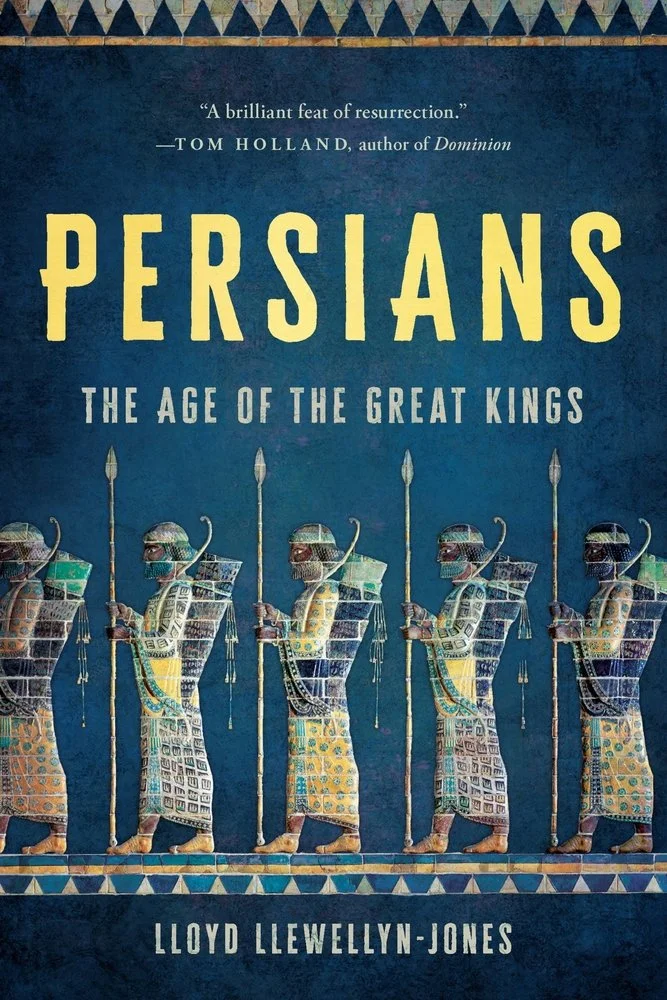
Roman historian Adrian Goldsworthy, who maintains an underrated YouTube channel that I’ve recommended on Substack before, dropped a new video this morning. It’s a conversation with historian Lloyd Llewellyn-Jones, whose book Persians: The Age of the Great Kings has been sitting high on my to-read stack for a while.

The conversation is informative and, since Goldsworthy and Llewellyn-Jones know each other from way back, a lot of fun, but Goldsworthy’s introductory remarks have some especially good insights. Noting that Persian history lies well outside the usual area covered by his channel, Goldsworthy notes

It’s slightly different from a lot of the stuff we tend to talk about and a lot of my own interest, but it’s complimentary, and the more you learn about different periods of history and how we try to understand them the greater the benefit for whatever your own focus is. It helps you to have that perspective of—sometimes it inspires you to ask slightly different questions to a topic that otherwise has become very familiar. It might suggest different approaches, different ways of using the evidence, or different types of evidence.

The same way a reader might alternate—as I do—a diet of spy thrillers with the occasional sci-fi novel or a string of mysteries with a western, it’s both refreshing and helpful for a historian to read outside his own field for precisely the reasons Goldsworthy lays out. It can give you new eyes, or at least clear the intellectual cobwebs away. Indeed, as Llewellyn-Jones discusses in the course of their conversation, his own approach to the classical past began with a theatre background and changed as he encountered and investigated new topics—Penelope’s veil in the Odyssey is an intriguing one—with surprising connections to each other.

Goldsworthy also points out the value of making history accessible to a public that always has an appetite for it:

[I]f you can’t share that enthusiasm, share the excitement, and share some of that understanding . . . you’re less than useful.

It’s all very well studying the past, coming to understand things, but if you can’t share that enthusiasm, share the excitement, and share some of that understanding—I think the awareness that this is fascinating, lots of people would be interested in this, it tells us important things about ourselves as human beings, it helps us to understand the world better, but unless you can actually communicate that, you’re less than useful.

He notes that courses on ancient history are popular with students and have no problem with enrollment. Such courses, however, are unpopular with the powers that be for non-academic reasons.

I could point out the same thing about military history (which is where my background overlaps with Goldsworthy’s somewhat). I’ve twice proposed development of an American Military History course that is listed as a possibility in the South Carolina Technical College System, each time making it to the curriculum committee stage before being shot down. I have no doubt it would be a popular class, not only because the well-known general interest in military history but also because some of our transfer students go to schools like Clemson with well-established ROTC programs. Maybe the third time is the charm.

Another significant topic of their conversation is the danger posed to Llewellyn-Jones’s program at Cardiff University. I’ll leave it at that but will note that it’s fun to hear some seasoned historians talk smack about administrators.

I haven’t quite finished the entire video but it’s been a pleasant and interesting discussion so far. I strongly recommend it. I’m hoping to pick up a copy of Goldsworthy’s latest, Athens and Sparta: The Rivalry that Shaped Ancient Greece, for my birthday next week and I mean to start Llewellyn-Jones’s Persians soon. Give their conversation a listen or a watch.

Hill 112

Men of the 8th Rifle Brigade in Normandy, June 29, 1944

In a passage from The Everlasting Man that I’ve referenced and quoted here many times, even way back at the very beginning of this blog, GK Chesterton argues that what fiction can evoke better than history is the feeling of living through an event. When historians neglect subjective experience—“the inside of history,” what it was like to live there and then and see those things—then “fiction will be truer than fact. There will be more reality in a novel; yes, even in a historical novel.”

But the historians and the novelists need not oppose one another. What was it like? has been one of my animating questions since I was a child, a question at the forefront of my mind as both an historian and a novelist. Combined correctly, the craft of the historian and the art of the novelist can, as Chesterton suggests, give the reader a powerfully truthful feel for the past. And I haven’t seen that done better recently than in Hill 112, the latest novel from the great historian of Ancient Rome and novelist Adrian Goldsworthy.

Hill 112 tells the story of three school friends serving in the British Army during the Second World War. Mark Crawford is a fresh new lieutenant in the infantry. Bill Judd, a working class contrarian, is a private and machine gunner in the same battalion is Mark. And James Taylor is a lieutenant in an armored reconnaissance unit with four Sherman tanks under his command.

When the novel begins on June 6, 1944, D-Day of Operation Overlord, James and his unit are waiting to go ashore on Gold Beach and Mark and Judd are encamped back in England, keeping up a mind-numbing regimen of training meant to prepare them to deploy to Normandy. As James and his tanks land and move into the hedgerow country in search of the Germans, Mark and Judd wait and wait, biding their time through route marches and lectures on venereal disease and handling personal drama. They are in love with the same girl, who doesn’t seem to have time for either of them, and they discover a terrible homefront secret when Evans, a young Welsh private, is caught deserting with Mark’s pistol.

Meanwhile, after a few days of traffic and confusion James’s unit meets the enemy. His first encounters with the Germans are surprising, exhilarating, and harrowing, and while he escapes these with his life, he has to replace both his tank and members of his crew. And not for the last time. After a few weeks of James’s motoring through the countryside—down narrow hedge-lined lanes, through the tight medieval streets of tiny villages, and across open fields of chest-high green wheat that German anti-tank shells part like the sea as they blast toward his tank—Mark and Judd’s unit takes ship for Normandy. Soon, both they in their infantry battalion and James in his tank squadron are fighting at the center of horrendous bloodletting in the battle for a piece of high ground just south of Caen: Hill 112.

In this novel, Goldsworthy does one of my favorite things in historical fiction: simply dropping the readers into a situation in medias res and inviting us to watch. It works brilliantly. The main action plays out over about about five weeks, from D-Day to July 11 (D+35). It begins immediately, as James waits to drive his Sherman ashore, and its forward momentum never lets up. Even the quiet moments of reflection, as when James thinks back on his recent engagement to the girlishly romantic Penny, who has given him a surprising good luck charm, or when Judd remembers his dalliance with leftwing politics, or when Mark broods over a terrible accident that occurs during his first assault, carry us onward into the hard work of the campaign. There is always more to do. Even the novel’s ending powerfully brings this home.

That feeling of neverending work is, after all, a crucial part of the experience of war. All three men come, at some point, to feel as though nothing else exists outside the war. For James especially, thinking ahead to “after the war,” when he and Penny will marry, begins to feel hopeless.

But the work is also dangerous, and Goldsworthy realistically captures the continuous danger of the war. Even on a mission to seek out and destroy the enemy, combat begins and ends suddenly and never goes according to plan. Men die not only of grisly wounds in combat—shot by rifle, pistol, or machine gun; shredded by shrapnel; burned up by incendiary grenades, blown apart by mines; decapitated or cut in half by artillery or killed outright by the concussion of an explosion—but unexpectedly and by accident. One of the lead reconnaissance tanks in James’s unit rolls over into an underwater crater immediately after landing on Gold Beach, and friendly fire happens on multiple occasions. The attrition and turnover in each unit is realistic and punishing. By the end, the three protagonists—and by extension we, the readers—are surrounded by new guys whose names they can’t even remember.

This is not to say that Hill 112 is a continuously grim slog. The darkness, as in real life, is lightened here and there with banter and gallows humor. James’s crew, with its mix of farmboys and Cockneys, is especially fun, and the novel’s many colorful side characters enrich the story: the fearless Captain Dorking-Jones, the Canadian Gary Cooper lookalike Buchanan, the serial deserter Reade, the veteran tanker Martin, who has two kids back home and tells James bluntly that he won’t take undue risks in combat, and O’Connor, a veteran not only of earlier theatres of the war but of Spain, who teaches Judd and his mates more practical soldiering than all their camp lecturers combined.

Goldsworthy writes in a lengthy and informative afterword that giving modern readers a sense of what it was like was one of his goals for Hill 112. He succeeded brilliantly. I’ve read many of Goldsworthy’s histories—one of my very first paid writing jobs was this review of his excellent book Pax Romana—and several of his other novels set on the Roman frontier during the reign of Trajan. I have enjoyed those novels, but Hill 112 is by far his finest fiction: immediately and continuously engaging, peopled with strong characters, exciting, horrifying, and profoundly moving. I heartily recommend it. Where were novels like this when I was a kid?