Perelandra on City of Man Podcast

Eve of Perelandra, by James Lewicki

Eve of Perelandra, by James Lewicki

A few weeks ago, my friend Coyle Neal of the City of Man Podcast hosted David Grubbs and I for a discussion of the first book of CS Lewis’s “Space Trilogy,” Out of the Silent Planet. That was a great conversation, and I finished it looking forward to talking about the second book with them. I’m happy to say our discussion of Perelandra has arrived.

Perelandra continues the story of philologist Elwin Ransom with a journey to Venus—Perelandra in the celestial tongue—where he is destined to play a role in the temptation of another Eve in another Eden. As part of our discussion, Coyle, David, and I talk about the book’s historical context, what had happened both in Lewis’s life and and the world since Out of the Silent Planet and how that shaped this book; the plot and characters; the literary influences Lewis masterfully drew upon to fashion the world of Venus and the thematic resonances and harmonies of the story, everything from Wolfram von Eschenbach’s Parzival to Dante and Milton and the anonymous poet of The Battle of Maldon; the book’s relation to others Lewis was working at the same time, like A Preface to Paradise Lost and The Screwtape Letters; the fallen Oyarsa of Thulcandra—Satan—and his pettiness, brutality, and continuous evolution from Hegel to Nietzsche to Lovecraft; the role of violence and righteous wrath in the story; and what, if anything, Lewis’s story has to teach us about the fall, temptation, sin, and redemption.

You can also learn what it is about Perelandra that reminds us of “Tiger King.”

I had a great time recording this episode—it may be the most fun I’ve had doing a podcast—and I hope y’all enjoy listening. We will finish our read-through of the Space Trilogy with That Hideous Strength soon. I’m looking forward to it.

In the meantime, you can listen to City of Man Podcast on iTunes, Stitcher, and other fine podcasting platforms, or to this particular episode of the show via the embedded Stitcher player in this post. Thanks for listening! Hope y’all enjoy.

How to Grow Old

I originally wrote and posted this review of De Senectute on Goodreads after I read it in March of 2017. I have fond memories of carrying this little book in my pocket on a trip to the Riverbanks Zoo in Columbia for my daughter’s birthday. Now, three years later, with two more children, a lot more grey on my chin, and the Riverbanks Zoo closed to prevent the spread of coronavirus, I revisited Cicero’s wonderful meditation and found it just as uplifting, enlightening, and challenging as before. I share my slightly emended original review with y’all in hopes that it will be beneficial and that some of y’all will check the book out.

 
Those who lack within themselves the means for living a blessed and happy life will find any age painful.
 

Late last year I found grey in the stubble on my chin. This year I’ve started sprouting grey hairs at my temples. Time and age catch up to us all, and for modern people—to judge by a perennially fruitful field of advertising—the discovery of grey hair, or crow’s feet, or a newly creaky joint, marks the beginning of a crisis. The same was apparently true in the ancient world, judging by the forceful arguments against bemoaning old age in Cicero’s De Senectute, loosely rendered here as How to Grow Old.

Cicero wrote On Old Age in early 44 BC, as he entered his 60s. One would imagine Cicero had more to worry about than growing old—in the twenty years since saving the Republic from the Catiline conspiracy, he had found himself marginalized and finally ousted from the Roman political scene. His friends or allies in the Civil War fell one by one as Caesar, whom he steadfastly opposed, carried all before him in the Civil War. Finally, his beloved daughter Tullia had died the year before. Cicero devoted this time to philosophical reflection, completing this book—one in a rapidly appearing series of works—just before Caesar’s assassination, which began a fresh round of strife that resulted in Cicero's murder.

Cicero set his dialogue in the illustrious past, before present troubles, which still intruded most notably in his choice of speaker: Cato the Elder, the revered great-grandfather of Cicero's sometime political ally Cato, who had disemboweled himself in Utica in 46 BC rather than be captured, forgiven, and used as a human prop for Caesar's propaganda purposes. The elder Cato had fought in the Second Punic War alongside Scipio Africanus—whose adopted grandson is one of Cato's young conversation mates in the dialogue—and lived well into his eighties. He lived on as a Roman ideal to more than just his great-grandson, and Cicero here makes him a spokesman for wise and dignified old age.

Much of Cato's advice rotates around the Stoic poles of Nature and Reason (already giving this book a significant edge over most current self-help advice on growing older). The right use of Reason, Nature’s great gift to man, brings man into alignment with Nature, and enables a life of virtue. This seemingly abstract idea helps make sense of much of the misery that the aging experience, and points to the real truth about the challenge of growing older: it all comes back to character.

344333FE-3999-44C0-AD4B-028271C39846-71883-00001EF5A6186183.jpeg

Cato tackles four major objections to aging: the denial of an active life (both physical and mental), the weakening of the body, the deprivation of sensual pleasure (especially sex), and—the big one—the ever nearing threat of death.

The answers to these objections stem from a deeply wise observation—aging well begins in youth. A once athletic man who mourns himself as dead when he loses the spryness of youth has had his priorities wrong from the beginning. A person mourning the inability to fulfill all their appetites never really knew what those appetites were for, and allowed them to master him. And people who fear death will never really be happy in any age, because death can come at any time—it is simply harder to ignore in old age. “Since death threatens us at every hour,” Cato asks, “how can anyone who is afraid of it have a steadfast soul?”

Cicero sprinkles imagery from nature (by way of Nature) liberally, particularly of the seasons. Granted that a person has lived virtuously as a youth and can approach aging properly, he will see that old age is simply another season, a season with pleasures, duties, and honors of its own. Cicero may not use these words, but a lifestyle appropriate to or befitting old age—Reason corresponding to Nature—is key. If weakness of the body is appropriate to old age, so is the wisdom of accumulated years. The fretful elderly who keep Viagra in business are, in Cicero’s mind, still mastered by an appetite appropriate to an earlier season, and create their own misery by their unwillingness to appreciate old age on its own terms.

Old age’s honors include respect and wisdom, time for simply pleasurable work (for Cato, farming and learning Greek), study, thought, and conversation, and some much-appreciated stability after the stormy passions of youth. Of course, respect is not guaranteed—one thinks of the way the elderly are shunted to the side as quickly and efficiently as possible in our world—but a life well lived is its own reward, and will result in a person calm and content in the face of death. The approach of death—which is one of the things appropriate to old age, like the fall of ripe fruit from a tree—does not rob old age of its value, but rather gives it value by focusing one’s priorities. Lust and greed should fall away (“What could be more ridiculous than for a traveler to add to his baggage at the end of a journey?”) in favor of reflection on past blessings. (I was reminded of his assertion in an old legal case that gratitude “is not only the greatest, but is also the parent of all the other virtues.”) Cato concludes his arguments with a really interesting and moving discourse on his belief in eternal life.

I wasn’t really bothered to find grey hair on my head—on the contrary, I think it’s really interesting to watch it spread—but a lot of people are, and as our culture values youth and vitality to an idolatrous extent, On Old Age is a refreshing celebration of age.

Philip Freeman’s translation of De Senectute is free and brisk and a delight to read, as I’m sure Cicero’s original (which is presented on the facing page for one to pick through and compare) is in the Latin. His short introduction offers a simple breakdown of the main benefits of aging that Cato extols in the body of the dialogue. A few pages of succinct, helpful endnotes identify people or explain allusions within the dialogue.

* * *

If you enjoyed this review, please give Philip Freeman’s wonderful translation a read, or check out the other volumes in the Ancient Wisdom for Modern Readers series from Princeton UP, including another of my favorites, Cicero’s De Amicitia or How to Be a Friend. And please check out my novella about Cicero’s death, The Last Day of Marcus Tullius Cicero. Thanks for reading!

Chesterton on fools

In honor of April Fools’ Day, here’s a quick batch of thoughts on fools and foolishness from GK Chesterton, a man who knew a thing or two about the topic—and also how to enjoy what he often called the “topsy turvy,” which is the essence of the holiday.

Alas, not everyone is a fan of April Fools’ Day. I’ve already seen warnings on social media regarding the precisely proper ways to celebrate it this year, admonitions so stern and moralistic I started checking the posters’ profile pictures for ruffs and broadcloth. I’ve also seen some deeply wise people suggesting we not fool around at all, reminding us that we have apparently evolved beyond the examples of those who survived the plague and religious persecution and the death camps and the gulag and can—and should—now hang up our humor and adopt a properly modern attitude of lugubrious, sorrowful navel-gazing. Which brings me to this line, from “The Neglect of Christmas,” 1906:

 
There are those who dislike playing the fool, preferring to act the same part in a more serious spirit.
 

Let the reader understand. And there’s this, from “A Defence of Heraldry,” collected in The Defendant, 1901:

 
We shall never make anything of democracy until we make fools of ourselves. For if a man really cannot make a fool of himself, we may be quite certain that the effort is superfluous.
 

Being foolish is not a choice. There is, indeed, no other option.

Chesterton will begin to make a lot more sense to you once you’ve reckoned with his thoughts on two categories of people: madmen and fools. Madmen, those afflicted with any number of the insanities that have created the modern world, are the tragic endpoint, and much of his writing was concerned with outlining, arguing against, and rescuing people from madness. We are susceptible to madness because we do not begin as a tabula rasa of sanity and then fall away into madness, but begin predisposed to it because we are all, in fact, fools.

This is not the kind of everyone-is-an-idiot cynicism of some modern thinkers and most middle school malcontents. It is not even necessarily a bad thing. That’s because it stems from Chesterton’s beliefs about mankind as informed by Christian doctrine. From Heretics, 1905:

The weak point in the whole of Carlyle’s case for aristocracy lies, indeed, in his most celebrated phrase. Carlyle said that men were mostly fools. Christianity, with a surer and more reverent realism, says that they are all fools. This doctrine is sometimes called the doctrine of original sin. It may also be described as the doctrine of the equality of men. But the essential point of it is merely this, that whatever primary and far-reaching moral dangers affect any man, affect all men.

Chesterton saw the Socratic truth that wisdom must begin from a recognition of one’s own foolishness, a foolishness shared with all of mankind and therefore not just the basis of any real equality but also of any real wisdom. From his 1910 book What’s Wrong With the World, in a passage on the ever-relevant topic of modern education:

 
We shall certainly make fools of ourselves; that is what is meant by philosophy.
 

This fundamental fact—that we are all fools, disguise it as we may—is also the basis of our one true hope, since only Christianity can acknowledge this universal human defect and not just offer a solution to it but make it one of the instruments of our redemption. From his great 1908 book Orthodoxy:

Christianity thus held a thought of the dignity of man that could only be expressed in crowns rayed like the sun and fans of peacock plumage. Yet at the same time it could hold a thought about the abject smallness of man that could only be expressed in fasting and fantastic submission, in the grey ashes of St. Dominic and the white snows of St. Bernard. When one came to think of one’s self, there was vista and void enough for any amount of bleak abnegation and bitter truth. There the realistic gentleman could let himself go—as long as he let himself go at himself. There was an open playground for the happy pessimist. Let him say anything against himself short of blaspheming the original aim of his being; let him call himself a fool and even a damned fool (though that is Calvinistic); but he must not say that fools are not worth saving. He must not say that a man, quâ man, can be valueless. Here again, in short, Christianity got over the difficulty of combining furious opposites, by keeping them both, and keeping them both furious. The Church was positive on both points. One can hardly think too little of one's self. One can hardly think too much of one's soul.

No one is too big a fool to be saved. As Chesterton knew, it is the engine of redemption and the acknowledgement that we are fools is a step toward sainthood. Indeed, the foolishness of holiday and ritual are part of the making of saints. Again from Heretics:

 
A man who has faith must be prepared not only to be a martyr, but to be a fool. It is absurd to say that a man is ready to toil and die for his convictions when he is not even ready to wear a wreath round his head for them.
 

A good reminder in this self-serious age. Don’t listen to the scolds. Be foolish, and even more importantly, be willing to be fooled. The more that we can do this, the more that we can take ourselves lightly—which, according to Chesterton, is why angels can fly—the more of us that can take that one small step called humility, the closer we fools will draw each other toward salvation.

Out of the Silent Planet on City of Man Podcast

oots.jpg

Among the many, many books CS Lewis wrote during his lifetime, the most rewarding and underappreciated may be the Space Trilogy (aka the Ransom Trilogy), three science-fiction novels that together make up some of his earliest and most inventive fiction. Last week I sat down to talk with my friend Coyle Neal of the City of Man Podcast and fellow guest David Grubbs about the first of the three, Out of the Silent Planet. David proved to be a fellow fan; Coyle not so much.

Tune in to hear our discussion, which covers the origins of the novel and its context both in Lewis’s career and in the world at large, the plot and the interesting creatures with which Lewis peopled his martian landscape, and the ideas Lewis grappled with in the persons of his three human characters and their conflicting approaches to understanding Mars. Along the way we talk about the inspirations for the story and its world including Edgar Rice Burroughs’s Barsoom series and HG Wells’s The First Men in the Moon, and how Lewis’s early fiction stacks up against that of GK Chesterton and JRR Tolkien.

We had a great time recording this episode and I hope y’all both enjoy the listen and find the discussion fruitful. We aim to continue Lewis’s trilogy with a discussion of Perelandra soon. In the meantime, You can listen to City of Man Podcast on iTunes, Stitcher, and other fine podcasting apps, or to this particular episode via the embedded Stitcher player in this post. You can look at the shownotes at the Christian Humanist Radio Network website here.

Scruton on risk aversion

scruton httsatp.png

From How to Think Seriously About the Planet, in a chapter entitled “Radical Precaution.” Scruton is critiquing the precautionary principle, a principle as vague, irrational, and inevitably absolutist, favoring stifling schemes (summarized as “Don’t!”) to reduce already remote risks to zero, shrouding real crises in fogs of non-negotiable regulation that often prevent decisive action, “confiscating” problems from those directly affected by them and tasking detached and unaccountable international agencies with finding universally applicable solutions. Scruton provides several discouraging examples.

Worse are the precautionary principle’s effects when it trickles down from being the guiding idea of governments and activists to being the way ordinary people approach the decisions they make in their lives. Scruton, arguing from experience, describes the breakdown of real communities and relationships wrought by the absolute Don’ts created by precautionary regulatory programs.

Building on those examples and elaborating upon those worries, Scruton writes, in response to arguments in favor of the precautionary principle based on the prioritization of needs over wants or desires, a prioritization that favors “a ‘heuristics of fear’, always focusing on worst-case scenarios and the costs that we might endure, rather than the benefits, however great, that might otherwise cast them in shadow,” that:

Distinguishing needs from desires is simply one part of the process of weighing reasons. And we should be clear that we do, in our ordinary reasoning, bargain with both life and need, and that the attempt to prevent this is rarely successful. Human beings risk their lives in skiing, hunting, driving and competitive sport; they happily exchange health for whisky and safety for love; they leap to the defence of their family and their country and throw caution to the winds. And sometimes they are prepared to risk the end of everything, in defence of a way of life that they refuse to jettison. The prefect of a Roman city besieged by Vandals or Huns would often choose to resist rather than surrender, even though the cost of failure would be total destruction, and the cost of surrender a negotiable servitude. We do not regard the choice as irrational, or as an immoral imposition on the citizens for whom the prefect stood as guardian. Indeed, we look with suspicion on those who are unwilling to risk death in defence of a shared way of life, and we recognize sacrifice as a fundamental component in the resilience of human communities. The Roman Empire lasted because it schooled its citizens in sacrifice; and the principle that governed the beleaguered cities was not ‘to save everything, risk nothing’, but ‘to save the best things, risk everything’. We should not, therefore, ring-fence our needs and our lives from the business of risk-taking. Whatever we do, the risk of death—our own death, but also the death of those who depend on us and whom we are duty-bound to protect—is real, however small. And to forbid us to bargain with this risk, as we bargain with all others, is to deprive us of our most important weapon in confronting it. Indeed, rational beings, it seems to me, can flourish only when they have risks to confront and responsibilities to assume. The risk-free life is not a life in which we are or can be fulfilled. Any pattern of thought that seeks to extinguish risk and to lift our responsibilities in the face of it is, therefore, one that threatens a primary human need.

I can’t remember where, but several times I’ve heard people say something like: “Sociology has spent the last fifty years proving that everything your grandmother said was true.” I see two grandma sayings in the passage above: “Need ain’t the same as want” (or one of a thousand variations on that theme), which is indisputably true, but when elevated to an absolute, universal guiding principle “throws the baby out with the bathwater.”

We live in an increasingly risk-averse culture (sometimes, as now, for good reasons), and Scruton’s counterpoint, coming back as he so often does to the nature of persons and their lives in community, is welcome food for thought.

Five good St Patrick’s Day books

St Patrick visits Purgatory, from a 15th century English manuscript

St Patrick visits Purgatory, from a 15th century English manuscript

Updated! With the addition of Freeman’s biography of St Patrick below, this post now has six good books to choose from. I hope y’all find something here to enjoy. Happy St Patrick’s Day!

Although I am imperfect in many ways, I want my brothers and relations to know what I’m really like, so that they can see what it is that inspires my life.
— St Patrick, Confessio VI

St Patrick’s Day has been one of my favorite holidays since I was a kid, when my mom would make sure my brother, sister, and I wore something green so that we wouldn’t get pinched at school. As I grew up I gradually learned more and more about the man behind the holiday and my appreciation only deepened. The childhood celebration, the fun of the holiday, led me eventually to what it all meant. It shaped me—both my imaginations and desires—like all holidays should, and are meant to.

I’m writing this at a time of heightened anxiety, as a lot of us are home under quarantine. Even those of us who are not particularly afraid of the disease making its way through the world right now probably have doubts about what the future will look like. With that in mind, I wanted to recommend a few books about St Patrick, books that will be accessible to a variety of readers, both to encourage y’all to learn more about a remarkable and righteous man, and to offer some comfort. Patrick was born into a world of even deeper uncertainties than our own, and confronted possibly more threatening enemies than mere disease, and yet he brought good out of those evils.

So I hope you’ll check out at least a few of these books. We need St Patrick and his example more than ever now.

The Confessio and Epistola, by St Patrick

I’ll start with the two surviving writings of St Patrick himself. The Confessio is our source for virtually all that we know about Patrick and his life. All other information comes to us second- or thirdhand and leans heavily toward the legendary. Patrick wrote the Confessio in response to accusations of corruption, and in it he gives a lengthy explanation of his own life: his kidnapping and enslavement by the Irish, his escape, how God compelled him to return to his former masters, and the work he undertook there among the Irish pagans. He makes vivid the many dangers faced by missionaries at this time, and forcefully responds to his critics. It’s a fascinating and bracing read, and Patrick makes it plain that his sole concern since returning to Ireland has been the Gospel. You won’t find it more clearly laid out than here. Indeed, Patrick’s powers of explanation, as displayed in this letter, at least partly explain his success as a missionary.

The Epistola or Letter to the Soldiers of Coroticus is another forceful piece by Patrick, this time in response to nominally Christian British raiders who had struck westward into Ireland and butchered or enslaved Patrick’s converts, some of them on the day of their baptism. Patrick violently condemns them and calls on other British Christians both to publicize Coroticus’s sins and treat him and his men as excommunicates until they repent and return their captives to their homeland. The Epistola offers us a vivid picture of what life was like in post-Roman Britain, and what a commitment it was to live a life according to the teachings of Christ—a commitment grown no less arduous despite fifteen-hundred years of change in time, place, and culture.

Both of these documents are short—even the longer Confessio you can read in twenty or thirty minutes—and both are freely available online. You can read the entire Confessio online here, and the Letter to the Soldiers of Coroticus here.

St. Patrick of Ireland: A Biography, by Philip Freeman

st patrick freeman.jpg

This is not only the best book on Patrick that I’ve read so far, but it’s one of the best books on the post-Roman British Isles and early medieval Christianity in general. These latter two constitute, of course, almost the whole world in which Patrick lived and moved, and it’s Freeman’s attention to the context of Patrick’s life that makes this such a powerful and enlightening work. Freeman, a classicist, is able to mine ancient Greek and Roman sources and the scant offerings of archaeology and Patrick’s own writings to offer a carefully researched, well-grounded picture of the challenges facing Patrick—from the problems afflicting Britain following its abandonment by Rome to the conditions of slavery in Ireland, a remote place dominated by numerous rival warlords and the worship of gods demanding human sacrifice.

Freeman includes his own complete translations of Patrick’s Confessio and Epistola, which are very good. (I have reviewed another of Freeman’s translations here before.)

Freeman is as gifted a writer as he is a scholar, and his St Patrick of Ireland reads briskly, wearing its research lightly and indulging in a minimum of speculation to fill gaps or round out our understanding of unclear events. The result is a striking portrait of a great man—a man who was only great because of his humble acknowledgement of his flaws—bringing light to a bleak world, a model as important today as it was to the medievals.

Patrick: Patron Saint of Ireland, by Tomie dePaola

patrick depaola.jpg

This is a relative newcomer to me and my family. My kids have enjoyed a number of Tomie dePaola’s books, and when I discovered he had a book on the life of St Patrick I made sure to get it in time for the holiday. We read it last night. My kids loved it—they picked it up to look back through it this morning while we were getting ready.

DePaola briefly sketches Patrick’s life—as outlined in his Confessio—from his noble background in Britain to his kidnapping, escape, return, and lifetime of missionary work. The pictures, as is the case with all of dePaola’s books that I’ve seen, are beautiful, influenced by but not mere imitations of the style of medieval manuscript illuminations, and the story includes a striking amount of detail for a short picturebook. The book also includes a little section on the legends associated with St Patrick, including his driving of snakes out of Ireland and the famously problematic shamrock story.

Tomie dePaola’s Patrick is an ideal way to relate his life story to kids while also making clear the counter-intuitive grace of what he did in returning to the people who had enslaved him. My daughter couldn’t believe it, providing a moment ripe for discussion.

Saint Patrick, by Jonathan Rogers

patrick rogers.jpg

An entry in the Christian Encounters series, Jonathan Rogers’s Saint Patrick is a brisk, readable, well-researched, and short biography.

Rogers’s brevity is one of the book’s main strengths. There are longer and more scholarly biographies of Patrick (see Freeman’s above, which is not much longer but certainly more scrupulously scholarly), but this is a book I’ve recommended to friends and students for years precisely because it is so easy to read and makes the history so accessible. Rogers does a good job of expanding upon and contextualizing what Patrick reveals of himself in his two surviving letters, and commendably avoids a lot of speculation and conjecture, which are constant temptations when dealing with a subject so remote and with so little primary source material to work from—not to mention the involvement of the druids, a guarantee that you’ll get some really crazy stuff muddying the waters. The result is a good biography that you can read in an hour or so.

As a bonus, this book includes the complete texts of the Confessio and the Epistola, making this book an excellent starting place for grownups looking to learn more about Patrick, his world, and his work.

Brendan, by Frederick Buechner

brendan buechner.jpg

This book is a bit of an outlier for a couple of reasons. First, it’s a novel, and everything else I’ve recommended so far is either one of St Patrick’s own writings or a biography of one kind or another. Second, St Patrick barely figures into the story, which mostly concerns the life and work of St Brendan the Navigator.

But Buechner’s novel so powerfully evokes the strange, dangerous world of Patrick and Brendan’s day—with violent warlords ruling diffuse petty kingdoms and druids still carrying on the demonic fertility rites of the old Irish gods in many places—that it offers an excellent way for us to understand anew what these men did and the risks they ran in doing it. And though Patrick is mostly a memory in the novel, his presence looms over Brendan because Brendan and his fellow Christians are the first generation of native Irish Christians. (We tend to forget that Patrick wasn’t himself Irish, but “Romano-British,” of mixed Roman and native Brythonic stock.) Brendan is a Christian because of Patrick, and he struggles to continue Patrick’s work of conversion, which, for him and his fellow believers living in this uncertain world, is not a foregone conclusion. The events of the novel test Brendan, and by the end, after decades in Ireland and many a God-directed voyage out to sea, he learns a lesson Patrick could have taught him—about strength being made perfect in weakness.

In conclusion

A “traditional Irish blessing” of the kind you see in memes would probably seem strange coming from an Anglo-German hillbilly like me, so let me wish you all a happy holiday and good health, and hope that you’ll find something on this list that entertains, informs, and uplifts you. Happy St Patrick’s Day!

On living in the age of coronavirus

This morning a colleague sent me this short post from the Gospel Coalition: “CS Lewis on the coronavirus.” It’s an excerpt from Lewis’s great essay “On Living in an Atomic Age,” which he wrote shortly after the shocking end of World War II in answer to the question “How are we to live in an atomic age?” As the poster there writes, “[j]ust replace ‘atomic bomb’ with ‘coronavirus’” and Lewis’s message moves from being of historical interest to strikingly relevant. Then, timelessness was a hallmark of his thought.

In answer to the question, Lewis writes that:

“I am tempted to reply: ‘Why, as you would have lived in the sixteenth century when the plague visited London almost every year, or as you would have lived in a Viking age when raiders from Scandinavia might land and cut your throat any night; or indeed, as you are already living in an age of cancer, an age of syphilis, an age of paralysis, an age of air raids, an age of railway accidents, an age of motor accidents.’”

As Ellis, the crippled former lawman who counsels Sheriff Bell in No Country for Old Men, might put it: “What you got ain’t nothing new.”

Lewis continues:

[D]o not let us begin by exaggerating the novelty of our situation. Believe me, dear sir or madam, you and all whom you love were already sentenced to death before the atomic bomb was invented: and quite a high percentage of us were going to die in unpleasant ways.

Lewis here confronts one of the basic facts of human life—that it will end. Modern people, heirs to the scientistic optimisms of the Enlightenment and the Progressive Era, many of whom honestly believe we can abolish death through science, are particularly prone to avoid even thinking about this fact, with dire results. As it happens, I’ve meditated on this here recently.

present+concerns.jpg

Having forced ourselves to look this fact in the eye, what then? How should we live under these circumstances?

If we are all going to be destroyed by an atomic bomb, let that bomb when it comes find us doing sensible and human things—praying, working, teaching, reading, listening to music, bathing the children, playing tennis, chatting to our friends over a pint and a game of darts—not huddled together like frightened sheep and thinking about bombs.

Lewis notes, poignantly for us at this time, that while atomic bombs “may break our bodies” even “a microbe can do that.” Nevertheless, these things “need not dominate our minds.”

All this comes from the introduction to the essay, and Lewis goes on to lay out his positive vision for responding to the threat of the atomic bomb—or, for us, pandemic—at great and winsome length in the rest of the essay. The whole thing is worth reading. “On Living in an Atomic Age” is collected in Present Concerns, a wonderful collection of topical pieces Lewis wrote for newspapers and magazines between the beginning of World War II and the late 1950s.

You can also listen to the entire essay as read by Ralph Cosham via the wonderful CSLewisDoodle channel on YouTube. I’ve embedded the video in this post. It’s worth your time.

In the meantime, whether still at work from day to day, on a mandated leave of absence from work or school, self-quarantined just in case, or—God forbid—sick, let these days “find us doing sensible and human things.” (Here’s one version of that that I’ve recently written about.) And, quite sensibly, we can always start with reflection.

Greyhound trailer reaction

Tom Hanks on the bridge of the destroyer Keeling in Greyhound

Tom Hanks on the bridge of the destroyer Keeling in Greyhound

Yesterday afternoon the first trailer dropped for Greyhound, a World War II film written by and starring Tom Hanks. Greyhound is based on the novel The Good Shepherd, by CS Forester (most famous as the creator of Horatio Hornblower), which was my favorite book of the year when I read it in 2018. I’ve been looking forward to the movie ever since.

good shepherd.jpg

The Good Shepherd is the story of Commander George Krause (Ernest Krause in the movie, per IMDb), a US Navy officer whose career has been undistinguished and his rise through the ranks slow. The outbreak of war with Germany and Japan finally gets him the rank of commander and the command of his own ship, the destroyer Keeling. Intensely religious, Krause reflects repeatedly on scriptures that seem to speak to his circumstances, and he approaches protecting the merchant ships entrusted to him with a fatalistic but Christlike sense of duty (it’s all right there in the title). This duty could mean redemption for Krause, who carries with him the burden of a long career with little actual experience, the seeming disregard of his superiors, and a failed marriage.

The novel begins as Krause, the thirty-seven merchant ships of his convoy, and the three other military escorts from other Allied countries enter the “air gap” or “black pit,” the stretch of the North Atlantic between Nova Scotia and Iceland and the British Isles that lay out of range of Allied air cover, where the convoys and their escorts had to fend for themselves. This zone was the primary hunting grounds of the U-boat wolfpacks. The subs which would fan out across the convoy routes until one submarine made contact, then signal the others to close in and harry the convoy from all directions. This technique proved devastatingly effective, especially during the periods in which the German Enigma codes were undeciphered, and The Good Shepherd takes place at the height of the U-boats’ success, in early 1942.

The novel was excellent—intense and gripping, comparable only to something like Deliverance in its conveyance of an exhausting life-and-death struggle. I read it in three days. I hope the movie lives up to it. So, as has become my wont when I do these trailer reactions on my blog, here are a few notes and impressions based on Greyhound’s first trailer:

  • The novel takes place across about three days and sticks with Krause the whole way. It’s told in third-person limited and, as I wrote when I named it my favorite fiction read of the year two years ago, it’s “intensely interior.” Krause doesn’t sleep and barely eats for three days, and a great deal of the drama comes not from colorful characters, the suspense of dramatic irony, or sheer action, but from the second-by-second calculations Krause makes any time a ship falls behind, one of the escorts under his command breaks away to chase a U-boat, leaving an opening, or a U-boat is spotted—rarest of sights—and the ships have to rush to its position and find it. There’s a lot of figuring and reckoning of relative speeds and distances and positions relative to the ship itself—all made with the continuous threat of U-boat attack if the Germans detect this vulnerable spot—and if Krause is not present or doesn’t see it, neither do we. It’s riveting. But I wondered even as I read it how to make it a movie. The filmmakers have clearly chosen to show us a lot more than we get in the book, which is fine—it’s not called adaptation for nothing—but I hope this doesn’t undermine the intense, exhausting mental game that the book evokes so strongly.

  • All that said, the trailer does give us plenty of shots of Krause’s bridge and the instruments he uses to captain the Keeling, communicate with the other escorts, and, especially, hunt the U-boats. The brief depth charge sequence in the trailer is suggestive—Krause has to guess on the basis of an oil slick whether they’ve killed a submerged U-boat or not. In the novel this is yet another source of anxiety, because Krause knows that the U-boat commanders will try to game him by dumping excess oil, blowing air from their ballast tanks to create phantom ASDIC pings, and all sorts of other tricks. Occasionally they succeed.

  • Hanks wrote the screenplay, and the film is directed by Aaron Schneider, whose previous movie, a Southern gothic fable called Get Low, I enjoyed. Based on that film and what we get in the trailer for Greyhound, Schneider has a strong visual sense and good feel for period filmmaking.

  • Lots of CGI, which is fine—I honestly don’t know how you’d tell this story without a lot of digital assistance. But it looks better than Midway, which ended up being good despite some of its special effects, so that’s something.

  • There are at least some real ships here, as Greyhound shot aboard the Fletcher-class destroyer USS Kidd. I hope this will lend the movie a lot of authenticity as well as something concrete and physical to which to the audience can anchor its imagination.

  • Related: Tom Hanks looks pretty great in uniform, and on the bridge. It’s easy to see why he’s made a career of playing unflashy and competent leaders.

  • The trailer includes scenes in a posh hotel lobby with Elisabeth Shue, presumably playing Krause’s estranged wife. As I mentioned, the whole book takes place over three days in the North Atlantic, so I wonder whether these are flashbacks, a sort of “cold open” or prologue, or if the film has an entirely different structure.

  • The film also stars Stephen Graham as one of Krause’s officers. Graham is British but has played Americans in period pieces a number of times—Sgt. Ranney in Band of Brothers, Baby Face Nelson in Public Enemies, Al Capone in Boardwalk Empire—so he seems like a natural fit. He’s also one of those actors who can arrest your attention with very little screentime, so I look forward to seeing what he brings to his part since the junior officers in the novel are, by design, very thinly characterized.

  • I’m a sucker for lowering skies and gloomy atmosphere, so I’m sold there. This looks like a realistically oppressive and dreary North Atlantic, though the ice and snow of the novel don’t seem to be present. The cinematographer is Shelly Johnson, who has, like Schneider, shown a knack for period atmosphere, shooting such films as Hidalgo, The Wolfman, and, speaking of World War II, Captain America: The First Avenger.

  • The film was shot two years ago and its release has been delayed several times. It was originally supposed to come out last March, then this May, and now June. I haven’t come across any specific reason for these delays, and—contra the whole internet—a delay or reshoot is unremarkable, but I do hope this doesn’t signal some kind of editing or story trouble.

  • “Inspired by actual events” seems kind of weaselly. Forester did base his novel on experiences as a civilian embedded with various Allied ships during World War II, including both American and Royal Navy vessels, and there was a Battle of the Atlantic, but beyond that The Good Shepherd and Greyhound are, as far as I know, fiction. “Inspired by” continues to be the best example of the Hollywood publicity machine’s manipulation both of the audience and the idea of a “true story.” Pin that on the PR people, though—I’m not holding that against Hanks or the film.

  • I had worried somewhat that the film would downplay the novel’s religious overtones, but, lo and behold, the trailer opens with Krause praying for strength and concludes with him bringing hellfire to the Germans.

  • Finally, this movie combines two of my favorite jokes: the internet meme advice never to travel with Tom Hanks, and the classic Onion article “Tom Hanks Forces Houseguests to Play ‘World War II’ With Him.”

I’ve watched the trailer a couple times now and am quite excited to see it. The sailors of the Atlantic convoys are seldom acknowledged heroes of World War II—they lived in some of the most stressful and dangerous conditions imaginable, from the ships themselves to the freezing weather and a powerful, mostly invisible foe that would strike without warning—and I hope Greyhound will effectively bring their story to a wide audience. Tom Hanks, with his long, genuine interest in the war and the ordinary men who fought it, seems like just the right man for the job.

Greyhound arrives June 12, just in time to be a belated birthday gift for me (I have already tipped my wife off that I might maybe perhaps like tickets). Looking forward to it!

Benign shabbiness

bilbo pipe.jpg

Apropos of yesterday’s post, several days after I had dug up that line from Tocqueville and read the Akallabêth, I ran across the following from the late Sir Roger Scruton. In reflecting on old age and especially the widespread anxiety of becoming senile and being neglected, Scruton reflects on the various modern responses to those problems, from the nursing home to euthanasia to manias for health and wellness. As he often does, he finds the root of these problems in a flawed view of humanity and whimsically suggests an alternative ordered to the truth.

From “Dying in Time,” collected in Confessions of a Heretic:

Courage therefore is the sine qua non of any attempt to deal with the threat of senility—courage to face the truth, and to live fully in the face of it. With courage a person can go about living in another way . . . This other way is not the way of the welfare culture in which we are all immersed. It does not involve the constant search for comforts or the obsessive pursuit of health. On the contrary, it is a way of benign shabbiness and self-neglect, of risky enjoyments and bold adventures. It involves constant exercise—but not of the body. Rather, exercise of the person, through relationships with others, through sacrifice, through the search for opportunities to be involved and exposed. Such, at least, is my intuition. The life of benign shabbiness is not a life of excess. Of course you should drink, smoke, eat fatty foods—but not to the point of gluttony. . . . The risks you take should not damage your will or your relationships, but only your chances of survival. Officious doctors and health fascists will assail you, telling you to correct your diet, to take better forms of exercise, to drink more water and less wine. If you pursue a life of risk-taking and defiance the thought-police will track you down, and your life style will be held up to ridicule and contempt. It is not that anyone intends you to live beyond your time. Rather, to use Adam Smith’s famous image, the old people’s gulag arises by an invisible hand from a false conception of human life—a conception that does not see death as a part of life, and timely death as the fruit of it.

An altogether English vision, unfussy and without vanity, with plenty of room for eccentricity. It reminded me—and here’s the almost purely subjective Tolkien connection—of the sheer enjoyment of life typical of hobbits. “Benign shabbiness” perfectly describes them, with their gardens and larders and tobacco and six meals a day and evenings at the Green Dragon. And not a surgeon general’s warning to be found.

“The main point, it seems to me,” Scruton says in conclusion, “is to maintain a life of active risk and affection . . . remembering always that the value of life does not consist in its length but in its depth.”

Tolkien, Tocqueville, and reckoning with death

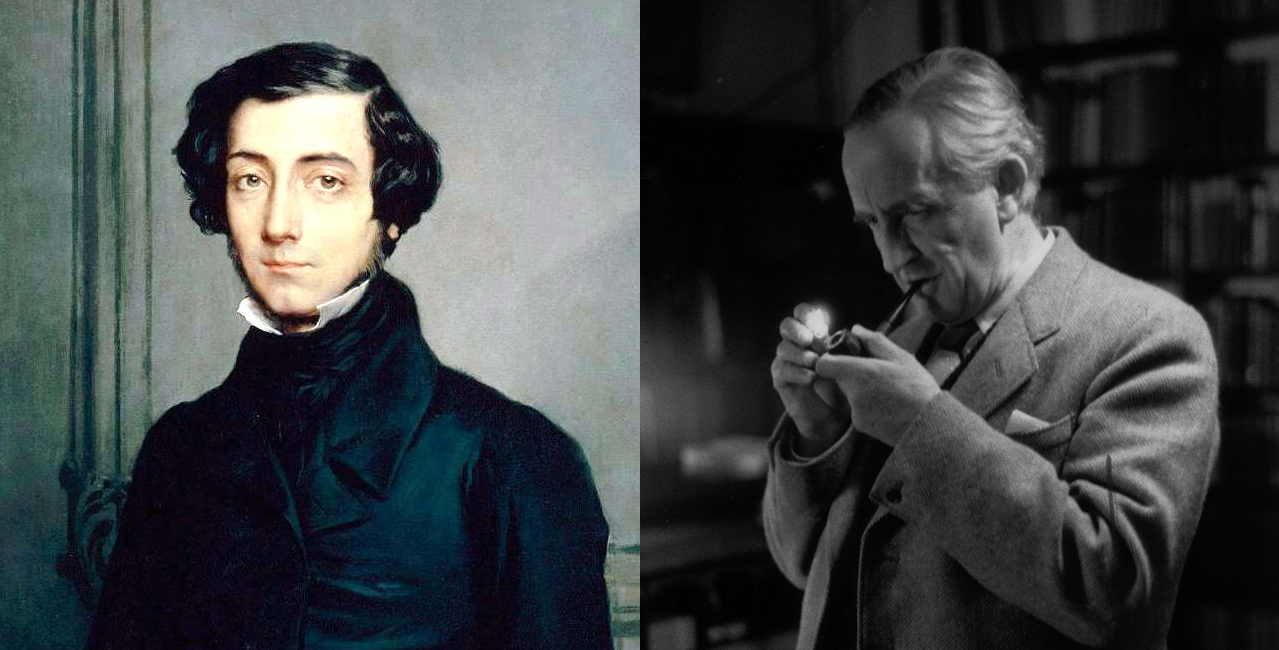
Alexis de Tocqueville (1805-59) and JRR Tolkien (1892-1973)

Alexis de Tocqueville (1805-59) and JRR Tolkien (1892-1973)

A few weeks ago I ran across a line from Alexis de Tocqueville that I had copied down—and preserved forever—as a Facebook status. The line comes from a passage in Democracy in America, his monumental book of observations on the political culture of the still young United States, about the delicate interplay of religion and self-interest among Americans:

 
However hard one may try to prove that virtue is useful, it will always be difficult to make a man live well if he will not face death.
— Alexis de Tocqueville
 

This line resonated with me because, at the time, I was finishing my first front-to-back reading of The Silmarillion, JRR Tolkien’s history of the First Age of Middle Earth. In addition to the stories of Middle Earth’s creation and fall, Tolkien tells the story of the human kingdom of Númenor and its rise and fall in the Second Age. The account of the rise and destruction of this kingdom comes from The Silmarillion’s penultimate section, Akallabêth, “The Downfallen.”

Here Tolkien describes the beginning of the Númenóreans turn toward evil:

Thus the bliss of Westernesse became diminished; but still its might and splendour increased. For the kings and their people had not yet abandoned wisdom, and if they loved the Valar no longer at least they still feared them. They did not dare openly to break the Ban or to sail beyond the limits that had been appointed. Eastwards still they steered their tall ships. But the fear of death grew ever darker upon them, and they delayed it by all means that they could; and they began to build great houses for the dead, while their wise men laboured unceasingly to discover if they might the secret of recalling life, or at least of the prolonging of Men’s days. Yet they achieved only the art of preserving incorrupt the dead flesh of Men, and they filled all the land with silent tombs in which the thought of death was enshrined in the darkness. But those that lived turned the more eagerly to pleasure and revelry, desiring ever more goods and more riches; and after the days of Tar-Ancalimon the offering of the first fruits to Eru was neglected, and men went seldom any more to the Hallow upon the heights of Meneltarma in the midst of the land.

Note, first, that Númenor’s “bliss” decreased while “its might and splendour increased.” Whatever evil is about to appear in Númenor is not the result of poverty or material want. Neither is it the result of ignorance, for they “had not yet abandoned wisdom” and their skills, while falling short of defeating death, are sufficient to stop the natural decay of flesh.

Rather than reckoning with death, which is one of the most important purposes of traditional religion and one of the necessary starting points of many philosophies, the Númenóreans try to first to defeat it, then to smother their fear of it, and finally they embrace it. “The desire to escape death,” Tolkien wrote in one of his letters, “produced a cult of the dead.” While the most obvious signs of this obsession were the “tombs and memorials” on which “they lavished wealth and art,” the cult was also made manifest in libertinism and consumption and the abandonment of religion. Not only do they fill the land with tombs, but they exalt the captive Sauron as an adviser, build him a temple to Morgoth, and turn to maritime kidnapping both to fill their coffers with wealth and to keep the human sacrifices burning in Sauron’s temple. Finally, seized with resentment of the immortals away west of them in the Undying Lands, they defy “the Ban” mentioned above and sail there with the goal of a violent takeover. They are instantly defeated and Númenor is sunk beneath the ocean in a cataclysm that reshapes the entire planet.

Reading this the same day that I rediscovered that quotation from Tocqueville was striking—it’s hard to imagine a more powerful or vivid illustration of the consequences of the refusal to face death. It’s also hard not to think of where we are in the present.

Technology has prolonged our lives to an unprecedented degree and, true to the Númenórean vision, there are those who promise the defeat of death, and soon. Simultaneously we live in an age of cultural malaise, discontent, and wild and irresponsible consumption and waste. Tolkien’s description of the people of Númenor turning “more eagerly to pleasure and revelry, desiring ever more good and more riches,” is apt, as are his descriptions of the suspicion and jealousy these spawn, and which Sauron takes advantage of. Sauron “denie[d] the existence of God,” Tolkien writes in a letter, “saying that the One is a mere invention [and that] The Ban is only a lying device of fear to restrain the Kings of Men from seizing everlasting life.” Our politics revolves more and more around questions of who has what and in what quantities, an obsessive materialism bound closely with envy and resentment, and questions of truth, morality, and the transcendent are treated as mere power plays in a game of oppression—the original Satanic lie. Finally, the rampant worship of death, the sacrifice of others to get us what we want, is as befitting of Morgoth as anything.

The fear of death, paradoxically, turns us toward it. We end by taking as many with us as we can.

In “Tolkien and the Gift of Mortality,” an article published almost twenty years ago, Anna Mathie notes that “immortality, or the lure of it, seems to turn members of all these races [men, elves, dwarves] in on themselves.” Those that pursue immortality end where the Númenóreans did—where I think we are—in a hunt for glory or pleasure, and those that achieve immortality become inert, lost in memory and self-regard. Barrenness marks both.

What to make of this?

Mathie argues that facing the fact of our eventual death and accepting rather than railing against it is what transforms death from a curse into a gift. The hobbits show this most clearly. In contrast to men or the elves, they hardly seem to think much less worry about death, this lack of desire for immortality being one of the reasons Bilbo and Frodo can resist the power of the ring for so long. The fact of death thus accepted, they get down to the plain business of living. While it’s the Númenóreans who take such pains to preserve flesh, it’s the hobbits who strike us as most fleshly and fully embodied precisely because they have accepted that this incarnate state is not forever, nor is it meant to be. Being willing to lose their lives, they find them.

Accepting death frees us to live. Accepting our mortality orients us otherward—it turns us inside out—first toward those immediately around us, then to past and future generations—whose value we perceive too, since they have or will share our fate. And, hopefully, looking at death as a reality to be reckoned with rather than ignored, fled from, or conquered will also force us to look beyond this world to another.

In a culture that shows all the marks of a Númenórean fear of death and its perverse turn toward destruction, this outward, mortal focus, a willingness to live with our limits, a willingness to face death as the prerequisite to virtue, fruitfulness, and goodness, is something we desperately need.