Heir to the Empire
/Well, here was a pleasant surprise. Though I’ve been aware of the legion of Star Wars novels that have been available since I was in elementary school, I’ve never read any, suspecting that their quality would lie somewhere between a Wookieepedia article and the usual movie tie-in novel. But over the years Timothy Zahn’s Thrawn Trilogy has gotten consistent enough praise for me to notice, and the strong recommendations of several of y’all whose taste I trust finally convinced me to check out the first volume, Heir to the Empire.
This novel picks up a few years after the original film trilogy ended. Han Solo and Princess Leia have married and are expecting twins. Leia, slowly undergoing her own Jedi training under Luke, learns that the twins will be especially strong with the Force. Luke begins the story troubled by the division with the Rebellion—now billing itself as the New Republic—especially internal factions attempting to assert themselves against the Rebellion’s more established leaders. Like many rebellions, success may prove to be the worst thing that could happen to it.
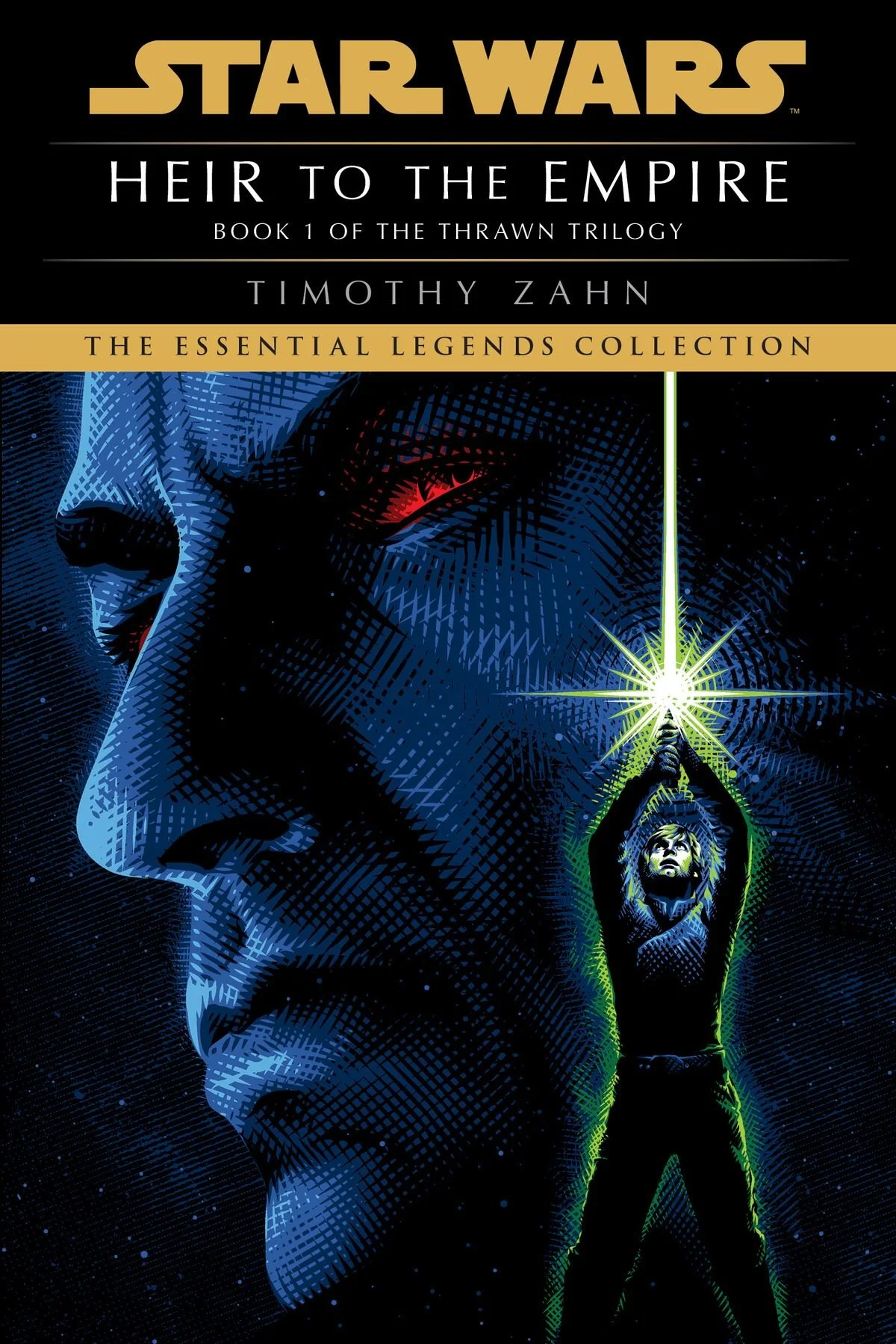
This vulnerability of the New Republic, struggling for both legitimacy and unified purpose as the Empire crumbles, arises as the Empire calls up a new leader to deal with the threat to its hegemony. Grand Admiral Thrawn, a blue-skinned, red-eyed being who has spent years campaigning in imperial backwaters, replaces Darth Vader. Thrawn views his predecessor as an unhinged mystic who catastrophically failed the Empire. He approaches defeating the New Republic with a combination of icy rationality and art. A connoisseur of painting and sculpture from worlds all over the Galaxy, Thrawn believes that understanding an opponent’s cultural background is as important in defeating them as pure logistics.
Not that the logistics don’t matter. The destruction of the second Death Star has created a manpower shortage across the Empire. Thrawn’s recruits are young and inexperienced, their training rushed and their discipline and protocol incomplete at best. Further, there is a shipping shortage across the Galaxy.
It’s this logistical problem that slowly becomes the center of the plot and draws the different characters together, as the New Republic dispatches Han to negotiate hiring smugglers as ad hoc transport—including some familiar characters from Han’s past—and Thrawn lays plans of his own for commandeering the vessels the Empire needs.
The one important plot element I haven’t mentioned here is the wild card: Mara Jade, a woman employed by one of the crime lords Han approaches about working for the New Republic. Mara is cagey about her past even with her boss, has an impressive breadth of technical skills she picked up who knows where, is familiar with the Force and lightsabers, and yearns to kill Luke Skywalker. But the less revealed about her, her background, and her quest to confront and kill Luke the better.
There’s much more going on in the story than even the above may suggest—including a trip to the Wookiee home world, a rogue leftover Jedi with a taste for mind control, and a race of brutal assassins Thrawn puts on the scent of Leia and her twins—and the richness with which Zahn evokes the world of the original trilogy is one of its pleasures. Heir to the Empire gives us a situation that believably continues that seen at the end of Return of the Jedi and introduces new complexity and depth to both the Rebellion and the Empire. But best of all, it provides an excellent villain. Thrawn is coolheaded, canny, skilled in both long-term strategy and tactical improvisation, and his insistence that culture matters combines menacingly with a typical Imperial willingness to use force. He proves a genuine threat to both the New Republic and to the familiar characters we care about.
But Zahn also manages to do what Disney failed at twenty years on: using the originals and their world to drive off in new directions that aren’t mere pastiche. Everything in Heir to the Empire feels truer to the original films and—perhaps even more importantly—plausible and true to real life than anything in the Disney trilogy. As I’ve noted elsewhere, it’s no wonder fans of books like this are ticked off with Disney.
But if Heir to the Empire stands out in comparison with something like The Last Jedi, that’s because it was already good in its own right. The quality of the writing itself is middling, improving over the course of the novel, but the plotting, characterization, and thoroughness of the world imagined by Zahn is outstanding. Heir to the Empire is solid genre fiction, which I’ve argued before no one should turn up their nose at, and enjoyable from beginning to end. I look forward to reading the rest of the trilogy.