9. April

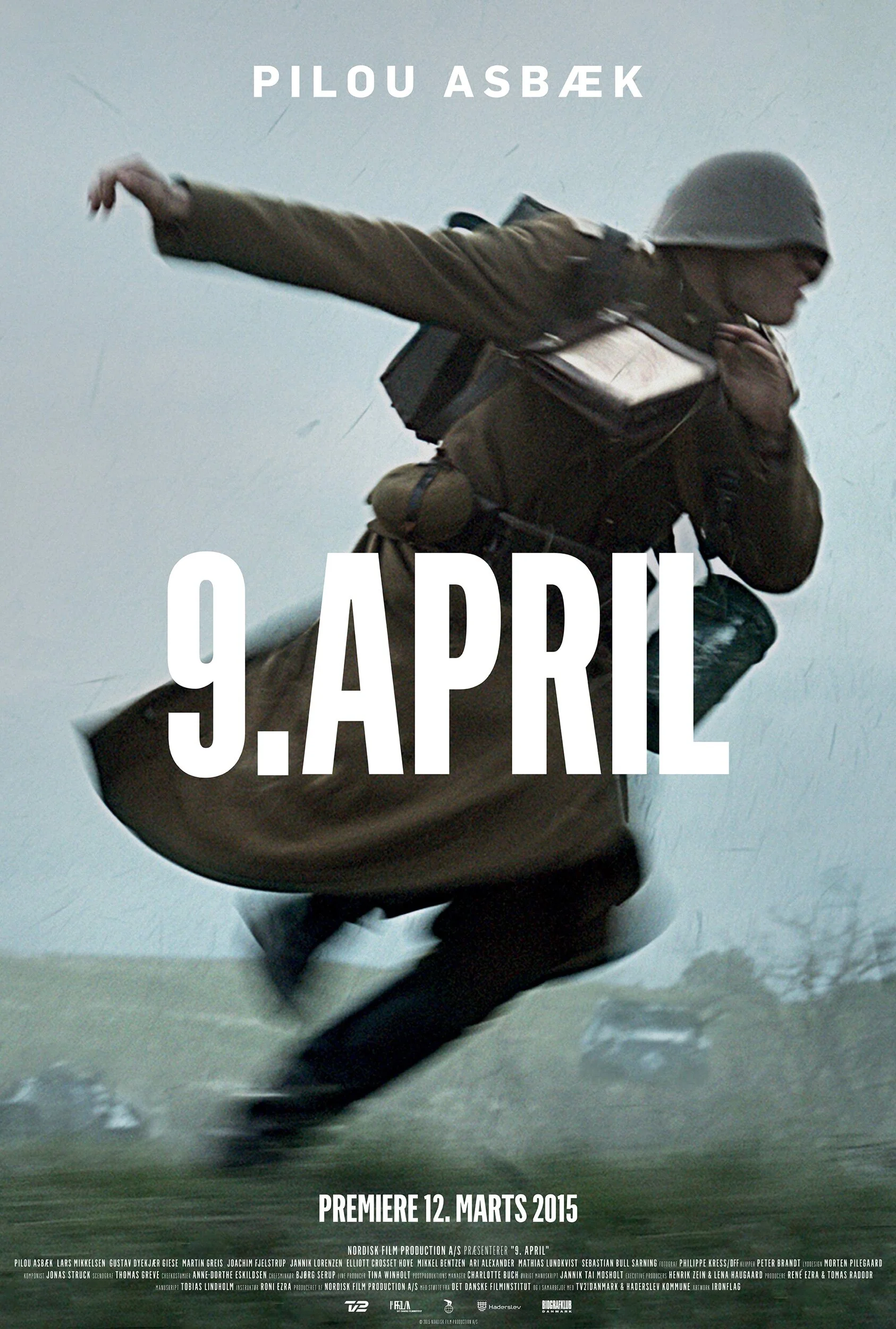
The men of LT. Sand’s bicycle platoon prepare to deploy in 9. April

The men of LT. Sand’s bicycle platoon prepare to deploy in 9. April

A few days ago I had a chance to watch 9. April, a 2015 Danish war film starring Pilou Asbæk, (of Overlord, which I’ve seen and enjoyed, and Game of Thrones, which I have not). I’ve wanted to see this film since I first watched a trailer for it some years ago, when it first came out, and I finally watched it thanks to Amazon Prime.

7F033A6B-D26C-4DD4-AEEE-DEF8B43CB664-14924-000005FE4645CFE4.jpeg

April 9, 1940 is the day Nazi Germany, flush with victory in Poland the previous fall and undeterred by the declarations of war of Britain and France, who had done almost nothing to stop German aggression, invaded both Denmark and Norway. While the fighting in Norway lasted well into the summer, beyond even the fall of France and the evacuations from Dunkirk, Denmark capitulated in less than a day.

9. April begins the day before, and tells the story of a platoon of bicycle infantry led by 2nd Lt. Sand (Asbæk). Sand’s men have been called up and placed on standby as Danish intelligence has gathered evidence of a German buildup on the border. Sand arrives as his men engage in target practice, and he has them repeatedly run through tire-changing drills for their bicycles. The men are so-so. Sand only barely conceals his lack of confidence.

Recalled to the barracks, the men are given the ominous order to sleep in their field uniforms and boots and to have their gear ready. The officers, gathered in grim conclave, exchange what little information they have and debate German intentions before retiring to the barracks, where they break up fights and smoke since no one can sleep. Sure enough, the word comes during the night that the Germans have crossed the border. Sand’s men mount up and head toward the invaders.

The rest of 9. April plays out over the single day of resistance, as Sand’s light bicycle infantry try to slow the onslaught of the Germans, who attack with truckloads of infantry, armored cars, and tanks, and whose air force fills the sky with fighters and bombers. Sand watches his platoon dwindle to six, including himself, and struggles with the tension between giving up and saving his men’s lives or withstanding the enemy at all costs. Asbæk’s subtle, soft-spoken performance is excellent, and one feels the weight of the decisions that come to rest upon him well before the film’s conclusion.

The film does a good job of bringing the viewer into a small unit battle, and allowing the viewer to feel—rather than laboriously explaining—the logic of each ambush, retreat, and attempt at regrouping to fight again. The realistic, grounded action increases in tension scene by scene. By the end I genuinely felt fear for the characters. The moody cinematography makes the misty, rolling landscapes of Jutland feel palpably cool and almost medieval in their desolation, and capably captures the shock and brutality of battle without descending into visual chaos.

And the film, without speechifying or bombast, offers a profound meditation on leadership under pressure in the person of Sand, who must both learn to lead once his platoon has lost contact with the chain of command as well as instruct his men in both leading and following, roles for which they may not be prepared. It’s subtly done and excellently presented.

Finally, 9. April portrays the agony of defeat better than many much larger and longer epic war films I’ve seen. One understands why—despite acquitting themselves honorably, continuing to fight long after others have fled, and bowing only to overwhelming force—the defeated feel such humiliation. In this age of endless “winning,” of an obsession with success and with zero-sum scoring against enemies real and perceived, it is worth our while to reckon with defeat and its meaning.

To quote Richard Weaver,

It is good for everyone to ally himself at one time with the defeated and to look at the ‘progress’ of history through the eyes of those who were left behind.

If you’re looking for a fresh, unusual perspective on World War II, war in general, or the relationship between leaders and followers, or simply for a riveting story populated with interesting characters and that offers some genuine food for thought, check out 9. April.

Finding Narnia

Young Warnie and Jack at home in Little Lea in Jessica Lanan’s beautiful, evocative artwork for Finding Narnia

Young Warnie and Jack at home in Little Lea in Jessica Lanan’s beautiful, evocative artwork for Finding Narnia

Did you know that CS Lewis had a brother? If you’ve only casually read the Chronicles of Narnia, or even dipped into his other fiction or his apologetics or even his academic work, you may not have known. But pick up any biography of Lewis and the importance of his big brother, Warren “Warnie” Lewis, becomes clear immediately. Just a few weeks ago I was reading Harry Lee Poe’s Becoming CS Lewis, which examines young Jack Lewis’s relationship with Warnie in great detail, and, coincidentally, I discovered a lovely new picture book called Finding Narnia: The Story of CS Lewis and His Brother.

The book begins in Jack and Warnie’s home, Little Lea, outside Belfast. This house, which features so prominently in the adult Jack’s memoir Surprised by Joy, shelters the boys and nurtures their imaginations, providing them with books and stories and a caring family. Jack, the younger of the two, loves high adventure and the dragon-slaying heroes of Norse myth. Warnie, who we see gazing out the window at the cargo ships in the harbor, loves trains and ships and other machinery. They create their own worlds—a land of talking animals for Jack, an elaborately imagined version of colonial India complete with railroads and timetables for Warnie—and together they imagine Boxen, their own fantasy playworld that combines the best parts of both.

Darkness intrudes when their mother dies and the boys leave for school, a section of Jack and Warnie’s story that the author, Caroline McAlister, mostly elides—understandably, I think. We see Jack and Warnie separated by schooling and by war, with both serving in France during the First World War in one of the book’s most melancholy but touching illustrations, and after the war by their professions, which keep Jack in his college at Oxford and Warnie in the army, manning his typewriter in colonial outposts as far from the British Isles as China.

But even here, their love for each other and their childhood collaborations return. In another striking and evocative image, the adult Jack, now a tutor at Magdalen College, Oxford, his shoulders hunched against the cold and his arms loaded with papers and books, glances into the quad to see, in the snow, a faun beside a lamppost.

finding narnia cover.jpg

The brothers reunite and their work together returns. We see Jack at his desk, writing longhand, and Warnie at his, typing, hunt-and-peck, to turn his brother’s scrawls into legible typescripts. From this teamwork we see elements from the earlier parts of their lives grow and interweave—the wardrobe from their childhood attic, the children hosted at Lewis’s home during the Second World War, the rainy day in which a child must explore or grow bored—and in the book’s final pages, thanks to Warnie’s friendship and partnership, we follow Jack’s imagination through the wardrobe and into Narnia.

When I discovered Finding Narnia (at a nice new bookstore on St Simons Island), I was struck by how much it reminded me of another wonderful picture book I reviewed here when this blog was young—John Ronald’s Dragons, about the childhood and youth of JRR Tolkien. There’s a good reason for that, one I could have known if I had bothered looking at the dust jacket flaps: the books are by the same author, and the care and gentleness with which McAlister tells both stories are complemented by the pictures, which are carefully researched and beautifully imagined. Finding Narnia’s pictures are by Jessica Lanan, and they’re marvelous.

My one very minor complaint about the book is the title—Finding Narnia, as a title, is kind of generic, and easily confused with a few other books with similar titles. It doesn’t grab you or given any indication of what its story is about the way John Ronald’s Dragons does. It’s up to the subtitle—The Story of CS Lewis and His Brother—to carry that weight, and I just wish there were a more direct way to bring the focus of the story into the title (and maybe Warnie’s name, too). But, again, that’s a minor complaint, and if you’ve read this far I hope you already know what a good book this is.

Through clear, simple text and lovely pictures, Finding Narnia presents the story of Jack and Warnie as two brothers who, though quite different, with different talents and interests that led them into dramatically different careers, enjoyed a lifelong loyalty and friendship that complemented and enriched them both. In a word, Finding Narnia is about brotherhood, and this is a story I hope a lot of young brothers will enjoy and learn from.

Fools, Frauds, and Firebrands

Sir Roger Scruton (1944-2020)

Sir Roger Scruton (1944-2020)

Since Sir Roger Scruton died in January, I have been on what I call the Roger Scruton Farewell Tour, reading those books of his that had until then sat unread on my shelf—and then some. Last night I finished Fools, Frauds, and Firebrands: Thinkers of the New Left, a hefty critique of leftist philosophers and theorists. Rather than write a more traditional review of the book, I wanted to offer some choice bits.

This is a long post. It could be longer. If you read no further, at least least my recommendation of the book: it’s excellent.

On Newspeak

One of the through-lines of Fools, Frauds, and Firebrands is the origin and development of Newspeak. While it was Orwell who coined the term, “the capture of language by the left is far older, beginning with the French Revolution and its slogans.” The variety parodied by Orwell in Nineteen Eighty-Four was that of “the Socialist International and the eager engagement of the Russian intelligentsia,” but Newspeak is a worldwide phenomenon.

Newspeak occurs whenever the primary purpose of language—which is to describe reality—is replaced by the rival purpose of asserting power over it. The fundamental speech-act is only superficially represented by the assertoric grammar. Newspeak sentences sound like assertions, but their underlying logic is that of the spell. They conjure the triumph of words over things, the futility of rational argument, and also the danger of resistance.

And, later in the book, in response to a blanket dismissal of most modern philosophers—thinkers as different as Descartes, Hegel, and Kant—as “empiricists” by the French leftist (n.b. the worst kind of leftist) Louis Althusser:

 
Someone acquainted with the real history of philosophy might be so astounded by this travesty as to overlook the purpose of Newspeak, which is not to describe the world as it is, but to cast spells.
 
fools frauds and firebrands.jpg

Newspeak is the language of repudiation and denunciation, of argument by assertion and the sorting of the world into immutable good and bad categories. Where “ordinary language warms and softens; Newspeak freezes and hardens.” It imposes ideological rigor on the messy world, with which ideologues only dare engage at arm’s length anyway. Reality destroys their plans, and their language is actively at war with reality, seeking both to reshape it and to prevent its being understood (almost exactly Orwell’s depiction of Newspeak).

On Newspeak and its plans:

Newspeak does not merely impose a plan; it also eliminates the discourse through which human beings can live without one. If justice is referred to in Newspeak, it is not the justice of individual dealings, but ‘social justice’, the kind of ‘justice’ imposed by a plan, which invariably involves depriving individuals of things that they have acquired by fair dealing in the market. . . . It is not the expression of a pre-existing social order shaped by our free agreements and our natural disposition to hold ourselves and our neighbors to account. It is the creator and manager of a social order framed according to an idea of ‘social justice’ and imposed on the people by a series of top-down decrees.

Why would this appeal to self-described intellectuals, and why have they spent so much time in the twentieth century (and before) thinking about, writing about, and agitating for it?

 
Intellectuals are naturally attracted by the idea of a planned society, in the belief that they will be in charge of it.
 

Scruton’s humor

Which brings me to Scruton’s sense of humor. As I’ve written before, Scruton’s wry, understated wit is one of his best and most underappreciated traits. He expertly seasons his writing and speaking with it, offering up subtle one-liners to emphasize a point, to give important ideas an intellectual hook to hang on, or simply for comic relief, a generous concession from someone who handles such heavy ideas.

But in the service of critique, his humor could have a razor-blade-and-turpentine bite. Here’s Scruton on the endlessly uncoiling mass of jargon and obscurantist vocabulary typical of leftist theory:

‘[R]eification’ became an important cult word in 1968 in Paris. But the subsequent discussions of the term in the New Left Review added nothing to the rhetoric except pseudo-theory: a morose prowling of the intellect around an inexplicable shrine. The lamest observation, expressed in the language of subject and object, could excite the most solemn respect. Marx’s declaration that ‘the bureaucrat relates himself to the world as a mere object of his activity’ is typical: trite, snobbish and slightly precious in suggesting that one is less an object the more time one spends in the British Museum Reading Room.

Burn.

Here’s another, of Slovenian Marxist philosopher Slavoj Zizek:

If he had stayed in Slovenia, and Slovenia had stayed Communist, Zizek would not have been the nuisance he has since become. Indeed, if there were no greater reason to regret the collapse of Communism in Eastern Europe, the release of Zizek on to the world of Western scholarship would perhaps already be a sufficient one.

The following comes from a passage describing György Lukács’s contention that “the knowledge yielded by the standpoint of the proletariat stands on a higher scientific plane objectively,” an assertion that, with a heaping helping of Foucault, certainly led to the modern obsession not with truth but with who is saying what from what position and with what identity, and the straight-faced assertions that some identities must be believed:

Lukács expands on this idea at considerable length, in prose of supererogatory greyness. But what is he asking us to believe? Apparently the working class, unlike the bourgeoisie, ‘always aspires towards the truth, even in its ‘false’ consciousness, and in its substantive errors’. To understand our situation, therefore, we must see it through proletarian eyes.

Who then should be our authorities—the articulate offspring of the true working class? D.H. Lawrence, Conrad, Céline? Don’t be ridiculous? says Lukács, who devotes many pages to anathematizing such counterrevolutionary lackeys of the bourgeoisie. It seems that proletarian thinking is not to be found in the works of proletarian writers, but only in the Marxist classics. . . . But when did Marx dirty his hands with manual labor? Or Engels, the factory owner, or Lenin, the gentleman in exile? Or Lukács himself—hereditary baron of the Austro-Hungarian Empire, heir to a banker’s fortune, scholar, aesthete and relentless conspirator among the ruling elites? A proletarian thinker? Consider his remedy for reification:

It can be overcome only by constant and constantly renewed efforts to disrupt the reified structure of existence by concretely relating to the concretely manifested contradictions of the total development, by becoming conscious of the immanent meanings of these contradictions for the total development.

Is that an authentic proletarian utterance? Come off it, mate!

That stinger actually made me laugh out loud when I read it. And coming as it does at the tail end of this summary of a tendentious and—as we are now seeing—dangerous set of ideas, flavored throughout with a condemnation of leftists for their (concealed) self-loathing and (obvious) hypocrisy, it really stung.

Apropos of nothing

And that brings me here, to a few passages that don’t at all remind me of anything going on right now.

Naturally, most of the mid- and late-twentieth century Marxists and other assorted leftists Scruton critiques are obsessed with class. Why class?

By seeing society in class terms we are programmed to find antagonism at the heart of all the institutions through which people have attempted to limit it. Nation, law, faith, tradition, sovereignty—these ideas by contrast denote things that unite us. It is in terms of them that we attempt to articulate the fundamental togetherness that mitigates social rivalries, whether of class, status or economic role. Hence it has always been a vital project on the left . . . to show these things are in some way illusory, standing for nothing durable or fundamental in the social order.

For class substitute identity—any form of identity and, as we have seen, if you are unhappy with the selection you can always create your own!—and you have much of today’s impassioned, aggressive non-discourse, Newspeak motivated by resentment and a furious demand that one’s subjective feelings be granted the status of Newtonian law.

Subjectivity is the order of the day. When Pilate asked Jesus “What is truth?” at least he was inquiring. Truth is a matter of virtually no concern now. At least some of this attitude we owe to Richard Rorty. In response to Rorty’s argument for what he called pragmatism, an “intersubjective agreement” as a replacement for “a natural and trans-cultural sort of rationality”—that is, objective truth accessible to reason regardless of one’s background or present context—Scruton writes:

There is no point to the old ideas of objectivity and universal truth; all that matters is the fact that we agree.

But who are we? And what do we agree about? Turn to Rorty’s essays, and you will soon find out. ‘We’ are all feminists, liberals, advocates of today’s radical causes and the open curriculum; ‘we’ do not believe in God, or in any inherited religion; nor do the old ideas of authority, order and self-discipline carry weight for us. ‘We’ make up our minds as to the meaning of texts, by creating through our words the consensus that includes us. There is no constraint on us, beyond the community to which we have chosen to belong. And because there is no objective truth but only our own self-engendered consensus, our position is unassailable from any point of view outside it. Pragmatists not only decide what to think; they protect themselves from whoever doesn’t think the same.

Later:

In place of objectivity we have only ‘inter-subjectivity’—in other words, consensus. Truths, meanings, facts and values are now regarded as negotiable. The curious thing, however, is that this woolly-minded subjectivism goes with a vigorous censorship. Those who put consensus in the place of truth quickly find themselves distinguishing the true from the false consensus. And inevitably the consensus is ‘on the left’. . . .

Thus the ‘we’ of Rorty rigorously excludes all conservatives, traditionalists and reactionaries. Only liberals can belong to it; just as only feminists, radicals, gay activists and anti-authoritarians can take advantage of deconstruction. . . . The inescapable conclusion is that subjectivity, relativity and irrationalism are advocated not in order to let in all opinions, but precisely so as to exclude the opinions of people who believe in old authorities and objective truths. This is the short cut to Gramsci’s new cultural hegemony: not to vindicate the new culture against the old, but to show that there are no grounds for either, so that nothing remains save political commitment.

And, later, more on that spirit of censorship:

And that is why, paradoxically, the postmodern curriculum is so censorious—in just the way that liberalism is censorious. When everything is permitted, it is vital to forbid the forbidder. All serious cultures are founded on the distinctions between right and wrong, true and false, good and bad taste, knowledge and ignorance. It was to the perpetuation of those distinctions that the humanities, in the past, were devoted. Hence the assault on the curriculum, and the attempt to espouse a standard of ‘political correctness’—which means, in effect, a standard of non-exclusion and non-judgement—is also designed to authorize a vehement kind of judgement, against all those authorities that question the orthodoxy of the left.

Unsurprisingly, if there is no objective truth and all that remains is a totalizing political commitment, base feelings will rise to the surface as motivation. Chief among these—manifested in the French Revolution and Marx, the Bolsheviks and the Nazis, the Parisian students of 1968 and the radical activist movements now—is resentment. Scruton addresses resentment thus, which I quote at length:

Resentment is not a good thing to feel, either for its subject or its object. But the business of society is to conduct our social life so that resentment does not occur: to live by mutual aid and fellowship, not so as to be all alike and inoffensively mediocre, but so as to gain others’ cooperation in our small successes. Living in this way we create the channels through which resentment drains away of its own accord: channels like custom, gift, hospitality, shared worship, penitence, forgiveness and the common law, all of which are instantly stopped up when the totalitarians come to power. Resentment is to the body politic what pain is to the body: it is bad to feel it, but good to be capable of feeling it, since without the ability to feel it we will not survive. Hence we should not resent the fact that we resent, but accept it, as a part of the human condition, something to be managed along with all our other joys and afflictions. However, resentment can be transformed into a governing emotion and a social cause, and thereby gain release from the constraints that normally contain it. This happens when resentment loses the specificity of its target, and becomes directed to society as a whole. That, it seems to me, is what happens when left-wing movements take over. In such cases resentment ceases to be a response to another’s unmerited success and becomes instead an existential posture: the posture of the one whom the world has betrayed. Such a person does not seek to negotiate within existing structures, but to gain total power, so as to abolish the structures themselves. He will set himself against all forms of mediation, compromise and debate, and against the legal and moral norms that give a voice to the dissenter and sovereignty to the ordinary person. He will set about destroying the enemy, whom he will conceive in collective terms, as the class, group or race that hitherto controlled the world and which must now in turn be controlled. And all institutions that grant protection to that class or a voice in the political process will be targets for his destructive rage.

That posture is, in my view, the core of a serious social disorder.

Thus far all of this has played out in the academy, where leftism has triumphed in the United States, and in what are broadly called the culture wars. The self-loathing of the university elite and their embrace of subjectivism and resentment-driven radicalism “have ended in America in a near-universal victory for the left. Many of those appointed as the guardians of Western culture will seize any argument, however flawed, and any scholarship, however phony, in order to denigrate their cultural inheritance.” One thinks of the 1619 Project, perhaps the most mendacious journalism to appear in the New York Times since Walter Duranty, an ahistorical, ideologically motivated attempt to create an utterly new conception of American history—Scruton’s description of Newspeak “casting spells” and “conjuring” again—a project that has already borne fruit. Scruton writes:

 
The final result of the culture wars has been an enforced political correctness, by which the blasted landscape of art, history and literature is policed for the residual signs of racist, sexist, imperialist or colonialist ways of thinking.
 

Anyone who is paying any attention—to the university, to the media, to popular literature (especially the cesspit of YA), to the arts, and to public commemoration—will recognize the truth in this description. But of course this “enforced political correctness” no longer plays out solely in academic institutions. One wonders what the next stage of this will look like. We are already seeing some of it.

Regardless, in Scruton’s assessment:

 
We have entered a period of cultural suicide.
 

In conclusion

That’s a grim note to leave off on, but I’ll conclude here. I could triple or quadruple the length of this post with more quotations. Fools, Frauds, and Firebrands is an excellent book. It’s going to continue to be relevant longer after our day, but in the meantime it offers an excellent critique of the schools of thought—and Newspeak—that have led us to where we are now.

And Scruton does not end on the note of doom and gloom that I do here. He proposes his own vision of an alternative—indeed, an alternative that can actually exist and actually has—a society founded on free association, private institutions, tradition, and meaning. He notes as well that the leftists profiled in his book are engaged in an essentially religious project, and that the resentment and violence they spawn come from the attempt to meet a religious need with thoughts that give no place to religion, and that this leftist faith—detached from any mediating institution or tradition, but with nothing like reason or a belief in truth to hang onto—blinds them. He does not directly address an alternative to this attempt to meet this need, but his silence on the point is powerful.

Sappho's wedding songs on Core Curriculum

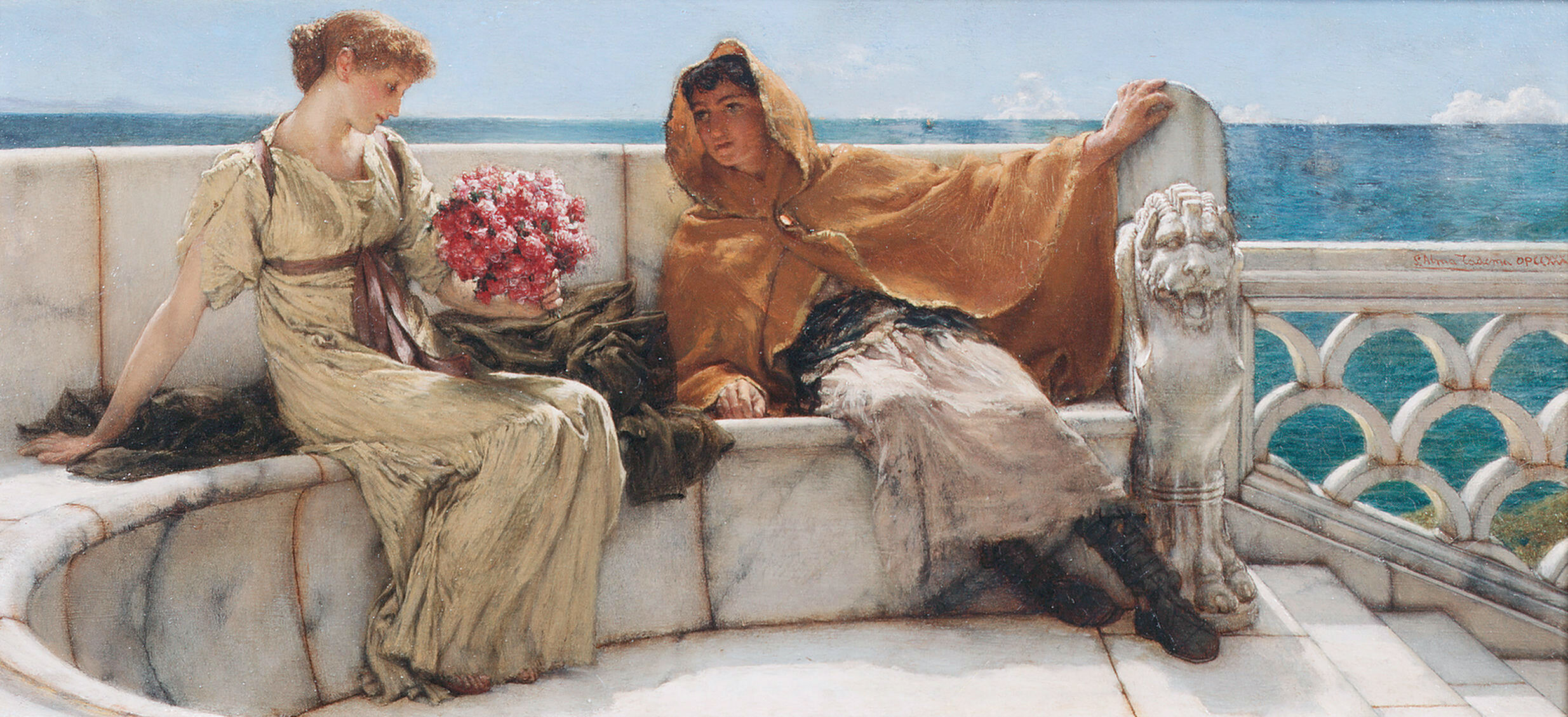
Amo te, ama me, by Sir Lawrence Alma-Tadema

Amo te, ama me, by Sir Lawrence Alma-Tadema

I’m particularly excited about this third episode of the Core Curriculum podcast’s series on Sappho because, in keeping with its theme of epithalamia—marriage songs—host Katie Grubbs invited my wife to join her, her husband David, and me for the discussion!

This is Sarah’s first podcast appearance and we had a great time discussing Sappho, what exactly an epithalamion is, these specific poems and their sometimes troubling, sometimes amusing, often touching themes, and marriage both then and now. It’s a wide-ranging discussion and Sarah and I really enjoyed it. Please listen in!

You can find this episode’s excellent and detailed shownotes—including the specific poems under discussion as well as the translations we used for this episode—at the Christian Humanist Radio Network site here. You can listen to Core Curriculum on iTunes, Stitcher, and other fine podcasting platforms, or listen to this episode via the embedded player in this post. Please also like the CHRN’s Facebook page to get updates on new shows and episodes as they arrive.

Thanks for listening! I hope y’all enjoy.

McClay on history as narrative

A Reading From Homer, by Sir Lawrence Alma-Tadema

A Reading From Homer, by Sir Lawrence Alma-Tadema

Last week I started reading Wilfred McClay’s Land of Hope: An Invitation to the Great American Story, a new one-volume narrative history of the United States. I’m up to the post-Revolution period of the Articles of Confederation and the Constitutional Convention, and so far it’s been measured, nuanced, and carefully balanced, with McClay falling into neither of the traps laid on either side of the historian’s path, traps that have caught (often quite willingly) a lot of other recent histories of the US—pathological suspicion and denunciation to the left, mindless jingoism and nationalism to the right. It’s excellent so far.

I started reading the introduction just for kicks and immediately knew I was going to dive into the book. Here’s McClay on the very first page, explaining the purpose of the book:

land of hope mcclay.jpg

Its principle objective is very simple. It means to offer to American readers, young and old alike, an accurate, responsible, coherent, persuasive, and inspiring narrative account of their own country—an account that will inform and deepen their sense of the land they inhabit and equip them for the privileges and responsibilities of citizenship. “Citizenship” here encompasses something larger than the civics-class meaning. It means a vivid and enduring sense of one’s full membership in one of the greatest enterprises in human history: the astonishing, perilous, and immensely consequential story of one’s own country.

McClay takes this as the jumping off point for explaining why he wrote Land of Hope as a narrative. Every semester I begin each of my classes with a short presentation on how I approach the past and how I plan to teach it, emphasizing—using quotations from Marc Bloch, LP Hartley, and Cicero—the past as the study of humanity (as opposed to endless eons of geological and biological forces) as it changes over time, with the ultimate purpose of expanding our own limited store of memories.

With that in mind, I read McClay’s introduction with greater and greater excitement. I quote at length so you can get the full import of his argument, and to enjoy his prose, which is elegant and economical throughout:

Let me emphasize the term story. Professional historical writing has, for a great many years now, been resistant to the idea of history as narrative. Some historians have even hoped that history could be made into a science. But this approach seems unlikely ever to succeed, if for no other reason than that it fails to take into account the ways we need stories to speak to the fullness of our humanity and help us orient ourselves to the world. The impulse to write history and organize our world around stories is intrinsic to us as human beings. We are, at our core, remembering and story-making creatures, and stories are one of the chief ways we find meaning in the flow of events. What we call “history” and “literature” are merely the refinement and intensification of that basic human impulse, that need.

The word need is not an exaggeration. For the human animal, meaning is not a luxury; it is a necessity. Without it, we perish. Historical consciousness is to civilized society what memory is to individual identity. Without memory, and without the stories by which our memories are carried forward, we cannot say who, or what, we are. Without them, our life and thought dissolve into a meaningless, unrelated rush of events. Without them, we cannot do the most human of things: we cannot learn, use language, pass on knowledge, raise children, establish rules of conduct, engage in science, or dwell harmoniously in society. Without them, we cannot govern ourselves.

Nor can we have a sense of the future as a time we know will come, because we remember that other tomorrows also have come and gone. A culture without memory will necessarily be barbarous and easily tyrannized, even if it is technologically advanced. The incessant waves of daily events will occupy all our attention and defeat all our efforts to connect past, present, and future, thereby diverting us from an understanding of the human things that unfold in time, including the paths of our own lives.

McClay says here what I've been saying at the start of all of my classes for years, and says it far better than I ever have. No one, I tell my students, really hates or is uninterested in history, because if I asked one student about her favorite TV show or another about how his favorite college football team is doing, both would immediately give me a narrative history—with cause and effect, careful attention to context, discrimination between important and unimportant events, probably a few heroes and certainly some villains. That often seems to click, and for those for whom it doesn’t, I can always ask How did you get here this morning? The answer, again, will be a narrative.

That said, I only add two short glosses or comments, because I can’t really improve on McClay.

We need history because we need a story with which to frame our lives, otherwise we are stuck in those “incessant waves,” that “unrelated rush of events.” We become stuck in the present—not just the present era but the present year, even, thanks to the brain-eroding forces of social media, the present day and hour and minute. That’s how animals live and perceive the world, which is why animals don’t meaningfully change. History is a critical part of what makes us human and is, I think, part of the mysterious imago Dei.

But I’m not going to draw any facile conclusions about how “relevant” this is, because worrying about relevance is another symptom of being enslaved in the present. Narrative history is “relevant” the same way bedrock, or the ocean, or our own skeletons are relevant, as things that support and give shape—and will outlast us.

McClay has much more to say in his introduction, and the history itself, as I said, is great so far. I definitely recommend it if you are at all interested in the past in general or the American story in particular.

That Hideous Strength, Part II, on City of Man Podcast

The City of Man Podcast’s final episode on CS Lewis’s Space Trilogy, the second half of our discussion of That Hideous Strength, arrived earlier this week. In Part I, Coyle, David, and I introduced the novel, summarized the plot, and started talking about some of the subplots and themes in this rich and complicated book. We also talked about Mr. Bultitude—how could we not?

In this episode, we pick up with David’s examination of NICE’s system of programmatic degradation and alienation and continue to talk about the novel’s parallel dramatic structure, its themes of rightly ordered love and marriage, NICE’s Babel-like project and the eventual confusion of speech that wrecks it, violent animal attacks, and the final surreal cataclysm that swallows up NICE and the village of Edgestow (much to my delight). We also discuss a little more of the novel’s historical context—wondering what That Hideous Strength might have looked like if Lewis had written it just a few months later, after the debut of the atomic bomb—as well as the novel’s Arthurian content and whether it works with the rest of the story, and what exactly “that hideous strength” is. We also have a lot of reading to recommend, and one great YouTube channel.

You can catch up by listening to Part I of this episode here, or go even further back to listen to our chats about the first two books in the trilogy, Out of the Silent Planet and Perelandra.

You can listen to City of Man Podcast on iTunes, Stitcher, and other fine podcasting platforms, or to this particular episode of the show via the embedded Stitcher player in this post.

Thanks as always for listening! I had a great time revisiting this trilogy and talking it over with some sharp and insightful friends, and I hope y’all enjoy it as much as I did.

Sappho and the gods on Core Curriculum

Sappho and Alcaeus, by Sir Lawrence Alma-Tadema (1836-1912)

Sappho and Alcaeus, by Sir Lawrence Alma-Tadema (1836-1912)

The Core Curriculum returns! After a first series on the Iliad, in several episodes of which I took part, and a second on Plato’s Republic, which, to my regret, I sat out, the show’s third series will take a close look at the fragmentary body of work of Sappho.

Sappho was a native of the island of Lesbos and lived the late 7th and early 6th centuries BC. Though widely respected in the ancient world for the quality of her lyrics, most of her poetry has come down to us in fragments or quotations in other writers. Only one of her poems survives in full. She is also the only known named female poet of the Greco-Roman world.

In this first episode, host Nathan Gilmour, fellow guest Michial Farmer, and I look at a selection of Sappho’s poems about the gods. We read through the poems individually, including that single, priceless complete lyric—and discuss their often highly allusive contents, the god or gods invoked by each, and what these poems can tell us about how the Greeks—and, more specifically, Sappho—conceived of the relationship between gods and mortals.

I really enjoyed this discussion and have to say I emerged from this episode—and the series as a whole—with a deepened appreciation for Sappho’s verse.

You can listen to Core Curriculum on iTunes, Stitcher, and other fine podcasting services, or via the embedded player in this post. You can find this episode’s excellent shownotes, including a full listing of this episode’s poems, the translations we used for reading, comparison, and discussion, and links to some of things we incidentally talk about, at the Christian Humanist Radio Network homepage here.

Thanks for listening! I hope y’all enjoy.

That Hideous Strength on City of Man Podcast

that hideous strength cover.jpg

The last installment of our City of Man series on CS Lewis’s Space Trilogy has arrived! Well, sort of—after discussing Out of the Silent Planet and its sequel, Perelandra, longish but single-part episodes, host Coyle Neal, fellow guest David Grubbs, and I found that That Hideous Strength proved so long and so rich that our discussion had to be split into two parts. Join us as we talk about the strange final chapter of Lewis’s already unusual science fiction trilogy.

How strange is it? In a series that so far has mostly involved interplanetary journeys, alien life, and a dash of the supernatural, That Hideous Strength features an evil government laboratory and think-tank trying to establish communication with demons, an amiable house-trained bear, a hyper-rational Ulsterman, a literal talking head, an unusual number of college faculty meetings for a sci-fi novel, a lot of sex stuff, and way, way more than one fatal animal mauling.

Also, Merlin is in it.

Tune in to Part I to hear us discuss all this and more, including the novel’s context in Lewis’s life and body of work, some of the themes and concerns Lewis develops from the previous books, the elements new to this third volume of the trilogy, and just what Coyle thinks pets are good for.

We had a great time talking about That Hideous Strength, and I hope you enjoy this first chunk of our discussion of this strange but rewarding novel. I listened to it while cooking dinner this evening and enjoyed every minute. You can look forward to Part II soon.

If you’re just now tuning in, you can catch up on our discussion by listening to our previous episodes on Out of the Silent Planet and Perelandra. In the meantime, you can listen to City of Man Podcast on iTunes, Stitcher, and other fine podcasting platforms, or to this particular episode of the show via the embedded Stitcher player in this post. Thanks for listening! Hope y’all enjoy.

Willy Wonka’s hidden Nazi joke

15712F4B-3313-49FA-A54A-0444D03AE0FE-25377-000032A3981D947D.jpeg

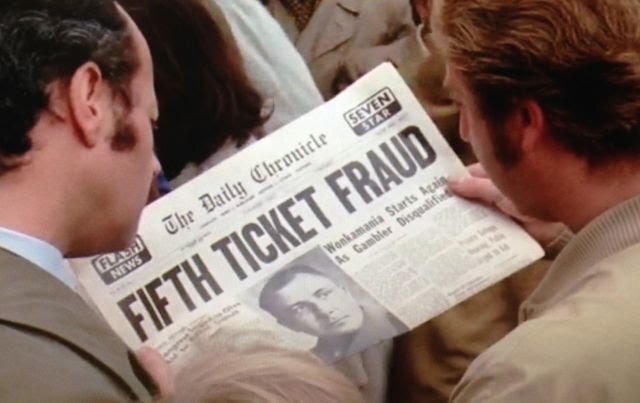
Anyone who watched Willy Wonka and the Chocolate Factory as a kid remembers the movie’s immense weirdness, the streaks of darkness that run through it like a layer of fudge in cake, and the crushing disappointment of Charlie Bucket when the last golden ticket has been found. According to the news report in the film, “a gambler in Paraguay” found the ticket, ending the contest. The news anchor holds up a picture of the lucky winner, an old-fashioned studio portrait of a doughy but well-dressed man.

Only later, after Charlie’s spirits have begun to rebound and he has bought Grandpa Joe a Wonka bar, do we learn that the last ticket was a forgery and the contest is still on.

“Can you imagine the nerve of that guy?” a man looking at the headline reporting the fraud says. “Trying to fool the whole world?”

There’s a joke lost in the shuffle here, one that was certainly lost on me as a kid wondering why the first four winners were children whom we met and learned a little about while the fifth was a middle-aged man in a photo: our shady South American gambler is Martin Bormann.

The 1934 portrait of Martin Bormann used by Willy Wonka’s filmmakers. The Reichsleiter rank insignia on his collar was airbrushed out for the film.

The 1934 portrait of Martin Bormann used by Willy Wonka’s filmmakers. The Reichsleiter rank insignia on his collar was airbrushed out for the film.

As Adolf Hitler’s personal secretary and Chief of the Nazi Party Chancellery, Martin Bormann was not only one of Hitler’s closest staff members and advisers but the second most powerful man in the Nazi Party. He was a longtime Party member and—following an act of political violence as an accomplice of Rudolf Höss, the man who would go on to command Auschwitz—a convicted murderer, and he ruthlessly used his positions to accrue and hang onto immense power. By the end of the war, because of his amoral hunger for power, his utter lack of scruples, and his tight control over access to Hitler himself, he had become one of the most feared and hated men in Germany. Party insiders called him “der braune Schatten”—The Brown Shadow or Brown Eminence because of his closeness to the Führer.

After Hitler killed himself on April 30, 1945, the survivors of the Führerbunker banded into small groups to try to break out of Berlin, which had been surrounded and overrun by the Soviet Red Army in the previous weeks. Bormann joined one of these groups and, after leaving the bunker and the ruins of Hitler’s headquarters, took cover behind a Tiger tank that was fighting its way up a rubble-jammed street. The Tiger took Russian fire and Bormann was thrown from his feet, but others ran into him again later on. The last person confirmed to have seen Bormann in Berlin was Artur Axmann, head of the Hitler Youth, who spotted Borman and Ludwig Stumpfegger—a Nazi doctor who had helped Joseph and Magda Goebbels poison their six children—lying on their backs near a railroad station.

After that, as far as Allied investigators were concerned, Bormann disappeared.

As one of the leading Nazis in the Third Reich, Bormann was at the top of the Allies’ most wanted lists. The Allies viewed him as so important to the functioning and the crimes of the Reich that he was tried in absentia at Nuremberg alongside Nazi leaders like Hermann Göring, Albert Speer, Rudolf Hess, Wilhelm Keitel, and Joachim von Ribbentrop—men who had actually been caught. The Nuremberg court convicted Bormann of war crimes and sentenced him to hang.

But they never caught him. As historian Luke Daly-Groves documents in Hitler’s Death, American and British intelligence services received a flood of tips and reported sightings for years—Brazil, Switzerland, Denmark, Egypt, England, the United States, Spain. He was reported to be living disguised as a monk in Rome (or maybe Spain) or to have fled via U-boat (or maybe helicopter) to Argentina (or maybe a Tibetan monastery) with Hitler. British intelligence received so many contradictory leads that Bormann’s supposed travel itinerary became the subject of jokes. And because of the conflicted but not mutually exclusive eyewitness accounts of survivors and the total lack of legitimate leads following the war, these agencies were confident that Bormann was dead. But the rumors continued, aided by a sensationalist media, and eventually, probably because so many Nazis who had escaped had fled to South America, the rumored location of Bormann’s refuge settled there.

And that’s the joke. The elusive man in South America faking the golden ticket is a wanted Nazi war criminal.

In his making-of book Pure Imagination, Mel Stuart, Willy Wonka’s director, acknowledges the joke, and that it didn’t land. “The scene was never as successful as I had hoped.” He also thinks he knows why: “twenty-five years after World War II, very few people knew or cared who Bormann was.”

Willy Wonka and the Chocolate Factory came out in 1971. In December of 1972, Martin Bormann was found. Construction workers near the Berlin railway station where Axmann had last seen Bormann uncovered two sets of human remains. One was the loathsome Dr. Stumpfegger. Dental analysis and, in the 1990s, DNA comparison with an elderly cousin, confirmed the other body’s identity—it was Martin Bormann. Glass fragments in the skull’s teeth showed that Bormann, like his Führer, had killed himself, but with cyanide rather than a bullet.

That fifth golden ticket proved even phonier than we thought.

Hitler's death, 75 years later

Hitler decorates a member of the HitlerjuGend in his last public appearance, April 1945

Hitler decorates a member of the HitlerjuGend in his last public appearance, April 1945

75 years ago today, Adolf Hitler killed himself in the bunker beneath the Reich Chancellery in Berlin. The city lay in ruins and hundreds of thousands of soldiers of the Soviet Red Army were at that moment only hours from grinding the last Nazi resistance to powder, and Hitler, after final farewells to the small coterie of staff members, secretaries, and toadies who had remained with him, retired to his personal chambers with the new Frau Hitler, where she took poison and he shot himself. The staff burned their bodies immediately.

A fitting end, and it would be tempting to gloat over the circumstances of his death were it not for the 80+ million people he dragged into the abyss with him. So I think such a date calls for commemoration—not necessarily celebration, though it will always be true that the people rejoice when the wicked perish, but rather a remembering in order to understand. It is good to look to the past, to look it as fully in the face as we are able, and to try to reckon with what we see there. This should be no exception.

So in that spirit of remembering and learning I wanted to recommend two films and three books that could help you learn about what took place today in 1945. I’ll start with the movies first:

Downfall (Der Untergang)

Downfall is the great film treatment of the final days of Hitler and the Third Reich. Based on a book by historian Joachim Fest (see below) and the memoirs of a number of survivors of the Führerbunker, Downfall opens on Hitler’s 56th birthday and follows a wide number of characters through his final ten days of life and beyond, concluding with the attempt of the bunker’s survivors to break through the Russian encirclement.

Bruno gANZ AS aDOLF hITLER IN dER uNTERGANG (2004)

Bruno gANZ AS aDOLF hITLER IN dER uNTERGANG (2004)

The filmmakers, led by director Oliver Hirschbiegel, include the perspectives of Traudl Junge, Hitler’s young, naive secretary, and her friends; the ordinary staff members of the bunker like switchboard operator Rochus Misch and Hitler’s personal adjutant Otto Günsche; the generals on Hitler’s staff and high-ranking members of his government like Joseph Goebbels and Albert Speer; soldiers and officers cobbling together Berlin’s defenses; the doctors trying to save the wounded; and ordinary citizens of all ages now struggling to support the collapsing Nazi military against the power of the Red Army. Its scope is impressive, and Downfall offers as comprehensive a picture of the fall of Berlin as is possible in a single film.

The filmmakers did a solid job of presenting the known facts, and opted to depict only those things they could confirm from actual historical sources. So, since no one who was in the room with Hitler when he killed himself survived, the viewer experiences that moment as the survivors outside did—a muffled gunshot followed by the disposal of the bodies. While the film takes some artistic liberties with the story (perhaps most notably, softening the fate of Frau Junge), it mostly adheres to the documented historical record and does so with a minimum of fictionalization.

But while that’s a reason to watch Downfall, it’s not the reason. The main reason should be Swiss actor Bruno Ganz’s performance as Hitler—a dark, subtle, scary portrayal of an evil man now sickly and beaten down, rolling back and forth between self-pity and rage, charm and brutality, his old magnetism and something utterly repellent. Ganz presents us with a man who believes his own lies and, faced with defeat, has determined to take everyone down with him. This decision testifies to his evil; that many of his followers stick with him is a testament to that indescribable other side of his personality that Ganz, better than anyone else, brings to life. It’s the best onscreen realization of this complicated, inscrutable man that I’ve seen, and the much-memed scene in which he rants against his generals for their supposed betrayal is only one of the film’s many overwhelmingly powerful moments.

Downfall is a grim film, and appropriately so. Most of the historical figures we meet die before the end, many by their own hands, and some choose coldbloodedly to take their children with them. Perhaps the most disturbing scene in the film is that in which Frau Goebbels first drugs and then, one by one, crushes cyanide capsules in the mouths of her six children.

But I think it’s a necessary film in the same way that a film about the Third Reich’s victims is, and with perhaps an even more important lesson. For where we all imagine what we might do if we were to face victimization by people like the Nazis, very few of us have the moral courage to imagine ourselves as the perpetrators. Until we can do that, and look beyond our easy image of the Nazis as monsters, we can’t fully recognize our own potential for evil. Downfall is at its best when it makes us most uncomfortable.

The Bunker

If you are curious about the subject but want to see something less graphic than Downfall or are genuinely intimidated by “the one-inch tall barrier of subtitles,” let me recommend The Bunker, a film based on the book of the same name by journalist James P. O’Donnell, the first non-Russian to gain access to the ruins of the bunker following the fall of Berlin.

Anthony Hopkins as Adolf Hitler in The Bunker (1981)

Anthony Hopkins as Adolf Hitler in The Bunker (1981)

The Bunker begins with Hitler’s move from above ground to the Führerbunker in January of 1945 and focuses primarily on the last two weeks or so of Hitler’s life there. The Bunker played on CBS in 1981 and has many of the limitations of a TV movie of that time—it’s decidedly cheap looking in many respects, owing mostly to TV-style lighting though the sets and especially the costumes look good. But the film’s big draw is the cast, which features solid work by a number of recognizable faces including Richard Jordan, Michel Lonsdale, Michael Kitchen, and a very young Julian Fellowes, most famous now as the creator of Downton Abbey. But most important of all is Anthony Hopkins in an Emmy-winning performance as Hitler.

Hopkins’s Hitler is closed off and detached, almost catatonic in some scenes and flying into rages in others. (The film makes much of the many drugs administered to Hitler by his personal physician, Dr. Morell, one of history’s great quacks.) Hopkins clearly studied Hitler’s flamboyant oratorical gestures closely and incorporates them whenever Hitler loses his temper. The impression one gets is of an enfeebled man who almost ceases to exist when he is not performing. It’s alienating and terrifying, and were it not for Ganz’s more fully rounded Hitler in Downfall—a Hitler that integrates all of these seemingly disparate parts as well as his much noted charm and magnetism—I’d rate this as perhaps the best imagined Hitler on film.

But caveat lector. Be aware that the cheapness of the cinematography is not the only issue with The Bunker. Its scope is narrower and unless you already know a little bit of who’s who, the film may get confusing. This is especially the case near the end, as the major cast members either kill themselves or join groups hoping to break out of Berlin. Some characters simply disappear from the narrative. But the source material’s reliance on Albert Speer is perhaps the biggest issue. The film spends a lot of time following Speer through a half-baked plot to flood the bunker with tabun (a nerve agent developed in Germany by some of the same chemists who created sarin), an interesting story but one that Speer almost certainly made up after the war, when he spent decades carefully crafting an image as an apolitical artist and technocrat hoodwinked by the regime.

Nevertheless, if you’re aware of some of these historical problems, The Bunker can be both instructive and, more important, gripping. The final hour—with Hitler’s suicide and the deaths of the entire Goebbels family and many, many others—is genuinely chilling, a testament both to the actors and to the power of the true story they’re trying to reenact.

While The Bunker is available on a rather expensive DVD, you can find it free in its entirety—albeit in VHS quality—on YouTube.

Having noted these two films, let me recommend a few books if you want more detailed and rigorous non-fiction presentations of these events:

Inside Hitler’s Bunker: The Last Days of the Third Reich, by Joachim Fest

The book that provided the basis for the film Downfall, Hitler biographer Joachim Fest’s Inside Hitler’s Bunker is a short, brisk read and a good guide to the sequence of events that played out in the days leading up to and following Hitler’s suicide. Fest capably interweaves the stories of the many people who both lived with Hitler in the bunker and those who passed through. (One of the striking things about the bunker, once you begin studying it, is how many people dropped in, especially in the final days. The films elide some of this out of necessity, though Downfall does an excellent job creating an impression of how busy the place was.) If you’re looking for a quick, straightforward narrative of Hitler’s final days and the fall of Berlin, this is the one I’d recommend.

As two bonus recommendations, if you’d like to read the perspective of just one of the people who visited the bunker in the final days, the opening chapters of Siegfried Knappe’s memoir Soldat relate his repeated trips to the bunker to brief Hitler as the defenses of Berlin crumbled; and if you’re interested in something that treats the last several months of the Reich in greater depth and gives a lot more context but shorter treatment to Hitler’s death, check out The Fall of Berlin 1945, by Antony Beevor.

Hitler: The Survival Myth, by Donald M. McKale

mckale hitler.jpg

Up to this point I haven’t mentioned the many, many conspiracy theories surrounding Hitler’s death. This is not because I am unaware of them. Indeed, I have at least one student per semester who either is curious about or fervently believes one of these theories. Unfortunately for these students, the theories are all bogus—and I can tell them that one of my professors at Clemson literally wrote the book on it. Hitler: The Survival Myth, tracks the origins, spread, and evolution of these myths and theories from the immediate aftermath of his death and the capture of the bunker by the Russians through the decades following. Most of the many, many competing theories stem from the uncertainty surrounding Hitler’s fate—an uncertainty deliberately created by the Russians as disinformation for the western Allies and unwittingly abetted by the sensationalist western press ever since. McKale follows the growth and elaboration of these myths through meticulous research into decades of news coverage, public opinion polls, and more, and carefully debunks them.

Though the book is almost forty years old (it was originally published in 1981, the same year that The Bunker premiered on CBS), it is available in an updated edition and its premises and conclusions still hold up, as the conspiracy theories have only become more and more tenuously connected to reality in the years since.

As another bonus recommendation, Dr. McKale’s most recent book is Nazis After Hitler: How Perpetrators of the Holocaust Cheated Justice and Truth, which deals in detail with some Nazis who did manage to escape and, in many cases, live to a ripe old age.

Hitler’s Death: The Case Against Conspiracy, by Luke Daly-Groves

Despite the prevalence and apparent popular appeal of Hitler survival theories, books like Dr. McKale’s are scarce, especially considering the vast literature on the Third Reich that has appeared in the last eighty years. Some of this scarcity surely stems from the association of these conspiracy theories with fringe pseudoscience (what begins as a question about Hitler’s suicide often quickly expands to encompass cloning and Nazi UFOs), Neo-Nazism (if Hitler didn’t kill himself, the Third Reich wasn’t really defeated, or so they think), and general kookery.

Luke Daly-Groves’s book Hitler’s Death: The Case Against Conspiracy comes as a relief then. He does not dismiss the conspiracy theories but directly investigates and engages them and drives out false knowledge with good, relying on the proper use of the historical method and the mountains of available evidence. His book is one of the most recent and comprehensive looks at the subject and is designed specifically to counter the still-widespread conspiracy theories. Daly-Groves argues that argument and persuasion are more powerful in the long run than dismissal, and I think that makes his approach through this book worthwhile. You can listen to a good short interview with him on the History Hit podcast here, or via the embedded Stitcher player in this post.

Conclusion

This is a big anniversary and I hope you’ll take some time to understand what happened, what it can teach us about both the Third Reich and ourselves, and what ghostly remnants of these events we’re still living with today. These films and books offer a good introduction and lots of food for thought. Thanks for reading!