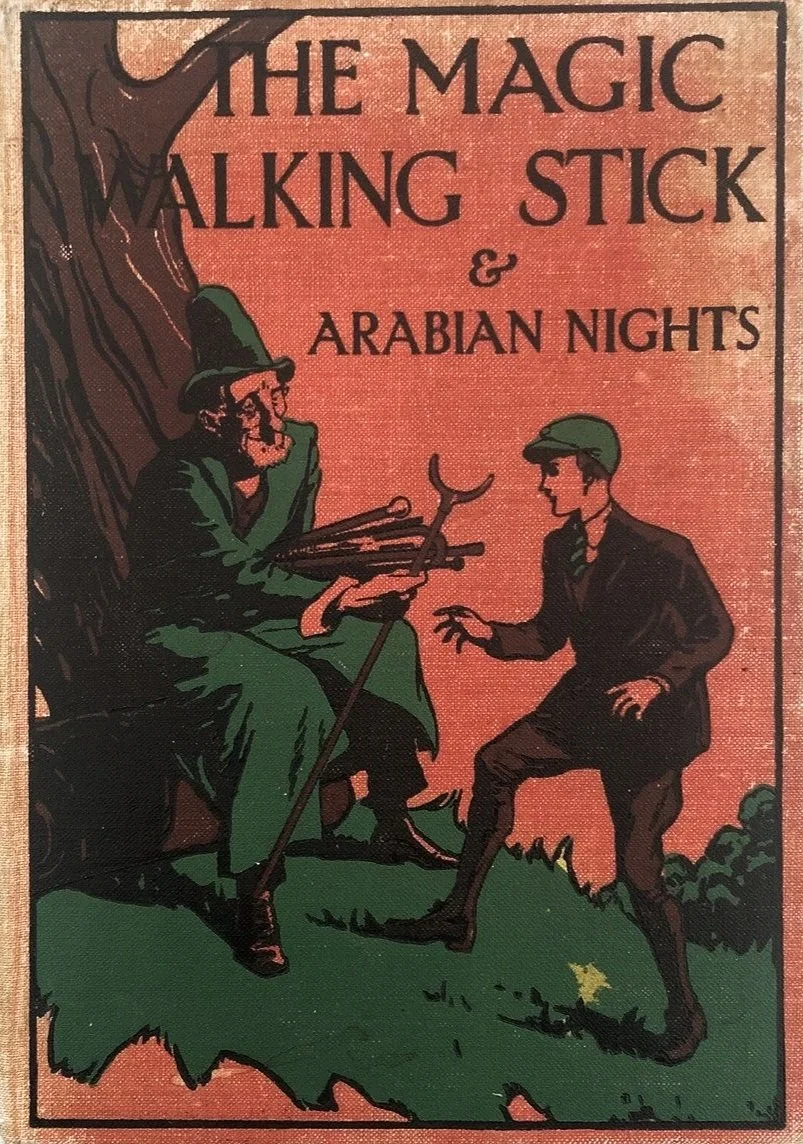
The Magic Walking Stick
/The fifth John Buchan June continues with a true outlier in Buchan’s vast and varied body of work. In the more than one hundred books published in his lifetime, Buchan wrote history, thrillers, historical fiction, poetry, and short stories—including weird fiction and supernatural horror—but only one children’s novel. That novel is 1932’s The Magic Walking Stick.
Thirteen-year old Bill is home from his boarding school and eager to go hunting. On the eventful day narrated in the first chapter, he sets off from his family’s country home with one of the gamekeepers. A storm is brewing up and they’re in a hurry, but Bill falls behind when he can’t find his walking stick. The gamekeeper and dogs leave without him and Bill, giving up on finding the stick, hurries to catch up.
In a wonderfully atmospheric opening, signs and portents appear suggesting something uncanny is about to happen, but Bill is too rushed to pay proper attention. He is stopped, however, by the sight of a old man sitting under a hornbeam. The old man is curiously dressed and has a strange, high-pitched voice, but offers to sell Bill a new walking stick from the bundle of sticks he carries. He offers a peculiar one—of a reddish wood with a white, crescent-shaped handle at the top. Bill accepts and pays a farthing.
When Bill catches up to the gamekeeper and tells him about the old man, they turn back to look but the man—hornbeam tree and all—is gone.
What Bill discovers that day is that the stick, if set in the ground and twirled while one wishes to be in another location, will transport him there instantly. He learns this by accident during their hunt: to his great delight when he lands in the middle of a flock of ducks and to his gratitude and relief when he is saved from a flash flood.
This begins the most fun and adventurous part of the story, as Bill experiments with the stick and discovers more of what it can do. He visits exotic places in the Pacific and Africa and plays a bold trick on his family’s obnoxious neighbors. He also learns more about the stick itself. By happenstance, his father is reading a medieval chronicle and relates one of those curious side-stories so many medieval scribes included without elaborating on the details we’d love to know now. Two ancient staves named Beauty and Bands had made their way to Charlemagne’s court. They could, if used properly, transport their owners anywhere, but each observed certain limits: one could be used only for serious work, the other for amusement. Misuse them and they would, somehow, disappear—as, indeed, they had later in the Middle Ages.
Bill decides his stick must be one of these but, not knowing which it is, disciplines his use. He doesn’t want to transport himself to the Solomon Islands on a lark only to be abandoned there by the stick. As in so many good stories of magic and fantasy, his exploration of what precisely he can do is a lot of the fun.
I won’t go into all of Bill’s adventures, but by the middle of the book he has learned how to honor the purposes of both sticks and work within their limits, first by saving an uncle who had disappeared why flying over the Sahara and finally, in the novel’s longest and most consequential series of adventures, by helping young Crown Prince Anatole, the heir to the throne of a troubled eastern European kingdom called Gracia, escape his anti-monarchical enemies and claim his throne.
This second half is pure Ruritanian romance and, as noted by Buchan biographer Andrew Lownie, thematically meshes with other Buchan novels of the time, especially the Dickson McCunn books, which entangle the retired Scottish grocer in the dynastic disputes and revolutionary upheavals of Evallonia. But where The House of the Four Winds, especially, falls apart as a novel, The Magic Walking Stick captures the lightness and swashbuckling high spirits of books like the original Ruritanian romance, The Prisoner of Zenda. Gracia’s political situation is not over-elaborated, Bill’s pluck as well as his friendship with Anatole make their escapades fun and engaging, and Buchan throws in enough twists and reversals to keep it suspenseful.
I think it’s safe to call The Magic Walking Stick a minor Buchan work. The two biographies I have, those of Lownie and Ursula Buchan, each mention the book only two or three times, and only Lownie explains anything about its story and reception. In trying to run down a copy for John Buchan June, even the cash-grab print-on-demand versions available on Amazon were few, and I ended up reading it in e-book form through our local library. A Buchan book being hard to find was a new one for me. (I’ll note that the entire thing is available from Project Gutenberg.)
This is too bad, because The Magic Walking Stick has the lightness of touch, the brisk pace, and the winsome young hero common to much classic children’s fantasy. The situations Bill gets himself into are varied and cleverly executed, and the many settings—including tropical places continents away, the moors and forests of Buchan’s beloved Scotland, and the fields and hills of southern England, which are clearly based on the Oxfordshire landscapes around Elsfield, where Buchan lived with his family at the time—are simply but beautifully described. Buchan makes Bill’s leaps from the thorny scrub of Africa back to the cold and damp of England palpable.
I also enjoyed the glimpse this book provides into the world of a well-to-do English boy of the early 1930s. Bill goes hunting and angling with the family keeper, knows his way around the servants’ quarters and back passages and can use them for mischief, and can visit London where, at the age of thirteen, he buys his friend a rifle for £25. A totally lost world. If Buchan’s original readers could thrill to imagining themselves traveling anywhere instantly, a modern reader of any age might just relish imagining having the kind of freedom Bill enjoys.
The Magic Walking Stick was a welcome surprise. As children’s fantasy, it is not of the same rank as The Hobbit or The Chronicles of Narnia but, as both Tolkien and Lewis were fans of Buchan, it is difficult to imagine those books existing without books like this one. It is not deep, but it is fun and exciting, and still worth a read for both adults and kids.