Lying and counting the inexplicable
/
The Messenger, Luc Besson’s brutal, ugly, inaccurate, and very very late 90s film about St Joan of Arc, is a terrible movie, but it has one brilliant scene that I’ve reflected on since the one time I watched it more than twenty years ago.
Late in the story, as Joan sits in prison awaiting trial and sentencing, she is visited by a character played by Dustin Hoffman called “The Conscience.” The Conscience has a literally satanic role as an accuser, introducing doubt where Joan has heretofore felt only conviction. His interrogation eventually centers on Joan’s sword, which she miraculously found in a field, an event she took as a calling from God. The Conscience seizes on this, pointing out that it is not self-evidently a sign, but simply a sword in a field. In an increasingly rapid montage, the Conscience suggests many possible ways the sword could have wound up there that did not require God placing it here for her to find.
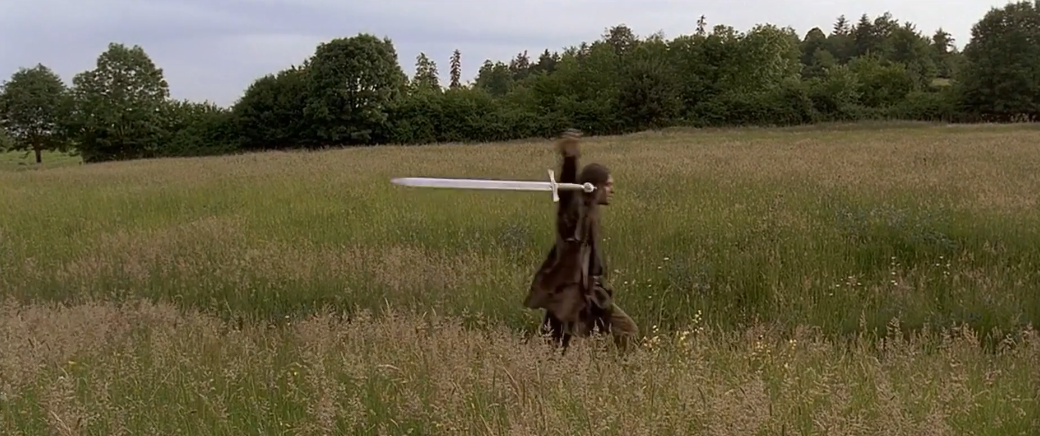
Having run through several scenarios in which the sword is dropped during combat or simply lost by accident, the Conscience says, “And that’s without counting the inexplicable.” Whereupon we see a man trudging through the same field carrying the sword, which he throws, entirely unprompted, into the tall grass. He doesn’t even stop walking.
The scene is clearly meant to mock supernatural belief—and it doesn’t even get St Joan’s history with that sword right—but that penultimate image of “the inexplicable” makes a valid, important point.
A young true crime YouTuber got me thinking about the Conscience and the inexplicable again. In my constant search for another Lemmino, I’ve tried out a lot of documentary channels on YouTube. Sturgeon’s Law being what it is, most of them aren’t very good. But in the course of finding a handful of decent documentary YouTubers to listen to or watch as I do the dishes or make the kids’ lunches, I’ve noticed that even the best of them have a persistent flaw.
The YouTuber in question is a college graduate with a degree in history. He’s smart, funny, and clearly paid attention in his historiography classes, as he demonstrates a good historian’s grasp of how to gather and assess evidence—most of the time. Faced with contradictory or irreconcilable details in whatever evidence he’s gathered (usually on old missing persons cases), he is far too willing to declare that someone is lying. Not mistaken, ignorant, misremembering, or misinformed—lying.
Part of this may be generational and cultural. I’m a geriatric Millennial from the Deep South, where accusing someone of lying is still serious business, and he’s a northern Zoomer. But it’s also a historiographic problem.
The accusation usually stems from discrepancies in whatever evidence is available—note that—and unacknowledged subjective impressions of the people involved. Discrepancies, in true crime theorizing, offer the same incentive that “anomalies” do to the conspiracy theorist. Our YouTuber falls into this trap whenever he takes discrepancies as evidence of willful deceit.
A lightly fictionalized version of a real example:
Two tourists disappear while hiking in Central America. Their diaries, when found, include a final entry on Monday, April 20. Locals confirm this date. But another tourist who briefly got to know them before their disappearance later recalls seeing the two tourists on Tuesday the 21st. But when first asked about the missing tourists by the police, the records show she stated this happened on that Monday. Why did she change her story? Why is she lying?
The most likely answer is that she didn’t, and she’s not.
Imagine meeting two strangers in a foreign country. You see them again sometime later. Being recent acquaintances, you notice them, but you’re busy with your own business. When they disappear, it turns out you’re one of the last people known to have seen them alive. Suddenly, details of that day take on a significance you never could have anticipated, you’re forced to try to recall things you never knew you would need to remember, and you may not have learned about the disappearance for days or weeks after it happened.
You’re interviewed by local police and by investigators from the tourists’ home country. You return to your own country and your previous life, and years go by. The investigation is reopened several times and you are interviewed again at some point in the process. How well will you remember these things this time? How well did you remember them in the first place?
No one in this scenario is lying, covering things up, or changing their stories. People make mistakes, misremember things, have their memories tainted by bad information relayed from someone else, or simply don’t know. None of this is “lying.”
This is where the inexplicable comes in. Without even factoring in these faults and flaws of memory, how well can you account for your own behavior, even in ordinary circumstances? People do things they can’t even always explain to themselves—out of habit, or intuition, or boredom, or a myriad of other barely conscious non-reasons. To paraphrase a meme, you do just do things.
But imagine a single day of yours is, for reasons beyond your control, placed under a microscope, with the authorities—and YouTubers and podcasters and a legion of other amateurs—poring over your every movement. Who wouldn’t end up looking a little suspicious, especially after being run through a strong rinse of insinuation, as the true crime and conspiracy folks are wont to do? Who couldn’t be accused of lying when forced to remember details you may have forgotten or simply can’t explain?
A few good rules of thumb for sifting evidence:
Always assume there is information you don’t have, especially when dealing with incomplete evidence. You can only work from what’s available. It’s irresponsible in the extreme to speculate on casefiles that are still partially classified, but guess what you’ll see on almost every true crime YouTube channel?
Even if you have a complete set of the available evidence, remember that the evidence is not a complete account of reality. Every piece has its own built in biases—limitations in the kind of evidence it’s designed to gather—and will leave things out.
Always assume there are things you don’t understand. This is especially important in highly technical cases like the radar, transponder, and cell tower evidence in the Malaysian Airlines Flight 370 case which—guess what?—our YouTuber, who doesn’t understand a lot about aviation, takes as evidence of the authorities lying. Aviation is a good example because it’s so obviously complex, but there are hidden technical pitfalls everywhere. In our lightly fictionalized example, consider the possible role of customs and immigration law in our tourists’ story, or unspoken local custom, or simple slang. These invisible technicalities can be the most dangerous. Just keeping Old and New Style dates straight in modern history can wreck your study of a specific event.
Don’t let your prejudices influence your interpretation. This should be obvious, but how many of us consistently meet this standard? Our YouTuber hates the Royal Canadian Mounted Police and the FBI, so guess how evenhandedly he approaches reports, statements, or other evidence from these institutions? The FBI’s handling of Waco doesn’t mean they’re lying about a child who went missing in the Great Smoky Mountains.
Always leave room for the inexplicable. Compare the Umbrella Man. And even if you carefully work through every alternative and can prove someone is lying, as the aforementioned Lemmino points out, you may never determine why they are.
Above all, remember historian’s bias. Approaching any event in the past will give us a different perspective and sense of its significance from everyone who actually lived through it. This is especially important to remember for people called to give an account of something that wasn’t significant to them at the time, that might, in the moment, to have been able to turn out some other way.
I could go on, but these are handy and important and should remain at the forefront of your mind when doing research. And if these are still not enough to dissuade you from leaping to the conclusion that someone you don’t know, under circumstances you haven’t lived through, that you don’t and can’t ever have a complete picture of, is lying, at least have a high enough regard for truth that accusing someone of falsehood becomes a charge you hesitate to make. Your conscience, at least, should demand as much.