Obvious headline is obvious
/Late last week I happened to see this front-page headline in the print edition of the Greenville News: “Fort Hill has ties to politics, slavery, founding of Clemson.”
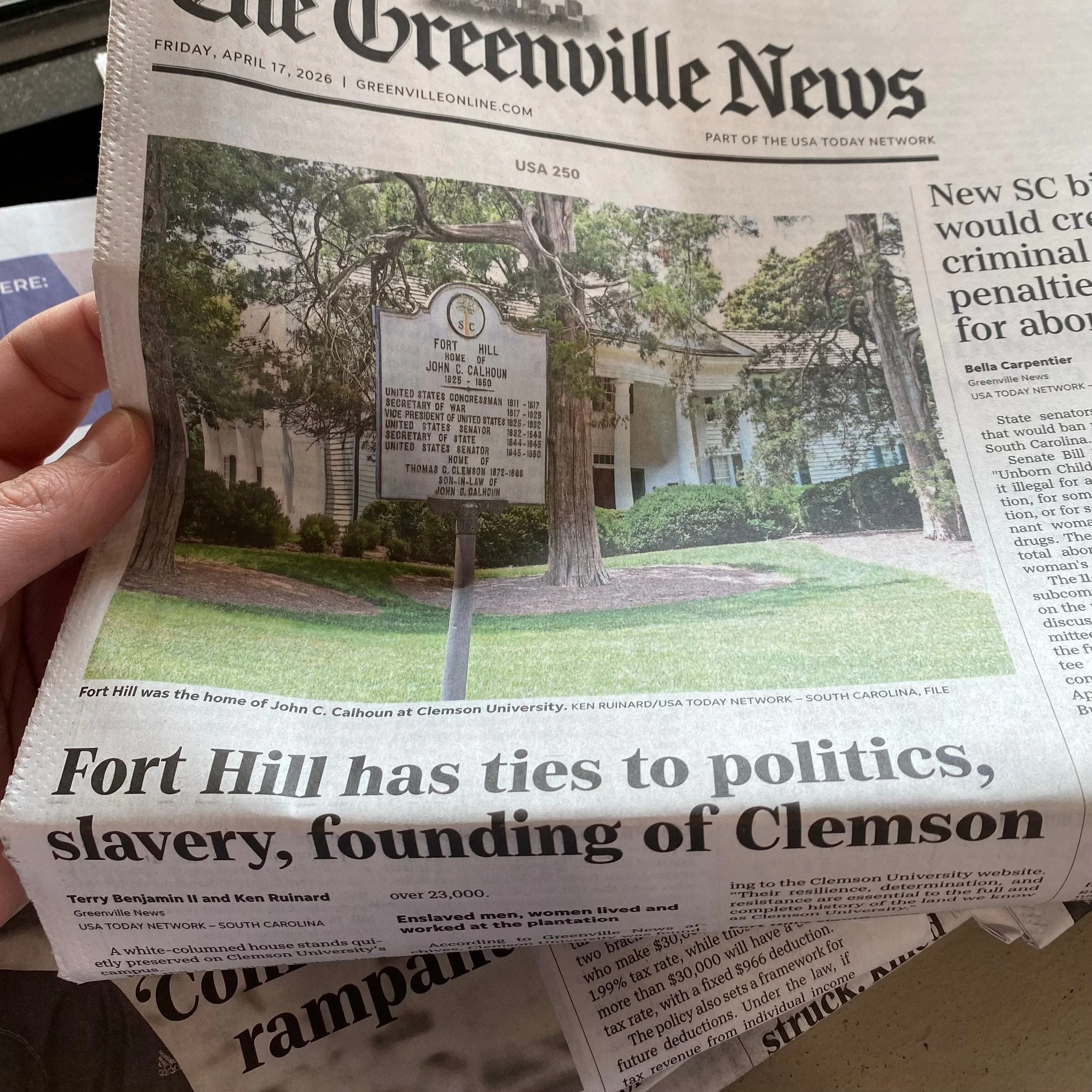
Fort Hill is the name of the plantation house now situated on the campus of Clemson, a few hundred feet away from where I spent grad school in Hardin Hall. It belonged to John C Calhoun, one of the most influential politicians—and one of the only important American political theorists—of the Republic’s second generation. His son-in-law, Thomas Green Clemson, bequeathed the former plantation property to the state for the creation of an agricultural college, which was founded the year after his death in 1888. So one could rewrite the Greenville News’s headline like this:
Plantation house of former congressman, senator, Secretary of War, Secretary of State, and VP John C Calhoun on campus of Clemson University has ties to politics, slavery, Clemson.
The only headline I’ve ever seen that exceeded this one in obviousness was in the New York Times in 2021: “With the Suez Canal Blocked, Shippers Go Around Africa.”
My chief question when looking at the original headline was “Who is this for?” Anyone who attended Clemson (and cares about the university for more reasons than football) already knows this, as do locals and anyone interested in upstate history. The paranoid part of my mind, which I usually hold firmly in check, perked up: was this meant as some kind of agitation for the legions of outsiders swarming into the area? A certain kind of newcomer to the South, a devout worshiper at the altar of the genetic fallacy, loves to discover “ties” that they can be outraged about. I’ve seen it happen.
I actually drafted a version of this post sitting in my kids’ car line Friday afternoon, right after seeing this newspaper lying on a lonely shelf in a Spinx. But before I could post it I began to doubt myself. I had skimmed the article just enough to roll my eyes at the predictable appearance of the circumlocution “enslaved people,” which I’ve picked apart here before. Had I misremembered the headline? Was this actually a front-page, above-the-fold article, or had I seen an accidentally separated travel section?
Well, that newspaper was still sitting there Saturday when I stopped at that same Spinx on the way to the dump. I made a point of doublechecking: it was a front-page story, and I hadn’t misremembered the headline. But looking through the whole article, I finally discovered what it really was—a poorly put-together travel article for a USA Today history initiative called USA 250, assembled mostly from spare parts of previous Greenville News items. The online version of the article makes this clearer without the apparent intent to stir something up: “How to visit historic home at Clemson University.”
The paranoid part of my mind could be safely returned to its cage. The truth was both more mundane and sadder: that print headline was an attempt to inform trying a bit too hard to be interesting. (Though the same article, shared on the paper’s Facebook page, did attract the following comment from one Boomer: “Calhoun bigot and racist.” Speaking of the obvious and predictable.)
Nevertheless: a slow week at the Greenville News. And people wonder why newspapers are dying.