
The Wendigo
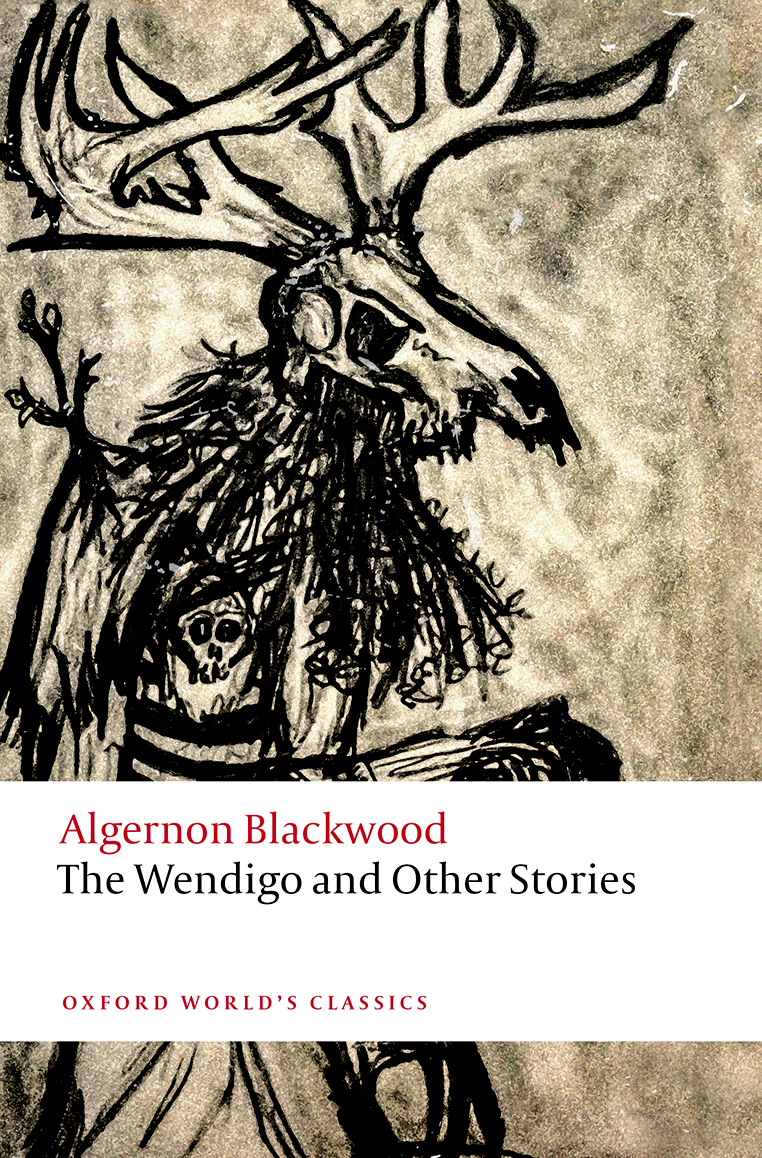
/Every Christmas we get the kids new calendars for their rooms. Typically we pick national parks or historic sites, but last year we thought the boys would enjoy a worldwide cryptids calendar—Bigfoot, Nessie, the Kraken, the Chupacabra, and the like. The boys greatly enjoyed it until this summer, when we turned to a new month and a new image: the Wendigo, giant, antlered, and skull-faced, lumbering through a dark forest on warped legs. One of the twins hated it so much we ended up turning to the next month weeks ahead of time (Fairies, for some reason assigned to Germany), meaning they had almost two months of August.
A silly thing, but it piqued my interest in the monster and I sought out the story that introduced this fixture of some Indian folklore to a mass audience, Algernon Blackwood’s 1910 novella The Wendigo.
Set among the dense forests and mazes of rivers and lakes in northwestern Ontario, The Wendigo is related secondhand, the unnamed narrator retelling a story told him by Dr Cathcart. A Scottish expert in the still-new field of psychology, Dr Cathcart has taken his nephew Simpson to Canada on a hunting trip. With two Canadian guides and an Indian cook the Scots work their way deep into the wilderness hunting moose only to be disappointed. The hunting is bad that year, and after considering their options, Dr Cathcart and Simpson decide to split up for a few days.
Leaving Punk, the Indian cook, at the camp, Dr Cathcart heads off in one direction with one of their guides. Simpson, fresh out of seminary and visiting Canada for the first time, travels with the other, the French Canadian Défago, an “imaginative and melancholy” man who knows the area, its hunting, and its lore well. They cross long lakes by canoe and travel inland through dense forest for days. Simpson is a novice woodsman and relies entirely on Défago, and so when they make camp one night and Défago, who senses and intuits far more than Simpson can perceive, catches a strange, foul scent on the breeze, his reaction terrifies Simpson.
Défago turns sullen and silent, refusing to discuss what the smell means or indicates to him. After the two bed down in their tent for the night, Simpson awakes to find Défago in a panic, trembling and muttering. Something is outside the tent, something enormous, something with an indescribable “singular odour,” something that bellows out a long, loud, terrible sound before calling Défago’s name.
Défago flees the tent. Simpson, barely resisting his panic, follows his tracks until the oppressive darkness and the gigantic, unidentifiable tracks alongside Défago’s send him back to the tent in terror. Unfortunately for him, the night and his trials have just begun.
I don’t want to describe any more of the story, but it involves voices in the sky, deformed feet, a long vigil by the campfire, and a visit from someone who looks like a friend. Only when Simpson, using what little knowledge of camping and trailblazing Défago had imparted to him, returns to the group’s camp after trekking alone for days does Défago’s fate become clear.
Or does it? The Wendigo exploits to the fullest the ambiguity of both Simpson’s experiences and his uncle’s narration. Dr Cathcart, remember, is a psychologist, and the narrator pointedly mentions that he wrote a book on shared hallucinations. But Dr Cathcart, who saw fit to tell this story to our narrator, also left this story out of his book and confesses near the end, when Simpson is pressing him to explain what had happened to him, that smells are less commonly hallucinated than sights and sounds. What to make of that?
“I make as much, or as little, probably, as you do yourself,” Dr Cathcart says, which our narrator follows with “He was not quite so glib as usual with his explanations.” As in so many weird stories and gothic tales, the man of science rushes to the limit of his knowledge and is forced to stop.
This ambiguity and the frame tale—another gothic staple—are a key part of the story’s effect, but the real power of the story is in its atmosphere. Blackwood, who spent years in Canada before returning to Britain, evokes the loneliness and potential terror of a night in the remote northern woods exceptionally well. The sensory detail—that “singular odour” on a cold light wind, the sunlight on the vast lakes, the snow, the crashing of something huge through the branches of the trees and the thumping of its feet as it approaches through the night—build into a suffocating sense of danger made all the worse by the fact that, whatever is out there, Simpson never sees it. It’s wonderfully done, one of the creepiest stories I’ve read in a long while.
But this being the age of Themes, I have to refute on something I saw on Wikipedia. The article on the wendigo cites a literary scholar’s argument that The Wendigo, through Blackwood’s “subtly-demonizing rhetoric[,] transforms the Wendigo from a native myth into a descriptive template for the Indian savage.” That is, The Wendigo is about the inferiority of Native Americans, and guilty of cultural appropriation to boot. This is stupid for three reasons: first, because cultural appropriation is ideological brainrot and inimical to all art and culture. Second, because Punk, the only Indian character in the story, is steady, capable, and also the only character with the good sense to leave when it becomes clear the Wendigo is nearby.
But finally and most importantly, the point of the story is to get a spook. It’s scary entertainment rooted in real places and folklore, and is “about” an ill-fated hunting trip. Expertly crafted and beautifully written, with a clear feel for the woods and how unsettling they can be, the story leaves the reader with enough questions to remain unsettled. Blackwood meant to entertain the reader and succeeded. Check your seminar table theory at the door.
The Wendigo is an enjoyable novella that offers creepy atmosphere, a weighty sense of dread—always a more powerful emotion to me than horror or the gross-out—and an imaginative, surprising story. It’s a worthwhile Halloween read and I’m glad to have finally gotten to it. I hope y’all will check it out. Our kids won’t be anytime soon.