The Long Traverse
/This year’s John Buchan June enters the homestretch with another curiosity. When I wrote about The Magic Walking Stick two weeks I go I was careful to note that it was Buchan’s only children’s book published during his lifetime. That’s because, at his untimely death in February 1940, in addition to having just completed his memoir Memory Hold-the-Door and his final novel, Sick Heart River, he was working on a new children’s book: The Long Traverse.
The young hero of this novel, Donald, is the son of a Canadian mining engineer. When the story begins, he has just left school on holiday and is excited to reach his family’s cabin in the forests of Quebec. His parents have given him permission to go a week early to prepare for their stay, which means a week of riding, hunting, fishing, playing in the woods and streams with his friends Simone and Aristide, local Indian children, and hearing stories from their uncle, Father Laflamme.
Donald is especially excited because he hates school. He resents his Latin lessons and finds history confusing and boring. He prefers the outdoors or, failing that, the movies.
When Father Laflamme learns about Donald’s lack of interest—especially his indifference to history—he discusses it with the family’s beloved Indian hunting and fishing guide, Negog. Descended from the priestly caste of the Cree, Negog thinks Donald should be open to learning from his ancestors and knows a secret method for commanding attention and teaching the stories of the past.
Every evening, after the day’s adventures, Negog ensures that Donald is near a body of water. As the sun sets, the fish rest, and the waters still to a mirror the cloudless golden sky, Donald experiences La Longue Traverse—visions of past events.
Day by day Donald meets the heroes of early Canadian history. He sees Jacques Cartier on his expedition to explore the St Lawrence River, Adam Dollard and his companions holding out against the Iroquois at the Battle of the Long Sault, voyageur Jean Cadieux and his last-stand against Indian attack, forgotten trappers, explorers, missionary priests, prospectors and miners, and ordinary people. My two favorite chapters concerned—unsurprisingly—the Norse exploration of the Canadian coast, in which Donald witness the long, hard expeditions of the fictitious Hallward, and a chapter set in the plains far from European settlement, where an Indian tribe, faced with enemies newly armed with the horse, trade for a yet deadlier weapon: the gun.
In The Long Traverse, Buchan combines the magic of his earlier children’s book with the story-made-of-stories setup of The Path of the King. Each story is engaging and exciting, and in the frame story that structures them Donald slowly learns more—and takes more and more pride and ownership—of his and his country’s past. Though he forgets the visions as soon as they end, the stories stay with him. In flash-forwards, his parents are astonished by the things he knows.
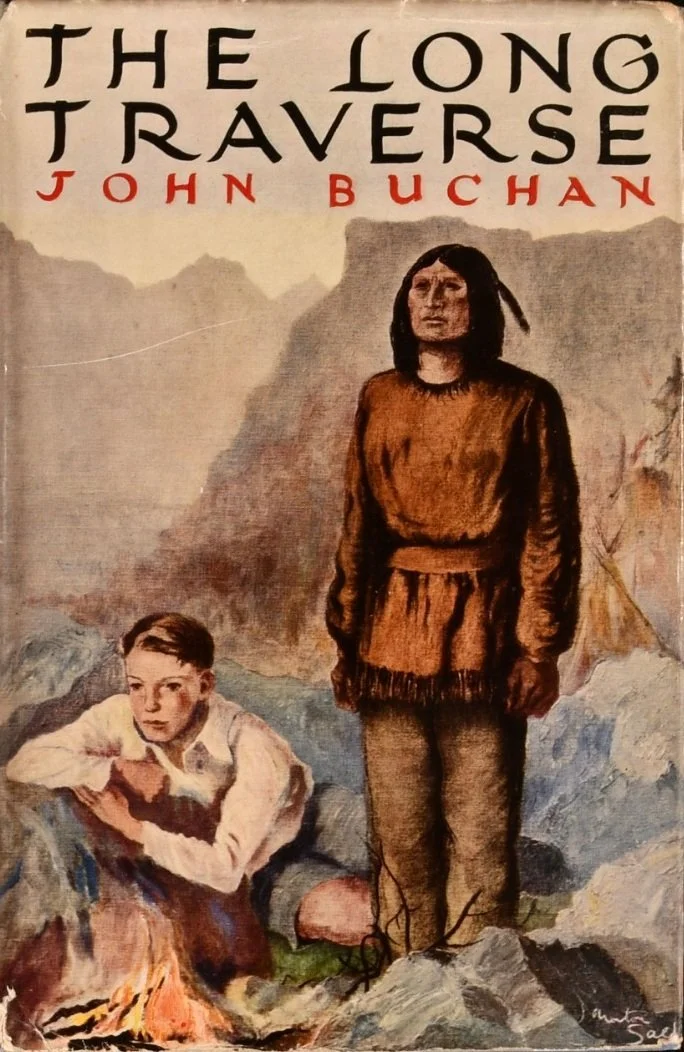
The subject matter is the stuff of adventure, but the true star of the book is the Canadian landscape. As with the best of his adventure fiction, Buchan conjures vivid settings and realistically describes them. The forested hills and lakes of Quebec are the most frequent locations, but the canyons and whitewater rapids of the Canadian Rockies, the endless plains, and the frozen coasts of Arctic islands also feature. Buchan describes all of this beautifully but does not leave out the unpleasant: heat, avalanche, dangerous rapids, and clouds of biting black flies. (The cover of the first edition, above, shows Donald sheltering by a lakeside fire built by Negog to keep the flies at bay.) The wildness and scale of the country, the hardships of daily life, and the hazards of travel—on foot, by horse, by canoe, by longship—demanded heroism of the people who lived there, and Buchan makes both feel real.
The Long Traverse ends suddenly after the story of a missionary priest’s eerie encounter with the Toonit, a population of relict prehistoric people not unlike the Picts of Buchan’s early short story “No-Man’s-Land.” Buchan was almost finished with the book when he died, and though the individual stories are wonderfully absorbing and readable—I read the book in two days—Donald’s story is left unresolved. A note by Buchan’s widow, Lady Tweedsmuir, explains the original conception and purpose of the book and a little of what Buchan left in outline at his death.
During his time as Governor-General of Canada Buchan came to love the country, not only its vast and varied landscapes but the peoples who lived there. (This comes across quite clearly in this 1937 New Years’ greeting.) He found its history fascinating, full of romance and figures worthy of emulation, and Canadian schools’ methods of teaching that history abominable. The textbooks, as he saw it, were more likely to kill than to encourage interest in the past. One sympathizes.
Donald is Buchan’s imaginary typical Canadian schoolboy, full of talent and potential but lacking direction and already let down by the schools. Negog and Father Laflamme sense that Donald is vulnerable, that, on the verge of manhood, his character is at a crucial moment in its growth, and that the cities and movies strive against the rootedness in the past that Donald and all of us need. Negog, as a Cree a figure of the past and as a Christian Canadian a figure of the present, puts him directly in touch with that past. Understanding one’s history, Buchan forcefully shows, is not only a duty but an important step in moral formation.
It is also interesting and fun. The stories Donald sees in The Long Traverse are all exciting, and Buchan envisioned them as a way to awaken the imaginations of young students. Thus awakened, they would be open to instruction. (It certainly worked on me; I learned a lot either reading or reading about the subjects of these stories.) He rightly understood that telling interesting stories about the people of past beats any state-approved textbook. The imagination must come first—a lesson still worth learning and remembering.