A Defence of Slang
/John Gardner begins his posthumously published On Becoming a Novelist with a consideration of the things that constitute “the writer’s nature.” The first item on his list is “verbal sensitivity.” This is not, Gardner points out, the same thing as grammatical accuracy: “Good grades in English may or may not go with verbal sensitivity, that is, with the writer’s gift for, and interest in, understanding how language works.” On either side of the verbally sensitive lie the dangers of the “tin ear” and the prescriptivist “stickler,” whom it is easy to imagine as a schoolteacher with a ready red pen:
given this distaste for linguistic change, or perhaps distaste for certain classes of humanity, the sophisticated stickler may dismiss without thought an ingenious and sensitive use of the suspect word or phrase. The true artist's verbal sensitivity may well be different, in other words, from that of the usual “writer of good English.” Black street kids playing “The Dozens”—piling up ingenious metaphorical insults of one another’s mothers, not all of the metaphors grammatical or unmixed—may in fact be showing more verbal sensitivity than the speechwriters who helped create the image of John Kennedy.
A point that has stuck with me since first reading this twenty years ago. And eighty years before Gardner, Chesterton made much the same argument in “A Defence of Slang.”
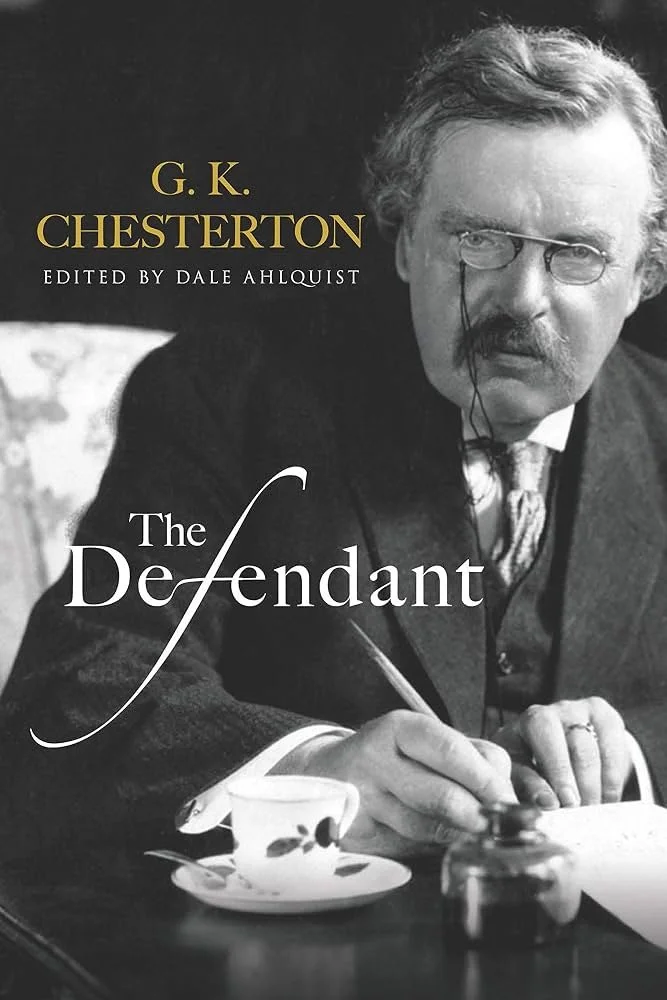
Consideration of class is only an aside in Gardner, but Chesterton’s starting point. The upper classes of his day, he asserts, have abandoned their duty to be vivacious and interesting. By comparison with their medieval forbears, who “could not write three legible letters, but . . . could sometimes speak literature,” their talk is lifeless and limited: “it is like the formless cries of animals, dimly indicating certain broad, well-understood states of mind. ‘Bored,’ ‘cut up,’ ‘jolly,’ ‘rotten,’ and so on, are like the words of some tribe of savages whose vocabulary has only twenty of them.”
The duty and privilege of bold and poetic language has, according to Chesterton, passed to the lower class. Where the wealthy might speak in “a mere string of set phrases,” the working man, “being filled with the Muse,” might “burst out into a solid literary effort”:
“You’re a gen’leman, aren’t yer… yer boots is a lot brighter than yer ‘ed... there’s precious little of yer, and that’s clothes... that’s right, put yer cigar in yer mouth ‘cos I can’t see yer be’ind it... . . .” and so on. It is evident that this mode of speech is not only literary, but literary in a very ornate and almost artificial sense. Keats never put into a sonnet so many remote metaphors as a coster puts into a curse.
One thinks of the elaborate facility with swearing of the military man. Watch the boot camp scenes from Full Metal Jacket again sometime and keep track of the rhetorical devices Gunnery Sergeant Hartman uses: irony, simile, synecdoche, anaphora, parallelism, and especially hyperbole, all with vivid, concrete images that both register immediately and are remembered. The endless invention of slang—often effortless and energetic, and the more energetic the more effortless—is art. To return to Gardner’s example, it’s not hard to imagine Chesterton enjoying the verbal play of “The Dozens,” especially the classic: “Your mama’s so fat, when she sits around the house she really sits around the house.”
Chesterton’s one serious point in “A Defence of Slang”—that the aristocracy lost its color when it ceased being a warrior class, and the lower classes now have have become colorful because they “live in a state of war”—is something of a truism. Affluence and artificiality sap the vitality of a society. Its manners, enjoyments, and its language degrade, and as I argued when writing about Heretics over the weekend, Chesterton loved the organic, the intuitive rather than the purely rational, and the lively. While highbrow poetry would enter a permanent state of recursive self-awareness not long after Chesterton wrote, the poetic instinct survived elsewhere: “The one stream of poetry which is continually flowing is slang.”
Not that all slang is wholesome—far from it. And perhaps the starkest difference between Chesterton’s world and our own is the degraded, unimaginative quality of slang at all levels of society. Even the operatic constructions of Gunny Hartman have given way to pervasive use of monosyllables.
But “[a]ll slang is metaphor, and all metaphor is poetry,” and, like penny dreadfuls, the crude slang of the lower classes of Chesterton’s day and—where it survives—in the present meets a human need:
It is unfortunate that the poetry which is developed by this process should be purely a grotesque poetry. But as the higher orders of society have entirely abdicated their right to speak with a heroic eloquence, it is no wonder that the language should develop by itself in the direction of a rowdy eloquence. The essential point is that somebody must be at work adding new symbols and new circumlocutions to a language.
As Chesterton famously wrote elsewhere, “if a thing is worth doing, it is worth doing badly.” You could even take that line as the belated thesis statement of The Defendant.
This particular essay is mostly Chesterton having fun, praising the lower classes for their “light, living, and flexible slang” and calling on our betters—either by birth or by presumption—to get over themselves and be more interesting, but his perceptiveness and insight also reflect well on himself as the appreciator of just such slang. As Gardner would write eighty years later, “though some great writers may at times write awkwardly, it is nevertheless the case that one sign of the born writer is his gift for finding or (sometimes) inventing authentically interesting language.”
Not a bad description of Chesterton, and this essay is good evidence for it.