Heretics
/
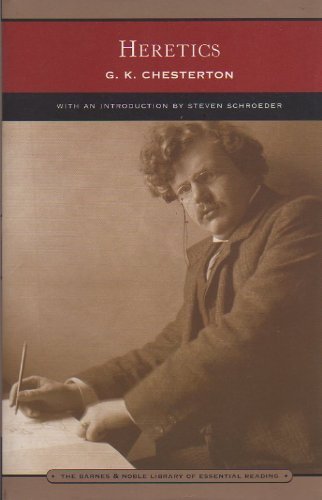
Critics and even some fans of Chesterton have tried to fault him with many defects in the ninety years since he died, but I’ve never seen anyone call him a coward. The early nonfiction work with which this abbreviated Chestertober continues today, Heretics, published when he was only thirty-one, offers an excellent sample of his willingness to disagree, to argue, and to name names.
Heretics is a bold title. The Edwardian world, Chesterton thought, was beset with harmful doctrines embraced by the powerful and influential. These are not merely differences of opinion but heresies, partial apprehensions of the truth that prove more damaging than indifference to it. Chesterton attacks many of these by focusing on the work and views of their most prominent spokesmen or on their manifestations in popular culture like painting and novels.
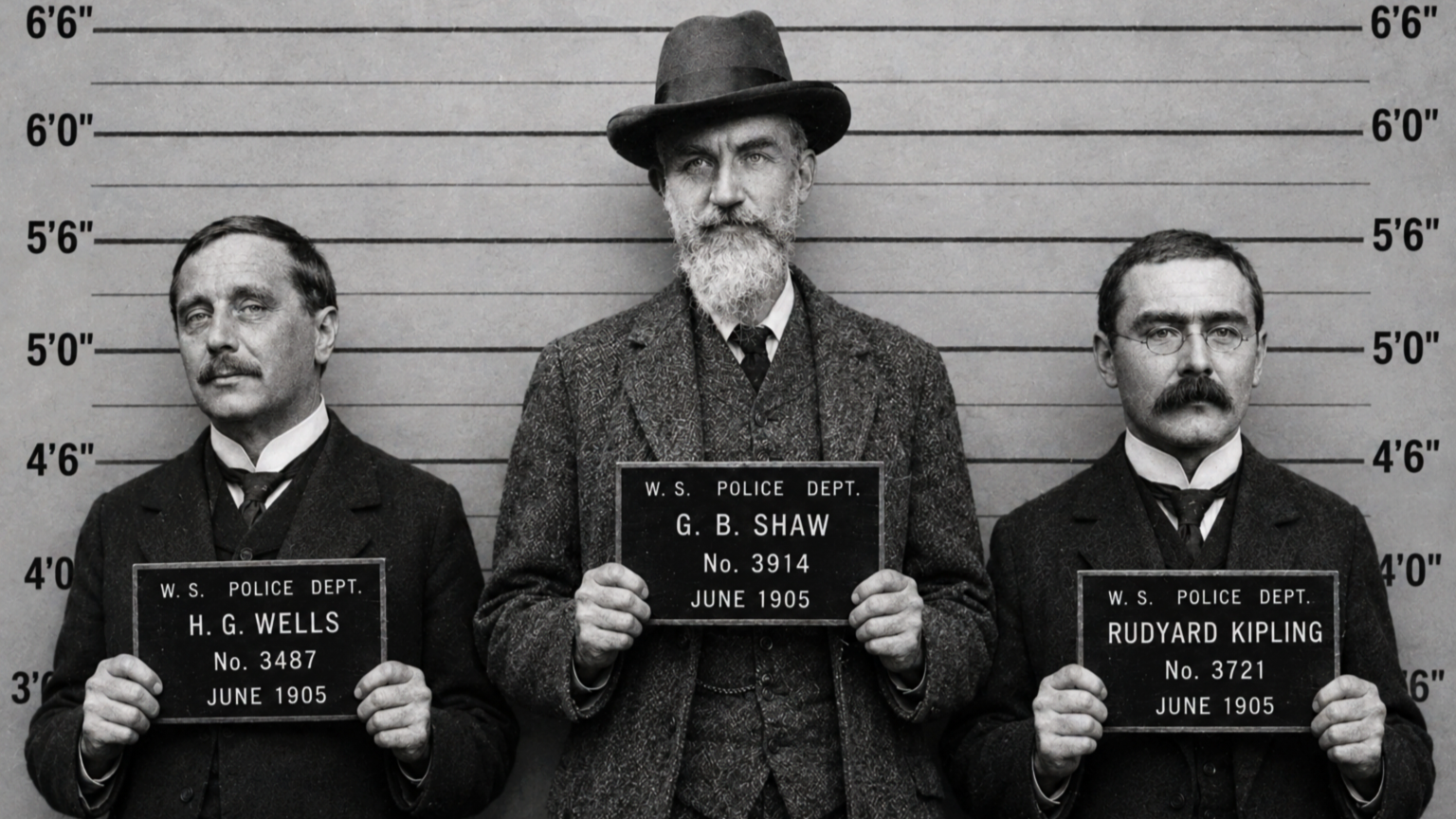
There are twenty essays, and they range widely. Among the heretics are names that remain famous like Rudyard Kipling, HG Wells, James McNeill Whistler, and George Bernard Shaw, and many more that have been forgotten to most of us: George Moore, Joseph McCabe, Olive Schreiner, Lowes Dickinson. Among their heresies: a deracinating globalism, a Nietzschean worship of power and will, journalism that substitutes cheap sensationalism for the real sensationalism of telling the truth, praising the metaphorical “youth” of “young nations” that already show signs of decay, the prideful assumptions of anthropology, novelists toadying to the rich, novelists presuming to represent the poor, scientific reductivism, pragmatism, militarism, nationalism, neopaganism, atheism, lack of a sense of humor, pride.
Heretics is much too complex and diffuse to summarize easily. A chapter-by-chapter breakdown, especially if including asides and subordinate arguments, would run to thousands of words. But what all of Chesterton’s critiques have in common regardless of target is an objection to the simplifying tendency of ideologies. Each view, whether the scientism of Wells or the art-for-art’s-sake amorality of Whistler, offers to make sense of the world according to some easy-to-use heuristic, and each fails either because it is founded on a misapprehension of the truth that warps one’s entire perception, or because it forces fragments of the truth to stand in for the whole.
And so those trying, in Chesterton’s day, to revive a pagan ethic do so out of a belief that ancient pagans were unencumbered with the guilt imposed by Christianity and “were continually crowning themselves with flowers and dancing about in an irresponsible state.” Actual paganism was diffuse, devoted to inscrutable gods, and sad, the pagans ironically being “praised as disobedient when they had only one great virtue—civic obedience” and “envied and admired as shamelessly happy when they had only one great sin—despair.” Remove religion and ethics from the question and focus on genetics and race, and one has the jingoist ethno-nationalism of the late 19th and early 20th centuries, “that silly Teutonism which knows as little about England as it does about anthropology, but which is always talking about Vikings.”
Sometimes the heresies seem to be opposites—a point Chesterton does not draw attention to, but which would go on to be an important part of his argument in the sequel to Heretics, Orthodoxy. In two interesting chapters on the fiction of his day, Chesterton criticizes novelists who flatter the pretentions of millionaires and aristocrats by making them sharp, witty, and urbane and their seeming opposites, novelists who explore the plight of the lower classes and depict them as degraded, helpless, even monstrous. Chesterton will abide neither obsequiousness to the rich nor condescension to the poor, neither of which is democratic in the sense of men conceiving of themselves as equals or brothers. Even “hereditary despotism” is to be preferred to managerialism under such types, “because with that you have the ordinary man misunderstood and misgoverned by some prig who has no brotherly respect for him at all.”
In addition to being untrue, these heresies also—as the above examples demonstrate—tend to make their adherents pretentious. This comes across clearly in perhaps the most entertaining and purely Chestertonian essay, “On Mr McCabe and the Divine Frivolity.” Former Catholic priest turned freethinking gadabout Joseph McCabe had, in an aside in one book, reproached Chesterton for writing about serious subjects lightheartedly. Chesterton’s opening salvo is still laugh-out-loud funny:
It is quite useless to talk about profane jesting. All jesting is in its nature profane, in the sense that it must be the sudden realization that something which thinks itself solemn is not so very solemn after all. . . . It is not I; it is not even a particular class of journalists or jesters who make jokes about the matters which are of most awful import; it is the whole human race. If there is one thing more than another which any one will admit who has the smallest knowledge of the world, it is that men are always speaking gravely and earnestly and with the utmost possible care about the things that are not important, but always talking frivolously about the things that are. Men talk for hours with the faces of a college of cardinals about things like golf, or tobacco, or waistcoats, or party politics.
Tellingly, it is humorlessness and pride that provoke Chesterton’s sharpest jabs. He respects all the other heretics in this book—and names them because he respects them as sincere men—but the puffed up, he implies, lack the honesty and humility to argue with him, or be saved.
First published in the summer of 1905, Heretics was assembled from some of Chesterton’s columns for the London Daily News. They vary greatly in length and detail and the subject changes sometimes dramatically from chapter to chapter. What keeps them from becoming a hodgepodge, a mere collection of essays, is Chesterton’s inimitable cheery tone, consistent conceptual overlap and recurring themes between chapters, and his already coherent worldview.
Chesterton’s highest formal schooling before becoming a journalist was the Slade School of Art, which is worth remembering because his sensibilities are above all artistic. He knew the marriage of hard work and pure enjoyment that sets the artist apart from the dabbler (“[t]he artistic temperament is a disease that afflicts amateurs”) and hates the squandering of natural talent on self-serious intellectual projects—as when he praises the “violent vision” of Wells’s early science fiction novels before tracing his descent into drab works of “scientific” history and social theory—and the blinkered imagination of the ideologue. Where Chesterton critiques the abstractly rational, the scientific, and the calculated, he favors the humble and common sense and argues for the organic, traditional, and intuitive, all of which are neighbors to the mystical.
Again, these points prefigure key elements of Orthodoxy.
The joy of his personality is key in a book like this, which in other hands would be twenty chapters of invective. Chesterton is charitable toward his “heretics” throughout, even to the humorless, and does not attribute base motives to them or suggest they are part of a conspiracy to bring down Western Civilization. A true happy warrior, he weighs them case-by-case, praises them where they deserve it and criticizes in a spirit of friendly correction. Their errors have helped him see the truth, and he wants to share.
Heretics is a lively critique and a perceptive survey of informed, fashionable opinion in Chesterton’s time. Though not straightforwardly an apologetic work, its arguments against the heretics and their heresies suggest the outline of an alternative, which he names in the introductory and concluding chapters: orthodoxy.
Heretics was well-received in its time even if, 120 years later, we agree with Chesterton biographer Ian Ker that it is a “major, if not great work.” What keeps it from being among the shortlist of Chesterton’s greatest hits and what poses the book’s biggest obstacle for the latter-day reader is precisely his strength as a journalist and a critic of his peers—his topicality. Kipling, Shaw, and Wells may still be familiar names to modern readers, but their social and philosophical ideas are likely to be less well-known. Lesser lights like McCabe or Moore or Dickinson, the politicians Chesterton namedrops (of whom probably only Arthur Balfour may now ring a bell, and likely not for good reasons), or those, like Whistler, known purely for images, are mostly forgotten.
I last read Heretics during grad school at Clemson sixteen or seventeen years ago. Many of the names were unfamiliar then but I got the gist. Rereading it now I know much more about Chesterton’s world, but there were still many names that sent me to Google for more detail. To get the most out of Heretics, one needs an annotated edition—with the disruption to the flow of Chesterton’s argument that that potentially entails—or preexisting knowledge of the period.
And yet—no matter what, Chesterton’s wit and fundamental arguments shine through. A modern reader may not know or remember much about Teutonism or Celticism now, but they’ll recognize the simplifying impulse of racial or class or gender essentialism of all kinds and all political stripes. A modern reader may not recognize the trend of novels about witty aristocrats, but they’ll know movies and books that flatter a certain kind of knowing irony or cynical, unsmiling flippancy, especially among our present elites—office drones, politicians, techbros. Try to read the following without thinking of Aaron Sorkin’s characters:
This new frivolity is inadequate because there is in it no strong sense of an unuttered joy. The men and women who exchange the repartees may not only be hating each other, but hating even themselves. Any one of them might be bankrupt that day, or sentenced to be shot the next. They are joking, not because they are merry, but because they are not; out of the emptiness of the heart the mouth speaketh.
The heretics have changed but the heresies haven’t. As Michael Ffinch argues in his biography of Chesterton, the book is “at its best . . . not so much when he was attacking the ideas of men like Shaw,” whom readers may or may not know much about, “but more when he was attacking some of the fads of the time, and in as much as some of these have remained fads until our time, Chesterton’s comments are still relevant.”
Heretics seems an unlikely book to remain relevant, but it’s true. It is also, like all of Chesterton’s books, immensely quotable. I’ve tried to avoid quoting the most famous passages here, but one in particular suggests itself for the end of this review:
Hope is the power of being cheerful in circumstances which we know to be desperate. It is true that there is a state of hope which belongs to bright prospects and the morning; but that is not the virtue of hope. The virtue of hope exists only in earthquake and, eclipse. . . . For practical purposes it is at the hopeless moment that we require the hopeful man, and the virtue either does not exist at all, or begins to exist at that moment. Exactly at the instant when hope ceases to be reasonable it begins to be useful.
A paradox worth remembering both in Chesterton’s age of heretics and ours.