Theo of Golden
/An elderly Portuguese man arrives in a picturesque Georgia college town. He is cultured, courteous, friendly but meditative, and clearly independently wealthy. Taken with the pencil portraits hanging in a coffee shop along the downtown thoroughfare, he buys them up in batches, finds the subjects one by one—janitors, accountants, musicians, a homeless woman—and gifts them to them, soliciting their life stories and changing a few lives along the way. And he has secrets, several of them.
The old man is Theo, the town, closely based on Columbus, is Golden, and his “bestowals” of the portraits to the people of the city are the story of Theo of Golden, the runaway word-of-mouth bestseller of the last year.
Theo of Golden the novel has, like some other famous books, become entangled with its publication history. Its author, Allen Levi, a musician and former judge from Georgia, self-published the book several years ago. Its reputation grew slowly thanks to the praise from readers who loved it and exponentially increasing word-of-mouth sales. I first heard of it last year at GJ Ford, our favorite local bookstore in St Simons Island, where the owner urged my wife to read it—and this was before it had been picked up by a traditional publisher. By the last time I checked a few weeks ago, it had sold millions of copies. Millions. This is one of the great self-publishing success stories, and I’m genuinely glad for Levi.
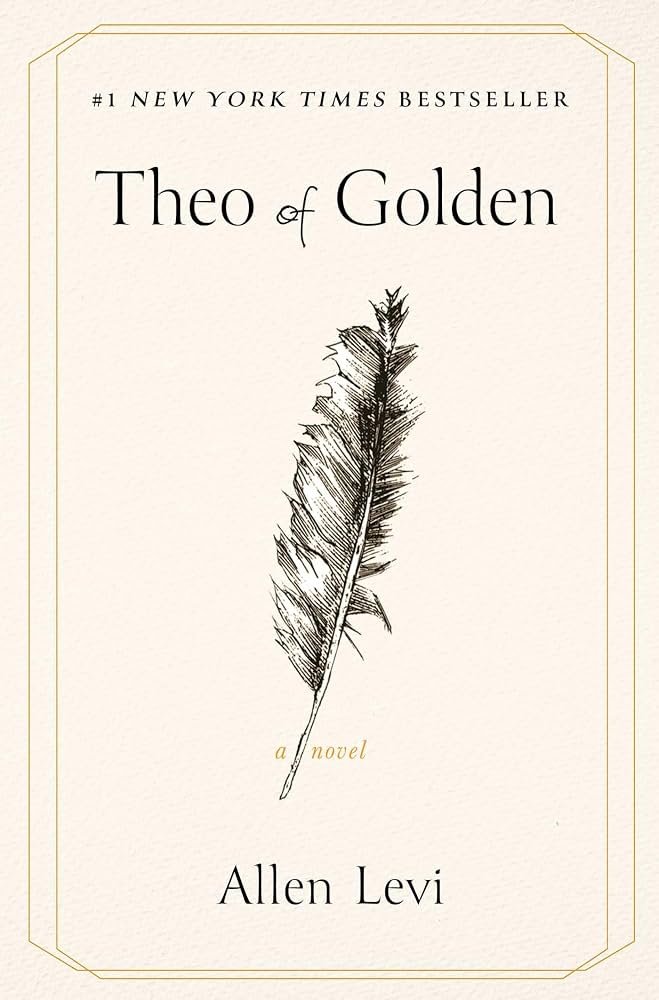
And I’m also glad to say it’s enjoyable. Theo is a well-drawn character and the story’s hook, the “bestowals” of local artist Asher Glissen’s portraits, is intriguing. Levi evokes the thriving New South town, with its shaded riverwalk, tree-lined main street, and seasonal rhythms built around tourism and college semesters with precision and affection. The story, with its emphasis on art, loss, family, faith, and redemption, aims to uplift and inspire.
That surely accounts for the book’s success. In a field crowded with trauma and grievance and general self-absorption, a book about living for others and bringing beauty into darkness has met a need the traditional publishers didn’t even know was there.
As soon as I finished reading it to my wife last week I set the book aside and, even through the drowsiness our bedtime reading is supposed to ease us into, we mulled over what we thought of it for probably twenty minutes. I’m thrilled for Levi’s success, did not mind reading it, and recognize why people love it, but it’s good, not great. Theo of Golden—enjoyable, uplifting, gentle to a fault—is fine. What my wife and I were trying to figure out is exactly why that is.
Whatever criticisms I have come from liking the book and seeing how it could have been better, not hating it. But even before finishing the book I saw a few savage negative reviews, perhaps the beginning of the kind of backlash all such successes provoke. I want to start with those, because I found the most negative reviews the most wrongheaded and oblivious to what keeps Theo of Golden from greatness.
First, Theo of Golden is not terribly written. I was prepared for that, self-publishing being what it is, but Levi’s straightforward, mostly unadorned style is perfectly clear and readable and better than plenty of traditionally published books I’ve read. There are none of the usual tells for amateur fiction: no bad strings of adverbs, clunky overreliance on participle phrases, embarrassing dialogue tags, or spatially incomprehensible descriptions of settings. Even the rare passages that strain themselves reaching toward lyricism fail not out of tastelessness but in overreach. He’s not Evelyn Waugh, but no one was asking him to be.
Then there’s hyperbole. Theo of Golden is not—cannot be—the worst book anyone has read in twenty years. (This writer also thinks there’s only one black character in Theo of Golden. I’m not sure why that would be a mark against it in the first place, but while Levi isn’t explicit about most of the characters’ races there are at least five black characters, including two of the core group that grows up around Theo. Pay attention, even to books you hate.)
Then there are matters of taste. I’ve seen reviews calling it predictable, its final revelations about Theo and his mission obvious. I didn’t find it so, though my wife guessed Theo’s identity about a quarter of the way through. Others objected to the novel’s Christian themes, but that is not an artistic critique and changing or omitting those themes would have gutted the book.
I hate to see a book criticized for bad reasons—or even praised for the wrong reasons—so I decided to review Theo of Golden out of a desire to defend it. But I also wanted to sort out exactly what I think doesn’t work in the book. Potential spoilers ahead.
The fairest criticisms I’ve seen are that Theo of Golden’s characters are too thin and the whole book is too sentimental. These two problems are linked, but one is more serious than the other.
I want to point out that not all of the characters are thin or flat. A number of the major characters who become Theo’s friends are well-realized, the best—or at least my favorite—being Tony, the bitter old Vietnam vet who owns the downtown bookstore. A wry skeptic, his talks with Theo deepen realistically from banter to heart-to-heart vulnerability, and he follows a subtle but believable arc prompted by their friendship. A late chapter in which Theo and Tony share a bottle of port may be the best in the book.
Other characters are less rounded, but that’s normal. Novels concentrate on a central set of major characters with side characters of diminishing importance and complexity. In all his cast, Levi only gives us one bad character: Pearce, Asher Glissen’s younger brother and the father of a young professional who receives one of Theo’s first gifts. Pearce is a caricature of a selfish businessman—loud, rude, constantly glued to his phone. He stands out among Levi’s cast because the others, if not complex, are believable and recognizable types.
No, Theo of Golden’s most serious fault is its sentimentalism. I don’t mind the sentimental myself, Lord knows, but sentimentalism weakens this novel in two interrelated ways.
First, by trying too hard to tug at the reader’s heartstrings. Another of Theo’s early bestowals goes to Kendrick. See if you can feel the point at which his situation starts to feel manipulative: Kendrick is a janitor at the local university and a young single father, his wife having been killed in a car accident that also injured their daughter, a faultless angel who is only ever sweet and who may be permanently disabled if she cannot get a necessary surgery soon. In case that’s not enough, we learn later that the car accident was caused by an illegal immigrant, and Kendrick, who must testify at the man’s sentencing, asks Theo for advice. It turns out the immigrant was only in Georgia illegally because his daughter in the US was in the hospital with cancer. Kendrick sees himself in the man and asks the judge for leniency.
Or consider Ellen, the middle aged homeless woman Theo befriends. She has a non-specific mental problem, sleeps under a bridge, and obsesses over her bicycle, which she refuses to let out of her sight, even in church. She is also a bookworm and—almost unconsciously—peppers her conversation with quotations and literary namedrops. Theo learns that, decades before, she had given birth in South Carolina and had her baby taken away by the state. You can probably guess what the end of her arc is.
Both of these situations present a lot of dramatic potential, only some of which is followed through on. In Kendrick’s case, the sentimentalism extends not only to himself but to the illegal immigrant who killed his wife. Of course Kendrick will forgive him. This is supposed to be a moment of grace, but Levi makes the man so sympathetic and pitiful that it becomes easy for Kendrick to forgive him. Imagine if, instead of an illegal immigrant with a cancer-stricken daughter, a local white trash boy high on meth had caused the accident. If grace means anything, it means forgiving the undeserving, but that’s not the situation Theo of Golden invites us into.
Similarly, Ellen is only ever a lovable eccentric. Her bicycle and her quotations and her sudden lurches in conversational topic are the severest symptoms of her illness. Levi gives her none of the off-putting, difficult, even dangerous qualities of real homeless and mentally ill people; she is simply there to be funny and affecting and to jerk tears with her backstory.
On a number of occasions I called this “overegging the pudding” or “laying it on too thick,” and this is nowhere more obvious than in the novel’s Calvary moment. (Again, spoiler warning.) Theo, awake with insomnia after a triumphant concert by the young cellist he has taken under his wing, hears Ellen being attacked outside by drunk college students. They steal her kooky hat and try to throw her bicycle in the fountain where Theo has carried out his bestowals. The cellist comes to the rescue, but the college boys beat him, smash his cello, and break his hand. Theo, distraught, trying to get their attention from the balcony of his apartment, falls to his death.
It is both moving and simply too much. Just as Kendrick’s situation would be more compelling if it were harder for him to forgive—a scenario we’d all be more likely to encounter—Ellen’s victimization would be more moving if she had proven harder to love, if Theo and everyone else had had to struggle more to bring her into their lives, and if Simone the cellist weren’t so carefully, icily calculated a victim, too.
That’s my biggest problem with Theo of Golden. I’ve dwelt on these subtle but fundamental flaws, but it is a good read and worthy of its success. I do not begrudge anyone their enjoyment of it the way I would a book by Dan Brown or the latest scummy romantasy, and I’ll certainly read the next book Levi writes. This is a smooth and easy read, vividly imagined, peopled with mostly believable and recognizable characters, emotionally involving, and, as Nadya Williams argues here, beautifully dramatizes the way mere mortals can help each other grow in saintliness simply by loving God and each other. But, as I wrote above, it’s gentle to a fault, and if it were to challenge a bit more than it endears, it would make its point much more powerfully.