Gordon Wood, RIP
/I was sorry to learn of the death of the great historian of the American Revolution, Gordon Wood, two days ago, and even sorrier to learn of the circumstances. Aged 92, he deserved a better ending, but none can doubt he leaves behind a great scholarly legacy. Since his death I’ve seen lots of tributes and recommendations of his most famous books—the kind large enough to be called tomes, influential enough to be called monumental, magisterial, definitive—but I’d like to acknowledge a small personal debt and recommend a less celebrated book.
When I graduated from Clemson sixteen years ago I received an MA in European History. I had taken Dr Edwin Moïse’s class on Vietnam as part of my focus on military history, Dr Rod Andrew’s seminar on American historiography as an elective, and read the late Sir John Keegan’s then-new The American Civil War: A Military History but otherwise didn’t touch US history—and hadn’t since my sophomore year of college. But at my very first teaching job as an adjunct at Greenville Tech my department head plopped a US History I course in my lap.
If you’ve heard that the best way to learn something is to teach it, it’s true. Completely. I learned more about American history over that first year or so than in all my studies up to that point. For the first time I began to form a coherent overall picture of everything from Columbus and Jamestown to Appomattox. Part of the joy I discovered in teaching—which I never could have predicted I would end up doing for a living—was the feeling of suddenly getting it, of the material clicking for me. A large part of my work since then has been communicating that joy to my students.
But I had a healthy self-doubt and didn’t want to fall prey to Dunning-Kruger. I knew enough to know how little I knew, and spent a lot of time checking myself, probing for gaps and holes in the narrative I was perceiving and presenting, and wanting to make sure I was getting things right.
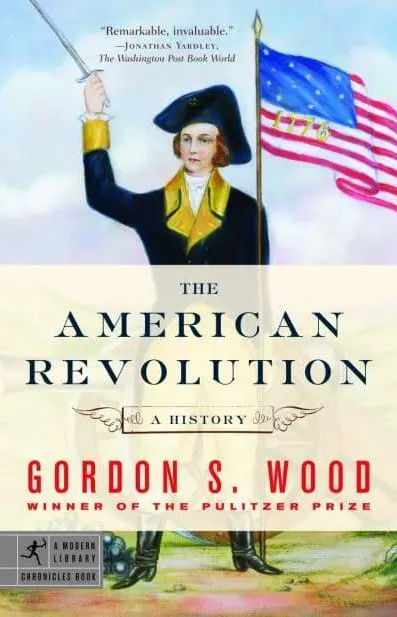
This is where Gordon Wood comes in. I have a lot of those famous books that I’ve read or dipped into as needed—The Radicalism of the American Revolution (c. 450 pages), Empire of Liberty (c. 780 pages), and The Purpose of the Past (300 pages on historiography)—but as I taught the Revolution for the first time I picked up his little 200+ page survey for the Modern Library Chronicles series, The American Revolution: A History.
This book was a godsend—short, well-written, approachable, and measured. The great test of the historian is to be both comprehensive and brief, and Wood demonstrated that favorite insight of Herbert Butterfield, that “The historian is never more himself than when he is searching his mind for a general statement that shall in itself give the hint of its own underlying complexity.” I still recommend it to students who want a good scholar’s take on the Revolution but don’t want to tackle the 800-page behemoths popular among buffs.
But most importantly, it reassured me. Over and over I read in Wood what I had arrived at and presented to students. I was not comforted that Wood agreed with me, but that I had worked my way into a position that accorded with a great authority. I was doing something right. I hadn’t lost my way among the details as I scrambled to form a big-picture interpretation. Wood settled my anxiety that, having been forced to return to American history, I could and understand and teach it. His work gave me confidence and made me a better teacher. For that I’m still grateful.
Gordon Wood, scholar, writer, and teacher, RIP.
I highly recommend The American Revolution: A History if you’d like a short, readable introduction to the topic (something I’m always interested in for any subject in the hopes of recommending it to students). For a valuable recent service from Wood, here’s his critique of the 1619 Project. And for a more personal appreciation and reminiscence from a former PhD student, here’s Clemson’s C Bradley Thompson on how Wood, who was his dissertation advisor, shaped him as a scholar.