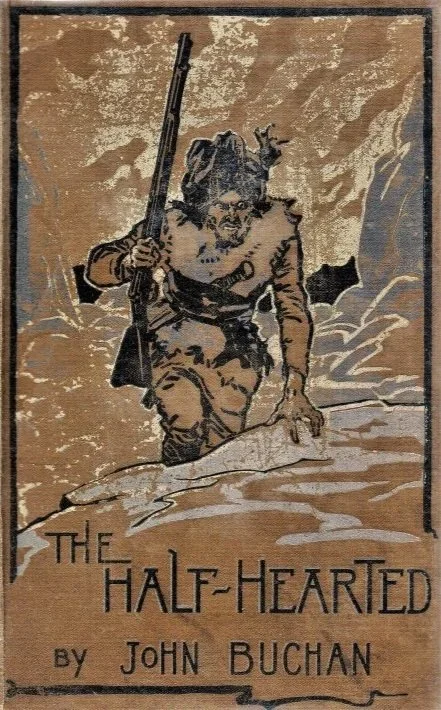
The Half-Hearted
/This fifth John Buchan June continues with The Half-Hearted, Buchan’s earliest novel with a contemporary setting, a story that ranges from Scotland to the mountains of northern India and concerns politics, espionage, love, and the tragedy of missed opportunities.
The Half-Hearted, appropriately, takes place in two parts. In the first, a young Scottish laird named Lewis Haystoun returns to his homeland after years abroad. He is beloved on his estate and among the locals and famous throughout the British Empire for his recently published travel book about the uncharted mountains of Kashmir. While fishing one day he meets Alice Wishart, the daughter of a successful merchant who has moved to the area. Alice had read Lewis’s book before moving to Scotland and has heard great things of him from his family and friends. Lewis and Alice are both smart, adventurous, and independent, and their attraction to each other is immediate.
And yet they never quite synchronize their attraction. Every time they meet some awkwardness intrudes—a misstep in manners, or Lewis, not wanting to appear too forward, erring on the side of formality, which suggests indifference to Alice, or some other misunderstanding. Their interest in each other survives, but only barely, and each missed opportunity further damages their shared hopes and Alice’s high regard for Lewis.
Further complicating matters, Lewis has a rival, Albert Stocks. Alice meets Stocks when she first arrives in Scotland and he shows immediate interest in her, but Stocks, a Radical politician, is a dull, unimaginative plodder. He is unattractive without being repellant, boring without being rude, and, above all, persistent.
Worse, Stocks defeats Lewis in an election. Lewis had only been convinced to run as a candidate by his more political friends, who appealed to his sense of duty. His obvious unwillingness to run and poor performance while campaigning almost convince Alice of his lack of courage and commitment—what she refers to as half-heartedness.
The story of Alice, Lewis, and Stocks reaches its climax during a picturesque country outing. While climbing a headland above a moorland pool, Alice and Lewis begin to connect at last, but the bank gives way beneath Alice and she falls into the river. Lewis, startled, does not react in time. Stocks does. Plunging instantly into the river, he hauls Alice to safety. Lewis, though thankful for Alice’s rescue, resents Stocks and blames himself intensely for that moment of unpreparedness and hesitation. Perhaps he is a coward, one of the half-hearted.
It’s this event—and that moment—that drive the first half of the novel to its conclusion and lead Lewis into the second.
In Part II, some of the geopolitical problems Lewis’s friends discuss offhandedly in Part I bring Lewis back to Kashmir. Thanks to his previous travels and familiarity with the area, he has been recruited for an intelligence-gathering mission. The authorities have already heard rumors of tribal disturbances and potential frontier uprisings and the Russians on the other side of the impassable, as yet unmapped interior mountains are reportedly massing troops. With the British army spread thin and consisting mostly of sepoy troops in small, vulnerable outposts, the imperial authorities need to know what precisely is going on, and need to know soon.
Forlorn and hopeless, as Lewis and Alice were only able, at last, to speak plainly to each other about their love once it was too late, Lewis hopes to redeem himself here, to show himself driven and courageous and capable of the unhesitating self-sacrifice required of the full-hearted man. Kashmir, where he made his name, will give him ample opportunity. This time he will not miss it.
The Half-Hearted was published in 1900, when Buchan was twenty-five and recently graduated from Oxford. It is shorter and more tightly plotted than his two previous books, the historical adventures John Burnet of Barns and A Lost Lady of Old Years, and is unusually psychologically acute. Buchan’s characters were always believable but seldom presented with such scrutiny of their thoughts. The vicissitudes of Alice and Lewis’s failed courtship, especially the reversals of Alice’s feelings with each new obstacle and misunderstanding, are realistically painful. These two people would be perfect for each other—would be.
The first half of the novel, though well-plotted, moves slowly, while the second half blazes past. Neither of these observations is a criticism—I enjoyed The Half-Hearted at a leisurely pace (which is why there was an uncharacteristic delay between this month’s first review and this one). Buchan’s nature writing is especially beautiful and the comedy of manners playing out in the upper class drawing rooms and moorland picnics of Scotland was enjoyable to imagine. There is even some humor, as when a nouveau riche visitor proves herself a bigger snob than the actual aristocrats. Fans of Richard Hannay will also appreciate the brief appearance of a Lady Clanroyden, whom one must assume is Sandy Arbuthnot’s mother.
That said, Buchan’s abilities as an adventure and thriller writer are apparent in the shift from Part I to Part II. Once Lewis has returned to Kashmir and received his mission, the novel steadily intensifies right up until the moving final pages. The intricacies of frontier espionage, the grueling nature of long-distance travel, the hazards of mountaineering, and the heroism of the desperate last stand all factor in, and all are thrilling.
It’s striking how much of Buchan’s later work is prefigured in The Half-Hearted. With a brave, noble character who willingly takes a loss for the sake of a woman and enters into realistically dangerous espionage work, I was reminded of Buchan’s underappreciated interwar novel A Prince of the Captivity. Its emphasis on the role of the lone, capable, honorable man racing against time is familiar from any number of other novels, from Prester John and The Thirty-Nine Steps to Midwinter and even Buchan’s more literary work like Witch Wood. Most resonantly, its plot of a man seeking redemption from his failings on a selfless task in a far-off rugged land bring to mind Buchan’s final and most moving novel, Sir Edward Leithen’s swansong, Sick Heart River.
The Half-Hearted is not as good as any of those later books but still has unique qualities that recommend it, not least its doomed romance. It is impossible to read about Alice and Lewis without feeling the agony of their near miss. While not rising to the level of Buchan’s best work, The Half-Hearted is an enjoyable read and an interesting early meditation on themes Buchan would elaborate and improve upon for the next forty years.