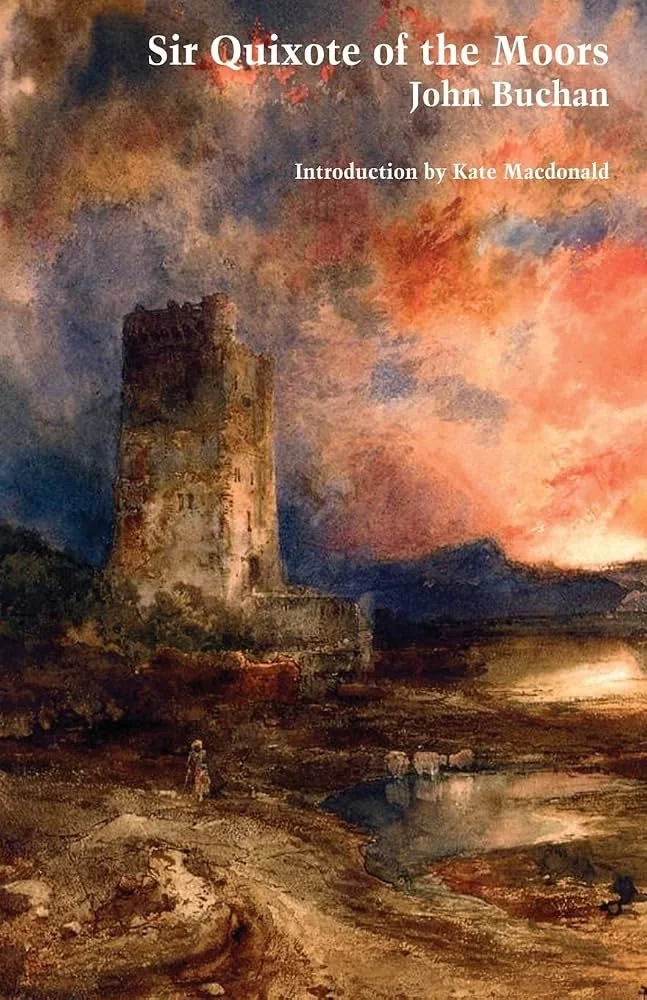
Sir Quixote of the Moors
/The first John Buchan June ended with Buchan’s final novel and one of his masterpieces, Sick Heart River. In a pleasing bit of symmetry, this fifth John Buchan June concludes with his first published book—and the last novel I hadn’t read since beginning this event: 1895’s historical novella Sir Quixote of the Moors.
Ten chapters and barely eighty pages long, Sir Quixote of the Moors is a brisk historical romp designed to pose the hero an unsolvable dilemma. I usually avoid major spoilers in these posts, but since this is a brief story aimed inexorably at its climactic chapter, I will reveal the ending. Avoid spoilers if you choose. But it’s a good story and good stories are spoiler-proof, and I’ve tried to leave out some of the details that make reading it rich and enjoyable.
Set in the Scottish Borders in the 1680s, Sir Quixote is a story of “The Killing Time,” when the Scots Covenanters were subject to pursuit and slaughter by forces loyal to King Charles II. The narrator is an outsider: Jean de Rohaine, a French Catholic nobleman who has come to Scotland on the invitation of an old Scottish schoolmate, who had promised military adventure. After days of carousing, Jean departs with his host on their first assignment, which turns out to be burning Covenanter farms and killing women, children, and old people. Jean, his sense of chivalric honor outraged, leaves his host on the spot.
He has acted on principle but his choice proves foolishly imprudent—a dynamic that will return. He doesn’t know his way back to the port where he entered Scotland and gets hopelessly lost on the moors. He is betrayed by an innkeeper working as an informant for the authorities and only the honorable conduct of one of his pursuers allows him to escape. Lost, hungry, on the run, and exhausted by the wind, cold, and rain, he throws himself on the doorstep of the next house he comes to.
This proves providential. Jean has cast up at the manse of an aged minister of the persecuted Covenanter church, who lives there with his daughter Anne and her fiancé, a laird named Henry Semple. They care generously for him in his distress but no sooner has he begun to recover than the minister and Henry are forced to flee into the wilderness. They leave Jean to protect the house and Anne, trusting in the sense of honor that first brought him to them.
Jean is as good as his word, driving off a party of government thugs hunting for Henry in one scene and attempting, through his charm and skill in the courtly arts of music and dancing, to help Anne pass the time while she awaits Henry’s safe return. The latter has an unintended effect, though. In trying to help Anne cope with Henry’s absence, he wins her over, and he feels himself falling in love with her as well.
When Henry reappears, starving and crazed, on the run again after his hiding spot has been betrayed and with news that Anne’s father is nearing death, Jean reaches a crisis. He cannot honorably act on his feelings for Anne, and remaining with her will only deepen the affection and attraction growing between them. But leaving her orphaned, her likely future a marriage to a madman—if Henry even survives—seems to be a failure in his duty to take care of her. Memories of his own lost love arise to accuse him, and in the final pages he makes his terrible decision. He flees.
There is more to it than that, but that’s the main arc of the story. In her introduction to the edition I read, Buchan scholar Kate Macdonald interprets Sir Quixote as a story about religious extremism. I think that’s a necessary element of the setting but not Buchan’s point. Jean’s dilemma pits his passion against his honor, the opportunities his situation opens to him against his constancy and good faith, his feelings for Anne against promises made to the one she, in turn, had promised herself to.
If this story were told today—and it has been, over and over—it could only end, with utter, tired predictability, one way. Buchan does something more interesting, but without comforting platitudes. Jean’s honor runs deeper than slogans, and when he makes the hard and unsatisfying choice Buchan does not ignore or conceal the pain of his decision: “‘But honour is more than life or love,’ I said, as I set my teeth with stern purpose.” And, in the next paragraph: “though all my soul was steeled into resolution, there was no ray of hope in my heart—nothing but a dead, bleak outlook, a land of moors and rain, an empty purse and an aimless journey.”
Virtue may be its own reward, yes, but that reward is not gotten lightly. Buchan makes the reader feel it. This, as with so much else in Buchan’s work, was surprising and refreshing.
Sir Quixote of the Moors is clearly an early work. The twenty-year old Buchan’s style has not yet balanced the sturdy clarity, archaism, and dialect he so skillfully intermingled later, and the characterization is—unsurprisingly in a book of less than eighty pages—thin. The characters are believable but not deep. But Sir Quixote also foreshadows much of the mature Buchan’s strengths as a writer: fast pacing that doesn’t feel rushed, smoothly incorporated historical detail, the palpable “moral atmosphere” praised by Sir John Keegan, and, most especially, beautifully and vividly described settings. The Borders locations familiar from so many of his other novels have never felt colder, more miserably rainy, or less forgiving.
This is an enjoyable romp and a piece of juvenilia most writers could be proud of—or at least not embarrassed by. But Buchan himself consistently denigrated it, beginning with the pre-publication proofs, which he found unsatisfying to read. Thirty years later he attempted, unsuccessfully, to prevent its being republished. Part of his attitude toward Sir Quixote may be the result of lessons learned. No good author looks back at early work without seeing tics and habits one is grateful to have grown out of. Buchan similarly dismissed his next book, his first full-length novel, John Burnet of Barns.
But another, more intriguing dimension of Buchan’s attitude toward this book may be the path it took to publication. Buchan, a young author (an “intimidatingly precocious” one, per Macdonald), had his title changed by the publisher. Originally called Sir Quixote, they added of the Moors and the cumbersome subtitle Being some Account of an Episode in the Life of the Sieur de Rohaine. Buchan also complained of the poor binding.
That’s bad enough, but then the American edition—which may have been pirated, though the details are still murky 130 years later—added two sentences to the final page. In this extra paragraph, Jean reverses himself and heads back for Anne.
This addition, apparently meant to give the book a happy ending, must have come from an illiterate editor because it completely undoes Jean’s story and misunderstands Buchan’s purpose behind it. At least one biographer has suggested that Buchan may have been asked to provide the extra lines, but it’s impossible to imagine Buchan accepting this change. With all this in mind his later attitude toward the book is suggestive.
The book’s background is interesting, and it also reveals a young author with enough tenacity to weather a bad first experience in publishing and keep going, but Sir Quixote of the Moors is still worth reading for its own sake. Simple, short, not especially deep but emotionally involving, and with many of the virtues of its author’s later work, it is more than a curiosity. It’s a fun and moving short story and, knowing as we do what treasures its author would gift us over the next forty-five years, an invitation and a preview. Sir Quixote is a worthy final read in this five-year journey.
* * * * *
Thanks again for another great John Buchan June. It’s both fun and a little melancholy to read the last unread Buchan novel after five years. As I said recently in a podcast interview about this project, if I had planned to read and write about all of them I never could have done it. But this has been a wonderful five years and, with all of the novels read and a handful of the non-fiction, I need to decide how to continue.
Likely I will read Buchan’s major biographies. As I mentioned at the beginning of the month, I had intended to read Oliver Cromwell but daily life impinged and I didn’t have time. That may be a good place to start for next year. I may also revisit the small handful of books I found underwhelming—Mr Standfast, The Courts of the Morning, The House of the Four Winds—and give them another shot.
But be assured, John Buchan June will return. Thanks for joining me. Your readership, notes, and e-mails have meant a great deal. I hope y’all have a good July and can enjoy at least one of the books I read this year!