Buchan’s Augustus
/To my surprise and joy, today marks the beginning of my fifth John Buchan June here on the blog. When I began this project five years ago it was a bit of a lark, a way to reclaim my birth month from other, more obnoxious themed celebrations. Since then it’s become a major part of my reading and intellectual life, has put me in touch with some wonderful people, and has become one of my favorite seasons of the writing year.
As I’ve run short on Buchan’s novels—I hope to cover the last few I haven’t read this month—I’ve branched out into his short stories and non-fiction. In the last couple years I’ve read two of his short biographies: a literary-critical introduction to Sir Walter Scott and a pithy, elegant little life of Julius Caesar. Today I start John Buchan June with one of Buchan’s best full-size biographies: Augustus.
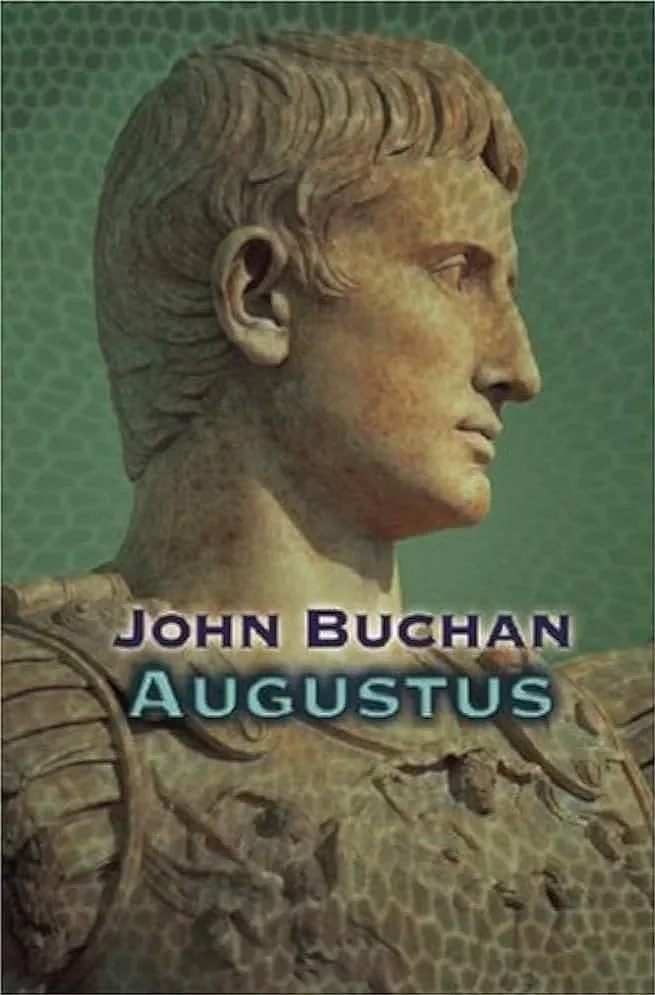
I won’t recapitulate Augustus’ life in detail here. Buchan begins with the boy Octavian, whose background of an unassuming equestrian ancestry and close relation to the most charismatic and powerful man of the day would prove surprisingly advantageous in the aftermath of Caesar’s assassination. Named his adopted son and heir in Caesar’s will, Octavian seemingly came from nowhere but was well-connected enough—thanks to those family ties to Caesar—and sober enough—thanks to that middle-class upbringing—to step into the role and navigate its numerous immediate hazards.
Among these were the courting of his favor and largesse by numerous people with ulterior motives and the rivalry created with Mark Antony, one of Caesar’s most trusted subordinates, the moment he was named as heir. Caesar’s assassins were still at large and fellow-travelers like Cicero, respected by the senatorial partisans and implacably hostile to Antony, hoped to use moral suasion and appeals to tradition to bring young Octavian to their side. But Octavian and Antony reconciled, revoked the amnesty given to the assassins, and proscribed political enemies they had formerly shielded from each other. A bloodbath ensued, “the darkest stain upon Octavian’s record.” Cicero was murdered, Brutus and Cassius killed themselves following military defeat, and Rome passed beyond the possibility of restoring the Republic.
Perhaps, anyway. That’s a what-if game that Buchan doesn’t really play, which is appropriate to his subject. He presents the future Augustus as canny and cautious, a man whose lack of imagination served him well in a situation too complicated and treacherous to treat with romance or fantasy.
This becomes most apparent in the latter half of Augustus, after civil war has again broken out, Octavian has defeated Antony and Cleopatra, and offered to relinquish his dictatorial power only to have it reaffirmed and expanded by the Senate. Now the Princeps, first citizen, he begins what to Buchan is his true work—rebuilding, restructuring, shoring up, and strengthening for the long haul.
Two things distinguish Augustus as both a biography and a work of literature. The first is Buchan’s scholarship. Those who rate Buchan as a mere entertainer and skilled craftsman of adventure stories miss an important aspect of the man. Deeply educated in and passionate about the classics, his knowledge of Greek and Roman literature informed his entire life and undergirds even his fiction—most obviously in novels about relict paganism like The Dancing Floor or Witch Wood but also in the education, moral framework, and long historical perspective shared by his heroic characters.
But his love of the classics was not limited to ready quotations or the encyclopedic familiarity of the amateur. He had a sharp understanding of historiography. In the preface of Augustus he explains his use of the available sources, their biases and limitations, and makes his judgments clear throughout. He uses them critically, carefully dissecting and comparing in order to construct as true a picture of events as possible—not with the intense ideological skepticism to which we have grown accustomed in many of our classicists—and complements the literary sources with the latest findings from the still-growing fields of archaeology and papyrology. Augustus, as a work of history, is meticulously constructed and judicious in its use of evidence. It holds up, and would pair well with a more recent biography by a scholar of similar sensibility, like Adrian Goldsworthy’s Augustus: First Emperor of Rome.
Buchan’s scholarship, like his writing, is excellent but not showy. Several chapters late in the book offer thematic looks at the Empire under Augustus. One examines Augustus’s family and friendships, another the social and religious reforms Augustus, with limited success, attempted to institute, but the most interesting is an imaginary tour of the Empire from east to west. Buchan impresses upon the reader not only the geography of the Augustan world but the immense variety encompassed by it—ancient, thriving, desirable Egypt; the slightly past-prime glories of Greece; the villages and smithies of Gaul; rugged, fragmented Spain; the difficulties and dangers of travel by sea; and rumors of other faraway places like Britain and future troubles among the Germans beyond the Rhine and, much more subtly and of an entirely unprecedented kind, Judaea.
The second great strength of Buchan’s Augustus, and one of the traits that most distinguishes it from modern histories of the same period, is its pervasive emphasis on character. Personality, virtues, and vices matter to Buchan, as do the cultures that produce them. People are not ciphers moved about by sociological forces and statistical trends beyond anyone’s understanding. Choices are not an illusion, but reveal character and have consequences.
Augustus therefore abounds in incisive character sketches. I wrote last month about Buchan’s final assessment of Cicero, but his portraits of other key players like Brutus, Agrippa, Cleopatra—whom he rightly takes down a peg—the poets Virgil and Horace, Augustus’s wife Livia, his ne’er-do-well daughter Julia, the brutish, shortsighted Antony, and, late in the story, Varus enliven the story and drive its events.
Perhaps the two best are of Augustus’s lifelong friend, ally, and lieutenant, Agrippa, and of Augustus himself. Upon Agrippa’s death, Buchan sums him up not only as a skilled combat leader but an able logistician and administrator whose friendship with Augustus made everything the latter achieved possible and yet nursed no resentments or private ambitions. Indeed, Buchan notes that even “gossiping Roman annalists, who found specks on every other sun, never suggested scandal or criticism about his public or private life,” living simply and honestly even after victory over Antony and the rise of Augustus to undisputed preeminence. That Augustus could enjoy the friendship and loyalty of a man like Agrippa, Buchan writes, reflects well on both.
“Close-lipped, tenacious, cautious and yet intrepid, he is amazing, but he is not attractive. . . . He took desperate risks, but only after meticulous calculation. He is the least romantic of great men.”
As for Augustus, the book is his, and Buchan’s most compelling character sketch is that which emerges over the course of the entire book. The contrast with Julius Caesar, whose late career and death drive the early chapters and first bring Octavian to prominence, is striking. Where Caesar was stirring, robust, magnetic, and driven by almost visible flashes of genius, Augustus was physically brittle, cagey, cautious, and lacked imagination in the way one might enjoy poetry while never being carried away by a daydream. Crucially, this son of the workaday equestrian class was always ready for the long, arduous work of building and lacked the aristocratic Caesar’s ego and destructive simplifying impulse. The difference between the uncle and adopted heir was that between boldness and prudence. Buchan explicitly invokes Aristotle’s phronesis. “Close-lipped, tenacious, cautious and yet intrepid,” he writes, Augustus “is amazing, but he is not attractive. . . . He took desperate risks, but only after meticulous calculation. He is the least romantic of great men.”
Buchan published Augustus in 1937, shortly after being appointed Governor-General of Canada by King George V. Buchan’s long concern for the fragility of civilization and the hard work of governing, unblurred by any illusions about human nature, are at the forefront of this work. Having reluctantly accepted his new position but dutifully embraced its burdens, it is easy to see why the principled, nose-to-the-grindstone character of Augustus appealed to him. (I will also not be the first to point out that, like Augustus, Buchan suffered immensely from recurrent lifelong illnesses, another point of kinship.) The result is one of Buchan’s best non-fiction books. Augustus was both critically well-received, even being adopted as a classroom text by one of the classicists he consulted, and commercially successful.
Last year I took some issue with Buchan’s presentation of Julius Caesar. I think his portrait of Augustus, which is sympathetic and admiring but by no means uncritical, especially with regard to the compromises Octavian made to survive early on, is impeccable. Where Caesar manipulated and destroyed, Octavian inherited a mess and, as Augustus, made the best of it. Buchan’s assessment that it was only because of Augustus that something of Rome remained to be destroyed by the barbarians centuries later is traditional but surely correct.
Buchan avoids making Augustus about his own time—“History does not repeat itself except with variations, and it is idle to look for exact parallels,” a point I wholeheartedly endorse—but he does pause over the present in the final paragraphs. “Once again the crust of civilization has worn thin,” he writes, in words that will be familiar from early in his fiction career, “and beneath can be heard the muttering of primeval fires.” The problems of Buchan’s day were not new; Augustus had faced them before in different form. But what troubled Buchan was the willingness of many moderns to cast off the hard work of self-governance, to “experiment with unknown forces” like shameless wars of aggression as a means of strengthening society and the hitherto undiscovered science of racial purity, and to embrace mob politics and dictatorship.
Imagining a resurrected Augustus surveying the world in 1937, Buchan concludes on a chilling note: “when this expert in mechanism observed the craving of great peoples to enslave themselves and to exult hysterically in their bonds, bewilderment would harden to disdain in his masterful eyes.”
The same must certainly be true—with variations—ninety years later. This is reason enough to read Augustus, but that it is also a fine work of history, an insightful study of human character, and a brilliantly readable narrative from a great author are the chief reasons to seek it out, enjoy it, and learn from it.
* * * * *
As mentioned previously, I read Augustus in a reprint by House of Stratus, a publisher that seems to be defunct, but the entirety of Buchan’s book is available in a carefully presented online version from the University of Chicago, with helpful additional commentary and footnotes by the scholars who transcribed it, here. This by itself is a testament to the virtues of Buchan’s book.
I hope to read another of Buchan’s major biographies—likely Oliver Cromwell, which will make even tougher demands on my sympathies than Julius Caesar—before the end of the month. Stay tuned, and thanks for joining me for another John Buchan June.