No aristocracy worth its salt
/
This week Before They Were Live dropped a new episode on Moana 2, which I haven’t seen, but Michial and Josh’s discussion of the film’s manifold weaknesses got me thinking about one of the biggest flaws in Frozen.
A few years ago I ranted about the dam in Frozen II—a badly imagined piece of infrastructure that has no use beyond serving as a cack-handed metaphor for the film’s political message. But that dam is not the first useless thing affecting the plot of a Frozen movie. I want to look at the first film’s villain, Prince Hans, and more specifically Arendelle’s useless aristocracy.
Here’s the rub: Prince Hans arrives early in the film and he and Anna, Queen Elsa’s younger sister, fall instantly in love. He swans around in a secondary role for a while until the climactic twist: Hans does not love Anna and, as the youngest son of another kingdom’s dynasty, has deliberately insinuated himself into Arendelle’s royal family to await an opportunity to take over. With Elsa feared and effectively outlawed and Anna mortally wounded by Elsa’s ice powers, Hans refuses Anna the kiss that will save her life, tells the handful of nobles hanging around the court that she’s dead, seizes control of Arendelle, and leads the attempt to eliminate Elsa. Boo, hiss.
I’m heartened to learn that I’m not the first person to criticize Hans as a villain. Others have pointed out the thin to nonexistent foreshadowing of his ulterior motives and the fact that his actions earlier in the film are counterproductive to his plot. (He’s also, in keeping with the political valence of the dam in Frozen II, more of a feminist device than a character, but more on that later.) These are legitimate complaints but not my chief problem with him.
The biggest problem with Hans, his plot, and Frozen’s climax is Arendelle’s useless aristocracy. I actually use this as a negative example when lecturing on the medieval nobility in Western Civ. Imagine: the youngest son of a foreign royal family shows up in a kingdom just emerging from a regency and ingratiates himself with the princess who is second in line to the throne. And consider the climax, when Hans, the only person allowed to talk to the severely ill princess, appears and tells the leading men that Anna is dead. Somewhere else. Trust me, bros. And they do.
A real aristocracy would have sniffed out Hans’s intentions in about ten seconds. No aristocracy worth its salt would have missed this, or failed to act against it. They would have sworn oaths to Elsa and her family and had roles to play under her rule and with respect to each other, roles they would fiercely protect. They would have duties and prerogatives. If they had somehow let things get to the point of Hans announcing Anna’s death, they would have demanded evidence. Immediately. He would have been an object of suspicion from beginning to end. A Bismarck, a John of Gaunt, a William Marshal, an Eorl Godwin, or your pick of the Percys, Hohenzollerns, or Carolingians would have eaten Hans alive.
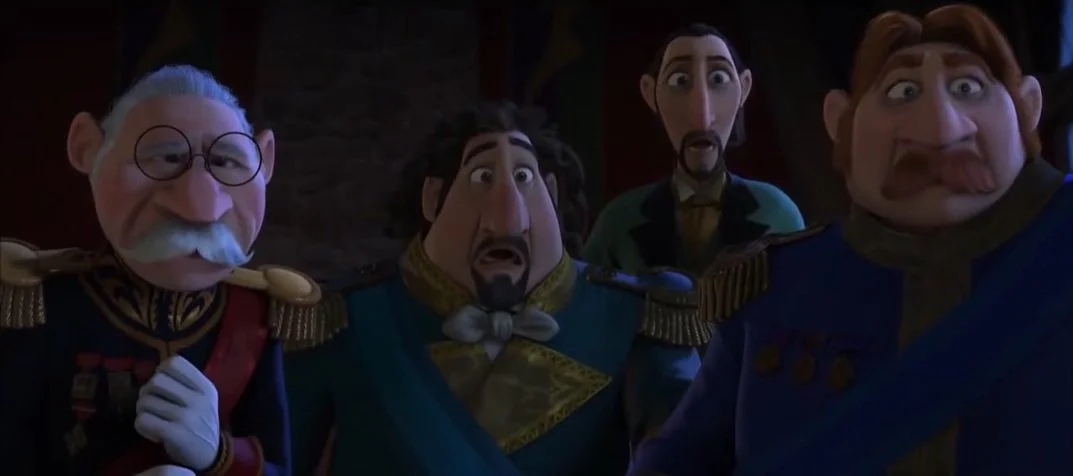
But Arendelle does not have an aristocracy worth its salt. There are only four other men in the room when Hans makes his bid for control and one of them is a foreign diplomat. The rest are nameless drones in uniforms and sashes. This curiously empty kingdom must be either an absolute monarchy, with Elsa at the top and no mediating ranks between her and the people, or have an unseen, unmentioned parliament that has reduced the monarch to a figurehead—which I strongly doubt, if Elsa’s throne is as desirable as Hans thinks it is.
You could try to excuse this as the necessary simplicity of a children’s film, but children’s films don’t have to be simple. It’s more a cliche born of a typical American incuriosity regarding nobility, Americans being incapable of imagining aristocrats as having functions and not just being privileged people who are excusable as targets of scorn and envy. Frozen’s feminist underpinnings are also a factor, feminist ideology—whatever the movement’s other merits—being a universal machine for making complex reality stupidly oversimplified. Google Prince Hans and see how often the cliche “toxic” comes up. He’s a powerful man and other powerful men are just going to trust him and follow him.
Again, study history, even a little bit.
Hans and the Arendelle nobility aren’t just unrealistic—though it’s fun to nitpick and, when I point this out in class, to see students recognize it as a flaw based on what we’ve learned about the past. The real problem is that the combined lack of imagination and ideological cliche evidenced in Hans weaken the story. Like the dam in Frozen II, he’s there to make a point and reinforce a message, not to live and breathe.
A real aristocracy—the kind that patronized the courtly love poets and commissioned altarpieces and cathedrals—wouldn’t have made this mistake.