Dr Johnson and General Oglethorpe
/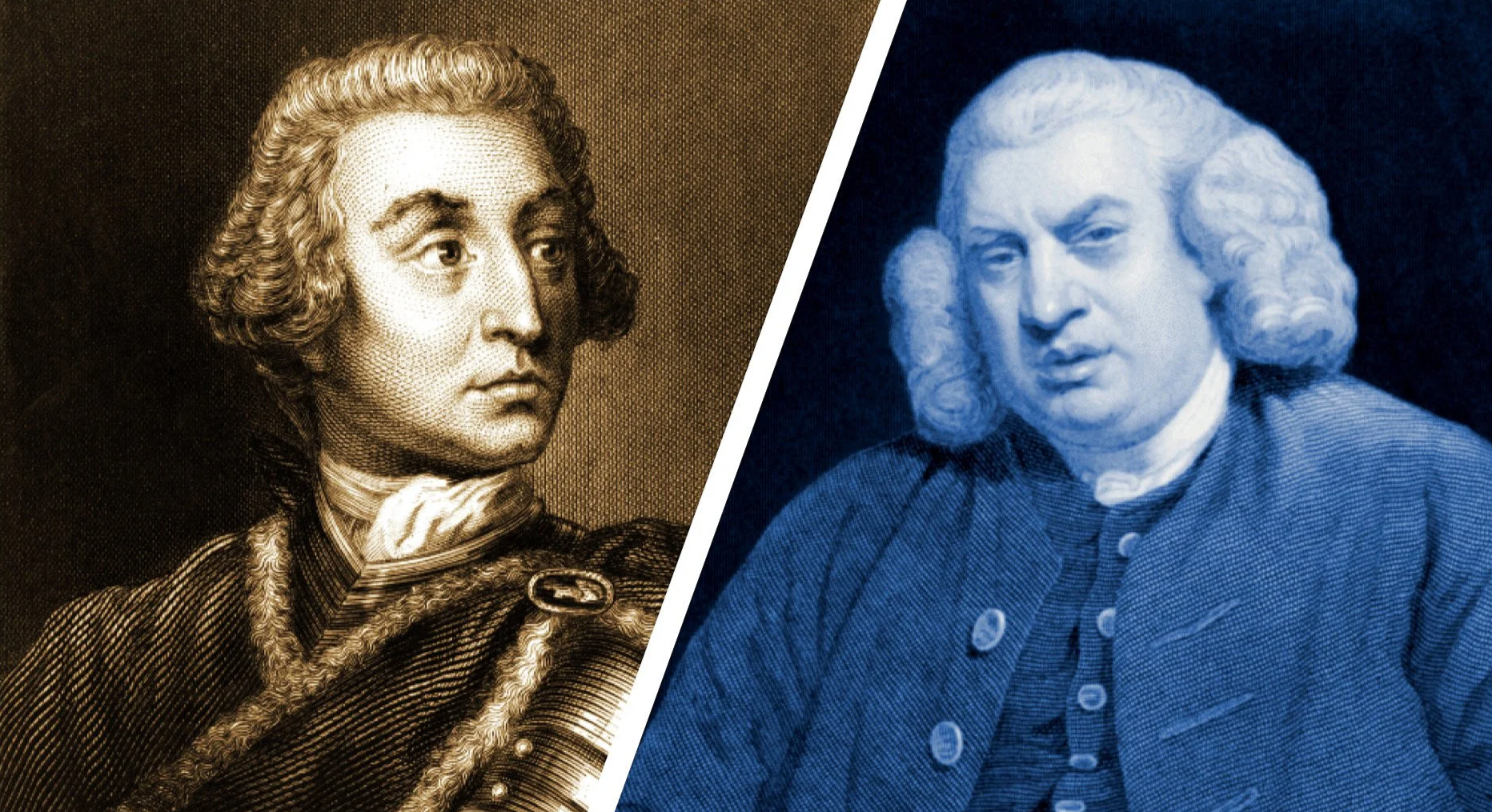
This week’s batch of The Rest is History is a four-episode series on Samuel Johnson, James Boswell, and their world. So far it’s a delight, and reflects well on Johnson. It also got me thinking about Johnson’s friendship with one of my heroes: soldier, humanitarian, and founder of Georgia James Oglethorpe.
I can’t recall how I first discovered their connection but it may have been through reading John Buchan’s Midwinter, a novel set during the Jacobite Rising in ’45 and in which both men appear. Possibly because of that, I dug into my copy of Boswell’s Life of Samuel Johnson and turned up a number of charming and tantalizing anecdotes about Johnson’s dinners at Oglethorpe’s house (and one in which Johnson unexpectedly hosts Oglethorpe).
I’ve been meaning to research this further but haven’t gotten around to it; what I can do is copy a few choice excerpts into this, my commonplace book, something I’ve been meaning to do for a long time. I hope y’all enjoy these as much as I have.
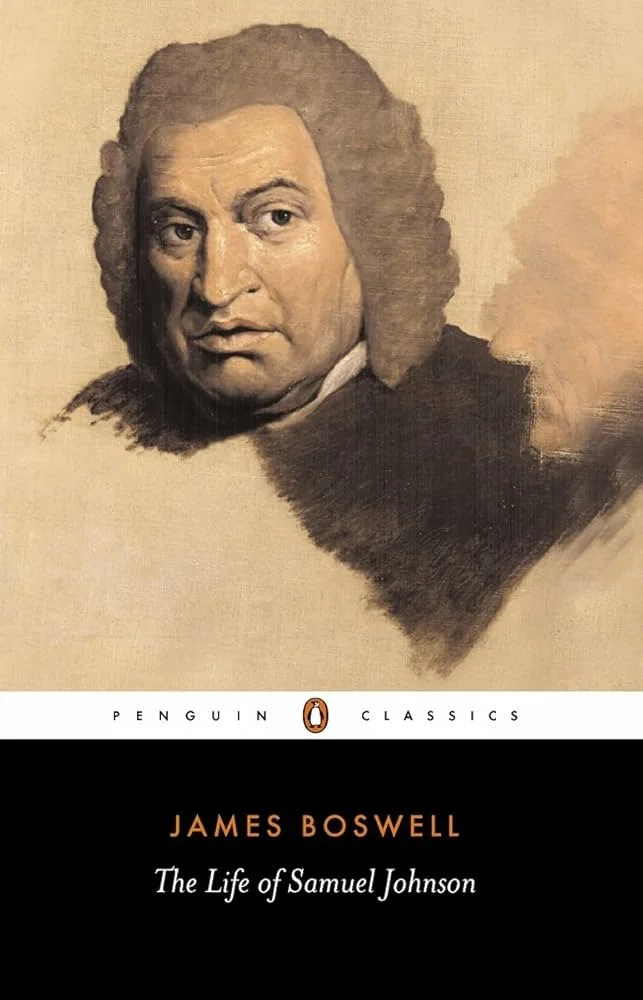
Here’s Boswell’s first mention of Oglethorpe, in the context of the publication of Johnson’s neoclassical poem London in 1738:
One of the warmest patrons of this poem on its first appearance was General Oglethorpe, whose ‘strong benevolence of soul,’ was unabated during the course of a very long life; though it is painful to think, that he had but too much reason to become cold and callous, and discontented with the world, from the neglect which he experienced of his publick and private worth, by those in whose power it was to gratify so gallant a veteran with marks of distinction. This extraordinary person was as remarkable for his learning and taste, as for his other eminent qualities; and no man was more prompt, active, and generous, in encouraging merit. I have heard Johnson gratefully acknowledge, in his presence, the kind and effectual support which he gave to his London, though unacquainted with its authour.
A good sketch of Oglethorpe’s character and virtues. I’d like to look into this further (this GHQ article is where I’ll start), as Oglethorpe was in England recruiting for his regiment in 1738 but Johnson’s London was initially published anonymously.
Boswell’s first account of a dinner at General Oglethorpe’s has Boswell provoking conversation with a question about the morality of dueling. Oglethorpe leaps in before Johnson can reply: “The brave old General fired at this, and said, with a lofty air, ‘Undoubtedly a man has a right to defend his honour.’” Not one to break character, the General.
There’s a bit of back-and-forth with Oliver Goldsmith before Boswell presses Johnson on the question of “whether duelling was contrary to the laws of Christianity.” Johnson gives a “masterly” and lengthy answer in favor of dueling as a form of self-defense. Oglethorpe chips in with an anecdote about accidental insult diplomatically avoided:
The General told us, that when he was a very young man, I think only fifteen, serving under Prince Eugene of Savoy, he was sitting in a company at table with a Prince of Wirtemberg. The Prince took up a glass of wine, and, by a fillip, made some of it fly in Oglethorpe’s face. Here was a nice dilemma. To have challenged him instantly, might have fixed a quarrelsome character upon the young soldier: to have taken no notice of it might have been considered as cowardice. Oglethorpe, therefore, keeping his eye upon the Prince, and smiling all the time, as if he took what his Highness had done in jest, said ‘Mon Prince,—’. (I forget the French words he used, the purport however was,) ‘That’s a good joke; but we do it much better in England;’ and threw a whole glass of wine in the Prince’s face. An old General who sat by, said, ‘Il a bien fait, mon Prince, vous l’avez commence:’ [He did well, my Prince; you started it] and thus all ended in good humour.
Dr. Johnson said, ‘Pray, General, give us an account of the siege of Belgrade.’ Upon which the General, pouring a little wine upon the table, described every thing with a wet finger: ‘Here we were, here were the Turks,’ &c. &c. Johnson listened with the closest attention.
An evening of war stories with General Oglethorpe!
There are several other mentions in the Life of dinners at Oglethorpe’s house, but not as much conversation. We do get observations of Oglethorpe’s character, though, such as Boswell’s note that “[t]he uncommon vivacity of Oglethorpe’s mind, and the variety of knowledge . . . sometimes made his conversation too desultory.” That is, he rambled. Johnson glossed this by saying of that Oglethorpe “never COMPLETES what he has to say.” One imagines him as an interesting conversationalist who leaps quickly from subject to subject.
There’s also the anecdote alluded to above, when Oglethorpe apparently assumed Johnson was having him over for dinner—entirely unbeknownst to Johnson. How this mixup occurred Boswell doesn’t say, but when he
mentioned this to Johnson, not doubting that it would please him, as he had a great value for Oglethorpe, the fretfulness of his disease unexpectedly shewed itself; his anger suddenly kindled, and he said, with vehemence, ‘Did not you tell him not to come? Am I to be HUNTED in this manner?’ I satisfied him that I could not divine that the visit would not be convenient, and that I certainly could not take it upon me of my own accord to forbid the General.
Boswell found Johnson talking to some ladies that night, morose because of a poorly performed play, but when Oglethorpe arrived Johnson was “was as courteous as ever.” A glimpse both of Johnson’s regard for Oglethorpe—which Boswell mentions almost every time he comes up—as well as some of Johnson’s mental troubles.
A final detail with regard to Johnson’s respect for Oglethorpe: one evening at Oglethorpe’s for dinner, Johnson “urged [him] to give the world his Life. He said, ‘I know no man whose Life would be more interesting. If I were furnished with materials, I should be very glad to write it.’”
It’s a shame we never got that book.

Again, a topic for further research one of these days. In the meantime, check out The Rest is History’s series on Johnson, and definitely give Buchan’s Midwinter a look. I glanced back through the parts mentioning Oglethorpe—Johnson is a major character throughout while Oglethorpe lurks in the background—and greatly enjoyed the novel’s final chapter, in which Johnson and Oglethorpe finally meet. The novel’s protagonist, Jacobite spy Alastair Maclean, who has befriended Johnson over the course of the uprising, arrives at Oglethorpe’s headquarters but
was not prepared for the sight of Oglethorpe; grim, aquiline, neat as a Sunday burgess, who raised his head from a mass of papers, stared for a second and then smiled.
“You have brought me a friend, Roger,” he told the young lieutenant. “These gentlemen will be quartered here this night, for the weather is too thick to travel further; likewise they will sup with me.”
When the young man had gone, he held out his hand to Alastair.
“We seem fated to cross each other’s path, Mr Maclean.”
“I would present to you my friend, Mr Samuel Johnson, sir. This is General Oglethorpe.”
Johnson stared at him and then thrust forward a great hand.
“I am honoured, sir, deeply honoured. Every honest man has heard the name.” And he repeated:
“One, driven by strong benevolence of soul,
“Shall fly like Oglethorpe from pole to pole.”
The General smiled. “Mr Pope was over-kind to my modest deserts. But, gentlemen, I am in command of a part of His Majesty’s forces, and at this moment we are in the region of war. I must request from you some account of your recent doings and your present purpose. Come forward to the fire, for it is wintry weather. And stay! Your Prince’s steward has been scouring the country for cherry brandy, to which it seems His Highness is partial. But all has not been taken.” He filled two glasses from a decanter at his elbow.
The beginning of a beautiful friendship.
* * * * *
Addendum: After posting this yesterday I listened to the end of the second episode, which mostly concerns Boswell, and Tom Holland quoted—in part—a charming passage from Boswell’s journals about his starstruck astonishment to be sitting and talking with Johnson and Oliver Goldsmith: “I just sat and hugged myself in my own mind.”
As it happens, I had just read the same passage in The Club: Johnson, Boswell, and the Friends Who Shaped an Age, by Leo Darmosch. For my purposes, Holland left out an extremely important bit. Here’s the whole passage from Darmosch:
In 1772 Boswell was flattered to be invited to dinner by General James Oglethorpe, then in his seventies, who had been a pioneer in prison reform and co-founder of the colony of Georgia. In his journal Boswell noted, “Mr. Johnson and Dr. Goldsmith and nobody else were in the company. I felt a completion of happiness. I just sat and hugged myself in my own mind. Here I am in London, at the house of General Oglethorpe, who introduced himself to me just because I had distinguished myself; and here is Mr. Johnson, whose character is so vast; here is Dr. Goldsmith, so distinguished in literature. Words cannot describe our feelings. The finer parts are lost, as the down upon a plum; the radiance of light cannot be painted.” (283)
I read this while browsing Mr K’s, our local used bookstore. I didn’t end up taking The Club home—I’m trying, however feebly, to thin our library out—but I did pick up Trevor Royle’s Culloden, which includes several pages on Oglethorpe’s role in suppressing the Jacobite Rising.