Mando, republics, and empires
/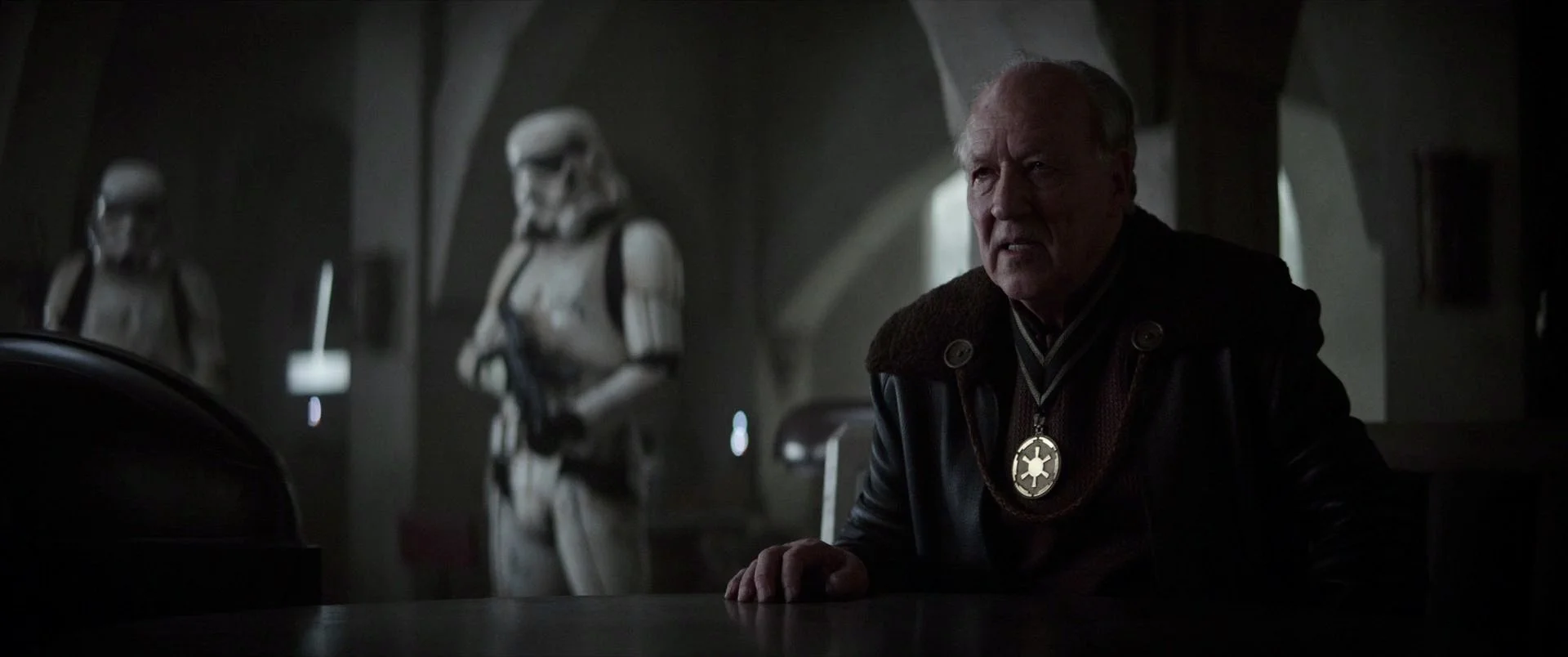
Werner Herzog sings the Empire’s praises in season one of “The Mandalorian”
Some of the most fun Star Wars heresy in the last few decades have been articles by Jonathan V Last and Sonny Bunch attempting to justify both the formation and actions of the Empire. Both, but Last especially, make the entirely plausible point that we see very little of the Empire in any of the Star Wars movies, and can’t leap to conclusions about its day-to-day functioning. But the films and especially series like The Mandalorian admit that the collapse of the Empire wreaks havoc on the galaxy, so it must have been doing something right. By historical analogy with Rome, Persia, the Holy Roman Empire, or even the British Empire, it’s not hard to imagine a Galactic Empire that exercised distant control but allowed most daily life to continue unchanged so long as taxes were paid, manpower for the army was provided, and a small number of universally applied laws were upheld.
And the first season of The Mandalorian confirms that the Empire could be beneficial. (There were, historically, some groups that requested Roman takeover because they saw what their Roman-controlled neighbors got out of it.) The Client, played by Werner Herzog, tells Mando that “The Empire improves every system it touches. Judge by any metric. Safety, prosperity, trade, opportunity, peace. Compare Imperial rule to what is happening now. Look outside. Is the world more peaceful since the revolution? I see nothing but death and chaos.”
Again, the show doesn’t disprove his point. Assuming all of this is true—that the Empire is not typically as intrusive as the episodes we have seen and it generally materially benefits its subordinate entities—the only legitimate reason to resent the Empire’s reach is the desire for pure independence. And for a localist, this is a powerful enough reason.
But the entire fifty-year run of Star Wars wants us to understand the Empire as stand-ins for the Nazis, so, granting that point, scrap those historical comparisons. Let us not imagine an Achaemenid Persia or a Holy Roman Empire but something more like the Third Reich—purely extractive, abusive, run along coldly calculated Malthusian lines, and prone not to the limited wars of the empires named above but to all-or-nothing Vernichtungskrieg.
What those thoughts out of the way, this week I finally saw (most of) The Mandalorian and Grogu. The opening titles exposed something of the political incoherence of the Star Wars legendarium:
The evil GALACTIC EMPIRE has fallen. Ex-Imperial Warlords remain scattered throughout the galaxy, plotting the Empire’s return. The fledgling NEW REPUBLIC has begun to reunite the galaxy.
There’s more about the Mandalorian himself, but this is the pertinent portion. What do you notice?
The Empire has fallen, which is good, because it was evil. The unstated suggestion throughout Star Wars is that the alternative to the Empire is freedom (as a Gungan in the special edition of Return of the Jedi reminds us, the destruction of the second Death Star and the death of the Empire means “Wesa free!”), but that’s not what we’re getting here. The fall of the Empire has introduced disorder—especially in the form of petty warlords—but the New Republic is reestablishing order. It is “reunit[ing] the galaxy.”
So the problem for the Rebellion is not the Empire’s power and reach but the Empire itself. The New Republic is apparently entitled to the same level of control but its authority is not questioned. This is the liberal illusion that if only the right people were in charge, the same level of intrusive universal government would somehow become tolerable.
Which leads one to wonder: What if there were some planet or system that wanted independence, not just from the Empire but from any external control? What if that unification is what its people object to in the first place? What if they resented the rule of benevolent EU bureaucrat types just as much as they had the Nazis? What if they rebelled? What might the gentle New Republic look like after it was done responding?
This, too, is easy to analogize historically. The wars of national unification in the mid-19th century—in Italy, Germany, and the United States—in which unwilling regional minorities were forcefully incorporated into larger, notionally democratic “national” entities for their own good come to mind. Republics can be just as ferocious and coldblooded as any empire. The United States’ bloodiest war wasn’t against the Nazis and Japanese but against its own people. It seems neither real life liberal democracy nor Star Wars has any place for localism or decentralization.
Then again, maybe what started as a Flash Gordon-meets-Kurosawa-meets-The Dambusters fantasy special effects extravaganza was never meant to bear this kind of weight.