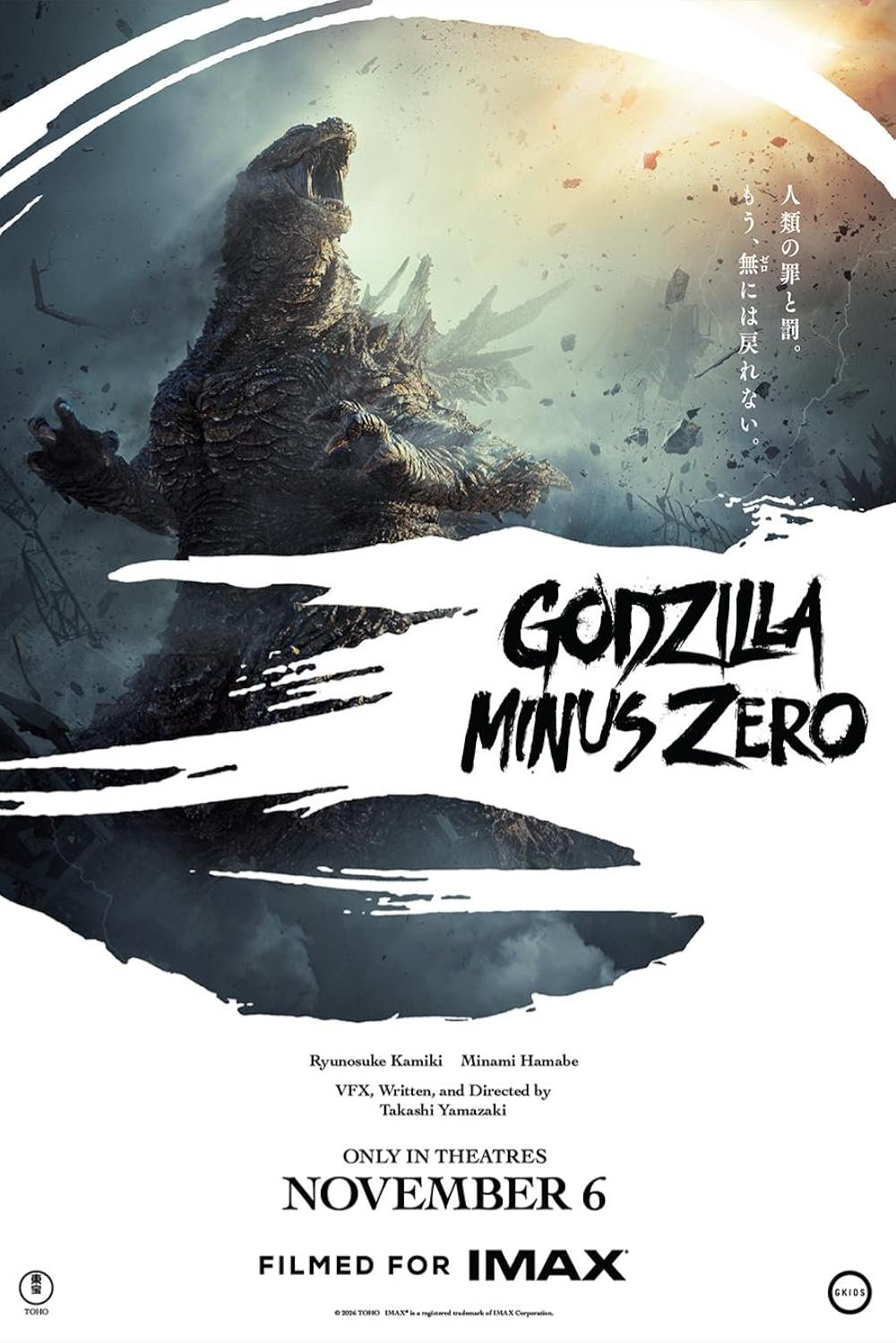
Godzilla Minus Zero
/Godzilla Minus One was my great cinematic surprise of the last several years. I couldn’t care less about monster movies most of the time, but its combination of historical setting, good character drama, and, yes, thrilling monster action totally won me over. It was my favorite of the year I saw it and when a sequel was announced I noted it as a must-see. Now that Godzilla Minus Zero has finally arrived—and, more crucially, I found time to see it early last week—I’m mostly satisfied.
Briefly, Godzilla Minus Zero picks back up with the characters from the original two years after Godzilla’s devasting attack on Ginza, former (and failed) kamikaze pilot Koichi Shikishima’s heroic defeat of Godzilla, and his wife Noriko’s miraculous survival. Now, a new monster, the dragon-like Ghidorah, is devastating the mountain villages around Nagano. Professor Noda, a naval weapons expert who had spearheaded the efforts to kill Godzilla in the last film, now leads a scientific bureau dedicated to preventing and dealing with monster attacks. He requests help from the American occupying forces but receives only token support: equipment and a few planes, but no pilots. Armed with these and experimental technology designed by meteorologist Makoto Aoyama, who believes Ghidorah is attracted to the electrical activity in thunderstorms, Noda casts about for a suitable pilot to lead the mission…
Despite Noda’s plans and Shikishima’s courageous efforts, the attempt to kill Ghidorah doesn’t merely fail but transforms him into the three-headed King Ghidorah, gigantic and more powerful than before. And no sooner has King Ghidorah laid waste to more villages and farms, killing 800, than Godzilla reappears off the coast.
I won’t say much more about the plot. Godzilla Minus Zero—the title suggesting that Godzilla’s victims, reduced to less than zero by the events of the first film, have only just started to claw their way back to stability—puts the characters and all of Japan in an even more desperate position than before. Faced with a new challenge in the form of King Ghidorah, they respond with techniques that worked once but now fail. In their scramble to deal with a creature they have accidentally strengthened and emboldened and to pivot toward the threat returning from the sea, Noda and company must seek new help and dangerous new methods to deal with both.
Just like the first movie, Godzilla Minus Zero is well acted. The standout among the new characters is Dr Murakami, an elderly scientist whose family was wiped out at Hiroshima. By a fluke, he was out walking by the sea that morning and suffers terrible survivor’s guilt. And having also lived through Ghidorah’s first rampage he is a survivor twice over, and hopes for revenge against both Ghidorah and the United States.
Of the returning characters, Noriko has the most interesting arc. Infected with an illness I don’t want to reveal, it has serious consequences both for her family and for everyone attempting to fight both King Ghidorah and Godzilla. As for Shikishima, his duty to protect Noriko and Akiko, their adopted daughter, is pitted against his duty to help defeat the monsters. His instinct to flee, a key element of his character in the first film, resurfaces just like Godzilla. Shikishima and Noriko wrestle painfully with what to do, especially once it becomes clear what use could be made of them—by Noda, by Murakami, by the Americans, who have an explicit onscreen presence in this film while still mostly lurking ominously offstage—if they prove successful.
I enjoyed Godzilla Minus Zero a great deal, but it is not as good as Godzilla Minus One. One of the great strengths of the latter movie was how organically it enmeshed the two halves of is story—the personal drama and the monster action. The sequel never feels quite as whole or complete, and Shikishima’s participation, in contrast to someone like Murakami, whose history and motivation mesh seamlessly with the new story, feels contrived on a few occasions. And an attempt to construct a surprise in the climactic action—which worked so well with Shikishima’s ejector seat in the first film—falls flat this time.
These problems are awkward but not insurmountable. My only real complaint was the way the screenplay, no doubt because of the success of the first film’s human story, tried to amp up the emotional drama. Godzilla Minus One was restrained and all the more powerful for it; Godzilla Minus Zero veers into emotional manipulation, overtly trying to squeeze tears out of the audience, especially in an attempt to create one final crisis for the audience in the very last scene. But that’s a relatively minor complaint—too much of a good thing. If there is a third movie, the filmmakers will likely course correct.
Despite this handful of weaknesses, Godzilla Minus Zero was still a worthy follow-up to Godzilla Minus One and its scares, heroism, family drama, suspense, high-tech brainstorming, well-realized period setting (including a dash of Cold War paranoia), great special effects, and—I can’t believe it took me until the penultimate paragraph to mention it—some truly gnarly monster fights make this great entertainment as well.
I mentioned above that I don’t typically care about monster movies, much less the kind in which two monsters fight each other, but there was a moment near the end of Godzilla Minus Zero, as King Ghidorah and Godzilla duke it out in the ruins of a city, each grasping for advantage using their particular powers, when I just grinned and thought, “This is sick.” I do hope there will be more.