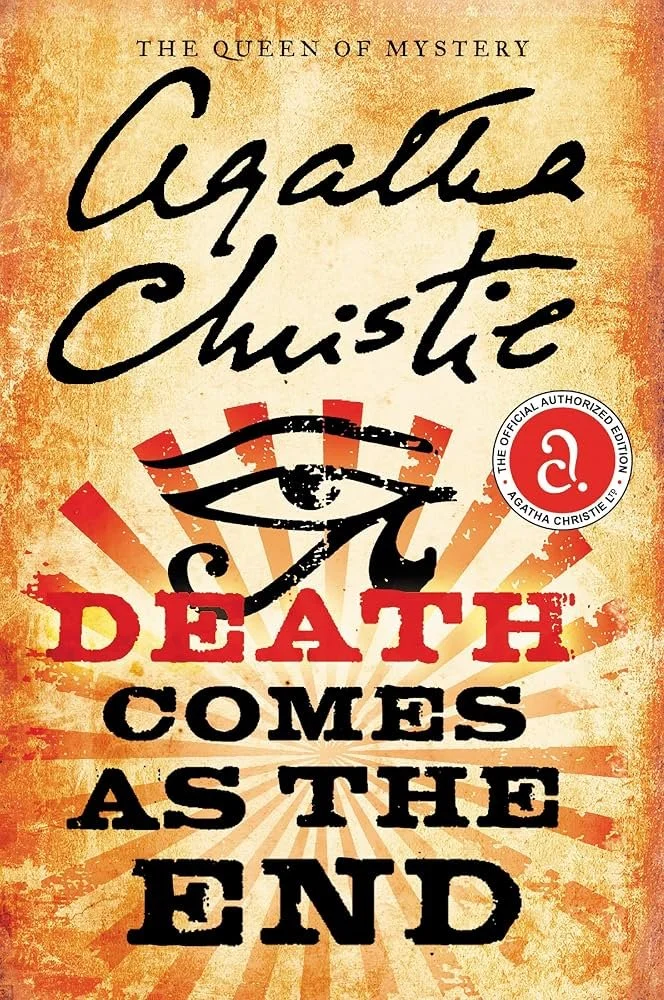
Death Comes as the End
/Last night I finished reading Agatha Christie’s only historical novel, Death Comes as the End, to my wife. This was my second reading of the novel and, although I had picked it as our bedtime read because I remembered enjoying it, I was pleasantly surprised just how much I enjoyed it the second time through. A shortish sick-day review:
Death Comes as the End takes place on the country estate of Imhotep, a ka-priest who lives near Thebes in Upper Egypt during the 11th Dynasty, over 3,000 years ago. As a ka-priest Imhotep is responsible for the maintenance and regular offerings and rites performed at a nearby tomb, where he also has an office managed by Hori, his trusted scribe. Thanks to the endowment of the tomb and the prestige of his position, Imhotep, now entering old age, enjoys authority and wealth—including estates downriver, in Lower Egypt near the mouth of the Nile.
Not that his wealth has brought him happiness or stability. His household includes three sons: the slow, dutiful Yahmose, the hard-partying and womanizing Sobek, and Ipy, the teenaged son of Imhotep’s old age. The two older sons have wives—shrewish, domineering Satipy and slow, plain, child-obsessed Kait, who tolerates Sobek’s philandering because of the benefit their marriage guarantees to her children—and Imhotep’s aged mother, Esa, the rarely-heeded brains of the family. Also skulking around the house is Henet, an old servant and companion of Imhotep’s long-dead wife. Henet is a Wormtongue-like flatterer who prides herself on gathering and using information. Her obsequious fawning just barely conceals her resentments.
The last member of the household, and the novel’s main character, is Imhotep’s only daughter, Renisenb. Newly widowed with one child, Renisenb has returned after eight years away with her husband and is still mourning—though, despite the freshness of her grief, she is bothered to find herself already forgetting her husband’s face, and has turned to the old rhythms and routines of her childhood home as a comfort. But it is precisely these that Renisenb will see demolished, and be forced to reckon with why.
Christie expertly introduces the reader to this family and its foibles—weak, status-conscious father, henpecked eldest son, pompous younger brothers, jostling and jealous daughters-in-law, wry grandmother—before injecting the element that will explode it and start the novel’s mystery: Nofret, the concubine Imhotep brings home from a trip to the richer, more glamorous north.
Nofret is beautiful, manipulative, and spurned in love. The details emerge slowly, but it is clear from the moment she arrives that she views becoming Imhotep’s concubine as settling. She heaps scorn on the family members, probes for weaknesses and disagreement between them, and exploits them for maximum discord. She forces Hori to send letters to Imhotep with false complaints against his sons, and—in a fatal decision—moves to have them disinherited. It is not long before Nofret is dead.
As so often in a Christie story, everyone had good reason to want her dead. Renisenb, without ever consciously thinking of herself as a detective, discusses the situation with Hori and her grandmother Esa, the two people she most trusts and who are least blinded by greed, envy, and foolishness.
Unlike many other Christie stories, the body count climbs. Whoever killed Nofret does not stop with her, killing off other family members and even a servant. Rumor that a vengeful Nofret is cursing the family from her chamber in the tomb run rampant, aggravated by missing jewelry turning up and at least one sighting of a woman in Nofret’s clothing just before someone else drops dead. Hori and Esa assure Renisenb that, based on her standing within the family and her attempts to be kind to Nofret, she cannot be a target. But as more and more die, Renisenb worries both for her family and friends and for herself.
I mentioned that I’ve jotted this review down during a sick day. In a nice coincidence, I first read Death Comes as the End three years ago, when I was sick and quarantined to protect our newborn twins and just in time to make the 2023 year-in-review. I’ve remembered it fondly, recommending it as a good short mystery read last year, and it didn’t disappoint on a reread. In fact, it passed that most difficult of hurdles for a mystery: upon rereading it, I couldn’t remember the solution to the mystery, who the murderer was and why they were doing it. All of the characters still seemed likely suspects, and the atmosphere of dread and suspense were just as palpable and enjoyable.
And Death Comes as the End is not only a satisfying mystery, it is a good historical novel. Christie, whose second husband was an archaeologist, based the novel on his research and her visits to Egypt as well as the extant letters of a similar Egyptian family. It has been a long time since my grad school Egypt course—which mostly focused on the 18th Dynasty anyway—so I can’t vouch for every detail, but Christie authentically evokes the mood and mental atmosphere of ancient Egypt. The story flows with the Egyptian calendar and the rhythms of the Nile and farm work, and the ordinary routines and worries of a well-off but not elite Egyptian priestly family is well imagined. One especially nice note, and a good spot of Christie’s wry dark humor, was Imhotep’s escalating concern about the cost of embalming.
Even in her English country house mysteries Christie was always adept at conveying the workaday concerns of the people who lived there, and without modernizing them or treating them as if nothing has changed in the 3,000 years between Renisenb’s time and ours, she makes these characters’ lives and concerns recognizable. This is a challenge for any historical novelist, and Christie, in her first and only foray outside the twentieth century, did it brilliantly. I was impressed, on that first reading three years ago, both with how well she created Egypt in the fictive dream of her story and with how economically she did so. There are no laborious explanations, no info dumps, no tedious piling on of detail. I’ll be returning to it for lessons in craft.
Death Comes as the End has much more going on in it than I can lay out here. I haven’t even nodded toward Renisenb’s interest in Kameni, an envoy from Lower Egypt who may offer her a better life away from the striving, petty jealousy, and death of her home, or the way their attraction eventually forces Renisenb into a dilemma. The plot is engaging, the characters well imagined and surprising—especially as the deaths begin to reveal more of what each has suppressed in their lives so far—and the historical setting effortlessly realized. This is not Christie’s most famous novel, but it is one of ones I have most enjoyed.