A Defence of Skeletons
/A recent tempest in the social media teapot brewed up over Halloween decorations. An angry dad, disturbed on behalf of his young daughters, complained on Substack about the excessive and grotesque decorations in his neighbors’ yards—in addition to cobwebs and tombstones, one featured things like animatronic zombies and demons and skeletons in bloodstained cloaks. It got shared and restacked many, many times and a lot of people shared opinions, usually in a tone of “Chill out and grow up” on both sides. It was pretty unseemly, but not as unseemly as those yard decorations.
I could understand the dad’s original complaint, but mainly on grounds of taste. A lot of Halloween decor is tacky and reveals mere grossness of mind, not least in its effort to shock. I saw a few people in the controversy suggesting a gentle middle way, of decorating with non-threatening pumpkins, bats, black cats, and so forth. I don’t actually agree with that. While the lurid and needlessly grotesque is one extreme, rendering the spooky toothless is also a mistake. I don’t object to skulls, bones, or whole skeletons on principle.
Chesterton’s “Defence of Skeletons” is not specifically about Halloween, but I think it has something to offer when thinking about a holiday in which death becomes decor, in which we are likely to confront an image of what we’ll all look like just a few years after we’re gone. Skeletons can teach us something.
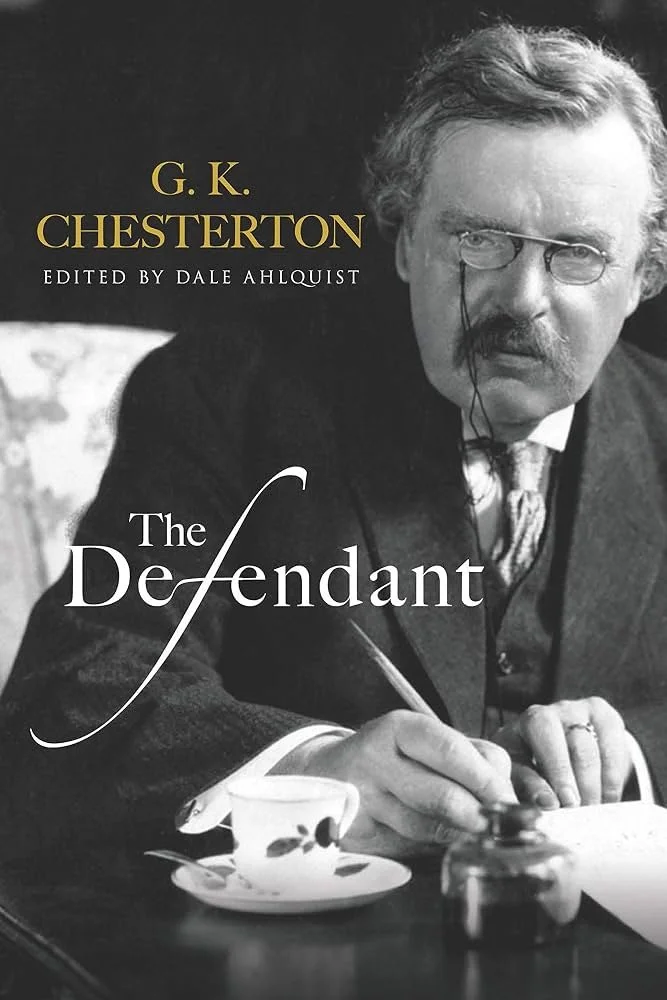
Opening with the image of leafless winter trees, Chesterton mentions the embarrassment with which the locals were apologizing for the bare branches. He doesn’t understand it. A leafless forest is still—or even especially—beautiful: “So far from the line of the tree when it is bare appearing harsh and severe, it is luxuriantly indefinable to an unusual degree; the fringe of the forest melts away like a vignette.”
This embarrassment reminds Chesterton of the “horror” people commonly have of skeletons. They find something unsettling about the revelation of hidden structure. “This is felt dimly in the skeleton of the tree: it is felt profoundly in the skeleton of the man.” But why? He wonders about this in his signature style:
Without claiming for the human skeleton a wholly conventional beauty, we may assert that he is certainly not uglier than a bull-dog, whose popularity never wanes, and that he has a vastly more cheerful and ingratiating expression. But just as man is mysteriously ashamed of the skeletons of the trees in winter, so he is mysteriously ashamed of the skeleton of himself in death. It is a singular thing altogether, this horror of the architecture of things. One would think it would be most unwise in a man to be afraid of a skeleton, since Nature has set curious and quite insuperable obstacles to his running away from it.
I should note that this is a funny essay, even by the standards of Chesterton generally and The Defendant specifically.
Interestingly, Chesterton argues that this shame or horror of the skeleton is only superficially about reminders of death. It actually stems from the skeleton’s condition of being exposed: “It is man's eccentric glory that he has not, generally speaking, any objection to being dead, but has a very serious objection to being undignified.” Skeletons make us uncomfortable because we fear not death but embarrassment.
The skeleton is a state of nakedness more total than that of leafless trees or unclothed humans, and it is “shamelessly grotesque.” Really think about the shapes of the bones under all of our flesh sometime: ribs, hips, tailbones, kneecaps, the jaw. But being uncomfortable with this indignity, Chesterton says, doesn’t make much sense. The world is full of strange, awkward, grotesque things and it is worth celebrating the gloriously ugly—the oinking of a pig, the cawing of rooks—because it is so innocent, honest, and full of life. Skeletons are good for us because they remind us of our place in this glorious grotesque world, of its goodness, and that everything, even ourselves, is funny.
That mankind is made uncomfortable by the sight of the thing that gives every one of us our shape is a mark of our pride. The strange appearance of bones should make us laugh and give up our cheap dignity, especially the cheap but insistent dignity of youth and beauty. Of the Renaissance types tempted to stand on this dignity in the face of death and for whom the artistic motif of the skeleton could “freezing the pride out of all earthly pomps and the fragrance out of all fleeting pleasures,” which “almost assuredly did more good than harm,” the fact
[t]hat the whole structure of their existence was as wholesomely ridiculous as that of a pig or a parrot they could not be expected to realize; that birth was humorous, coming of age humorous, drinking and fighting humorous, they were far too young and solemn to know. But at least they were taught that death was humorous.
It is through this, and not abject fear of death, that skeletons humble us.
At least, if we are willing to be humbled. But here the skeleton plays a final great joke on us, because “however much my face clouds with sombre vanity, or vulgar vengeance, or contemptible contempt, the bones of my skull beneath it are laughing for ever.”
A good note to end this foreshortened Chestertober on. Happy Halloween!