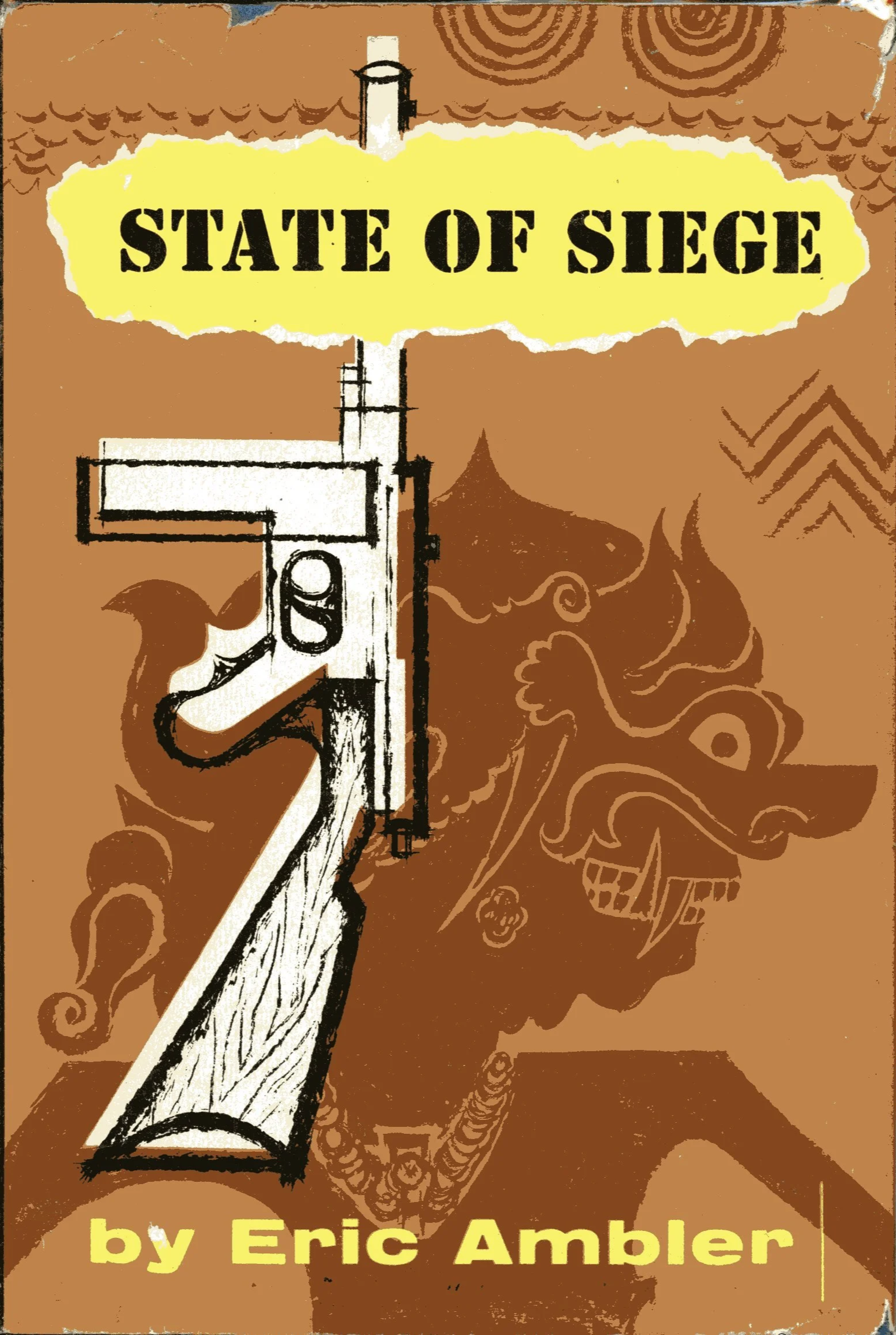
State of Siege
/In reviewing Eric Ambler’s Judgment on Deltchev last year, I noted that Ambler’s postwar novels, while focusing on polyglot, cosmopolitan, but out-of-the-way worlds unsettled by global events like his early classics, are marked by a broader scope and more mature perspective. Deltchev, his first postwar thriller, takes place in an unnamed Eastern European state faced with imminent Stalinist takeover. His next, The Schirmer Inheritance, follows an American lawyer tasked with settling an old lady’s estate on a journey through postwar West Germany, its scarcely buried past, and the lingering dangers of guerrilla warfare in Greece. Passage of Arms sprawls across British-controlled Malaya, newly independent and unsettled Indonesia, arms trafficking, Communist insurgency, Chinese organized crime, and American tourists.
These are tense and well-plotted but slower, statelier, with seemingly more at stake than the fates of their characters. State of Siege, published in 1956 between The Schirmer Inheritance and Passage of Arms, comes as a bit of a surprise then.
When the novel begins, British engineer Steve Fraser has finished a three-year assignment to build a dam on the island of Sunda, a former Dutch colony that has gained its independence from both the Dutch and Sukarno’s Indonesia. The dam is part of an international development scheme for southeast Asia. Fraser believes in the work but is happy to be leaving. Rampant local corruption and a succession of inept, unqualified native liaisons with the Sundanese government have left him disillusioned if not embittered. Only one local, Major Suparto, has proven tough, intelligent, competent, and genuinely involved with the project—suspiciously so.
Fraser flies to the capital, Selampang, and has only to wait a few days for the regularly scheduled cargo plane out. An Australian friend sets him up with female company, a half-Dutch, half-Sundanese girl named Rosalie van Linden, and his apartment on the town square by the radio station. Fraser is set for a pleasant few days before flying home but for one discordant note: while walking with Rosalie in the garden of a club, he overhears a voice he recognizes—Major Suparto.
The major has arrived by jeep from the dam, a strenuous daylong drive on seasonal roads through territory controlled by leftwing nationalist rebels under General Sanusi, who hopes to root out corruption and turn Sunda into an Islamic republic. That Suparto has arrived on the same day as Fraser, who flew, suggests that he is a part of the rebel movement, and his overheard conversation with “the general” seems to prove it.
Fraser puts it out of his mind. Whatever Suparto, the rebels, and local mobsters are up to, he’s leaving. He continues his preparations to return home, has a second date with Rosalie, and takes her back to his friend’s apartment.
That night, revolution breaks out.
The army having left Selampang on maneuvers, Sanusi’s rebels seize the opportunity to take over the capital and declare a regime change. His troops occupy the city and take over the radio station. Fraser and Rosalie, in their friend’s apartment nextdoor, find their building turned into the headquarters of Sanusi himself.
There they sit, trapped at the center of the revolution, watching and waiting through aerial and naval bombardment, street fighting, the revelation of competing loyalties and betrayal among the revolutionaries, and the growing pressure in Sanusi’s inner circle to eliminate any potential threat to the revolution, including Fraser and Rosalie: one a foreigner, the other a child of the former colonial oppressors.
I began by saying that State of Siege proved a bit of a surprise among Ambler’s postwar thrillers. Like the others I mentioned it has a sweeping, utterly realistic and plausible scope. Sunda is a fictitious island—one of several Ruritanias Ambler dreamed up for his stories, and likely the most vividly realized of them—but it feels of a piece with that part of the world at that time. Ambler never bludgeons the reader with explanation but allows the corruption and mismanagement of the national government, the idealism and brutality of the Islamic rebels, the broader political situation, the ethnic hodgepodge of Selampang, with its foreign engineers, Chinese business class and gangsters, and benighted native population, and even the geography of the conflict to emerge effortlessly, through Fraser simply telling his story.
That gives State of Siege a real-world believability and convinces the reader of the danger Fraser and Rosalie face, but Ambler combines this quality with the best of his pre-war thriller pacing. His typically skillful use of foreshadowing helps sets the story in motion from the first page and, once underway, the action and suspense build steadily right up to the end.
Fraser and Rosalie are also standouts among Ambler’s protagonists. His novels typically feature unadventurous, nose-to-the-grindstone types—often engineers, as Ambler had formal education in engineering—who find themselves embroiled in international intrigues not of their own making, and Steve Fraser seems at first to fit the standard Ambler type. But he proves unusually resourceful and plucky and, perhaps uniquely for Ambler’s put-upon main characters, keeps his cool in danger. A mid-story sequence in which Fraser is forced to work for the rebels in order to protect himself and Rosalie is arduous, tense, and makes his engineering an exciting and integral part of the plot.
And Rosalie may be Ambler’s best leading lady, not only working as a foil and romantic interest to Fraser but contributing, through her personal story growing up among the Dutch plantations in the back country, a strong sense of dread over the outcome of the revolution. Fraser is a tough, fundamentally honest man who wants to think well of people. Rosalie has no illusions whatsoever about what will happen to her if Sanusi’s side wins. Her perspective not only heightens the tension but adds to the realistic murk of Sunda. One’s sympathies may be pulled in one direction or the other—a tension maintained by the complicated and surprising rebel characters—but one cannot sensibly call either side in the revolution the “good guys.”
Finally, one of the unusual joys of State of Siege is watching Fraser and Rosalie’s casual, transactional relationship deepen through the danger they share. Ambler was not known for his romantic plots, but this works wonderfully, not least—without giving too much away—by adding a bittersweet note to the novel’s ending.
Short, briskly paced, but rich and surprising and centered on two of Ambler’s most sympathetic characters, State of Siege may well be my favorite of postwar Ambler. I hope to read it again soon.