Just as nasty as the enemy
/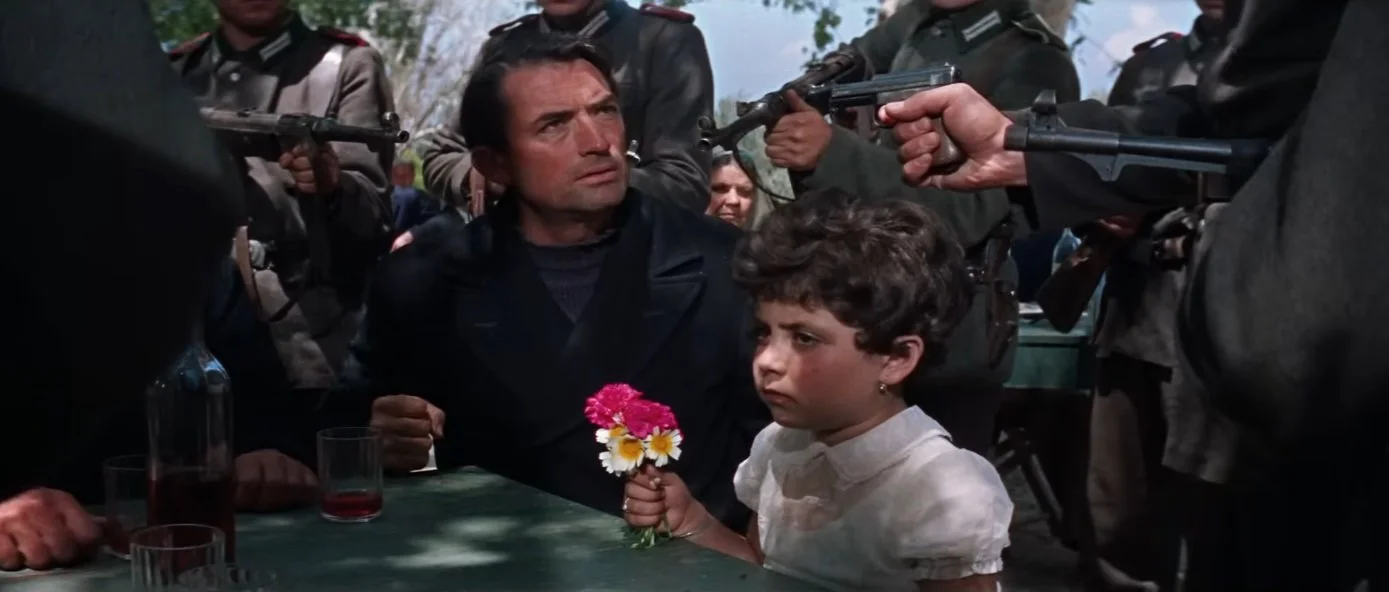
Gregory Peck in The Guns of Navarone (1961)
Despite YouTube’s thrumming ecosystem of amateur film criticism, there are precious few video essays on movies from before the Star Wars era, much less classic war movies. So it was a pleasant surprise to discover this nine-minute video (from five years ago) unpacking a little of what makes The Guns of Navarone great.
The host rightly starts with the strength of The Guns of Navarone’s story—a cast of interesting characters on a dangerous mission, wonderful scenery, a Mission: Impossible-like situation requiring a multi-part plan using all of the characters’ skills to accomplish. This is only right. The story should be good first; only then can interesting themes or lessons or philosophical implications emerge to be examined. Navarone has both: scope and depth.
As the host gives attention to the movie’s moral and philosophical dimension he highlights the contested pragmatic or utilitarian ethics of the men on the mission. The man who came up with the plan, Major Franklin (Anthony Quayle), is horribly injured while infiltrating enemy territory and, now viewed by some of the others (and himself) as a burden upon the team’s time and resources and a danger to the mission, there is a brief debate about what to do. Andrea Stavrou (Anthony Quinn), the hardened local guerrilla, suggests shooting Franklin and moving on. Captain Mallory (Gregory Peck), now the leader of the team and an old friend of Franklin’s, nixes that and they take Franklin along.
Franklin later tries to shoot himself—a calculated, coldly rational solution to the obstacles created by his injury rather than an act of desperation. Demolitions expert Corporal Miller (David Niven), Franklin’s most doggedly loyal subordinate, stops him. This is a pure act of love, and Miller, who has been comic relief up to this point, functions as the film’s conscience for the rest of the movie. (We learn during the briefing that Miller once blew up a Nazi headquarters in North Africa without damaging the orphanage nextdoor. This is presented as evidence of his skill with explosives but it also suggests an attempt to fight justly that is absent in the others, like Spanish Civil War knife-fighter Brown or “born killer” Spiros.)
Captain Mallory (Gregory Peck) has a quiet word with Franklin. Miller, unable to listen, at first interprets this as a moment of moral suasion, one old friend trying to reason with another. But Mallory is actually feeding Franklin false information—the mission has been canceled—that could play to their advantage if Franklin is captured and interrogated.
Mallory does his best to protect Franklin and the rest of the team but they do end up captured, and, when they manage to escape, Mallory leaves Franklin behind. His argument is that Franklin needs medical attention that they can’t give him. But he also has the secret knowledge that Franklin might be useful.
When Miller learns this—in later circumstances I won’t spoil—he is appalled: “Oh, I misjudged you. You’re rather a ruthless character, Captain Mallory.”
Not entirely, however. Mallory appears conflicted, as well he should be. (This is my favorite Peck performance, by the way.) Earlier in the film, in private conversation with Franklin long before Franklin’s accident, Mallory confesses to having ruined Andrea’s life through a gesture of chivalry earlier in the war, which he blames on “my stupid Anglo-Saxon decency.” But he’s gotten wiser since then: “To win a war you have to be just as nasty as the enemy. What worries me is that we’re likely to wake up one morning and find out we’ve become even nastier.”
It’s a rare film that raises this as a possibility for the good guys, especially in the main character’s argument for himself.
The thing is, Mallory’s ploy works—the Germans do get the false intelligence and do strip the defenses of the team’s target. But that’s not a neat resolution. We see Franklin being tortured and must assume that, offscreen, he broke. In Miller’s words, Mallory has “used up” his old friend for the sake of the mission. Mallory’s utilitarian arguments don’t withstand Miller, and Miller’s attempt to treat Mallory as coldly as he has treated Franklin ends in obvious regret. Both men, for different reasons, have tried to play the pragmatist and learned the hard way that it’s wrong.
And Franklin is only one instance of the damage wrought by the mission. Mallory’s self-accusing worries and Miller’s accusations are allowed to stand, even in light of the team’s ultimate success. What is permissible to win? An ever-necessary question.
Like The Bridge on the River Kwai, which similarly throws characters with distinct, conflicting worldviews at each other in a dangerous situation, The Guns of Navarone lets all of this grow organically out of the characters and story. It doesn’t feel forced, which makes it more powerful and also means that the action-packed adventure I thrilled to as a kid has grown deeper and weightier as I’ve gotten older. A rare accomplishment.